
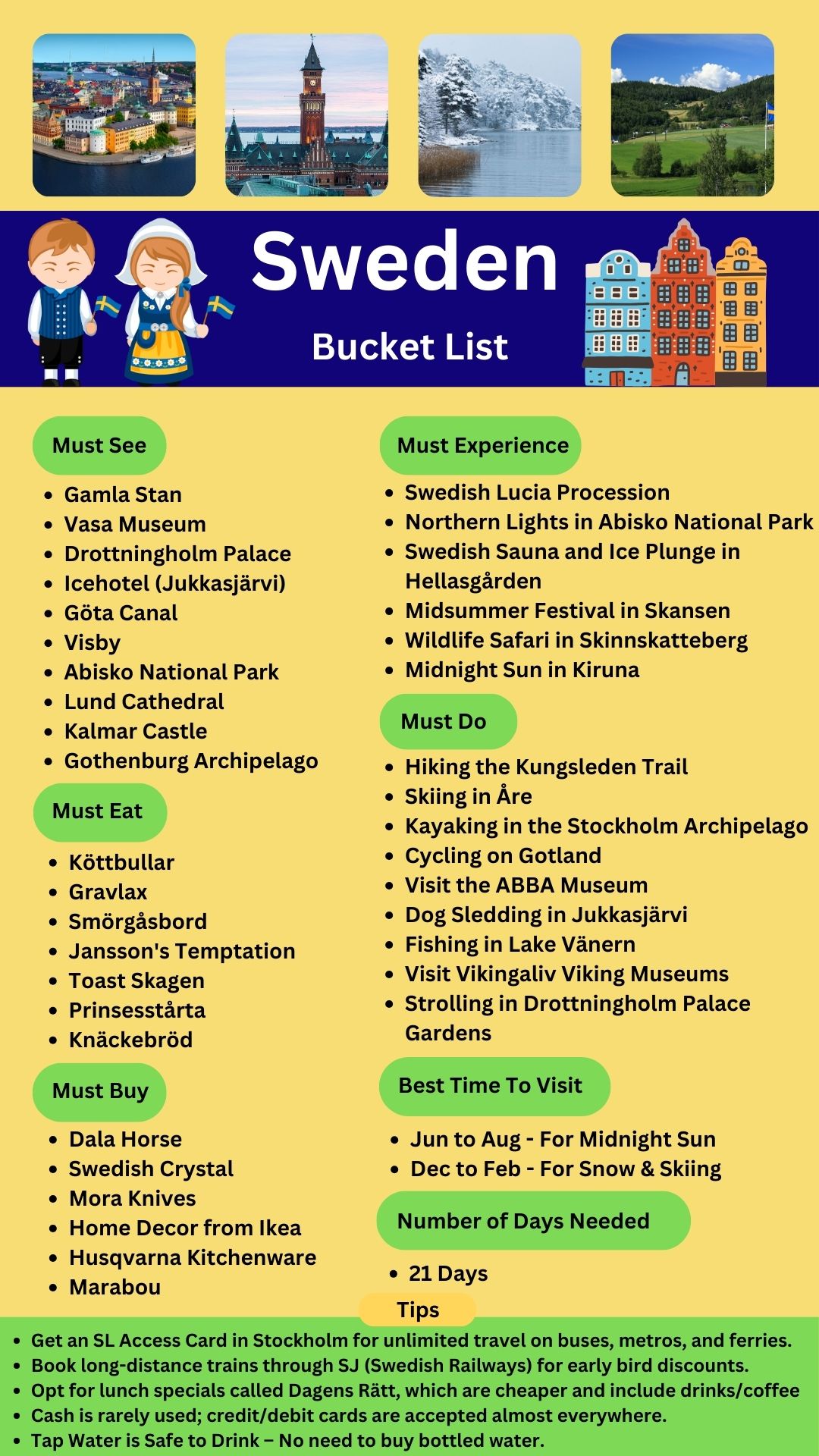
Sweden earns its place on every traveler’s bucket list through a rare mix of medieval old towns, Arctic wilderness, and genuinely thoughtful design. Colorful waterfront buildings sit beside sleek modern architecture, while the far north offers northern lights and midnight sun within the same country. Few destinations let you experience such dramatic seasonal extremes in one well-connected trip.
This is a destination for travelers who appreciate history, nature, and understated Scandinavian charm. Outdoor enthusiasts can hike Arctic trails or kayak island archipelagos, while culture lovers will find centuries of royal and maritime history preserved in exceptional detail. Food lovers get to explore everything from humble meatballs to elegant open-faced classics.
Whether you have one week or three, Sweden rewards a well-planned mix of cities, islands, and Arctic adventures. This bucket list breaks down everything essential, from must-see landmarks to practical tips worth building your trip around.
Trip Planning Overview
| Category | Top Recommendation | Best Time | Recommended Duration |
|---|---|---|---|
| Must-See Landmarks | Gamla Stan, Vasa Museum | May to September | Half day to full day each |
| Experiences | Northern lights in Abisko, Midsummer festival | June to August, December to February | 2-4 hours to a full day |
| Outdoor Activities | Hiking the Kungsleden Trail, skiing in Are | Summer for hiking, winter for skiing | Half day to multiple days |
| Local Food | Kottbullar, smorgasbord | Year-round | Ongoing |
| Overall Trip | Full country exploration | June to August, December to February | 21 days |
Must-See Landmarks and Attractions
Sweden’s landmarks span centuries of maritime power, royal heritage, and medieval trading history. These sites anchor most first-time itineraries for good reason. Each one reveals a different chapter of the country’s story.
Places You Shouldn’t Miss
- Gamla Stan, Stockholm’s old town, preserves narrow medieval streets and colorful buildings dating back to the 13th century. This is the historic heart of the Swedish capital, home to the Royal Palace and the Nobel Museum. Wander here early in the morning to see the cobblestone lanes before the crowds arrive.
- The Vasa Museum houses a nearly fully intact 17th-century warship that sank on its maiden voyage in 1628, recovered remarkably preserved centuries later. This remains Sweden’s most visited museum, offering a genuinely striking look at maritime history. Budget at least two hours to appreciate the ship’s scale and the surrounding exhibits.
- Drottningholm Palace, a UNESCO World Heritage Site, serves as the private residence of the Swedish royal family while remaining open to visitors. Its formal gardens and baroque theater reflect centuries of royal tradition. A boat trip from central Stockholm offers a scenic way to reach the palace.
- The Icehotel in Jukkasjarvi rebuilds itself entirely from ice and snow each winter, offering rooms, an ice bar, and an ice chapel that exist only for a season. Staying overnight here ranks among the most unique lodging experiences in the world. Book well in advance, since rooms sell out quickly during peak winter months.
- The Gota Canal links the North Sea to the Baltic Sea across nearly 200 kilometers of locks, lakes, and canals, a 19th-century engineering achievement still in operation. Multi-day boat cruises let you experience the countryside at a genuinely relaxed pace. Summer offers the most comfortable conditions for a canal cruise.
- Visby, the medieval walled city on the island of Gotland, preserves one of the best-kept city walls in Northern Europe. Cobblestone streets and rose-covered ruins give the town a fairy-tale atmosphere unlike anywhere else in Sweden. This UNESCO World Heritage Site rewards a full day of unhurried wandering.
- Abisko National Park offers some of the best conditions in the world for viewing the northern lights, thanks to its unique microclimate and minimal light pollution. The Aurora Sky Station provides a dedicated viewing platform above the treeline. Visit between September and March for the best chance of a clear aurora display.
- Lund Cathedral, one of Scandinavia’s oldest and most significant cathedrals, dates back to the 12th century and anchors the historic university town of Lund. Its astronomical clock still performs a daily medieval melody. This makes an easy day trip from nearby Malmo or Copenhagen.
- Kalmar Castle stands as one of Sweden’s best-preserved Renaissance castles, its fortifications tracing back to the 12th century with later elegant additions. The castle played a central role in the country’s medieval and early modern history. A visit here pairs naturally with exploring the charming town of Kalmar itself.
- The Gothenburg Archipelago offers a scattering of car-free islands just a short ferry ride from Sweden’s second city. Fishing villages, rocky coastline, and relaxed island life define the area. This makes an easy half-day or full-day escape from Gothenburg’s urban center.
Must Experience
Certain moments in Sweden go beyond typical sightseeing. These experiences connect travelers directly to the country’s traditions, landscapes, and dramatic seasonal shifts. Building even a few into your itinerary adds real depth to the trip.
Unforgettable Experiences
- The Swedish Lucia Procession, held each December 13th, features candlelit processions and traditional songs marking one of Sweden’s most cherished winter celebrations. Schools, churches, and workplaces across the country hold their own versions. This offers genuine insight into Swedish midwinter tradition during the darkest time of year.
- Northern lights in Abisko National Park rank among the most reliable aurora viewing experiences anywhere in the world, thanks to consistently clear skies in this microclimate. The Aurora Sky Station chairlift takes visitors above cloud cover for optimal viewing. Plan for multiple nights, since clear conditions are never guaranteed on any single evening.
- A Swedish sauna and ice plunge at Hellasgarden, just outside Stockholm, offers a genuine taste of Nordic wellness tradition. Alternating between the hot sauna and a plunge into cold lake water is a beloved local ritual, even in winter. This makes for a memorable, invigorating half-day activity close to the capital.
- The Midsummer Festival at Skansen, Stockholm’s open-air museum, brings traditional maypole dancing, flower crowns, and folk music to life each June. This celebration marks one of the most important dates on the Swedish calendar. Arrive early, since Skansen draws large crowds for this particular event.
- A wildlife safari in Skinnskatteberg offers a chance to spot moose, one of Sweden’s most iconic animals, in their natural forest habitat. Guided evening safaris typically run during the animal’s most active hours at dusk. This works well as a relaxed day trip from Stockholm for nature-focused travelers.
- The midnight sun in Kiruna allows visitors to experience continuous daylight during the height of summer, a striking phenomenon found only this far north. This far-northern mining town also serves as a gateway to Abisko and other Arctic destinations. Visiting between late May and mid-July offers the fullest midnight sun experience.
Outdoor Activities
Sweden’s varied terrain supports everything from Arctic trekking to island kayaking. These activities suit travelers who want more than passive sightseeing. Most require moderate fitness, though a few reward existing outdoor experience.
Best Outdoor Adventures
- Hiking the Kungsleden Trail takes you through roughly 440 kilometers of Arctic wilderness in Swedish Lapland, passing mountains, valleys, and reindeer herding lands. Full sections can take weeks, though shorter multi-day segments suit travelers with less time. Summer offers the most accessible conditions, with mountain huts spaced along the route.
- Skiing in Are brings you to one of Scandinavia’s premier ski resorts, with terrain suited to both beginners and experienced skiers. The resort town also offers a lively apres-ski scene during the winter season. December through April provides the most reliable snow conditions.
- Kayaking in the Stockholm Archipelago lets you explore a scattering of over 30,000 islands and skerries just outside the capital. Guided tours and rental options suit both beginners and experienced paddlers. Summer offers calm water and long daylight hours for extended exploring.
- Cycling on Gotland takes advantage of the island’s relatively flat terrain and scenic coastal roads connecting Visby to smaller villages and beaches. Rental bikes are widely available in Visby for day trips or multi-day touring. This makes an easy, low-impact way to see more of the island beyond the walled city.
- Visiting the ABBA Museum in Stockholm offers an interactive, thoroughly entertaining look at Sweden’s most famous pop export. Exhibits include recreated recording studios and costumes from the band’s peak years. This works well as a lighter, more playful stop between heavier historical sites.
- Dog sledding in Jukkasjarvi offers a genuinely thrilling way to experience the Arctic winter landscape, guided by experienced mushers through snow-covered forest. Multi-hour and multi-day tours are both available depending on your appetite for adventure. This pairs naturally with a stay at the nearby Icehotel.
- Fishing in Lake Vanern, Sweden’s largest lake, offers a relaxed outdoor activity amid genuinely beautiful scenery. The lake supports a variety of freshwater fish species popular with anglers. Boat rentals and guided fishing trips are available in towns along the shoreline.
- Visiting Vikingaliv Viking Museums brings Sweden’s Viking Age history to life through immersive exhibits and a boat ride experience recreating a Viking voyage. This offers an engaging, family-friendly alternative to more traditional museum visits. Stockholm’s location makes this an easy addition to a city-focused day.
- Strolling in Drottningholm Palace Gardens offers a peaceful, formally landscaped escape just outside central Stockholm. The gardens showcase centuries of royal landscaping tradition alongside the palace itself. A relaxed walk here pairs naturally with a full palace tour.
Local Food
Swedish cuisine leans on quality local ingredients, preserved fish, and a strong baking tradition. Regional specialties appear throughout the country, giving food-focused travelers plenty to explore. Meals here tend to be simple, well-balanced, and rooted in centuries of practical, seasonal cooking.
What to Eat
- Kottbullar, Swedish meatballs, represent the country’s most internationally recognized dish, traditionally served with lingonberry sauce, cream gravy, and mashed potatoes. Nearly every traditional restaurant serves its own version, though quality varies. Look for versions made with a mix of pork and beef for the most authentic flavor.
- Gravlax features salmon cured with salt, sugar, and dill rather than smoked, a preparation method dating back centuries. This dish appears on menus throughout the country, often served with a mustard-dill sauce. Coastal restaurants near the source of fresh salmon tend to serve particularly good versions.
- Smorgasbord offers a buffet-style spread of Swedish dishes, traditionally served at holidays and celebrations but also available at dedicated restaurants year-round. This format lets you sample multiple regional specialties in one sitting. Look for smorgasbord restaurants around Christmas and Midsummer for the fullest seasonal spread.
- Jansson’s Temptation combines potatoes, onions, and pickled sprats baked in cream, a beloved Swedish casserole despite its unusual-sounding ingredients. This dish appears frequently during the Christmas season alongside other traditional holiday foods. It works well as a comforting side dish alongside other classics.
- Toast Skagen layers a mound of shrimp in a creamy dill and mayonnaise dressing atop buttered, fried bread, a beloved Swedish appetizer. This dish originated as a simple seafood starter and remains a staple on menus throughout the country. Coastal restaurants near Gothenburg often serve particularly fresh versions.
- Prinsesstarta, or princess cake, features layers of sponge cake, jam, and pastry cream covered in a dome of green marzipan. This visually striking dessert remains one of Sweden’s most iconic baked goods. Bakeries and cafes throughout the country sell it as a classic afternoon treat.
- Knackebrod, Swedish crispbread, offers a dense, crunchy alternative to soft bread, traditionally made to store well through long winters. This staple appears at breakfast tables and alongside cheese boards throughout the country. Regional variations exist, with some incorporating rye or seeds for added texture.
Must Buy Souvenirs
Shopping in Sweden reflects the country’s strong design heritage and traditional craft. Many products here carry genuine cultural meaning rather than simple tourist novelty. These souvenirs make meaningful reminders of the trip long after returning home.
What to Buy
- The Dala horse, a carved and painted wooden horse originating in the Dalarna region, ranks among Sweden’s most recognizable cultural symbols. Traditional workshops still hand-paint each horse using centuries-old patterns. Sizes range from small keychains to large decorative pieces suitable as a centerpiece gift.
- Swedish crystal, particularly from the Kingdom of Crystal region in Smaland, represents generations of glassmaking tradition. Factory shops and outlets in the region offer a wide range of both functional and decorative pieces. Prices vary considerably based on the maker and complexity of the design.
- Mora knives, traditional Swedish hunting and utility knives, come from the town of Mora and reflect centuries of blacksmithing skill. These practical, well-made knives suit both collectors and outdoor enthusiasts. Specialty shops throughout the country carry a range of styles and price points.
- Home decor from Ikea offers an easy, practical souvenir tied directly to one of Sweden’s most famous global exports. Certain regional or limited-edition items are sometimes only available in Swedish stores. This makes a fun, functional option for travelers with extra luggage space.
- Husqvarna kitchenware reflects the company’s long history of Swedish manufacturing, now producing high-quality cookware alongside its better-known outdoor equipment. Specialty kitchen shops throughout the country carry a range of pieces. This makes a durable, practical gift for home cooks.
- Marabou chocolate, one of Sweden’s most beloved chocolate brands, offers a wide range of flavors rarely found outside the country. Supermarkets and specialty shops stock dozens of varieties, including seasonal and limited editions. This makes a lightweight, easy, and widely appreciated souvenir.
Best Time to Visit
Timing your trip well affects both comfort and the specific experiences available. Sweden’s climate shifts dramatically between seasons, with the far north offering extreme contrasts between summer daylight and winter darkness. Your priorities should shape when you visit.
Seasonal Highlights
- June through August brings the midnight sun to northern Sweden, along with warm temperatures and long daylight hours throughout the country. This period suits hiking, island exploring, and outdoor festivals like Midsummer. Book accommodations early, since this remains Sweden’s busiest tourist season.
- December through February offers the best conditions for snow-based activities, including skiing in Are and dog sledding in Jukkasjarvi. This period also provides the darkest skies for viewing the northern lights in Abisko. Pack serious cold-weather gear, since temperatures in the north can drop well below freezing.
- Shoulder seasons, particularly May and September, offer a reasonable middle ground with milder weather and thinner crowds than peak summer. This period suits city-focused itineraries in Stockholm, Gothenburg, and Malmo. Fewer daylight hours in the far north make this less ideal for Arctic-focused travel.
- Winter in southern Sweden stays relatively mild compared to the Arctic north, making cities like Stockholm and Gothenburg reasonably comfortable for a winter city break. Christmas markets and festive lighting add seasonal charm during this period. This season suits travelers prioritizing museums and indoor cultural experiences.
How Many Days Do You Need
A full exploration covering Stockholm, the Arctic north, and a southern region like Gotland or Skane realistically takes around three weeks. This allows time for both major cities and slower, more remote destinations without constant rushing. Shorter trips work too, though they typically mean focusing on either the south or the far north.
One week suits travelers focused primarily on Stockholm and a day trip or two, such as Drottningholm or the archipelago. Two weeks allows a more complete itinerary mixing the capital with Gothenburg, Gotland, or a Lapland extension. Adding a dedicated Arctic trip for the northern lights or midnight sun generally requires four to five additional days.
Travel Tips
A few practical details make navigating Sweden noticeably smoother. These tips cover transportation, budgeting, and local customs worth knowing before you arrive. None require much effort, but all save time or money along the way.
Essential Travel Tips
- Getting an SL Access Card in Stockholm provides unlimited travel on buses, metros, and ferries throughout the city. This card can be loaded with credit and used across the entire integrated transit system. It offers real convenience for travelers planning to move around the capital frequently.
- Booking long-distance trains through SJ, Sweden’s national railway, often unlocks early bird discounts for advance bookings. Trains connect major cities efficiently, making rail a practical alternative to renting a car for longer distances. Booking a few weeks ahead typically secures the best fares.
- Opting for lunch specials called Dagens Ratt offers a genuinely good value way to eat well in Sweden, since these fixed midday menus often include a drink or coffee. Restaurants throughout the country offer their own daily version, typically available on weekdays. This makes lunch noticeably more affordable than dinner at the same restaurant.
- Carrying cash is rarely necessary, since credit and debit cards are accepted almost everywhere, including small shops and market stalls. Some businesses have gone entirely cashless, making cash occasionally more of a hassle than a help. Confirm your card works internationally before relying on it exclusively.
- Drinking tap water is completely safe throughout Sweden, and the quality is genuinely excellent. Carrying a reusable bottle saves money and eliminates the need to buy bottled water anywhere in the country. This applies equally in cities and rural areas.
Final Thoughts
Sweden offers enough variety to fill several return trips, from medieval old towns to Arctic wilderness and island archipelagos. Use this list as a starting point rather than a strict itinerary. Mix well-known landmarks with a few flexible days, and let the country’s design, food, and dramatic seasonal extremes shape a trip you will want to repeat.