
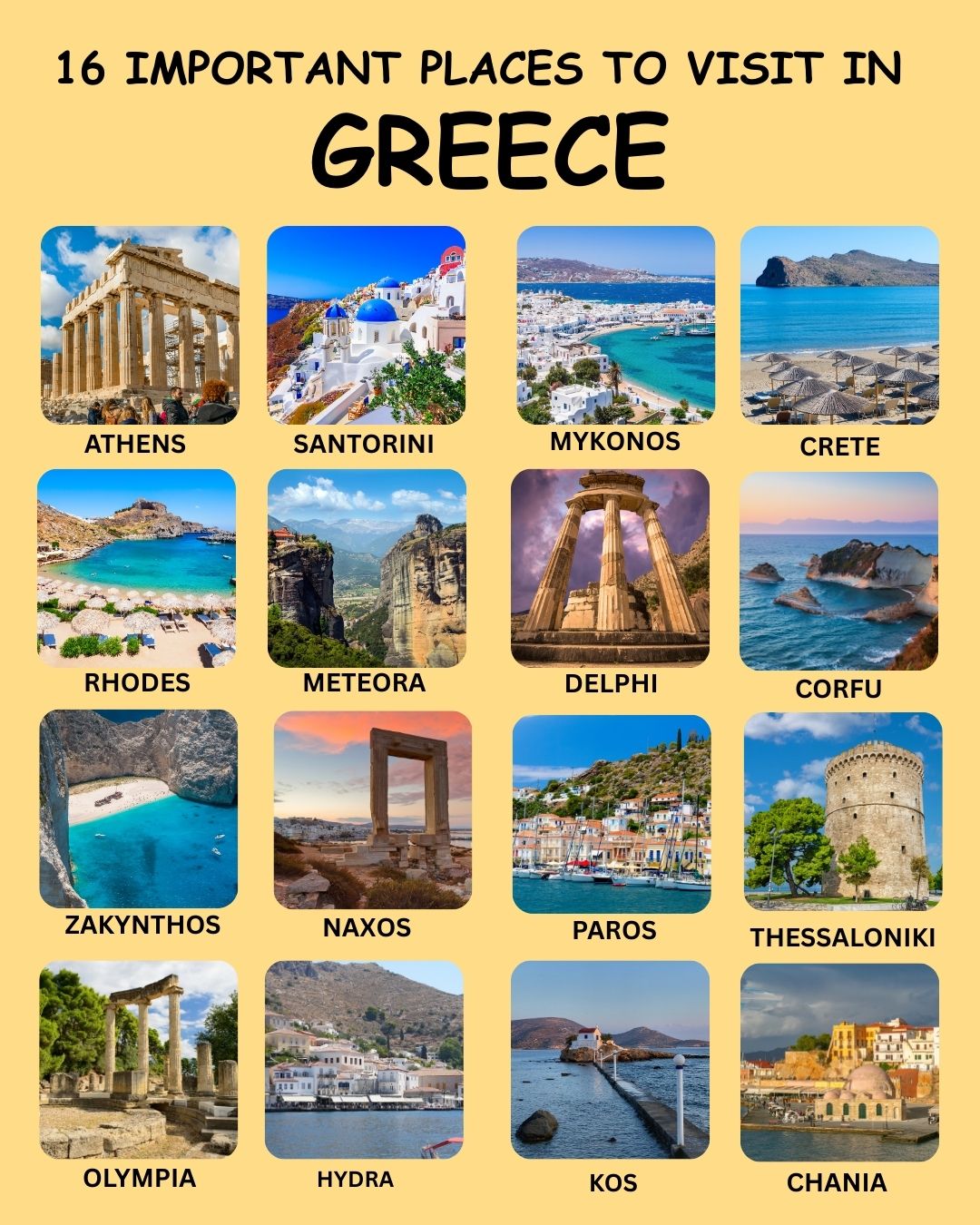
Greece delivers an extraordinary mix of ancient ruins, volcanic islands, and dramatic coastlines within a single country. Marble temples sit beside turquoise water, while mountaintop monasteries rise from sheer rock pillars. Few destinations pack this much historical and natural variety into one relatively compact corner of the Mediterranean.
These sixteen destinations represent the best of what Greece has to offer, from the ancient capital to quiet island harbors. Each one brings something different, whether that is architecture, mythology, or natural scenery. Together, they form a strong foundation for any first-time trip or a longer, more thorough exploration.
Whether you have one week or a full month, this guide breaks down what makes each place worth visiting. Read on for practical insights and the top sights at every stop.
Destination Overview
| Destination | Region | Best Known For | Best Time to Visit |
|---|---|---|---|
| Athens | Attica | Acropolis, ancient ruins | March to May, September to November |
| Santorini | Cyclades | Caldera views, blue-domed churches | April to October |
| Mykonos | Cyclades | Windmills, nightlife | May to September |
| Crete | Crete | Beaches, Minoan ruins, mountains | April to October |
| Rhodes | Dodecanese | Medieval old town, castle | April to October |
| Meteora | Thessaly | Cliffside monasteries | Year-round |
| Delphi | Central Greece | Ancient oracle, archaeological site | Year-round |
| Corfu | Ionian Islands | Venetian architecture, green landscapes | April to October |
| Zakynthos | Ionian Islands | Shipwreck Beach, turquoise coves | May to September |
| Naxos | Cyclades | Ancient ruins, mountain villages | May to September |
| Paros | Cyclades | Traditional villages, beaches | May to September |
| Thessaloniki | Macedonia | Byzantine history, food scene | Year-round |
| Olympia | Peloponnese | Birthplace of the Olympic Games | Year-round |
| Hydra | Saronic Islands | Car-free island, artistic history | April to October |
| Kos | Dodecanese | Ancient medical history, beaches | May to September |
| Chania | Crete | Venetian harbor, old town | April to October |
Athens
Athens anchors any trip to Greece, a sprawling capital built around the ancient Acropolis. The Parthenon crowns the hilltop, visible from nearly every corner of the city below. Centuries of layered history sit alongside a modern, energetic urban center.
Most visitors spend two to three days here, enough time for the major ruins and a few neighborhoods. Walking remains the best way to explore the historic core, though the metro connects farther-flung sites easily. Early morning visits to the Acropolis help beat both heat and crowds.
What to See in Athens
- The Acropolis and Parthenon showcase the pinnacle of ancient Greek architecture and engineering.
- The Acropolis Museum displays artifacts recovered directly from the hill, including original sculptures.
- Plaka’s narrow, neoclassical streets offer the city’s most atmospheric neighborhood for wandering.
- The Ancient Agora reveals the heart of Athenian civic and philosophical life in antiquity.
- Monastiraki’s flea market and Roman ruins mix commerce with archaeology in one lively square.
- Lycabettus Hill rewards a climb or funicular ride with the best panoramic view over the city.
Santorini
Santorini formed from a massive volcanic eruption, leaving behind a dramatic caldera now lined with whitewashed, blue-domed villages. Oia’s clifftop sunset views rank among the most photographed scenes in the world. The island’s black and red sand beaches reflect its volcanic origins.
Two to three days allow time for the main towns and a proper sunset viewing. Crowds peak significantly in summer, so arriving at viewpoints early secures a good spot. The island’s dramatic scenery comes with correspondingly higher prices than most other Greek islands.
What to See in Santorini
- Oia’s whitewashed streets and blue-domed churches deliver the island’s most iconic sunset views.
- Fira, the capital, offers dramatic caldera views along its clifftop walking path.
- Red Beach features striking volcanic red cliffs contrasting against dark sand and blue water.
- Ancient Akrotiri preserves a remarkably intact Bronze Age settlement buried by volcanic ash.
- Wine tours through the island’s volcanic vineyards introduce Assyrtiko, Santorini’s distinctive white wine.
Mykonos
Mykonos built its reputation on iconic windmills, whitewashed architecture, and a famously energetic nightlife scene. The island draws a glamorous, international crowd, particularly in high summer. Beyond the party reputation, Mykonos Town’s maze-like streets hold genuine architectural charm.
Two to three days allow time for the main town, beach clubs, and a boat trip to nearby Delos. Little Venice, where buildings sit right at the water’s edge, offers some of the island’s best sunset views. Prices here run higher than most other Greek islands, reflecting its upscale reputation.
What to See in Mykonos
- The iconic windmills overlook the town and harbor, among the most photographed landmarks in Greece.
- Little Venice’s waterfront buildings deliver dramatic sunset views over the Aegean.
- Delos, a short boat ride away, preserves one of the most important archaeological sites in Greece.
- Paradise and Super Paradise beaches anchor the island’s famous beach club scene.
- Mykonos Town’s narrow, whitewashed streets reward slow, aimless wandering and shopping.
Crete
Crete stands as Greece’s largest island, home to the ancient Minoan civilization and a striking range of landscapes. Mountains, gorges, and long sandy beaches all sit within a single island large enough to feel like its own country. The Palace of Knossos anchors the island’s deep archaeological significance.
Four to five days allow time to properly explore Crete’s size and variety. The island rewards travelers willing to venture beyond the main coastal resorts into mountain villages and gorges. Renting a car makes the most sense here, given the island’s scale.
What to See in Crete
- The Palace of Knossos reveals the heart of ancient Minoan civilization, Europe’s oldest advanced society.
- Samaria Gorge offers one of Europe’s longest hikeable gorges, stretching toward the southern coast.
- Elafonisi Beach features pink-tinted sand and shallow, turquoise water in a protected nature reserve.
- Balos Lagoon delivers striking turquoise water framed by dramatic cliffs, reachable by boat or a scenic hike.
- Rethymno’s old town preserves a well-maintained Venetian and Ottoman quarter worth a slow walk.
Rhodes
Rhodes holds one of the best-preserved medieval old towns in Europe, encircled by massive fortified walls built by the Knights of Saint John. Cobblestone streets wind past Gothic architecture layered over ancient Greek and Ottoman history. This makes Rhodes one of the most historically dense islands in Greece.
Two to three days cover the old town and a few of the island’s beaches. The Palace of the Grand Master anchors the medieval quarter with genuine architectural grandeur. Rhodes also offers easy access to the ancient site of Lindos, with its dramatic acropolis overlooking the sea.
What to See in Rhodes
- The Old Town’s medieval walls and cobblestone streets rank among the best-preserved in Europe.
- The Palace of the Grand Master showcases the island’s era under the Knights of Saint John.
- Lindos Acropolis combines ancient Greek ruins with sweeping views over a picturesque bay below.
- The Street of the Knights preserves rows of medieval inns built by different national orders.
- Anthony Quinn Bay offers a scenic, sheltered cove for swimming near the island’s eastern coast.
Meteora
Meteora ranks among the most surreal landscapes in Greece, monasteries perched atop towering sandstone pillars. Monks began building here in the 14th century, seeking isolation and closeness to the divine. The result remains one of the most photographed sites in the country.
Six monasteries still operate today, though only a handful remain open to visitors. Sunrise and sunset here deliver dramatic light across the rock formations. A full day allows time to visit two or three monasteries without rushing.
What to See in Meteora
- The Great Meteoron, the largest monastery, houses centuries-old frescoes and a small museum.
- Varlaam Monastery offers dramatic views and insight into the original rope-and-basket access system.
- Sunset viewpoints along the main road deliver some of the most striking photography in Greece.
- The town of Kalambaka below serves as a practical base, with hiking trails leading up toward the rocks.
- Rock climbing routes throughout the area draw climbers alongside spiritual visitors.
Delphi
Delphi held legendary status in the ancient world as the seat of the Oracle, believed to be the center of the earth. Pilgrims traveled from across Greece to consult the priestess before major decisions. The archaeological site today sits dramatically on the slopes of Mount Parnassus.
A single day covers the site and its excellent on-site museum comfortably. Morning visits offer cooler temperatures and softer light for photography. The drive from Athens takes about two and a half hours, making it a popular day trip or overnight stop.
What to See in Delphi
- The Temple of Apollo marks the heart of the ancient sanctuary, where the Oracle once delivered prophecies.
- The Ancient Theatre offers sweeping views down toward the valley and distant mountains.
- The Delphi Archaeological Museum houses the famous bronze Charioteer statue among other treasures.
- The Sacred Way winds uphill past treasuries once built by competing Greek city-states.
- The Castalian Spring, where pilgrims once purified themselves, sits just outside the main site.
Corfu
Corfu sits in the Ionian Sea, its Venetian-influenced old town setting it apart from the more classically Greek architecture found elsewhere. Centuries of Venetian, French, and British rule left a distinct architectural fingerprint across the island. Lush, green landscapes contrast with the drier islands of the Aegean.
Three to four days allow time for both the old town and the island’s varied coastline. Corfu Town’s UNESCO-listed center rewards slow wandering through arcaded streets. The island’s interior offers quiet villages and olive groves worth a detour.
What to See in Corfu
- Corfu Town’s Old Fortress and Venetian architecture reflect centuries of layered European influence.
- The Liston, an arcaded promenade modeled on Parisian architecture, anchors the old town’s social scene.
- Achilleion Palace, built for an Austrian empress, offers ornate gardens and sweeping sea views.
- Paleokastritsa’s coves provide some of the island’s most scenic swimming and boat tour departures.
- Angelokastro, a hilltop Byzantine fortress, rewards the climb with panoramic coastal views.
Zakynthos
Zakynthos draws visitors primarily for Shipwreck Beach, a dramatic cove accessible only by boat, framed by sheer white cliffs. The island’s turquoise coves and sea caves rank among the most photographed in Greece. Loggerhead sea turtles also nest along protected stretches of coastline here.
Three to four days allow time for boat tours, beach days, and the island’s quieter interior villages. Shipwreck Beach gets crowded by midday, so early morning boat trips offer calmer water and better light. The Blue Caves on the island’s northern tip make a worthwhile add-on to any boat excursion.
What to See in Zakynthos
- Shipwreck Beach, also called Navagio, delivers one of the most iconic coastal views in the Mediterranean.
- The Blue Caves reveal striking underwater light effects, best seen on a morning boat tour.
- Laganas Bay protects nesting loggerhead sea turtles, observable through responsible boat operators.
- Zakynthos Town’s rebuilt neoclassical center reflects the island’s recovery after a 1953 earthquake.
- Porto Limnionas offers a quieter, cliffside swimming spot away from the busiest beaches.
Naxos
Naxos stands as the largest of the Cyclades, combining sandy beaches with a mountainous, agricultural interior. The island’s ancient marble quarries once supplied statues found across Greece. A partially built marble gateway, the Portara, frames the harbor entrance dramatically.
Two to three days allow time for the main town, mountain villages, and beach time. Naxos feels less commercialized than Mykonos or Santorini, with a stronger connection to traditional Greek island life. Renting a car opens up the island’s scenic mountain villages and ancient sites.
What to See in Naxos
- The Portara, a massive marble doorway, frames sunset views over the harbor from an unfinished ancient temple.
- Naxos Town’s Venetian Kastro district preserves fortified medieval architecture worth exploring on foot.
- Plaka Beach offers long, soft sand backed by dunes, among the island’s best stretches of coastline.
- The mountain village of Halki showcases traditional architecture and a historic citrus liqueur distillery.
- Ancient marble quarries near Apollonas reveal unfinished, giant kouros statues abandoned mid-carving.
Paros
Paros offers a calmer, more traditional alternative to its flashier Cycladic neighbors. Whitewashed villages, working windmills, and quiet beaches define the island’s character. Naoussa, its prettiest town, mixes a working fishing harbor with boutique shops and restaurants.
Two to three days allow time for both main towns and a few of the island’s best beaches. Paros also serves as a convenient ferry hub for exploring smaller nearby islands. The island’s relatively flat terrain makes cycling a practical way to get around.
What to See in Paros
- Naoussa’s harbor mixes traditional fishing boats with a lively evening restaurant and bar scene.
- Parikia, the main town, holds the Panagia Ekatontapiliani, one of Greece’s oldest surviving churches.
- Kolymbithres Beach features unusual, wind-sculpted granite rock formations along the shoreline.
- Lefkes, a hilltop village, preserves traditional Cycladic architecture away from the coastal crowds.
- The Byzantine Road connects several villages via an old marble-paved footpath worth hiking.
Thessaloniki
Thessaloniki serves as Greece’s second city, a Byzantine stronghold with a distinctly different feel from Athens. Centuries of Ottoman, Jewish, and Byzantine influence shaped its architecture and culture. The city’s waterfront promenade and lively food scene give it a relaxed, cosmopolitan energy.
One to two days cover the major historic sites and a proper introduction to the local cuisine. The city works well as a base for exploring nearby Halkidiki’s beaches or the Meteora monasteries further west. Thessaloniki’s food scene, blending Greek and Ottoman influences, ranks among the best in the country.
What to See in Thessaloniki
- The White Tower anchors the waterfront, a former Ottoman fortress now housing a city history museum.
- The Rotunda of Galerius showcases a rare, remarkably intact Roman-era monument turned church.
- Ano Poli, the upper town, preserves narrow streets and Byzantine walls above the modern city.
- The Archaeological Museum displays finds spanning the region’s ancient Macedonian history.
- Aristotelous Square opens onto the waterfront, a lively hub for evening strolls and people-watching.
Olympia
Olympia holds a singular place in world history as the birthplace of the Olympic Games, first held here in 776 BC. The ancient stadium and temple ruins sit in a peaceful, wooded valley in the Peloponnese. This site connects directly to a tradition still celebrated globally every four years.
A single day covers the archaeological site and museum comfortably. The setting feels notably calmer than more crowded sites like Delphi or the Acropolis. Runners sometimes take a symbolic lap around the ancient stadium track.
What to See in Olympia
- The Ancient Stadium lets visitors walk the same track where the first Olympic athletes competed.
- The Temple of Zeus once housed one of the Seven Wonders of the Ancient World, a massive gold and ivory statue.
- The Archaeological Museum displays sculptures and artifacts recovered from the sanctuary grounds.
- The Palaestra ruins reveal where ancient athletes trained for wrestling and boxing events.
- The surrounding pine forest offers a shaded, peaceful walk between the site’s scattered ruins.
Hydra
Hydra offers a genuinely car-free island experience, just a short ferry ride from Athens through the Saronic Gulf. Donkeys and small boats replace vehicles entirely, giving the island a distinctly slower pace than nearly anywhere else in Greece. This quiet, traffic-free charm has long attracted artists and writers seeking inspiration.
A day trip from Athens covers the harbor town comfortably, though an overnight stay allows for quieter exploring after the day-trippers leave. Stone mansions built by wealthy 19th-century shipowners line the hillside above the port. The island’s lack of cars makes it a genuinely peaceful escape close to the capital.
What to See in Hydra
- The harbor town’s stone architecture and car-free streets create a uniquely peaceful island atmosphere.
- Hydra’s historic mansions, built by wealthy shipping families, reflect the island’s 19th-century maritime wealth.
- Small swimming spots along the rocky coastline offer a quieter alternative to sandy beach islands.
- The Historical Archives Museum documents Hydra’s significant role in Greece’s war of independence.
- Hiking trails into the island’s hills lead to quiet monasteries away from the busy port.
Kos
Kos combines ancient medical history with relaxed, sandy beaches along the Dodecanese coast. The island holds deep significance as the birthplace of Hippocrates, considered the father of Western medicine. Ancient ruins sit alongside a laid-back, beach-focused atmosphere throughout the island.
Two to three days allow time for the main town’s ruins and a few of the island’s best beaches. The Asklepion, an ancient healing sanctuary, offers a genuinely unique historical stop. Renting a bike is a popular and practical way to explore the relatively flat island.
What to See in Kos
- The Asklepion, an ancient healing sanctuary, reflects the island’s deep ties to early medical history.
- The Tree of Hippocrates, where the physician reportedly taught, anchors Kos Town’s historic center.
- Kos Castle, built by the Knights of Saint John, guards the harbor with commanding views.
- Tigaki Beach offers long, sandy shoreline ideal for a relaxed day by the water.
- Cycling paths throughout the island make exploring beyond the main town easy and enjoyable.
Chania
Chania preserves one of Crete’s most atmospheric old towns, its Venetian harbor lined with colorful waterfront buildings. Centuries of Venetian and Ottoman rule left a distinct architectural layer visible throughout the city. This coastal setting makes Chania a popular base for exploring western Crete.
A day or two covers the old town and harbor comfortably, with easy access to nearby beaches and mountain villages. The covered market offers a vivid introduction to local Cretan products. Sunset over the harbor, framed by the historic lighthouse, ranks among the best views in Crete.
What to See in Chania
- The Venetian harbor’s colorful buildings and historic lighthouse create one of Crete’s most photogenic settings.
- The covered Municipal Market showcases local cheese, honey, and olive oil in a grand early 20th-century building.
- The old town’s narrow lanes reveal a mix of Venetian mansions and Ottoman-era architecture.
- Nearby Balos Lagoon and Elafonissi Beach make easy day trip additions from Chania’s base.
- The Maritime Museum of Crete documents the island’s seafaring history within the old fortress walls.
Final Thoughts
Greece’s sixteen essential destinations reveal a country far richer than its most famous postcards suggest. From Athens’s ancient ruins to the quiet, car-free streets of Hydra, each stop offers a genuinely different experience. History, coastline, and culture sit within easy reach of one another throughout the country.
Build a trip that mixes major islands with smaller, lesser-known destinations for the most rewarding experience. Give yourself time to wander without a fixed schedule at each stop. Greece rewards curiosity, and its diverse regions make every visit feel worth repeating.