
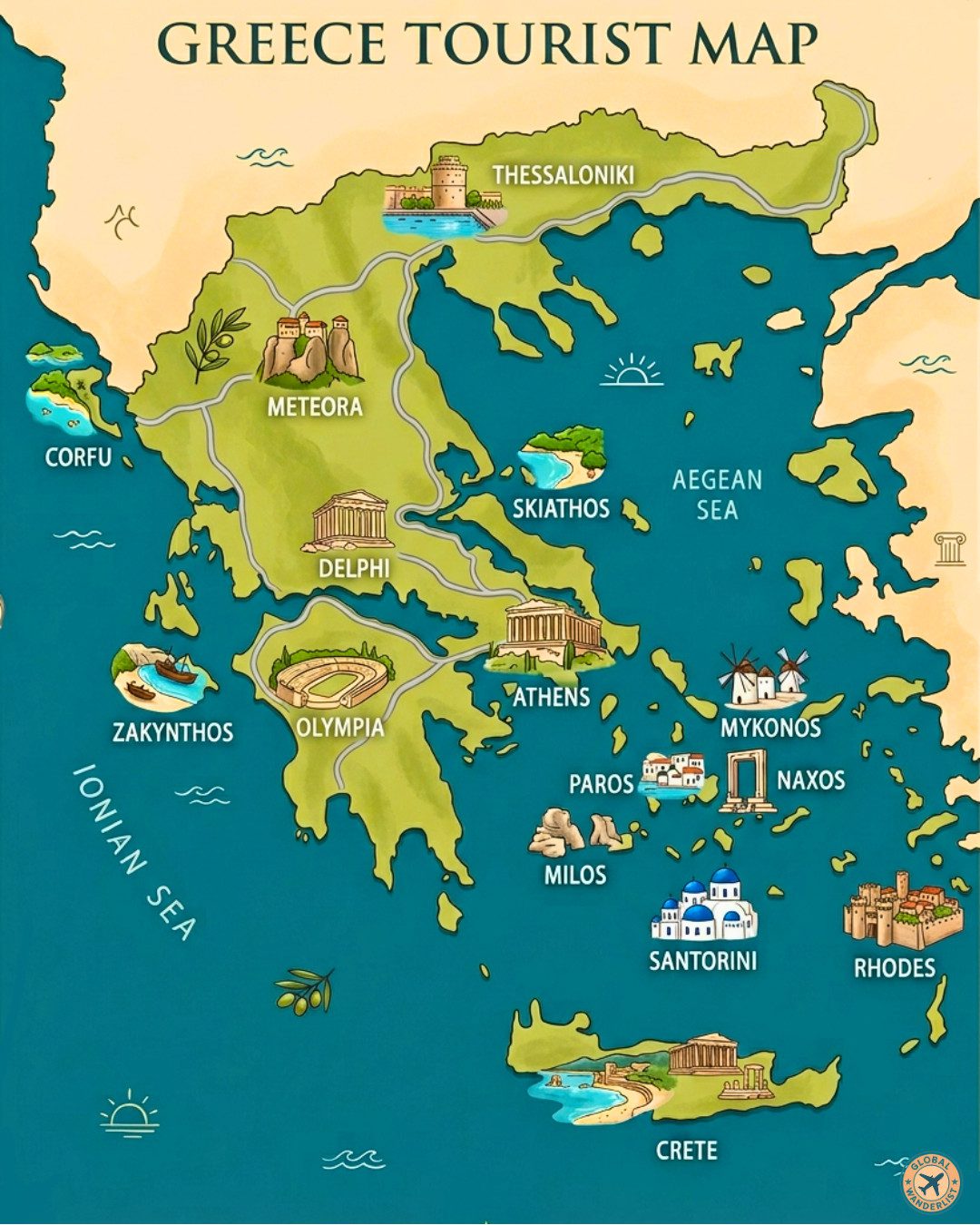
Greece delivers an extraordinary mix of ancient history, dramatic landscapes, and island life within a single country. Marble ruins sit beside turquoise water, while whitewashed villages cling to volcanic cliffs. Few destinations pack this much variety into one relatively compact corner of the Mediterranean.
This is a destination for travelers chasing both culture and coastline. History lovers can trace the roots of Western civilization through ancient temples and oracles. Island hoppers will find everything from party towns to quiet fishing villages, often just a short ferry ride apart.
Greece also rewards flexible travel. Ferries and domestic flights connect the mainland to dozens of islands, while a rental car opens up mainland sites like Meteora and Delphi. Whether you are chasing ruins, beaches, or quiet villages, this guide covers the destinations worth building a trip around.
Destination Overview
| Place | Category | Best Known For | Recommended Visit Duration |
|---|---|---|---|
| Athens | Capital City | Acropolis, ancient ruins | 2-3 days |
| Thessaloniki | City | Byzantine history, food scene | 1-2 days |
| Meteora | Historic Site | Cliffside monasteries | 1-2 days |
| Delphi | Historic Site | Ancient oracle, archaeological site | 1 day |
| Olympia | Historic Site | Birthplace of the Olympic Games | 1 day |
| Corfu | Island | Venetian architecture, green landscapes | 3-4 days |
| Zakynthos | Island | Shipwreck Beach, turquoise coves | 3-4 days |
| Skiathos | Island | Sandy beaches, pine forests | 2-3 days |
| Mykonos | Island | Windmills, nightlife | 2-3 days |
| Paros | Island | Traditional villages, beaches | 2-3 days |
| Naxos | Island | Ancient ruins, mountain villages | 2-3 days |
| Milos | Island | Volcanic beaches, colorful cliffs | 2-3 days |
| Santorini | Island | Caldera views, blue-domed churches | 2-3 days |
| Rhodes | Island | Medieval old town, castle | 2-3 days |
| Crete | Island | Beaches, Minoan ruins, mountains | 4-5 days |
Athens
Athens anchors any trip to Greece, a sprawling capital built around the ancient Acropolis. The Parthenon crowns the hilltop, visible from nearly every corner of the city below. Centuries of layered history sit alongside a modern, energetic urban center.
Most visitors spend two to three days here, enough time for the major ruins and a few neighborhoods. Walking remains the best way to explore the historic core, though the metro connects farther-flung sites easily. Early morning visits to the Acropolis help beat both heat and crowds.
What to See in Athens
- The Acropolis and Parthenon showcase the pinnacle of ancient Greek architecture and engineering.
- The Acropolis Museum displays artifacts recovered directly from the hill, including original sculptures.
- Plaka’s narrow, neoclassical streets offer the city’s most atmospheric neighborhood for wandering.
- The Ancient Agora reveals the heart of Athenian civic and philosophical life in antiquity.
- Monastiraki’s flea market and Roman ruins mix commerce with archaeology in one lively square.
- Lycabettus Hill rewards a climb or funicular ride with the best panoramic view over the city.
Thessaloniki
Thessaloniki serves as Greece’s second city, a Byzantine stronghold with a distinctly different feel from Athens. Centuries of Ottoman, Jewish, and Byzantine influence shaped its architecture and culture. The city’s waterfront promenade and lively food scene give it a relaxed, cosmopolitan energy.
One to two days cover the major historic sites and a proper introduction to the local cuisine. The city works well as a base for exploring nearby Halkidiki’s beaches or the Meteora monasteries further west. Thessaloniki’s food scene, blending Greek and Ottoman influences, ranks among the best in the country.
What to See in Thessaloniki
- The White Tower anchors the waterfront, a former Ottoman fortress now housing a city history museum.
- The Rotunda of Galerius showcases a rare, remarkably intact Roman-era monument turned church.
- Ano Poli, the upper town, preserves narrow streets and Byzantine walls above the modern city.
- The Archaeological Museum displays finds spanning the region’s ancient Macedonian history.
- Aristotelous Square opens onto the waterfront, a lively hub for evening strolls and people-watching.
- Modiano Market offers a vivid introduction to the city’s food culture, from spices to fresh seafood.
Meteora
Meteora ranks among the most surreal landscapes in Greece, monasteries perched atop towering sandstone pillars. Monks began building here in the 14th century, seeking isolation and closeness to the divine. The result remains one of the most photographed sites in the country.
Six monasteries still operate today, though only a handful remain open to visitors. Sunrise and sunset here deliver dramatic light across the rock formations. A full day allows time to visit two or three monasteries without rushing.
What to See in Meteora
- The Great Meteoron, the largest monastery, houses centuries-old frescoes and a small museum.
- Varlaam Monastery offers dramatic views and insight into the original rope-and-basket access system.
- Sunset viewpoints along the main road deliver some of the most striking photography in Greece.
- The town of Kalambaka below serves as a practical base, with hiking trails leading up toward the rocks.
- Rock climbing routes throughout the area draw climbers alongside spiritual visitors.
Delphi
Delphi held legendary status in the ancient world as the seat of the Oracle, believed to be the center of the earth. Pilgrims traveled from across Greece to consult the priestess before major decisions. The archaeological site today sits dramatically on the slopes of Mount Parnassus.
A single day covers the site and its excellent on-site museum comfortably. Morning visits offer cooler temperatures and softer light for photography. The drive from Athens takes about two and a half hours, making it a popular day trip or overnight stop.
What to See in Delphi
- The Temple of Apollo marks the heart of the ancient sanctuary, where the Oracle once delivered prophecies.
- The Ancient Theatre offers sweeping views down toward the valley and distant mountains.
- The Delphi Archaeological Museum houses the famous bronze Charioteer statue among other treasures.
- The Sacred Way winds uphill past treasuries once built by competing Greek city-states.
- The Castalian Spring, where pilgrims once purified themselves, sits just outside the main site.
Olympia
Olympia holds a singular place in world history as the birthplace of the Olympic Games, first held here in 776 BC. The ancient stadium and temple ruins sit in a peaceful, wooded valley in the Peloponnese. This site connects directly to a tradition still celebrated globally every four years.
A single day covers the archaeological site and museum comfortably. The setting feels notably calmer than more crowded sites like Delphi or the Acropolis. Runners sometimes take a symbolic lap around the ancient stadium track.
What to See in Olympia
- The Ancient Stadium lets visitors walk the same track where the first Olympic athletes competed.
- The Temple of Zeus once housed one of the Seven Wonders of the Ancient World, a massive gold and ivory statue.
- The Archaeological Museum displays sculptures and artifacts recovered from the sanctuary grounds.
- The Palaestra ruins reveal where ancient athletes trained for wrestling and boxing events.
- The surrounding pine forest offers a shaded, peaceful walk between the site’s scattered ruins.
Corfu
Corfu sits in the Ionian Sea, its Venetian-influenced old town setting it apart from the more classically Greek architecture found elsewhere. Centuries of Venetian, French, and British rule left a distinct architectural fingerprint across the island. Lush, green landscapes contrast with the drier islands of the Aegean.
Three to four days allow time for both the old town and the island’s varied coastline. Corfu Town’s UNESCO-listed center rewards slow wandering through arcaded streets. The island’s interior offers quiet villages and olive groves worth a detour.
What to See in Corfu
- Corfu Town’s Old Fortress and Venetian architecture reflect centuries of layered European influence.
- The Liston, an arcaded promenade modeled on Parisian architecture, anchors the old town’s social scene.
- Achilleion Palace, built for an Austrian empress, offers ornate gardens and sweeping sea views.
- Paleokastritsa’s coves provide some of the island’s most scenic swimming and boat tour departures.
- Angelokastro, a hilltop Byzantine fortress, rewards the climb with panoramic coastal views.
Zakynthos
Zakynthos draws visitors primarily for Shipwreck Beach, a dramatic cove accessible only by boat, framed by sheer white cliffs. The island’s turquoise coves and sea caves rank among the most photographed in Greece. Loggerhead sea turtles also nest along protected stretches of coastline here.
Three to four days allow time for boat tours, beach days, and the island’s quieter interior villages. Shipwreck Beach gets crowded by midday, so early morning boat trips offer calmer water and better light. The Blue Caves on the island’s northern tip make a worthwhile add-on to any boat excursion.
What to See in Zakynthos
- Shipwreck Beach, also called Navagio, delivers one of the most iconic coastal views in the Mediterranean.
- The Blue Caves reveal striking underwater light effects, best seen on a morning boat tour.
- Laganas Bay protects nesting loggerhead sea turtles, observable through responsible boat operators.
- Zakynthos Town’s rebuilt neoclassical center reflects the island’s recovery after a 1953 earthquake.
- Porto Limnionas offers a quieter, cliffside swimming spot away from the busiest beaches.
Skiathos
Skiathos packs over 60 beaches onto a small, pine-forested island in the Sporades. Koukounaries Beach, backed by a protected pine forest, regularly ranks among Greece’s best. The island balances lively nightlife with genuinely beautiful, less commercialized coves.
Two to three days cover the main beaches and a walk through the atmospheric old town. Boat taxis connect many of the island’s best coves, since roads do not reach every beach. The car-free monastery of Evangelistria offers a quiet contrast to the busier coastline.
What to See in Skiathos
- Koukounaries Beach combines soft sand with a shaded pine forest backdrop, ideal for a full beach day.
- Lalaria Beach, reachable only by boat, features striking white pebbles and dramatic rock arches.
- Skiathos Town’s narrow streets and busy harbor offer a lively base for exploring the island.
- Bourtzi, a small pine-covered peninsula, separates the town’s two harbors and makes a scenic short walk.
- Evangelistria Monastery, set in the hills, provides a quiet, historic detour from the beach scene.
Mykonos
Mykonos built its reputation on iconic windmills, whitewashed architecture, and a famously energetic nightlife scene. The island draws a glamorous, international crowd, particularly in high summer. Beyond the party reputation, Mykonos Town’s maze-like streets hold genuine architectural charm.
Two to three days allow time for the main town, beach clubs, and a boat trip to nearby Delos. Little Venice, where buildings sit right at the water’s edge, offers some of the island’s best sunset views. Prices here run higher than most other Greek islands, reflecting its upscale reputation.
What to See in Mykonos
- The iconic windmills overlook the town and harbor, among the most photographed landmarks in Greece.
- Little Venice’s waterfront buildings deliver dramatic sunset views over the Aegean.
- Delos, a short boat ride away, preserves one of the most important archaeological sites in Greece.
- Paradise and Super Paradise beaches anchor the island’s famous beach club scene.
- Mykonos Town’s narrow, whitewashed streets reward slow, aimless wandering and shopping.
Paros
Paros offers a calmer, more traditional alternative to its flashier Cycladic neighbors. Whitewashed villages, working windmills, and quiet beaches define the island’s character. Naoussa, its prettiest town, mixes a working fishing harbor with boutique shops and restaurants.
Two to three days allow time for both main towns and a few of the island’s best beaches. Paros also serves as a convenient ferry hub for exploring smaller nearby islands. The island’s relatively flat terrain makes cycling a practical way to get around.
What to See in Paros
- Naoussa’s harbor mixes traditional fishing boats with a lively evening restaurant and bar scene.
- Parikia, the main town, holds the Panagia Ekatontapiliani, one of Greece’s oldest surviving churches.
- Kolymbithres Beach features unusual, wind-sculpted granite rock formations along the shoreline.
- Lefkes, a hilltop village, preserves traditional Cycladic architecture away from the coastal crowds.
- The Byzantine Road connects several villages via an old marble-paved footpath worth hiking.
Naxos
Naxos stands as the largest of the Cyclades, combining sandy beaches with a mountainous, agricultural interior. The island’s ancient marble quarries once supplied statues found across Greece. A partially built marble gateway, the Portara, frames the harbor entrance dramatically.
Two to three days allow time for the main town, mountain villages, and beach time. Naxos feels less commercialized than Mykonos or Santorini, with a stronger connection to traditional Greek island life. Renting a car opens up the island’s scenic mountain villages and ancient sites.
What to See in Naxos
- The Portara, a massive marble doorway, frames sunset views over the harbor from an unfinished ancient temple.
- Naxos Town’s Venetian Kastro district preserves fortified medieval architecture worth exploring on foot.
- Plaka Beach offers long, soft sand backed by dunes, among the island’s best stretches of coastline.
- The mountain village of Halki showcases traditional architecture and a historic citrus liqueur distillery.
- Ancient marble quarries near Apollonas reveal unfinished, giant kouros statues abandoned mid-carving.
Milos
Milos ranks among the most geologically striking islands in Greece, shaped by volcanic activity into dramatic, multicolored cliffs. Sarakiniko Beach’s lunar-like white rock formations look unlike anywhere else in the country. The island remains less crowded than its more famous Cycladic neighbors.
Two to three days allow time for a boat tour around the island’s coastline and its scattered beaches. Many of Milos’s best coves are reachable only by boat, making a day cruise a worthwhile investment. The island also holds genuine archaeological significance as the discovery site of the Venus de Milo statue.
What to See in Milos
- Sarakiniko Beach’s white volcanic rock formations create an otherworldly, almost lunar landscape.
- Kleftiko’s sea caves and rock arches rank among the most dramatic coastal scenery in the Cyclades.
- Plaka, the main town, offers sunset views from its hilltop Venetian castle ruins.
- The Catacombs of Milos preserve early Christian burial chambers carved into volcanic rock.
- Colorful fishing villages like Klima showcase traditional syrmata, boat garages built into the cliffside.
Santorini
Santorini formed from a massive volcanic eruption, leaving behind a dramatic caldera now lined with whitewashed, blue-domed villages. Oia’s clifftop sunset views rank among the most photographed scenes in the world. The island’s black and red sand beaches reflect its volcanic origins.
Two to three days allow time for the main towns and a proper sunset viewing. Crowds peak significantly in summer, so arriving at viewpoints early secures a good spot. The island’s dramatic scenery comes with correspondingly higher prices than most other Greek islands.
What to See in Santorini
- Oia’s whitewashed streets and blue-domed churches deliver the island’s most iconic sunset views.
- Fira, the capital, offers dramatic caldera views along its clifftop walking path.
- Red Beach features striking volcanic red cliffs contrasting against dark sand and blue water.
- Ancient Akrotiri preserves a remarkably intact Bronze Age settlement buried by volcanic ash.
- Wine tours through the island’s volcanic vineyards introduce Assyrtiko, Santorini’s distinctive white wine.
Rhodes
Rhodes holds one of the best-preserved medieval old towns in Europe, encircled by massive fortified walls built by the Knights of Saint John. Cobblestone streets wind past Gothic architecture layered over ancient Greek and Ottoman history. This makes Rhodes one of the most historically dense islands in Greece.
Two to three days cover the old town and a few of the island’s beaches. The Palace of the Grand Master anchors the medieval quarter with genuine architectural grandeur. Rhodes also offers easy access to the ancient site of Lindos, with its dramatic acropolis overlooking the sea.
What to See in Rhodes
- The Old Town’s medieval walls and cobblestone streets rank among the best-preserved in Europe.
- The Palace of the Grand Master showcases the island’s era under the Knights of Saint John.
- Lindos Acropolis combines ancient Greek ruins with sweeping views over a picturesque bay below.
- The Street of the Knights preserves rows of medieval inns built by different national orders.
- Anthony Quinn Bay offers a scenic, sheltered cove for swimming near the island’s eastern coast.
Crete
Crete stands as Greece’s largest island, home to the ancient Minoan civilization and a striking range of landscapes. Mountains, gorges, and long sandy beaches all sit within a single island large enough to feel like its own country. The Palace of Knossos anchors the island’s deep archaeological significance.
Four to five days allow time to properly explore Crete’s size and variety. The island rewards travelers willing to venture beyond the main coastal resorts into mountain villages and gorges. Renting a car makes the most sense here, given the island’s scale.
What to See in Crete
- The Palace of Knossos reveals the heart of ancient Minoan civilization, Europe’s oldest advanced society.
- Samaria Gorge offers one of Europe’s longest hikeable gorges, stretching toward the southern coast.
- Elafonisi Beach features pink-tinted sand and shallow, turquoise water in a protected nature reserve.
- Chania’s Venetian harbor combines colorful waterfront architecture with a genuinely atmospheric old town.
- Balos Lagoon delivers striking turquoise water framed by dramatic cliffs, reachable by boat or a scenic hike.
Final Thoughts
Greece rewards travelers willing to look beyond its most famous postcards. Beyond Santorini’s sunsets and the Acropolis, quiet mountain villages, volcanic islands, and ancient oracles wait for those willing to explore further. Give yourself time to island hop or wander inland.
The best trips here mix iconic landmarks with slower, less crowded stops. Ferries and domestic flights make island combinations easy to plan. Greece consistently rewards curiosity, and its lesser-known corners often become the most memorable part of any trip.