
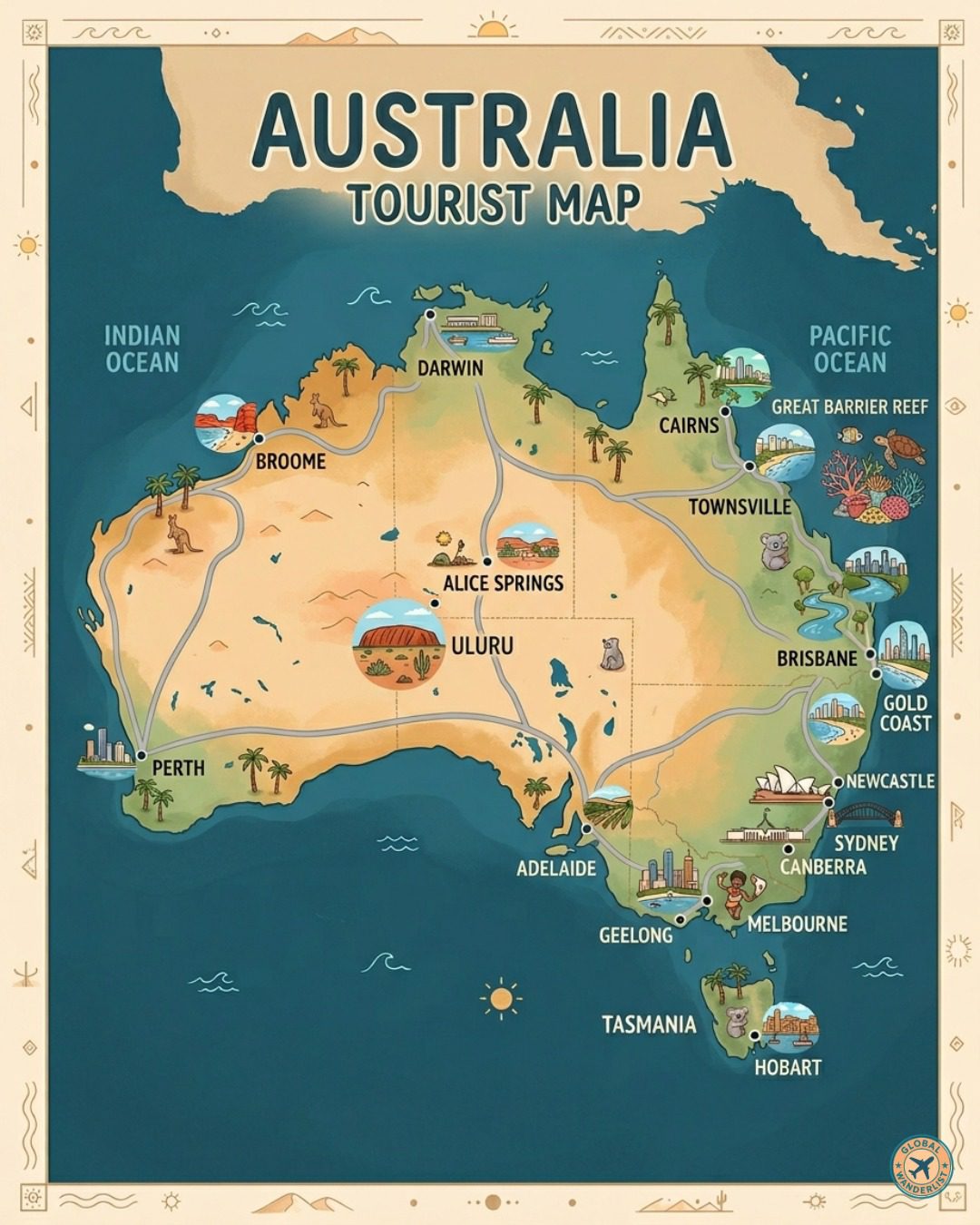
Australia spans nearly 7.7 million square kilometers, making it one of the most challenging countries in the world to plan a single trip around. Most visitors end up choosing a handful of regions rather than attempting the whole continent at once. Understanding what each major destination actually offers makes that decision far easier.
This guide walks through Australia’s most visited hubs, from the tropical Top End to Tasmania’s cooler southern coast. Below is a region-by-region breakdown, including what to see and practical tips for timing your visit.
Destination Overview
| Region | Key City | Best Known For |
|---|---|---|
| Top End | Darwin | Wetlands, Kakadu National Park |
| Kimberley | Broome | Pearling history, red cliffs |
| Red Centre | Alice Springs & Uluru | Desert landscapes, Aboriginal culture |
| Far North Queensland | Cairns | Great Barrier Reef, rainforest |
| North Queensland | Townsville | Magnetic Island, diving |
| Southeast Queensland | Brisbane & Gold Coast | City culture, surf beaches |
| New South Wales | Sydney & Newcastle | Harbor icons, coastal walks |
| Australian Capital Territory | Canberra | Museums, national institutions |
| Victoria | Melbourne & Geelong | Coffee culture, laneway art |
| South Australia | Adelaide | Wine regions, festivals |
| Western Australia | Perth | Beaches, Rottnest Island |
| Tasmania | Hobart | Wilderness, food and wine |
Each of these regions could easily fill a standalone trip. Below is a closer look at what makes each one worth visiting.
Darwin and the Top End
Darwin serves as Australia’s tropical northern capital, rebuilt after Cyclone Tracy devastated the city in 1974. It sits close to Kakadu National Park, one of the country’s largest and most significant protected areas. The region operates on a distinct wet and dry seasonal cycle rather than four traditional seasons.
What to See in Darwin and the Top End
- Visit Kakadu National Park for ancient Aboriginal rock art and expansive wetlands teeming with birdlife.
- Explore Darwin’s waterfront precinct, including its wave pool and harborside dining strip.
- Take a Yellow Water cruise to see saltwater crocodiles and thousands of migratory birds up close.
Best Time to Visit
- Travel between May and October during the dry season, when roads are open and humidity stays manageable.
- Avoid the peak wet season from January to March, when monsoonal rains can flood roads and limit access to national parks.
- Catch the Mindil Beach Sunset Market if visiting during the dry season, held Thursday and Sunday evenings.
Broome and the Kimberley
Broome sits on Western Australia’s northern coast, built originally on the pearling industry and now known for its striking red cliffs meeting turquoise water. It serves as the main gateway to the Kimberley, one of the most remote and least developed regions in Australia. Cable Beach draws most visitors, especially for its camel ride sunsets.
What to See in Broome and the Kimberley
- Watch the sunset camel ride procession along Cable Beach, one of the most photographed scenes in Western Australia.
- Explore Broome’s Chinatown and pearling history at the town’s historical museum.
- Venture further into the Kimberley to see the Bungle Bungle Range in Purnululu National Park, a series of striped sandstone domes.
Best Time to Visit
- Visit between April and September during the dry season, when temperatures are more comfortable and roads into the Kimberley remain accessible.
- Book accommodation well ahead during the peak July and August period, when the region gets its highest visitor numbers.
- Avoid the wet season between November and March, when many unsealed roads become impassable.
Alice Springs and Uluru: The Red Centre
Alice Springs sits roughly at the geographic center of Australia, surrounded by the West and East MacDonnell Ranges. A short flight or long drive south brings visitors to Uluru, the country’s most recognizable natural landmark. Together, these two hubs form the heart of Australia’s Red Centre.
What to See in the Red Centre
- Walk the base loop around Uluru, a 10.6-kilometer trail that reveals rock art sites significant to the Anangu people.
- Visit Kata Tjuta, a group of large domed rock formations near Uluru with equally deep cultural history.
- Explore the MacDonnell Ranges near Alice Springs, including gorges like Trephina and Ormiston.
Best Time to Visit
- Travel between May and September, when daytime temperatures are mild and evenings are cool rather than freezing or scorching.
- Avoid summer months between December and February, when temperatures regularly exceed 40 degrees Celsius.
- Book sunset and sunrise viewing spots at Uluru in advance, since designated areas can fill during peak season.
Cairns and the Great Barrier Reef
Cairns serves as the main gateway to the Great Barrier Reef, one of the seven natural wonders of the world. The city also sits at the edge of the Daintree Rainforest, giving visitors access to two World Heritage sites within a short drive of each other. Its Esplanade and waterfront dining precinct make it an easy, relaxed base.
What to See in Cairns and the Great Barrier Reef
- Take a day trip out to the reef for snorkeling or diving, with numerous operators running trips directly from the Cairns marina.
- Explore the Daintree Rainforest, one of the oldest continuously surviving rainforests on Earth.
- Ride the Kuranda Scenic Railway or cableway for views over the rainforest canopy and surrounding valleys.
Best Time to Visit
- Visit between June and October for the best diving visibility and cooler, drier weather.
- Avoid stinger season between November and May if you plan to swim without a stinger suit, since jellyfish are common along this stretch of coast.
- Book reef tours a few days ahead during peak season, since popular operators fill quickly.
Townsville and Magnetic Island
Townsville is North Queensland’s largest city, known for its dry, sunny climate compared to the more humid stretches further north. Magnetic Island sits a short ferry ride offshore, offering koala spotting and quiet beaches. The Strand, Townsville’s waterfront promenade, anchors much of the city’s outdoor life.
What to See in Townsville and Magnetic Island
- Walk or cycle along The Strand, a palm-lined waterfront with swimming enclosures and parkland.
- Take the ferry to Magnetic Island, known for its resident koala population and uncrowded beaches.
- Visit the Museum of Underwater Art, an artificial reef installation combining marine conservation with sculpture.
Best Time to Visit
- Visit between April and September, when humidity drops and conditions are ideal for outdoor activities.
- Avoid the cyclone season between November and April, when storms can occasionally disrupt travel plans.
- Book Magnetic Island accommodation ahead during school holiday periods, when the island gets noticeably busier.
Brisbane and the Gold Coast
Brisbane, Queensland’s capital, sits along a winding river with a relaxed, subtropical character. Just an hour south, the Gold Coast offers a completely different energy, built around high-rise towers and world-class surf beaches. Together, they form one of the most accessible city-and-beach combinations in the country.
What to See in Brisbane and the Gold Coast
- Swim at South Bank Parklands’ Streets Beach, a free, man-made lagoon in the heart of Brisbane.
- Surf or relax at Surfers Paradise Beach, the Gold Coast’s most iconic stretch of sand.
- Visit one of the Gold Coast’s major theme parks, popular with families traveling with children.
Best Time to Visit
- Visit between April and October, avoiding the most humid summer months if possible.
- Book Gold Coast accommodation well ahead during school holidays, since the region is a major domestic tourism hub.
- Consider a midweek visit to avoid the Gold Coast’s busiest weekend crowds.
Sydney and Newcastle
Sydney needs little introduction, home to the Opera House, Harbour Bridge, and some of the country’s most famous beaches. Newcastle, a couple of hours north, offers a quieter alternative with a similarly strong beach and cafe culture. Together, they showcase two very different sides of New South Wales.
What to See in Sydney and Newcastle
- Walk across the Sydney Harbour Bridge for sweeping views of the Opera House and harbor below.
- Explore the Bondi to Coogee coastal walk, linking several of Sydney’s best beaches in one outing.
- Visit Newcastle’s Nobbys Beach and historic ocean baths for a relaxed, less crowded coastal experience.
Best Time to Visit
- Travel between September and November or March and May, when temperatures are mild and crowds are thinner than peak summer.
- Book Opera House tours online in advance, since walk-up tickets are not always available.
- Avoid Sydney’s peak summer crowding around Christmas and New Year if you prefer a quieter visit.
Canberra
Canberra, Australia’s purpose-built capital, sits roughly between Sydney and Melbourne. Its planned layout centers on Lake Burley Griffin, with most major national institutions clustered within walking distance of each other. The city is often underrated compared to Australia’s larger coastal capitals.
What to See in Canberra
- Visit the Australian War Memorial, widely regarded as one of the most moving museums in the country.
- Walk or cycle the Lake Burley Griffin foreshore trail, passing Parliament House and the National Carillon.
- Tour Parliament House, including its public galleries, with free guided tours running throughout the day.
Best Time to Visit
- Visit during autumn between March and May, when Canberra’s tree-lined streets turn vivid shades of red and gold.
- Avoid winter mornings if you dislike cold weather, since Canberra experiences noticeably colder temperatures than coastal cities.
- Plan museum visits on weekdays if possible, since major institutions can get busy with school groups on weekends.
Melbourne and Geelong
Melbourne is widely considered Australia’s cultural capital, known for laneway art, strong coffee culture, and a compact, walkable center. Geelong, a short drive southwest, serves as the gateway to the Great Ocean Road and Bellarine Peninsula wine region. Together, they anchor Victoria’s most visited stretch.
What to See in Melbourne and Geelong
- Walk through Hosier Lane to see Melbourne’s constantly changing street art scene.
- Visit the Royal Botanic Gardens for a relaxed, green escape close to the city center.
- Explore Geelong’s waterfront and use it as a base for a Great Ocean Road day trip.
Best Time to Visit
- Visit between March and May or September and November, when Melbourne’s notoriously changeable weather is at its most pleasant.
- Pack layers regardless of season, since Melbourne is famous for experiencing four seasons in a single day.
- Book Great Ocean Road accommodation ahead during summer, since this stretch is extremely popular with domestic travelers.
Adelaide
Adelaide sits between the Adelaide Hills and Gulf St Vincent, known for its wide streets, strong festival calendar, and proximity to some of Australia’s best wine regions. The Barossa Valley and McLaren Vale both sit within easy day-trip distance. It remains one of the more underrated state capitals for food and wine travelers.
What to See in Adelaide
- Walk through the Adelaide Central Market for a strong sense of the city’s food culture.
- Visit the Adelaide Botanic Garden, home to a striking glasshouse within walking distance of the CBD.
- Take a day trip into the Barossa Valley or Adelaide Hills for wine tasting at historic cellar doors.
Best Time to Visit
- Visit during autumn between March and May for mild weather and the tail end of the wine harvest season.
- Check the city’s festival calendar before booking, since Adelaide hosts major events like the Fringe Festival in February and March.
- Book Barossa Valley tours ahead during peak season, since popular wineries can get busy on weekends.
Perth
Perth is Australia’s most isolated major city, separated from the rest of the country by vast stretches of desert. Its relaxed, sunny character and proximity to excellent beaches give it a noticeably different pace compared to the eastern capitals. Rottnest Island, home to the famous quokka, sits just offshore.
What to See in Perth
- Walk through Kings Park for sweeping views over the Swan River and city skyline.
- Take the ferry to Rottnest Island to see quokkas and some of Western Australia’s best beaches.
- Explore Fremantle’s historic port precinct, known for its markets and converted warehouses.
Best Time to Visit
- Visit between September and November or March and May, avoiding the more intense summer heat.
- Book Rottnest Island ferries in advance, especially during school holidays when sailings fill quickly.
- Consider combining a Perth visit with a coastal road trip north toward Ningaloo Reef if time allows.
Hobart and Tasmania
Hobart, Tasmania’s capital, offers a cooler, wilder alternative to mainland Australia’s major cities. The island state is known for its rugged national parks, strong food and wine scene, and a noticeably slower pace of life. Mount Wellington towers directly over the city, offering panoramic views within a short drive of the center.
What to See in Hobart and Tasmania
- Drive or hike up Mount Wellington for sweeping views over Hobart and the surrounding waterways.
- Visit Salamanca Market on Saturdays, one of Australia’s best-known outdoor markets, held right on the historic waterfront.
- Take a day trip to Bruny Island, known for its oysters, cheese, and dramatic coastal scenery.
Best Time to Visit
- Visit between December and February for the mildest weather, since Tasmania’s climate runs noticeably cooler than the mainland year-round.
- Pack warm layers regardless of season, since weather in Tasmania can shift quickly even in summer.
- Book Bruny Island tours ahead during peak summer, since day trips are popular with both domestic and international visitors.
Final Thoughts
Australia’s sheer size means most trips end up focused on one or two regions rather than the whole country at once. Whether you are drawn to the tropical Top End, the red desert of the Centre, or the cooler wilderness of Tasmania, each region delivers a genuinely different experience. Match your timing to the season that suits your chosen destination, and the trip will fall into place far more smoothly than trying to see it all at once.