
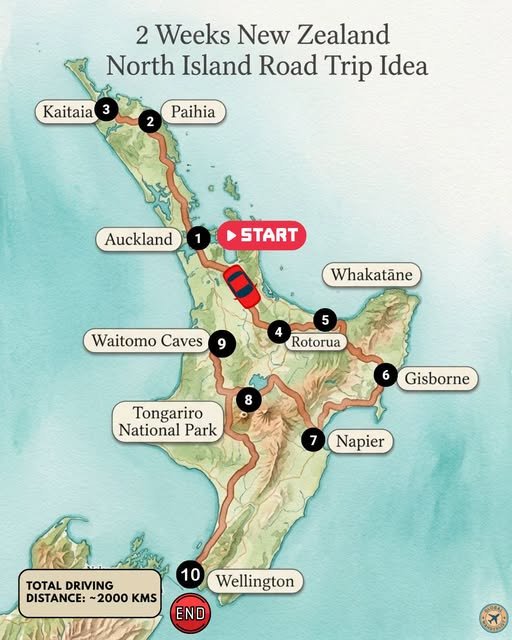
New Zealand’s North Island rarely gets the same spotlight as its more mountainous southern sibling, yet it packs an equally impressive range of landscapes into a more compact, road-trip-friendly footprint. Geothermal fields that hiss and bubble, subtropical beaches in the far north, volcanic national parks, wine country, and two of the country’s most characterful cities all sit within a single loop that clocks in at roughly 2,000 kilometres. Given two weeks, this route makes an ideal introduction to everything the North Island does best.
Starting Point: Auckland
Every good North Island road trip begins in Auckland, the country’s largest city and a natural launching point thanks to its international airport and easy access to rental cars. Built across and around no fewer than 53 extinct volcanic cones, Auckland is worth a day or two before hitting the road. The harbour-front Viaduct area, the view from the top of Mount Eden, and the short ferry ride across to Waiheke Island for a lazy afternoon of vineyard-hopping all make for a solid warm-up before the driving begins in earnest.
Once ready to depart, most road-trippers head north first, saving the volcanic and geothermal heartland of the central North Island, along with the eastern coast and the capital, for the return leg south.
Heading North: Paihia and the Bay of Islands
The drive north from Auckland leads to Paihia, the gateway to the Bay of Islands, one of the country’s most celebrated maritime playgrounds. This stretch of coastline, dotted with roughly 144 islands, is best explored by boat, and Paihia serves as the departure point for cruises out to the Hole in the Rock at Cape Brett, as well as dolphin-watching trips and day sails around the bay’s sheltered waters. History buffs will also want to make time for nearby Waitangi, where the treaty that founded modern New Zealand was signed in 1840, an event now marked by a museum and cultural centre well worth a visit.
Paihia’s laid-back, holiday-town atmosphere makes it a natural spot to slow down for a night or two before continuing further north.
The Far North: Kaitaia
Continuing further up the peninsula, the road leads to Kaitaia, the northernmost town of any real size in New Zealand and the jumping-off point for trips to Cape Reinga, the dramatic headland where the Tasman Sea and Pacific Ocean are said to meet. Along the way, the vast golden dunes of Ninety Mile Beach offer a surreal driving and sandboarding experience, while the ancient kauri forests scattered through the region, remnants of trees that can live for well over a thousand years, provide a completely different kind of scenery from the coastal drama further along the peninsula.
Kaitaia marks the natural turning point of the trip. From here, the route heads back south, this time angling toward the geothermal and volcanic heart of the North Island.
Back Through Auckland Toward Rotorua
After retracing the route south past Auckland, the road curves toward Rotorua, one of New Zealand’s most distinctive destinations thanks to its intense geothermal activity. Bubbling mud pools, steaming vents, and the unmistakable whiff of sulphur in the air are all part of daily life here. Geothermal parks such as Wai-O-Tapu showcase colourful silica terraces and erupting geysers, while Rotorua is also considered the cultural heart of Māori tourism in New Zealand, with numerous opportunities to experience traditional hangi feasts and cultural performances.
Beyond the geothermal attractions, Rotorua’s surrounding forests have become a mountain biking mecca, and the nearby lake offers everything from kayaking to simply relaxing with a view of the steam rising off the water in the early morning.
East to Whakatāne and Gisborne
From Rotorua, the route swings east toward Whakatāne, a sunny coastal town known as one of the sunniest spots in the country and the launching point for boat trips out to White Island (Whakaari), an active volcanic island offshore, conditions and access permitting. Whakatāne’s relaxed beach-town character offers a nice change of pace after the geothermal intensity of Rotorua.
Continuing along the coast, the road reaches Gisborne, a city with the distinction of being one of the first places on Earth to see the sunrise each day thanks to its position near the International Date Line. Gisborne is also home to a growing and highly regarded wine region, particularly known for its Chardonnay, along with some of the North Island’s best surf beaches. This stretch of the East Coast remains one of New Zealand’s least-visited corners despite its striking scenery, making it a rewarding detour for travellers who want to escape the more heavily trafficked tourist trail.
South to Napier and the Art Deco Coast
From Gisborne, the route continues south to Napier, a city famous for something few visitors expect: its architecture. After a devastating earthquake levelled much of the city in 1931, Napier was rebuilt almost entirely in the Art Deco style then in fashion, and today it holds one of the most complete collections of Art Deco buildings anywhere in the world. Wandering the pastel-coloured streets of the city centre feels like stepping into a different decade entirely.
Napier also sits at the heart of Hawke’s Bay, one of New Zealand’s premier wine regions, particularly celebrated for its Bordeaux-style reds and Chardonnay. A day spent touring the region’s vineyards and orchards, set against a backdrop of dry, sun-soaked hills, makes for one of the more relaxed stops on the entire itinerary.
Into the Volcanic Heart: Tongariro National Park
Turning inland from Napier, the road climbs toward Tongariro National Park, home to some of the North Island’s most dramatic volcanic scenery and New Zealand’s oldest national park. The park is dominated by three active volcanoes, Ruapehu, Ngauruhoe, and Tongariro itself, and offers what is widely considered one of the best day hikes in the country: the Tongariro Alpine Crossing, a roughly 19-kilometre trek across otherworldly volcanic terrain, past emerald-green crater lakes and steaming vents.
Fans of a certain film trilogy will also recognise the landscape here, since Ngauruhoe served as the visual basis for a certain fictional mountain, adding an extra layer of appeal for travellers making the pilgrimage. Even without hiking the full crossing, simply driving through the park offers striking views of the volcanic plateau, particularly dramatic at sunrise or sunset.
Waitomo Caves: Into the Underground
From Tongariro, the route heads northwest to Waitomo, famous for its extensive network of limestone caves and, in particular, the glowworms that inhabit them. A boat trip through the Waitomo Glowworm Caves, drifting silently beneath a ceiling that glows like a starlit night sky, ranks among the more unusual and memorable experiences available anywhere in New Zealand. For those wanting more adventure, the region also offers black-water rafting, essentially tubing through underground rivers inside the cave systems, along with abseiling and caving tours for various levels of adrenaline tolerance.
Waitomo’s compact size means most visitors only need a day here before continuing on toward the final leg of the journey.
The Final Stretch: Wellington
The road trip concludes in Wellington, New Zealand’s capital and, by most accounts, one of its most characterful cities. Built around a dramatic harbour and framed by steep, bush-covered hills, Wellington packs a surprisingly large amount of culture, food, and history into a relatively compact urban footprint. The Museum of New Zealand Te Papa Tongarewa offers an excellent overview of the country’s natural and cultural history, while the cable car up to the Botanic Garden provides sweeping views back over the city and harbour below.
Wellington has also earned a reputation as something of a foodie capital, with a café culture that rivals any city its size in the world, along with a thriving craft beer and wine bar scene. For film fans, the city is also closely associated with Weta Workshop and the special effects industry that grew up around major film productions shot in the country, with several tours and exhibits available for those interested in the filmmaking side of New Zealand’s tourism story.
Planning Your Own Route
At roughly 2,000 kilometres of total driving, this loop is comfortably achievable over two weeks, allowing time to properly enjoy each stop rather than simply passing through. A rough pacing guide might allocate two to three days around Auckland and the far north, two to three days in the Rotorua and Bay of Plenty area, a couple of days working down the East Coast through Gisborne and Napier, two to three days around Tongariro and Waitomo, and a final two to three days in Wellington before flying out or continuing on to the South Island via the Interislander ferry.
New Zealand’s roads, while generally well maintained, can be narrower and windier than many visitors expect, particularly in hill country, so building extra time into longer driving days is wise. It’s also worth noting that distances on a map can be deceptive: a 200-kilometre drive in New Zealand can easily take three to four hours given the terrain, so this itinerary rewards travellers who resist the urge to over-schedule.
Whether it’s the geothermal drama of Rotorua, the Art Deco streets of Napier, the underground glow of Waitomo, or the volcanic crossing of Tongariro, this North Island loop offers a genuinely comprehensive sample of what makes New Zealand one of the world’s most rewarding road trip destinations, all without ever needing to leave a single island.