
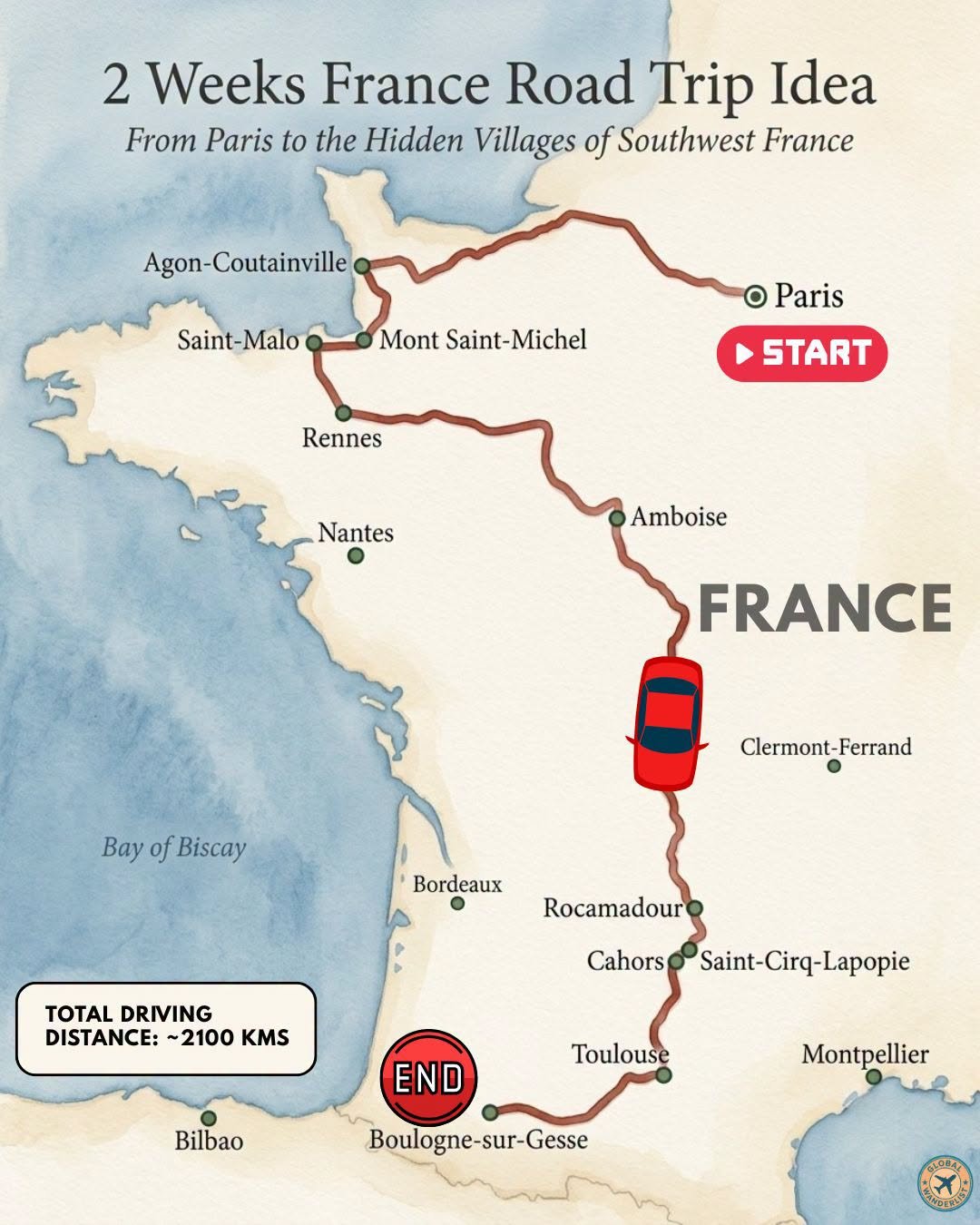
This two week loop takes travelers from the boulevards of Paris up through Normandy’s wild coastline, across Brittany’s walled ports, down through Loire Valley château country, and deep into the limestone canyons and medieval villages of the Lot valley. It suits travelers who want genuine variety, trading famous landmarks for quiet clifftop drives, riverside villages, and some of France’s most underrated countryside. Photographers, slow travelers, and anyone chasing scenery beyond the postcard highlights will love this route.
The pace allows real time in each stop rather than rushing between photo ops, with roughly 2,100 kilometers covered over two weeks. Below is a full overview, followed by a detailed stop by stop guide.
| Stop | Distance from Previous Stop | Driving Time | Main Highlights | Recommended Stay Duration |
|---|---|---|---|---|
| Paris | Starting point | N/A | Eiffel Tower, Louvre, historic boulevards | 2-3 days |
| Agon-Coutainville | 340 km | 3.5 hours | Normandy beach town, oyster bars, coastal sunsets | 1 day |
| Saint-Malo | 90 km | 1.25 hours | Walled port city, ramparts, fresh seafood | 1-2 days |
| Mont Saint-Michel | 55 km | 1 hour | Medieval tidal abbey, dramatic causeway views | 1 day |
| Rennes | 65 km | 1 hour | Breton capital, half timbered old town | 1 day |
| Amboise | 220 km | 2.5 hours | Loire château country, riverside old town | 1-2 days |
| Rocamadour | 300 km | 3.5 hours | Cliffside pilgrimage village, dramatic canyon views | 1 day |
| Cahors | 60 km | 1 hour | Malbec wine country, medieval bridge | 1 day |
| Saint-Cirq-Lapopie | 30 km | 40 minutes | One of France’s most beautiful villages, clifftop views | 1 day |
| Toulouse | 100 km | 1.25 hours | The Pink City, canal walks, southwest gastronomy | 1-2 days |
| Boulogne-sur-Gesse | 75 km | 1 hour | Rural Gascon village, lake views, quiet countryside | 1 day |
Paris
Paris opens this road trip as a natural starting point before heading into the French countryside. Two or three days here lets you see the major landmarks before hitting the road, without cramming everything into a single rushed day.
Where to Eat in Paris
- Pink Mamma, Italian, $$$. A lively, plant filled trattoria in Pigalle known for its beef carpaccio and rooftop dining room.
- L’As du Fallafel, Middle Eastern, $. A Marais institution famous for falafel sandwiches piled high with fresh vegetables and tahini.
- Brasserie des Prés, French, $$$. A charming brasserie tucked into a quiet Saint-Germain courtyard, known for onion soup and duck dishes.
What to See in Paris
- The Eiffel Tower remains France’s most iconic landmark, especially memorable at sunset or with evening lights. Booking timed tickets in advance saves significant waiting.
- The Louvre Museum houses an extraordinary art collection, though focusing on a few wings makes for a far more manageable visit.
- Montmartre offers a village like escape atop a hill, crowned by the white domed Sacré-Cœur and the artist filled Place du Tertre.
- A Seine River cruise offers a relaxed way to see illuminated landmarks from the water, a memorable way to close out your time in the city before driving north.
Agon-Coutainville
Agon-Coutainville introduces the Normandy coast with a relaxed, less touristed beach town feel. Its wide sandy beach and oyster producing waters give it a genuine, local character compared to busier Norman resorts. This stop offers an easy first driving day out of Paris, with a coastal sunset as your reward.
Where to Eat in Agon-Coutainville
- Chez Le Père GUS, Seafood, $$. An oyster bar and workshop serving fresh oysters raised directly on the owner’s own beds near the beach.
- Restaurant du Casino, French, $$. Rated 4.5 out of 5, this friendly spot at the Coutainville casino welcomes both gamblers and non-gamblers alike.
- Le Manchot, French, $$. A well recommended local favorite worth seeking out during a stop in Agon.
What to See in Agon-Coutainville
- The wide sandy beach at Agon-Coutainville offers calm, family friendly water and a relaxed pace, perfect for stretching your legs after the drive from Paris.
- Watching the sunset over the water here is a genuine local tradition, with several beachside spots offering unobstructed views.
- Pointe d’Agon marks a scenic natural area just outside town, worth a short walk for coastal views away from the main beach crowds.
- Local oyster farms along the coast offer a direct, authentic introduction to Normandy’s shellfish industry, often with tastings available on site.
Saint-Malo
Saint-Malo anchors this route’s entry into Brittany, a dramatic walled port city rebuilt after heavy World War II damage. Its granite ramparts encircle a dense, atmospheric old town, with the open Atlantic just beyond the walls. This stop rewards both a proper seafood dinner and a sunset walk along the fortifications.
Where to Eat in Saint-Malo
- Louno, French, $$$. Rated 9.7 by TheFork users, this stands among the most highly regarded restaurants in the city.
- Le Saint Placide, French, $$$. A romantic, well reviewed spot popular for special occasion dinners.
- L’Ancrage, Seafood, $$. A family run restaurant recommended directly by local hoteliers, known for consistently fresh fish.
What to See in Saint-Malo
- Walking the full loop of Saint-Malo’s ramparts offers sweeping views over both the old town and the open Atlantic. Sunset is the most atmospheric time to go.
- The walled old town’s narrow streets reveal centuries of maritime history, rebuilt with care after significant wartime destruction.
- A short ferry ride from the harbor reaches nearby islands, offering an easy half day escape from the town itself.
- Fresh oyster and seafood platters at harborside restaurants capture the essence of Breton coastal dining, best enjoyed with a view of the water.
Mont Saint-Michel
Mont Saint-Michel stands as one of France’s most extraordinary sights, a medieval abbey rising from tidal flats at the border of Normandy and Brittany. Its silhouette has inspired travelers for centuries, and the surrounding bay produces some of the most dramatic tidal shifts in Europe. A short drive from Saint-Malo makes this an easy, essential stop on this route.
Where to Eat in Mont Saint-Michel
- La Mère Poulard, French, $$$. A historic institution on the Mont, famous for its traditional fluffy omelettes cooked over an open fire.
- Restaurant Le Pré Salé, French, $$$. A well reviewed spot serving regional lamb raised on the surrounding salt marshes, with views toward the abbey.
- Creperie La Cloche, Crêperie, $$. Run by a family with roots on the Mont dating to 1663, offering classic crepes in an authentic setting.
What to See in Mont Saint-Michel
- The abbey itself sits at the summit, combining centuries of Romanesque and Gothic architecture built up over generations. Guided tours explain the engineering behind its construction.
- The ramparts encircling the base of the mount offer sweeping views over the bay and its shifting sandbanks, an easy 30 minute walk at a relaxed pace.
- Checking tide schedules before your visit is essential, since the water can rise faster than a person can run during peak tidal surges.
- The causeway connecting the mount to the mainland offers striking photo opportunities, especially at low tide when reflections stretch across the wet sand.
Rennes
Rennes brings this route into the heart of Brittany’s regional capital, blending medieval half timbered streets with a lively, youthful energy. Its compact historic center makes for an easy day of walking, and the city’s food scene punches well above its size. This stop offers a good overnight base before turning south toward the Loire.
Where to Eat in Rennes
- Bistrot Canaille, French, $$$. Rated 9.3 by TheFork users, this romantic bistro is a favorite for its inventive seasonal menu.
- Le Galopin, French, $$$. A modern French restaurant known for fresh seafood and elegant presentation.
- La Fontaine aux Perles, French, $$$$. An established fine dining destination showcasing culinary artistry alongside traditional Breton flavors.
What to See in Rennes
- Rennes’s historic center features colorful half timbered houses dating back centuries, best explored on foot around Place Sainte-Anne and the surrounding lanes.
- Cathédrale Saint-Pierre anchors the old town with its grand interior, worth a quiet stop between wandering the surrounding streets.
- Parc du Thabor offers a peaceful, formally landscaped green space, a pleasant break from the busier historic center.
- The Marché des Lices, one of France’s largest open air markets, fills the city with local produce and Breton specialties on Saturday mornings.
Amboise
Amboise introduces the Loire Valley’s château country, a riverside town with deep ties to French royal history. Leonardo da Vinci spent his final years here, and the town’s château overlooks the Loire from a commanding hilltop position. This stop suits a day or two exploring both the town and nearby castles.
Where to Eat in Amboise
- Restaurant Berthelot, French, $$$. Rated 9.8 by TheFork users, set in a 14th century half timbered house with a menu focused on fresh, seasonal produce.
- Les Arpents, French, $$$. A modern gastronomic restaurant praised for its creativity and thoughtful wine pairings.
- L’Epicerie, French, $$. Highly recommended for dinner, offering a warm, personal dining experience in the heart of town.
What to See in Amboise
- Château Royal d’Amboise overlooks the Loire River from its hilltop position, with royal history stretching back centuries. Leonardo da Vinci’s tomb sits within the grounds.
- Clos Lucé, Leonardo da Vinci’s final residence, offers insight into his later work and inventions, just a short walk from the château.
- The town’s riverside promenade makes for a pleasant evening walk, with views back toward the illuminated château after dark.
- The Friday and Sunday morning market along the Loire quays offers fresh regional produce and a lively local atmosphere.
Rocamadour
Rocamadour delivers one of this route’s most dramatic sights, a medieval pilgrimage village built directly into a limestone cliff face above a river gorge. Chapels and houses stack vertically up the rock, drawing pilgrims and visitors alike for centuries. This stop rewards an early arrival, before the day’s heaviest crowds.
Where to Eat in Rocamadour
- La Table du Curé, French, $$. A classic village bistro offering a warm welcome and hearty regional dishes in the heart of Rocamadour.
- Le Terminus des Pèlerins, French, $$. Run by the same family since 1947, this restaurant offers a genuine taste of local tradition.
- BeauSite – St Jehan de Valon, French, $$$. Known for its panoramic terrace overlooking the valley below.
What to See in Rocamadour
- The cliffside village itself is the main attraction, with stacked chapels and houses climbing dramatically up the rock face. Walking or taking the elevator up offers different perspectives on the scale of the site.
- The Sanctuaries, a cluster of chapels partway up the cliff, mark the historic heart of Rocamadour’s pilgrimage tradition dating back nearly a thousand years.
- Views from the château at the very top of the village stretch across the Alzou canyon, especially striking in early morning light.
- The surrounding Gorges de l’Alzou offer hiking trails for those wanting to see the village from below, framed by the dramatic cliffs above.
Cahors
Cahors anchors this route’s introduction to Malbec wine country, a riverside town wrapped in a dramatic bend of the Lot River. Its medieval Pont Valentré, a fortified bridge with three towers, ranks among the most photographed landmarks in southwestern France. This stop pairs naturally with a day of wine tasting in the surrounding vineyards.
Where to Eat in Cahors
- Le Balandre, French, $$$. A well regarded restaurant offering elegant regional cuisine, often featuring the area’s noted black truffles.
- Chez Suzanne, French, $$$. A romantic dining spot praised for its warm atmosphere and quality ingredients.
- Le Lamparo, French, $$. A busy, beloved spot in the old town center, best visited early for lunch given its popularity.
What to See in Cahors
- The Pont Valentré, a fortified medieval bridge with three towers, remains the town’s defining landmark and a striking subject for photography.
- Cahors’s old town features narrow medieval streets and stone buildings, best explored slowly on foot.
- Vineyard tours throughout the surrounding countryside introduce visitors to Cahors’s distinctive, tannic Malbec wines, considered the grape’s original home before it became famous in Argentina.
- Saturday morning markets in the town center showcase local produce, cheese, and the region’s noted foie gras.
Saint-Cirq-Lapopie
Saint-Cirq-Lapopie often tops lists of France’s most beautiful villages, perched dramatically above the Lot River on a rocky outcrop. Stone houses with steeply pitched roofs cling to the cliffside, and the entire village has drawn artists for generations, including surrealist André Breton. This stop rewards slow wandering more than any checklist of sights.
Where to Eat in Saint-Cirq-Lapopie
- Le Cantou, French, $$$. Widely praised as an incredible dining experience, set within a beautiful historic building in the heart of the village.
- La Tonnelle, French, $$. A charming spot with seating beneath climbing vines, offering a relaxed atmosphere in the village center.
- Restaurant Le Gourmet Quercynois, French, $$. A consistently well reviewed choice for regional Quercy cuisine.
What to See in Saint-Cirq-Lapopie
- The village itself, with its steep cobblestone streets and stone houses, is best explored on foot, since cars cannot access the historic core.
- Viewpoints along the cliff edge offer sweeping views over the Lot River valley below, especially striking in late afternoon light.
- The ruins of the Château des Cardaillac sit above the village, offering a quiet historic stop with additional valley views.
- Artisan workshops throughout the village, a legacy of its long history as an artist community, offer a chance to see local crafts in progress.
Toulouse
Toulouse closes out the wine and river valley stretch of this route with the energy of a major southwestern city. Known as the Pink City for its distinctive brick architecture, it blends a strong culinary tradition with a lively student population. This stop offers a good final city break before heading into the quieter Gascon countryside.
Where to Eat in Toulouse
- Restaurant J’Go, French, $$$. A bistro known for local Southwest French flavors and a warm, welcoming atmosphere.
- Chez Emile, French, $$$. A well regarded spot in central Toulouse, praised for both food quality and friendly service.
- Restaurant Michel Sarran, French, $$$$. A Michelin recognized restaurant offering exceptional service and refined regional cuisine.
What to See in Toulouse
- The Basilica of Saint-Sernin ranks among the largest surviving Romanesque churches in Europe, its pink brick construction glowing warmly at sunset.
- Place du Capitole anchors the city center, surrounded by grand pink brick architecture and lively cafes.
- The Canal du Midi, a UNESCO listed waterway, offers a scenic walking or cycling route along tree lined banks just outside the city center.
- Marché Victor Hugo showcases the region’s food culture, filled with charcuterie, cheese, and fresh produce stalls worth a slow browse.
Boulogne-sur-Gesse
Boulogne-sur-Gesse closes this loop with a quiet, rural taste of the Gascon countryside. This small lakeside village offers a relaxed final stop, far removed from the bigger cities and famous landmarks earlier in the trip. It rewards travelers looking to unwind before the drive home or onward journey.
Where to Eat in Boulogne-sur-Gesse
- Le Restaurant de la Tour, French, $$$. A genuine fine dining experience using fresh, local ingredients, praised for its warm, personal service.
- Café de l’Esplanade, French, $$. A reliable local spot for a relaxed meal in the village center.
- La Ferme de Preville, French, $$. A farm style restaurant offering hearty, homestyle regional cooking.
What to See in Boulogne-sur-Gesse
- The village’s lake offers a peaceful spot for a walk or picnic, a fitting, quiet close to a road trip built around scenery and slower travel.
- Église Sainte-Marie anchors the village center with its modest but historic architecture.
- The surrounding Gascon countryside rewards a final scenic drive, with rolling hills and small farms typical of this quieter corner of southwestern France.
- Local markets in the region showcase Gascon specialties, including duck products and Armagnac, a fitting final taste of the Southwest.
Ready for the Road
This two week loop delivers an extraordinary range of French landscapes, from Norman beach towns and Breton ramparts to Loire Valley châteaux and the limestone canyons of the Lot. Medieval pilgrimage villages, dramatic tidal abbeys, and quiet Gascon countryside all sit within a well planned driving route covering roughly 2,100 kilometers.
Book accommodations in advance for smaller villages like Saint-Cirq-Lapopie and Rocamadour, since options are limited despite their popularity. Pack for changing weather between the Atlantic coast and the drier southwest, and allow flexibility in your schedule for scenic stops along the way. This route rewards travelers willing to slow down, offering a genuinely complete look at France beyond its most famous cities.