
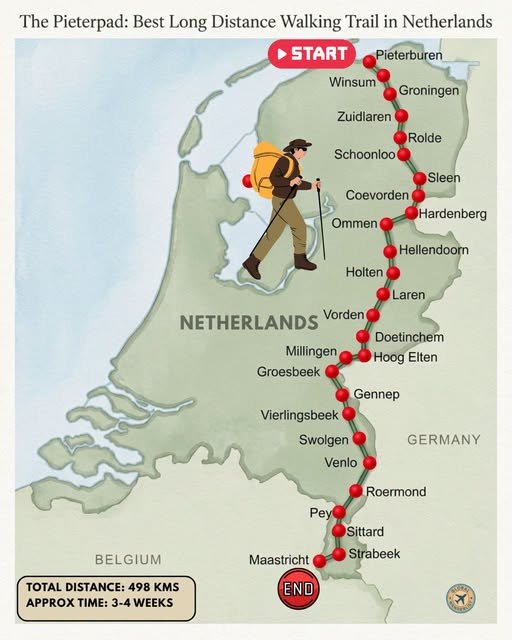
The Pieterpad stretches roughly 498 kilometers from the northern village of Pieterburen to Sint-Pietersberg near Maastricht, crossing the entire length of the Netherlands on foot. Windswept clay farmland gives way to forested heathland, quiet river valleys, and finally the rolling hills of Limburg. Few trails let you walk from one end of a country to the other while staying almost entirely on quiet paths.
This trek suits hikers of any experience level who want a long-distance walk without technical difficulty. The terrain stays flat to gently rolling throughout, with the trail’s highest point reaching just 135 meters near the very end. Most hikers complete the full route in three to four weeks, staying in hotels, guesthouses, and B&Bs in towns and villages along the way.
The trail remains walkable year-round, though spring and summer offer the most reliable weather and longest daylight hours. Below is a complete breakdown of every major stop, following the trail south from Pieterburen to Maastricht.
Trek Overview
| Trek Stop | Elevation | Distance from Previous Stop | Estimated Hiking Time | Overnight Stay |
|---|---|---|---|---|
| Pieterburen (Start) | 1 m | – | – | Hotel or guesthouse |
| Winsum | 1 m | 12 km | 3 hours | Guesthouse or B&B |
| Groningen | 1 m | 19 km | 4-5 hours | Hotel or B&B |
| Zuidlaren, Rolde, and Schoonloo | 10 m | 57 km | 14-15 hours | Hotel or guesthouse |
| Sleen and Coevorden | 15 m | 36 km | 9 hours | Hotel or guesthouse |
| Hardenberg | 15 m | 24 km | 6 hours | Hotel or B&B |
| Ommen | 10 m | 20 km | 5 hours | Hotel or B&B |
| Hellendoorn and Holten | 60 m | 32 km | 8 hours | Guesthouse or B&B |
| Laren | 20 m | 18 km | 4-5 hours | Guesthouse |
| Vorden and Doetinchem | 25 m | 30 km | 7-8 hours | Hotel or B&B |
| Hoog Elten and Millingen | 60 m | 25 km | 6 hours | Guesthouse |
| Groesbeek | 90 m | 15 km | 4 hours | Hotel or B&B |
| Gennep, Vierlingsbeek, and Swolgen | 20 m | 45 km | 11 hours | Guesthouse |
| Venlo | 20 m | 18 km | 4-5 hours | Hotel or B&B |
| Pey and Roermond | 25 m | 30 km | 7-8 hours | Hotel or guesthouse |
| Sittard and Strabeek | 60 m | 35 km | 8-9 hours | Guesthouse or B&B |
| Maastricht (End) | 109 m | 20 km | 5 hours | Hotel or guesthouse |
Pieterburen
Pieterburen marks the official start of the Pieterpad, a small village in the Hogeland region known for its seal rehabilitation center along the Wadden Sea coast. The trail begins at a dedicated Pieterpad wall, a popular spot for a starting photo before setting off. This remote, windswept corner of Groningen sets a genuinely peaceful tone for the weeks ahead.
Many hikers arrive a day early to settle in and stretch their legs on an optional loop toward the Wadden Sea dike. This extra walk offers early views of the bird-rich mudflats that define the region. Public transport connections require a short transfer from the nearest train station, so plan arrival time accordingly.
Where to Stay in Pieterburen
Hotel Waddenweelde sits right at the trail’s starting point, a well-established option specifically geared toward Pieterpad hikers beginning or finishing their journey. Camping Marenland nearby offers a hotel, camping pitches, and trekker huts, giving a wider range of budgets a place to stay. Both properties cater specifically to the steady stream of hikers passing through this small but trail-famous village.
What to See in Pieterburen
- The seal rehabilitation center cares for injured and orphaned seals rescued along the Wadden Sea coast.
- The Wadden Sea dike offers sweeping views over the tidal mudflats, rich with migratory birds.
- The Pieterpad wall marks the official trailhead, a popular spot for a first-day photo.
- The surrounding polder landscape introduces hikers to the flat, windswept farmland typical of Groningen.
Winsum
Winsum greets hikers after a gentle first stage through the mound village of Eenrum, home to a late Romanesque church dating to the 13th century. This village was voted the most beautiful in the Netherlands in 2020, and its well-kept streets make the honor easy to understand. Wide green pastures and a beautiful 1855 windmill in nearby Mensingeweer add to the scenic approach.
This short opening stage eases hikers into the rhythm of daily walking without overwhelming distance. The flat, open terrain here offers little shade, so sun protection matters even on cooler days. Winsum’s compact center makes it easy to find a meal and rest before the longer stage ahead.
Where to Stay in Winsum
Winsum offers a range of guesthouses and B&Bs well accustomed to hosting Pieterpad hikers passing through. Properties here tend to be small, family-run establishments offering a genuine welcome after the trail’s first stage. Booking ahead through the official Pieterpad accommodation network helps secure a bed during busier summer months.
What to See in Winsum
- The village’s well-preserved streets earned Winsum recognition as the most beautiful village in the Netherlands in 2020.
- The historic windmill in nearby Mensingeweer, built in 1855, offers a scenic photo stop along the route.
- Eenrum’s 13th-century Romanesque church reflects the region’s deep medieval religious history.
- The open Groningen countryside surrounding the village showcases the wide, flat pastures typical of this stage.
Groningen
Groningen ranks as the largest city on the entire Pieterpad, a lively university town with a genuinely youthful energy. The final stretch into the city passes through Northern Park and along a picturesque harbor before reaching the historic center. Roughly a quarter of the population consists of students, giving the city’s streets and cafes a distinctly vibrant atmosphere.
This stage covers a longer distance through agricultural polder land dotted with ancient dwelling mounds called wierden. The city itself offers a welcome change of pace, with real shopping and restaurant variety after several quieter villages. Groningen makes a natural rest day option given its size and amenities.
Where to Stay in Groningen
B&B Stadspark stands out among Pieterpad hikers for its uncomplicated setting and genuine hospitality, with hosts fluent in Dutch, German, English, French, and the local Gruns dialect. The property offers private rooms with their own refrigerator, parking, and a shared guest kitchen. Its popularity with trail walkers reflects a level of comfort and welcome tailored specifically to long-distance hikers.
What to See in Groningen
- The Grote Markt square anchors the city center, ideal for a well-earned drink after a long walking day.
- The Groninger Museum showcases contemporary art and design inside a striking, colorful building.
- The old city center’s canals and historic streets reward a relaxed evening wander.
- Northern Park, passed on the approach into the city, offers a green transition from countryside to urban center.
Zuidlaren, Rolde, and Schoonloo
This stretch carries hikers into Drenthe, a region defined by sandy forests, ancient burial mounds, and the UNESCO Global Geopark Hondsrug. Zuidlaren, Rolde, and Schoonloo each mark a stage endpoint along this scenic run through Drentsche Aa National Park. Prehistoric dolmens, massive stone burial chambers built thousands of years ago, appear along the trail through this region.
The Brink Hotel in Zuidlaren sits directly on the trail, with the Pieterpad passing right by its entrance. This section covers noticeably more forest and heathland than the open polder terrain further north. Traditional Saxon farmhouses along the way add architectural interest to an already scenic stretch.
Where to Stay in Zuidlaren, Rolde, and Schoonloo
The Brink Hotel in Zuidlaren caters specifically to Pieterpad walkers, offering a special hiker package that includes an overnight stay, breakfast buffet, packed lunch, and a two-course dinner at a neighboring restaurant. Additional guesthouses and hotels in Rolde and Schoonloo provide similar trail-friendly accommodations along this stretch. Staying directly on the route here simplifies logistics considerably.
What to See in Zuidlaren, Rolde, and Schoonloo
- Drentsche Aa National Park protects a landscape of streams, heathland, and forest largely untouched by modern development.
- Ancient dolmens along the trail reveal massive stone burial chambers built by prehistoric communities.
- The UNESCO Global Geopark Hondsrug explains the region’s unique glacial ridge formation.
- Traditional Saxon farmhouses throughout this stretch showcase a distinctive regional architectural style.
Sleen and Coevorden
Sleen offers a notable stop for hikers seeking a rest day, home to one of the region’s centers for those needing a break before continuing. Coevorden, once an important fortified stronghold, retains a well-preserved star-shaped fortress layout with a central castle still anchoring the town today. This historic defensive town marks a clear shift in the trail’s character toward more built-up terrain.
This stage covers substantial distance through Drenthe’s remaining forest and farmland before reaching Coevorden’s fortifications. The town’s canals and compact center offer a satisfying, historically rich overnight stop. Coevorden sits close to the German border, adding a slightly different regional flavor to the walk.
Where to Stay in Sleen and Coevorden
Sleen and Coevorden both offer established hotels and guesthouses well used to accommodating long-distance walkers. Coevorden’s town center provides the wider range of options, given its larger size and historic tourism appeal. Booking ahead remains wise during the busiest hiking months of summer.
What to See in Sleen and Coevorden
- Coevorden’s star-shaped fortress layout reflects centuries of strategic military engineering.
- The central castle in Coevorden anchors the town’s historic core with genuine defensive architecture.
- Coevorden’s canals add a scenic, water-lined character to the compact town center.
- The surrounding countryside marks a transition zone between Drenthe’s forests and Overijssel’s river landscapes ahead.
Hardenberg
Hardenberg sits along the Vecht River, a market town that serves as a practical waypoint between Drenthe and the hillier terrain further south. This stage introduces hikers to riverside walking after several days inland. The town itself offers straightforward resupply options without heavy tourist development.
This stretch covers a moderate distance through varied countryside, easing hikers toward the more dramatic landscape ahead in Overijssel. Hardenberg’s position along the Vecht makes for a pleasant, water-adjacent overnight stop. The town’s practical character suits hikers wanting an uncomplicated rest before continuing.
Where to Stay in Hardenberg
Hardenberg offers a range of hotels and guesthouses suited to trail walkers passing through this market town. Properties here provide straightforward, comfortable accommodation without the premium pricing of larger tourist centers. Booking a day or two ahead helps secure a room during peak hiking season.
What to See in Hardenberg
- The Vecht River adds a scenic waterside element to this stretch of the trail.
- Hardenberg’s town center offers practical shopping and dining for resupplying mid-trek.
- The surrounding countryside eases hikers from Drenthe’s flat terrain into Overijssel’s gentle hills.
- Local markets in town provide a good opportunity to stock up on trail snacks and supplies.
Ommen
Ommen continues along the Vecht River, a small town known for its surrounding forests and outdoor recreation culture. This stage offers a quieter, more scenic alternative to the larger towns on the route. The Vecht’s meandering course through this region has made it a popular canoeing destination for Dutch outdoor enthusiasts.
This stage covers a shorter distance, allowing for a somewhat easier day after Hardenberg. Forest paths and riverside trails dominate this stretch of the walk. Ommen’s relaxed atmosphere makes it a pleasant, low-key overnight stop.
Where to Stay in Ommen
Ommen offers a solid range of hotels and B&Bs, reflecting its established reputation as an outdoor recreation destination. Properties here cater to both hikers and the area’s canoeing and cycling visitors. This variety makes finding a comfortable bed straightforward even during busier periods.
What to See in Ommen
- The Vecht River’s meandering course through Ommen makes it a popular canoeing and kayaking destination.
- Surrounding forests offer additional walking and cycling trails beyond the main Pieterpad route.
- The town’s relaxed center provides a good rest stop with cafes and shops.
- This stretch of the Vecht valley showcases some of the greenest, most pastoral scenery on the northern half of the trail.
Hellendoorn and Holten
Hellendoorn and Holten introduce the trail’s first proper hills, part of the Sallandse Heuvelrug, a ridge of wooded hills rising above the surrounding lowlands. This range offers some of the most scenic elevation change on the entire Pieterpad, still gentle by any standard but a welcome contrast to earlier flat stretches. Holten sits at the edge of Sallandse Heuvelrug National Park, known for its heathland and wildlife.
This stage covers real distance through forest and heath terrain, with modest but noticeable climbing. Wildlife sightings increase through this stretch, including grazing sheep that help maintain the heathland ecosystem. The hills here offer some of the best panoramic views found anywhere along the trail.
Where to Stay in Hellendoorn and Holten
Hellendoorn and Holten both offer well-established guesthouses and B&Bs suited to hikers crossing this hillier stretch. Properties in Holten specifically cater to visitors exploring the adjacent national park. Booking ahead helps during summer, when the area draws both hikers and day-trippers to the park.
What to See in Hellendoorn and Holten
- Sallandse Heuvelrug National Park protects heathland and forest across the trail’s most significant hills.
- Grazing sheep throughout the heathland help maintain this increasingly rare Dutch landscape type.
- Panoramic viewpoints along the ridge offer some of the best sightlines on the entire route.
- The wooded hills provide welcome shade during warmer stretches of the summer hiking season.
Laren
Laren, a small village in Overijssel not to be confused with the more famous artist colony near Amsterdam, offers a quiet, unhurried stop along the trail’s midsection. This stage moves through gentle countryside, easing from the hills of Sallandse Heuvelrug toward the Achterhoek region ahead. The village itself provides simple, practical amenities for a resting hiker.
This shorter stage allows for a somewhat easier day after the hillier stretch before it. Farmland and small wooded patches define the surrounding scenery. Laren’s modest size means services are limited, so plan resupply accordingly.
Where to Stay in Laren
Laren offers a small number of guesthouses suited to hikers passing through this quieter stretch. Given the village’s limited size, confirming availability in advance is worthwhile. Nearby larger towns provide backup options if Laren’s accommodations are full.
What to See in Laren
- The surrounding farmland offers a peaceful, unhurried stretch after the hillier terrain further north.
- Small wooded patches throughout this stage provide intermittent shade along the walk.
- The transition in scenery here marks the shift from Overijssel toward the Achterhoek region ahead.
- Local farms along the route offer a genuine glimpse of rural Dutch agricultural life.
Vorden and Doetinchem
Vorden and Doetinchem carry hikers through the Achterhoek, a region known for its many castles and estates scattered across gentle countryside. This area feels distinctly rural, with half-timbered farmhouses and moated manor houses appearing regularly along the trail. Doetinchem, the larger of the two towns, offers a proper resupply stop with wider services.
This stage covers substantial distance through varied farmland and small settlements. The Achterhoek’s castle-dotted landscape adds genuine visual interest to an otherwise pastoral stretch. Doetinchem’s size makes it a practical choice for restocking supplies before continuing south.
Where to Stay in Vorden and Doetinchem
Vorden and Doetinchem both offer a range of hotels and guesthouses suited to long-distance hikers. Doetinchem, being the larger town, provides more variety and availability during peak season. Both towns see steady Pieterpad traffic, so accommodations here are generally well set up for trail walkers.
What to See in Vorden and Doetinchem
- Castles and moated manor houses scattered throughout the Achterhoek reflect the region’s historic landed estates.
- Vorden’s rural surroundings showcase traditional Dutch farmhouse architecture.
- Doetinchem’s town center offers practical shopping and dining for a proper resupply stop.
- The gentle, castle-dotted countryside here ranks among the most visually varied stretches of the trail.
Hoog Elten and Millingen
Hoog Elten sits right at the German border, briefly taking the trail across into Germany before returning to Dutch soil near Millingen. This unusual international crossing adds a memorable, if brief, change of scenery. The hilltop abbey at Hoog Elten offers sweeping views back over the surrounding Rhine floodplain.
This stage covers a mix of hillier terrain near the border followed by flatter approach into Millingen along the great rivers region. The convergence of the Rhine, Waal, and Meuse rivers nearby marks one of the most significant geographic points in the Netherlands. This stretch offers a genuinely different landscape than anything encountered further north.
Where to Stay in Hoog Elten and Millingen
Hoog Elten and Millingen offer modest guesthouse accommodations suited to this border-crossing stretch of the trail. Given the area’s smaller size, booking ahead ensures availability. Nearby Nijmegen offers additional options if needed as a backup.
What to See in Hoog Elten and Millingen
- The hilltop abbey at Hoog Elten offers sweeping views over the Rhine floodplain below.
- Briefly crossing into Germany adds a memorable international detour to this stage of the trail.
- The convergence of the Rhine, Waal, and Meuse rivers nearby marks a significant Dutch geographic landmark.
- The changing terrain here previews the hillier landscape waiting near Nijmegen and Groesbeek.
Groesbeek
Groesbeek sits in one of the hilliest parts of the Netherlands, close to Nijmegen and steeped in World War II history from the Battle of Arnhem and Operation Market Garden. War memorials and a national liberation museum in the area commemorate this significant chapter of the region’s past. The surrounding hills offer some of the most dramatic elevation on the entire trail.
This shorter stage allows time to properly absorb both the scenery and the area’s wartime history. Forest paths wind through hillier terrain than most of the trail’s northern half. Groesbeek’s position near Nijmegen also makes it a convenient resupply stop.
Where to Stay in Groesbeek
Groesbeek offers a solid range of hotels and guesthouses, benefiting from its proximity to Nijmegen and its role as a regional tourism destination tied to wartime history. Properties here comfortably accommodate the steady stream of hikers and history visitors alike. Booking ahead is wise given the area’s popularity for both hiking and historical tourism.
What to See in Groesbeek
- The National Liberation Museum commemorates the region’s pivotal role in Operation Market Garden.
- War memorials scattered throughout the area honor Allied forces who fought in the 1944 battle.
- Groesbeek’s hills offer some of the most significant elevation change found along the entire Pieterpad.
- Nearby Nijmegen, one of the oldest cities in the Netherlands, makes a worthwhile short detour.
Gennep, Vierlingsbeek, and Swolgen
This stretch moves hikers into Limburg’s northern reaches, passing through Gennep, Vierlingsbeek, and the ecclesiastical village of Swolgen. Vierlingsbeek offers a stop at Potterie de Tramhalte, a local ceramic workshop worth a visit. Ruins of the 15th-century Makken Castle appear shortly after leaving Vierlingsbeek, adding historic texture to the walk.
This long stretch can be split into two shorter days with an overnight in Meerlo if the full distance feels excessive. The Boschhuizer Bergen shifting sand area and the Schuitwater nature reserve, with its wooden boardwalks through wetland forest, both feature along this stage. The scenery here shifts noticeably toward Limburg’s sandier, more varied terrain.
Where to Stay in Gennep, Vierlingsbeek, and Swolgen
Gennep and Vierlingsbeek both offer established guesthouses and hotels suited to hikers covering this longer stretch. Meerlo, roughly midway, provides a convenient split-stage option for those wanting to break the distance into two shorter days. Booking ahead helps, particularly for the smaller villages with limited room availability.
What to See in Gennep, Vierlingsbeek, and Swolgen
- Potterie de Tramhalte in Vierlingsbeek showcases local ceramic craftsmanship worth a stop.
- The ruins of 15th-century Makken Castle add historic atmosphere just outside Vierlingsbeek.
- The Boschhuizer Bergen shifting sand area offers an unusual, dune-like landscape inland from the coast.
- Schuitwater nature reserve’s wooden boardwalks lead through wetland forest along an old Maas river meander.
Venlo
Venlo anchors a proper city stop along the southern stretch of the trail, its monumental Sint-Martinus street and 16th-century town hall marking genuine architectural highlights. The approach into town crosses the Maas River by ferry, passing through the scenic floodplains of the Oeye-Weerd nature area. This stage offers welcome city amenities after several quieter village stretches.
This stage covers a moderate distance, easing into Venlo after passing 15th-century castle farms and historic chapels along the way. The Maas ferry crossing adds a memorable, low-key adventure to the day’s walk. Venlo’s size makes it a practical stop for restocking gear and supplies.
Where to Stay in Venlo
Venlo offers the widest range of accommodations on this stretch of the trail, from budget guesthouses to comfortable mid-range hotels. Its size and established tourism infrastructure make finding a room straightforward even during peak season. This makes Venlo a sensible choice for a proper rest day if needed.
What to See in Venlo
- The monumental Sint-Martinus street showcases some of Venlo’s finest historic architecture.
- The 16th-century town hall anchors the city center with genuine civic grandeur.
- Crossing the Maas River by ferry adds a memorable, low-key highlight to this stage.
- The Oeye-Weerd floodplain offers a scenic natural approach into the city.
Pey and Roermond
Pey and Roermond continue the trail south along the Maas and Roer rivers, with Roermond marking the point where the Roer flows into the larger Maas. This substantial town offers a proper city stop with wider dining and shopping options than the smaller villages preceding it. The rivers here define much of the surrounding landscape and local culture.
This stage covers real distance through riverside terrain and quiet farmland. Roermond’s historic center provides a satisfying overnight stop after a demanding day. The convergence of two rivers adds scenic and geographic interest to this stretch.
Where to Stay in Pey and Roermond
Roermond offers the fuller range of accommodations along this stretch, given its larger size and established tourism infrastructure. Some hikers stay in Roermond even when starting the next day’s stage from nearby Montfort, given more reliable room availability. Booking ahead remains wise during summer months.
What to See in Pey and Roermond
- The confluence of the Roer and Maas rivers in Roermond marks a significant geographic point along the trail.
- Roermond’s historic center offers a proper city stop with wider dining and shopping options.
- The surrounding riverside terrain provides scenic, gently varied walking through this stage.
- Local markets in Roermond offer a good opportunity to restock supplies before the final push south.
Sittard and Strabeek
Sittard and Strabeek carry hikers into the rolling hills of southern Limburg, a region that feels distinctly different from the flat north. Historic towns with half-timbered houses appear throughout this stretch, alongside quiet forest paths and creek valleys. This area marks the trail’s final significant landscape shift before reaching Maastricht.
This stage covers substantial distance through increasingly hilly terrain, the most dramatic elevation change since Groesbeek. Sittard’s historic center offers a worthwhile overnight stop with genuine architectural charm. The approach toward Strabeek introduces the marl hills that define the trail’s final stretch.
Where to Stay in Sittard and Strabeek
Sittard offers well-established guesthouses and hotels suited to hikers on this penultimate stretch of the trail. Strabeek, being smaller, offers more limited options, so many hikers base themselves in nearby Valkenburg instead. Booking ahead is worthwhile given this stage’s proximity to the trail’s popular final approach.
What to See in Sittard and Strabeek
- Sittard’s historic center showcases half-timbered houses typical of southern Limburg’s architecture.
- The rolling hills throughout this stretch mark a distinct shift from the flat terrain further north.
- Creek valleys and forest paths offer some of the most scenic walking on the trail’s southern half.
- Nearby Valkenburg, a popular hiking and holiday destination, makes a worthwhile short detour.
Maastricht
Maastricht marks the finish line, one of the oldest cities in the Netherlands and the site where the 1992 Treaty on European Union was signed. The Pieterpad officially ends atop Sint-Pietersberg, a hill overlooking the city with sweeping views across Limburg’s marl hills and old quarries. This final ascent delivers a genuinely fitting conclusion after weeks of flat northern terrain.
The approach into Maastricht follows the final stretch through marl quarries and heathland along the Geul River valley. Many hikers pause atop Sint-Pietersberg for a celebratory photo before descending into the city. Maastricht’s historic charm and riverside cafes provide a well-earned place to reflect on the journey.
Where to Stay in Maastricht
Maastricht offers the widest range of accommodations found anywhere on the trail, from budget hostels to comfortable historic hotels throughout the city center. Its established tourism infrastructure makes finding a celebratory final night’s stay straightforward. Booking ahead is still wise during summer, given the city’s broader popularity beyond just Pieterpad hikers.
What to See in Maastricht
- Sint-Pietersberg marks the trail’s official end, with sweeping views across Limburg’s marl hills and old quarries.
- The former marl quarries throughout the area reveal centuries of local stone extraction history.
- Maastricht’s historic center reflects the city’s Roman, medieval, and modern European significance.
- Riverside cafes along the Maas offer a fitting spot to celebrate finishing the full trail.
Final Thoughts
The Pieterpad delivers three to four weeks of genuinely varied Dutch countryside, from windswept northern polders to the rolling hills of Limburg. Pace yourself on the longer stages, and take advantage of the trail’s frequent villages and reliable public transport for flexibility. The trail remains walkable year-round, though spring and summer offer the most comfortable conditions.
Book accommodations ahead during peak season, particularly in smaller villages with limited rooms. Respect the trail and its rural communities by staying on marked paths and packing out any trash. Complete this trek with care, and the Pieterpad will reward you with a genuinely thorough introduction to the Dutch landscape.