
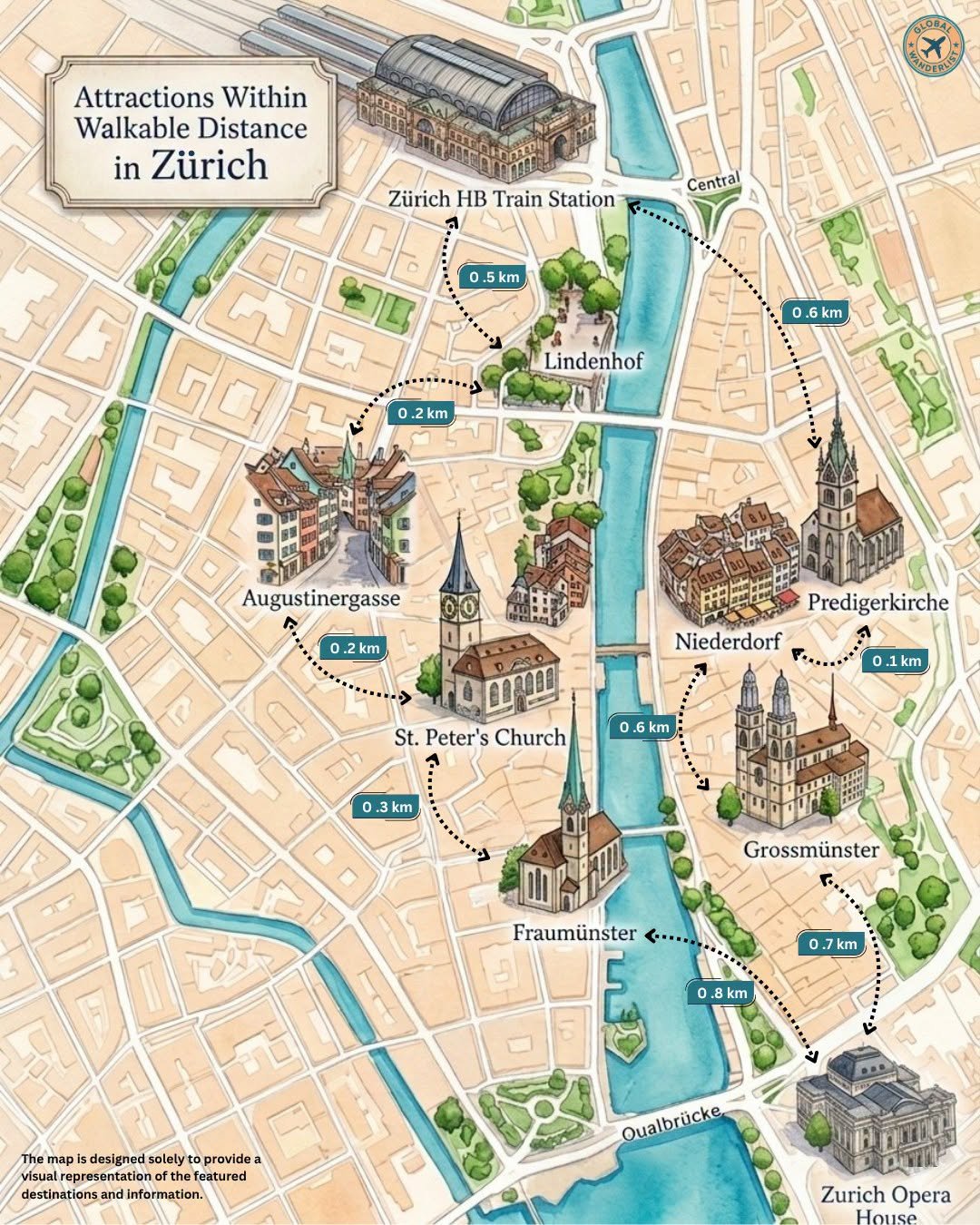
Zürich’s old town squeezes an impressive number of landmarks into a tight, walkable core on both banks of the Limmat River. Church spires, cobbled lanes, and a historic hilltop park all sit within a few minutes of each other. You could easily string together a full day on foot, starting at Lindenhof and finishing by the lake at the Opera House. Below is a rundown of each stop, with opening hours and entry fees pulled from official church and venue websites. Whether you have half a day or a full one, this route covers Zürich’s best-known sights without needing a single tram ride.
Lindenhof
Lindenhof sits on a small rise above the Limmat, and it holds more history than its quiet, tree-lined appearance suggests. Romans built a customs post here centuries ago, and later a Carolingian palace stood on the same ground. A stone from that era, engraved with the word Turicum, still marks the site as one of the earliest written references to Zürich. In medieval times, women of the city famously dressed as soldiers here to bluff off an approaching army, a story locals still tell with pride.
Today, the hill functions as a public square, popular with chess players and anyone looking for a quiet break from the busier streets below. Linden trees shade most of the space, and benches line the edges for resting. The real draw, though, is the view. From the top, you can see across the river to the Grossmünster’s twin towers, along with the rooftops of the old town and, on clear days, the Alps in the distance. It costs nothing to visit and stays open around the clock, making it an easy stop whenever your schedule allows.
- Opening hours: Open 24 hours, every day
- Entry fee: Free
Augustinergasse
This narrow cobbled street ranks among the prettiest in Zürich’s old town, and photographs of it show up constantly in city guides and Switzerland guides for good reason. Colorful oriel windows, called Erker in German, jut out from the facades of the historic buildings lining both sides. Many of these bay windows date back centuries and once served practical purposes, letting residents watch the street below without leaning out.
The street connects several other old town landmarks, sitting just a short walk from both Lindenhof and St. Peter’s Church, which makes it easy to fold into a longer walking route rather than visiting as a standalone stop. Small boutiques and cafes now occupy many of the ground floors, giving the street a lived-in, unpolished feel compared to some of Zürich’s more commercial shopping areas. Early morning or early evening tends to offer the best light for photos, since the narrow street catches shadows quickly once the sun moves overhead. There’s no ticket needed and no set hours to plan around, since it functions as a normal public street rather than a managed attraction.
- Opening hours: Open 24 hours, every day
- Entry fee: Free
St. Peter’s Church
St. Peter’s holds the title of Zürich’s oldest parish church, with a history stretching back to before the year 900. Its most famous feature isn’t hidden inside but sits right on the tower: a clock face measuring 8.7 meters across, the largest of its kind in Europe. Until 1911, the tower doubled as a fire lookout point, with watchmen scanning the city for smoke. Inside, the church shows a mix of architectural styles built up over centuries, from an unadorned Gothic nave to a more ornate Baroque choir added later.
Five stained glass windows by Augusto Giacometti, installed in 1930, bring color into an otherwise austere stone interior. A carved walnut pulpit from 1705 adds another layer of craftsmanship worth pausing to look at. The church sits right beside Lindenhof hill, making it an easy addition to that part of your walk. It remains an active place of worship, so visitors are asked to stay quiet and respectful, particularly if a service happens to be underway during your visit.
- Opening hours: Monday to Saturday, 10am to 6pm; Sunday, 11:30am to 6pm
- Entry fee: Free
Fraumünster
Fraumünster’s slim green spire ranks among the most recognizable shapes on Zürich’s skyline, visible from across the river and from several points around the old town. The church began as a Benedictine abbey in 853, founded by King Louis the German for his daughter. For centuries, the abbess here held real political power, controlling coinage, tolls, and the city market. What draws most visitors today isn’t that history, though, but five stained glass windows designed by Marc Chagall in the 1970s, installed when the artist was already in his eighties.
Morning light works best for viewing them, since it brings out the deep blues and reds Chagall was known for. A separate rose window by Augusto Giacometti, added decades earlier, sits in the north transept and offers its own striking burst of color. Downstairs, a small crypt museum preserves fragments of the original 9th-century convent building. The church sits directly across the river from the Grossmünster, so pairing both visits in one afternoon makes logical sense given how close they sit to each other.
- Opening hours: March to October, Monday to Saturday, 10am to 6pm; open Sundays after service; shorter hours November to February
- Entry fee: CHF 5 for adults; free for children and students
Niederdorf
Niederdorf spreads across the east bank of the Limmat, a tangle of narrow lanes packed with restaurants, bars, and small shops. During the day, it has a relaxed, browsable feel, with plenty of spots to stop for coffee between sightseeing. Once evening arrives, the neighborhood shifts gears entirely, becoming one of the liveliest nightlife areas in the city. Medieval buildings line most of the streets here, many now converted into bars and eateries rather than the residences they originally were.
Niederdorfstrasse itself runs as the main pedestrian spine through the district, connecting to both the Grossmünster and Predigerkirche without much walking required. Because it functions as a genuine neighborhood rather than a single ticketed site, there’s no fixed schedule to plan around and no cost involved in simply walking through it. Locals use it just as much as tourists do, which keeps the atmosphere feeling authentic rather than staged purely for visitors. It works well as a base for an evening out after a day spent covering the more historic stops nearby.
- Opening hours: Open 24 hours, every day (individual shops and restaurants keep their own hours)
- Entry fee: Free to walk through
Predigerkirche
Predigerkirche’s tower rises 97 meters above the old town, making it the tallest church spire in Zürich and a genuinely striking sight against the skyline. Dominican monks founded the original monastery here in 1231, and construction on the church itself wrapped up by 1269. A fire destroyed much of the surrounding monastery complex in 1887, and the city later built its central library on that same footprint.
The tower seen today, rebuilt afterward by architect Gustav Gull, replaced an earlier medieval structure lost in that same fire. Inside, the church keeps a simple, largely unadorned look, a legacy of Reformation-era changes that stripped out most of the original Catholic ornamentation. Despite that plain interior, the building holds an unusually strong musical archive, including a significant collection of Wagner’s work, along with two organs used for regular concerts. The church operates as an open, welcoming space today, with counselors available on weekdays for anyone who simply wants to talk. It sits close to Niederdorf, making it easy to combine both stops in a single walk.
- Opening hours: Tuesday to Saturday, 10am to 6pm; Monday, 12pm to 6pm; Sunday, 12pm to 5pm
- Entry fee: Free
Grossmünster
Grossmünster’s twin towers define Zürich’s skyline more than any other single structure in the city. Legend credits Charlemagne with founding the original church, supposedly after his horse stumbled over the graves of the city’s patron saints. The building you see today dates mostly from the Romanesque period, though its role in Swiss history matters just as much as its architecture. In the early 1500s, reformer Huldrych Zwingli preached from this pulpit, launching the Zurich Reformation from right inside these walls. Modern stained glass by Augusto Giacometti fills the choir with color, a striking contrast to the church’s otherwise austere Romanesque stonework.
Down in the crypt, a Romanesque statue of Charlemagne survives from the medieval period, one of the building’s oldest surviving artifacts. Climbing the Karlsturm tower rewards visitors with sweeping rooftop views across the old town and, on a clear day, out toward the Alps. The 187 steps up are steep and narrow, so sturdy shoes make the climb considerably easier.
- Opening hours: Monday to Saturday, 10am to 6pm (March to October) or 10am to 5pm (November to February); Sunday, 12:30pm to 5:30pm
- Entry fee: Free to enter the church; CHF 5 to climb the tower
Zurich Opera House
The Zurich Opera House sits right on the lakeshore, its neo-Baroque facade standing out against the more austere old town architecture nearby. Built in 1891, the building has hosted premieres of major 20th-century works, including pieces by Hindemith and Schoenberg. Inside, the auditorium seats just over 1,200 people, giving performances here a more intimate feel than some of Europe’s larger opera houses.
From September through June, the schedule fills with opera, ballet, and orchestral concerts, drawing both serious opera fans and casual visitors alike. Even without attending a performance, the building and the surrounding Opera Square are worth a stop, especially at golden hour when the facade catches the evening light. For those wanting a closer look, backstage tours run through the costume and make-up departments, offering a rare glimpse behind the scenes. Performance tickets vary considerably based on seating and show, while the foyer itself typically opens about an hour before each performance for ticket holders arriving early.
- Opening hours: Exterior and square viewable anytime; foyer opens roughly one hour before performances
- Entry fee: Free to view the exterior; performance tickets start around CHF 15; backstage tours cost CHF 15 to 25
Final Thoughts
Zürich’s old town rewards a slow, riverside walk more than a rushed checklist. Nearly every stop on this list sits within a few hundred meters of the next, so you can move between churches, historic streets, and the lakefront without ever needing transport. Start at Lindenhof for the view, work your way through the old town’s churches, and finish the day in Niederdorf or by the Opera House as evening sets in. Check individual church websites before visiting, since opening hours can shift around services and special events.