
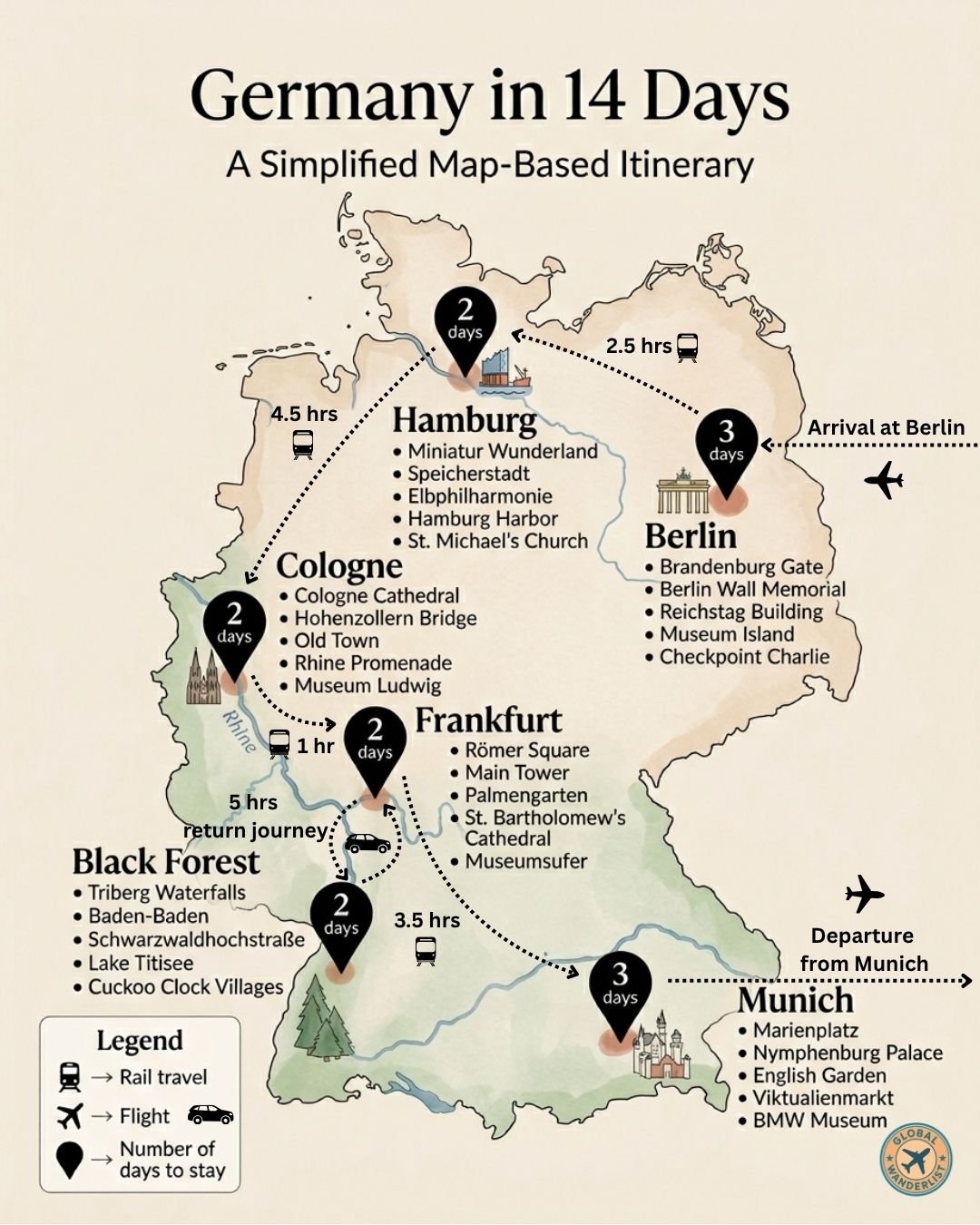
Germany rewards travelers who give it real time, moving from the capital’s layered history through northern port culture, Gothic cathedrals, Black Forest villages, and Bavarian castles. This route covers Berlin, Hamburg, Cologne, Frankfurt, the Black Forest, and Munich, connected by an efficient rail network. Few countries offer this much regional contrast within one well-organized trip.
This itinerary suits first-time visitors wanting a thorough, well-paced introduction to Germany’s major regions. It balances dense city days with slower countryside stops, and works comfortably by train for most of the route. History enthusiasts, architecture lovers, and anyone craving variety will find plenty to hold their interest here.
Below is a full stop-by-stop breakdown, along with where to stay and what to prioritize along the way.
Germany Itinerary Summary Table
| Stop | Recommended Stay | Main Highlights | Driving Time to Next Stop | Best For |
|---|---|---|---|---|
| Berlin | 3 nights | Brandenburg Gate, Berlin Wall Memorial, Museum Island | 2.5 hours by high-speed train | History and culture lovers |
| Hamburg | 2 nights | Speicherstadt, Elbphilharmonie, Hamburg Harbor | 4.5 hours by train | Waterfront and architecture fans |
| Cologne | 2 nights | Cologne Cathedral, Old Town, Rhine Promenade | 1 hour by train | Cathedral and river lovers |
| Frankfurt | 2 nights | Römer Square, Main Tower, Palmengarten | 5 hours round trip by car | City sightseeing, transit hub |
| Black Forest | 2 nights | Triberg Waterfalls, Baden-Baden, cuckoo clock villages | 3.5 hours by train | Nature lovers, scenic drives |
| Munich | 3 nights | Marienplatz, Nymphenburg Palace, BMW Museum | N/A, departure city | Bavarian culture, museums |
Berlin
Berlin opens this itinerary as Germany’s capital and its most historically layered city. Cold War history sits beside contemporary art, world-class museums, and some of Europe’s most significant 20th-century landmarks. Three days here allows time to properly absorb a city defined by reunification and reinvention.
Most international flights arrive at Berlin Brandenburg Airport, connected to the city center by direct train in about 30 minutes.
Things to Do in Berlin
- Brandenburg Gate: This iconic neoclassical monument has witnessed some of Germany’s most pivotal historical moments, from division to reunification. It anchors most first-time visits to the city.
- Berlin Wall Memorial: This preserved section of the wall, along with a documentation center, offers a sobering look at the city’s Cold War division. Allow at least an hour to walk the site and exhibits.
- Reichstag Building: Germany’s parliament building features a striking glass dome offering panoramic city views. Free reservations are required in advance for dome access.
- Museum Island: This UNESCO World Heritage site holds five major museums, including the Pergamon and Neues Museum. Budget at least half a day if visiting more than one museum here.
- Checkpoint Charlie: This former Cold War border crossing offers a compact, accessible piece of Berlin’s divided history. It pairs well with a broader walk through the surrounding Mitte district.
- East Side Gallery: Not far from the city center, this open-air gallery covers a long stretch of the former wall with murals from international artists.
Where to Stay in Berlin
- Hotel Adlon Kempinski – Luxury
- Motel One Berlin Hackescher Markt – Mid-range
- Habyt The Waterfront – Budget
Hamburg
A high-speed train connects Berlin to Hamburg in about two and a half hours, delivering travelers to Germany’s major northern port city. Hamburg blends maritime history with striking modern architecture, most visibly in its waterfront concert hall. The city’s canals and warehouse district give it a character distinct from anywhere else on this route.
Two nights allows time to properly explore both the historic harbor and the newer HafenCity development.
Things to Do in Hamburg
- Miniatur Wunderland: This is the world’s largest model railway exhibition, with astonishingly detailed miniature landscapes from around the globe. Plan at least two hours, since the scale rewards a slow walk-through.
- Speicherstadt: This UNESCO-listed historic warehouse district features red-brick buildings lining narrow canals. Walking or taking a short boat tour both offer good ways to see it.
- Elbphilharmonie: This striking concert hall rises dramatically above the harbor, its wave-like glass facade now a defining symbol of the city. The public viewing platform offers sweeping harbor views even without a concert ticket.
- Hamburg Harbor: One of Europe’s largest ports, a harbor boat tour offers a different perspective on the city’s maritime scale and history. Evening tours catch good light over the water.
- St. Michael’s Church: Known locally as Michel, this baroque church offers tower views over the city for those willing to climb. It remains one of Hamburg’s most recognizable landmarks.
Where to Stay in Hamburg
- Sofitel Hamburg Alter Wall – Luxury
- Steigenberger Hotel Hamburg – Mid-range
- The Nikolai Hotel Hamburg – Budget
Cologne
The journey from Hamburg to Cologne takes about four and a half hours by train, arriving at one of Germany’s oldest and most recognizable cities. Cologne Cathedral’s twin spires dominate the skyline, visible from nearly every angle in the city center. The Rhine River adds a scenic backdrop to a city with roots stretching back to Roman times.
Two nights allows time for the cathedral, old town, and a relaxed walk along the riverfront.
Things to Do in Cologne
- Cologne Cathedral: This Gothic masterpiece took over 600 years to complete and remains one of Germany’s most visited landmarks. Climbing the south tower rewards visitors with sweeping city views.
- Hohenzollern Bridge: This railway bridge has become famous for thousands of padlocks left by couples, framed by cathedral views behind it. It’s a popular, easy photo stop near the main station.
- Old Town: Cologne’s Altstadt offers narrow streets, traditional Kölsch beer taverns, and a lively riverside atmosphere. It’s best explored slowly, without a strict itinerary.
- Rhine Promenade: A relaxed walk along the river offers good views back toward the cathedral and old town skyline. Sunset is especially rewarding here.
- Museum Ludwig: This modern and contemporary art museum sits right beside the cathedral, holding significant works by Picasso and Warhol. Two hours covers the main collection comfortably.
Where to Stay in Cologne
- Excelsior Hotel Ernst – Luxury
- Hyatt Regency Cologne – Mid-range
- Hotel Sandmanns am Dom – Budget
Frankfurt
A short one-hour train ride connects Cologne to Frankfurt, Germany’s financial capital and a fitting contrast after several days of older architecture. Glass skyscrapers rise beside a carefully reconstructed medieval square, reflecting the city’s dual identity as both historic and thoroughly modern. Frankfurt also functions as a practical hub for reaching the Black Forest region that follows.
Two nights here balances city sightseeing with a comfortable base before the scenic countryside stretch ahead.
Things to Do in Frankfurt
- Römer Square: This picturesque square holds Frankfurt’s iconic gabled town hall, rebuilt after World War II to preserve its medieval appearance. Evening light makes it especially photogenic.
- Main Tower: This skyscraper observation deck offers panoramic views over Frankfurt’s distinctive skyline, one of the few in Germany dominated by high-rises. Sunset visits are particularly rewarding.
- Palmengarten: This expansive botanical garden offers a peaceful, green escape from the city’s financial district. It’s a pleasant midday break between sightseeing stops.
- St. Bartholomew’s Cathedral: This Gothic church served as the coronation site for Holy Roman Emperors and sits just steps from Römer Square. A quick visit pairs naturally with the square outside.
- Museumsufer: This riverside museum district holds numerous galleries and collections along the Main River. Picking two or three museums makes for a manageable afternoon.
Where to Stay in Frankfurt
- Sofitel Frankfurt Opera – Luxury
- 25hours Hotel The Trip – Mid-range
- Motel One Frankfurt – Budget
Black Forest
Reaching the Black Forest from Frankfurt typically involves renting a car, given the region’s scattered villages and scenic driving routes. This dense, fairy-tale forest region offers a dramatic pace change after four straight days of city sightseeing. Waterfalls, spa towns, and centuries-old clock-making traditions define this stretch of the route.
Two nights allows time for both Triberg’s waterfalls and a scenic drive through the surrounding villages.
Things to Do in the Black Forest
- Triberg Waterfalls: These cascading falls, among the highest in Germany, are reached via a well-marked forest trail. Allow about an hour for a relaxed round trip.
- Baden-Baden: This elegant spa town has attracted visitors for centuries, known for its thermal baths and belle-époque architecture. A soak at one of its historic bathhouses makes a relaxing stop.
- Schwarzwaldhochstraße: This scenic high-altitude road winds through the heart of the Black Forest, offering sweeping viewpoints along the way. It’s one of Germany’s classic scenic drives.
- Lake Titisee: This glacial lake offers boat rentals and lakeside walking paths framed by dense forest. It’s a popular stop for a relaxed afternoon break.
- Cuckoo clock villages: Towns throughout the region showcase traditional clock-making workshops, including displays of the world’s largest cuckoo clocks. It’s a distinctly regional souvenir stop.
Where to Stay in the Black Forest
- Best Western Plus Schwarzwald Residenz – Mid-range
- Hotel Café Adler – Mid-range
- Gästehaus Zur Lilie – Budget
Munich
The final stretch covers roughly three and a half hours by train from the Black Forest region into Munich, Germany’s Bavarian capital. Marienplatz anchors the city center, where the Glockenspiel’s animated figures perform daily to gathered crowds. Beer halls, palace gardens, and world-class museums give Munich a fitting, well-rounded close to this route.
Three nights allows time for the city’s major sights along with a more relaxed final day before departure.
Things to Do in Munich
- Marienplatz: This central square hosts Munich’s famous animated Glockenspiel show, performed several times daily. Arrive a few minutes early for a good view among the crowd.
- Nymphenburg Palace: This grand baroque palace was the summer residence of Bavarian royalty, surrounded by expansive formal gardens. A slow walk through the grounds makes a peaceful afternoon.
- English Garden: One of the world’s largest urban parks, this green space offers walking paths and a Japanese teahouse. It’s a relaxed way to spend a sunny afternoon.
- Viktualienmarkt: This lively food market sells Bavarian specialties and beer garden seating at its center. It’s a natural stop for lunch between sightseeing.
- BMW Museum: This museum covers the automaker’s history alongside its neighboring showroom, BMW Welt. Car enthusiasts should budget at least two hours between both sites.
Where to Stay in Munich
- Bayerischer Hof – Luxury
- Platzl Hotel – Mid-range
- Motel One München – Budget
Practical Travel Advice
Germany’s high-speed rail network, Deutsche Bahn, connects Berlin, Hamburg, Cologne, and Frankfurt efficiently, making a rental car unnecessary for most of this route. A car becomes genuinely useful only for the Black Forest stretch, where villages and scenic roads sit spread across a wider rural area. Booking major train routes and popular attractions like the Reichstag dome in advance saves both time and money.
Comfortable walking shoes matter throughout this itinerary, given the amount of cobblestone streets and museum walking involved. Spring and early fall offer the most comfortable weather for outdoor sightseeing, while winter adds festive Christmas markets to cities like Cologne and Frankfurt. Munich serves as the final departure point, so building in a relaxed last day helps close out the trip without feeling rushed.
Final Thoughts
This fourteen-day route balances Germany’s major cities with its most scenic countryside stops, from Berlin’s layered history to Black Forest waterfalls and Bavarian castles. Follow it as outlined, or adjust the pacing to linger longer in any one region that catches your interest. Either way, this itinerary delivers a thorough, memorable introduction to the country’s history, culture, and landscapes.