
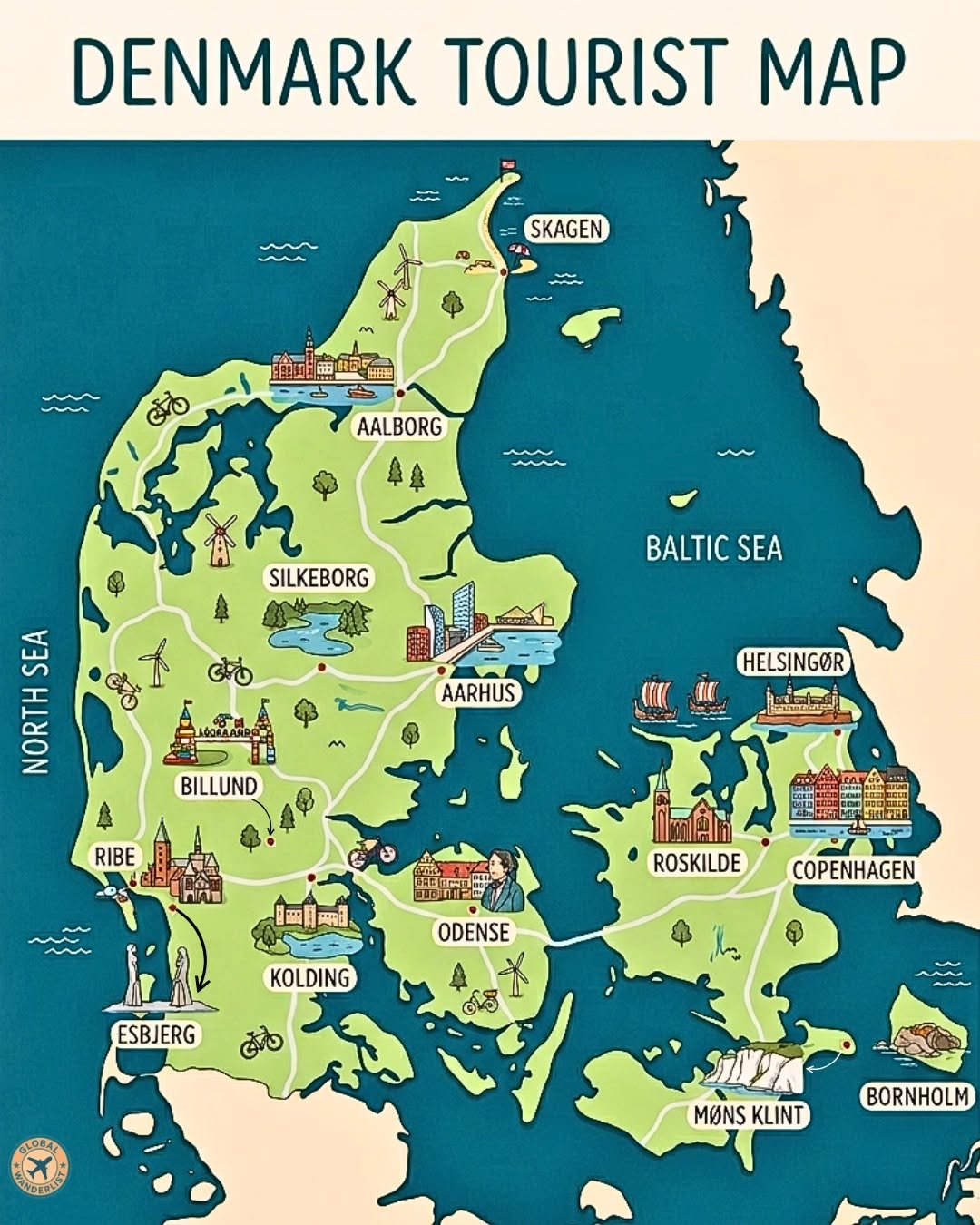
Denmark packs an impressive range of experiences into a compact, easy-to-navigate country. Medieval market towns, dramatic chalk cliffs, and Viking history all sit within a few hours of each other. Few countries in Europe make exploring this effortless, thanks to excellent trains, ferries, and cycling infrastructure.
This is a destination for travelers who appreciate design, history, and understated natural beauty. Families will find world-class attractions built specifically with kids in mind. History lovers can trace Viking heritage and royal history across multiple well-preserved towns.
Denmark also rewards slow travel. Trains connect most major cities, while ferries link the islands scattered along the coast. Whether you are chasing design museums, coastal cliffs, or quiet fishing villages, this guide covers the destinations worth building a trip around.
Destination Overview
| Place | Category | Best Known For | Recommended Visit Duration |
|---|---|---|---|
| Copenhagen | Capital City | Royal palaces, design, Tivoli Gardens | 3-4 days |
| Aarhus | City | Modern architecture, museums | 1-2 days |
| Odense | City | Hans Christian Andersen heritage | 1 day |
| Aalborg | City | Viking history, waterfront | 1 day |
| Skagen | Coastal Town | Where two seas meet, artist colony | 1-2 days |
| Silkeborg | Town | Lake district, forests | 1 day |
| Billund | Town | LEGOLAND, family attractions | 1-2 days |
| Ribe | Town | Denmark’s oldest town, medieval streets | 1 day |
| Kolding | Town | Koldinghus Castle, design museum | 1 day |
| Esbjerg | Coastal City | Man Meets the Sea sculpture, ferry hub | Half day |
| Roskilde | Town | Viking Ship Museum, cathedral | 1 day |
| Helsingør | Coastal Town | Kronborg Castle, Hamlet setting | 1 day |
| Møns Klint | Natural Landmark | Dramatic white chalk cliffs | Half day |
| Bornholm | Island | Beaches, round churches, smokehouses | 2-3 days |
Copenhagen
Copenhagen anchors any trip to Denmark, a compact capital known for its design-forward architecture and relaxed, bike-friendly streets. Centuries of royal history sit alongside a genuinely modern, forward-thinking city. Copenhagen consistently ranks among the world’s most livable cities, and visitors quickly understand why.
Most travelers spend three to four days here, enough time for the major landmarks and a few neighborhoods. Cycling remains the best way to get around, with dedicated bike lanes covering nearly the entire city. Early evening visits to Tivoli Gardens offer a magical, lit-up atmosphere.
What to See in Copenhagen
- Tivoli Gardens, one of the world’s oldest amusement parks, dazzles with rides and gardens especially at night.
- Nyhavn’s colorful 17th-century harbor houses rank among the most photographed scenes in Scandinavia.
- Amalienborg Palace hosts the Danish royal family, with a daily changing of the guard ceremony.
- Rosenborg Castle displays the Danish crown jewels inside a 17th-century Renaissance building.
- Christiania offers a car-free, self-governing community known for street art and alternative culture.
- The Little Mermaid statue, though modest in size, remains Denmark’s most iconic symbol.
Aarhus
Aarhus stands as Denmark’s second city, known for striking modern architecture and a genuinely lively cultural scene. The ARoS Art Museum, topped by a rainbow-colored rooftop walkway, has become one of the country’s most photographed buildings. This city balances a historic core with forward-thinking design throughout.
One to two days cover the major museums and the atmospheric old town. The Latin Quarter’s narrow streets hold boutique shops and cafes worth a slow wander. Aarhus works well as a base for exploring nearby Silkeborg’s lake district.
What to See in Aarhus
- ARoS Art Museum’s rooftop rainbow walkway offers panoramic city views alongside its extensive art collection.
- Den Gamle By, an open-air museum, recreates Danish town life across several historical periods.
- The Latin Quarter’s cobblestone streets hold Aarhus’s oldest buildings, now filled with shops and cafes.
- Aarhus Cathedral, Denmark’s longest church, showcases centuries of Gothic architectural additions.
- Moesgaard Museum combines archaeology exhibits with a dramatic, grass-roofed building design.
- The harbor district offers waterfront dining and views of the city’s modern Dokk1 library.
Odense
Odense holds deep cultural significance as the birthplace of Hans Christian Andersen, Denmark’s most famous storyteller. The city has embraced this heritage thoroughly, with museums and walking routes tracing his life and work. Beyond Andersen, Odense offers a charming, walkable city center worth exploring at a relaxed pace.
A single day covers the main Andersen sites and the historic center comfortably. The H.C. Andersen Museum reopened with an expanded, immersive design in recent years. Odense sits conveniently between Copenhagen and Jutland, making it an easy stop on a cross-country route.
What to See in Odense
- The H.C. Andersen Museum offers an immersive, modern look into the author’s life and famous fairy tales.
- Odense’s historic center preserves colorful, half-timbered houses along narrow cobblestone streets.
- Odense Cathedral houses the tomb of King Canute IV, Denmark’s patron saint.
- Munke Mose park offers a peaceful riverside stroll near the city center.
- The Funen Village open-air museum recreates 19th-century rural life on the island of Funen.
Aalborg
Aalborg anchors northern Jutland, a waterfront city with roots stretching back to the Viking Age. The Limfjord waterway runs through the city center, lined with a lively mix of historic buildings and modern development. This city offers a genuine, less touristed alternative to Denmark’s more famous stops.
A single day covers the historic center and waterfront comfortably. Aalborg’s nightlife district along Jomfru Ane Gade ranks among the liveliest in the country. The city also serves as a practical gateway for exploring northern Jutland, including Skagen further up the coast.
What to See in Aalborg
- The waterfront promenade along the Limfjord offers scenic walks past both historic and modern architecture.
- Aalborg Castle, a 16th-century royal residence, sits quietly in the city center with free entry.
- The Utzon Center, designed by the architect behind the Sydney Opera House, showcases contemporary exhibitions.
- Jomfru Ane Gade, the city’s famous nightlife street, comes alive with bars and restaurants after dark.
- Lindholm Høje, a Viking burial site just outside the city, preserves hundreds of stone ship settings.
Skagen
Skagen sits at Denmark’s northernmost tip, famous as the point where the North Sea and Baltic Sea visibly collide. Artists flocked here in the late 19th century, drawn by the region’s unusual quality of light, founding what became known as the Skagen Painters movement. This small fishing town retains a genuinely artistic, coastal character.
One to two days allow time for both the town and the dramatic meeting point of the seas, called Grenen. Yellow-painted houses with red roof tiles give Skagen a distinct visual identity found nowhere else in Denmark. Summer brings the biggest crowds, though the area’s light remains striking in any season.
What to See in Skagen
- Grenen marks the exact point where two seas meet, visible as a dramatic line of clashing waves.
- The Skagen Museum showcases works by the artist colony that made the town famous in the 1800s.
- Den Tilsandede Kirke, a sand-buried church, reveals only its tower above the dunes.
- Skagen’s yellow harbor houses create one of the most photogenic townscapes in Denmark.
- Local fish restaurants near the harbor serve some of the freshest catches in the country.
Silkeborg
Silkeborg sits at the heart of Denmark’s lake district, a region of forests, rolling hills, and interconnected waterways. This is one of the country’s most scenic natural areas, popular for hiking, cycling, and boat trips. The town itself offers a relaxed, nature-focused base for exploring the surrounding countryside.
A single day allows time for a boat trip and a walk through the surrounding forest trails. The Museum Silkeborg houses the remarkably preserved Tollund Man, a 2,000-year-old bog body. This region works well as a scenic detour between Aarhus and Billund.
What to See in Silkeborg
- Himmelbjerget, one of Denmark’s highest points, offers sweeping views over the surrounding lakes.
- A historic paddle steamer still operates scenic cruises across Silkeborg’s interconnected lake system.
- The Museum Silkeborg displays the Tollund Man, an extraordinarily preserved Iron Age bog body.
- Cycling paths wind through forests and along lakeshores, ideal for a relaxed half-day ride.
- The town center’s riverside cafes offer a pleasant stop after outdoor activities.
Billund
Billund holds an outsized reputation for its small size, home to LEGOLAND and the birthplace of the LEGO brick itself. This purpose-built family destination draws visitors from across Europe, particularly during summer school holidays. The town centers almost entirely around its famous toy company and its attractions.
One to two days allow time for LEGOLAND and the nearby LEGO House experience center. Families with young children will find this one of the most rewarding stops in the country. Billund also has its own international airport, making it a convenient gateway for a Jutland-focused trip.
What to See in Billund
- LEGOLAND Billund offers rides, shows, and elaborate brick sculptures across a sprawling theme park.
- LEGO House, shaped like giant interlocking bricks, houses interactive exhibits celebrating creative play.
- Legoland’s Miniland recreates famous landmarks entirely from LEGO bricks in impressive detail.
- The surrounding town offers family-friendly hotels and restaurants geared toward theme park visitors.
Ribe
Ribe holds the title of Denmark’s oldest town, founded over 1,300 years ago as a Viking trading settlement. Cobblestone streets and half-timbered houses give the town a remarkably preserved medieval atmosphere. This is one of the best-kept historic towns in the country, rewarding a slow, unhurried walk.
A single day covers the town’s compact historic center comfortably. The famous night watchman still leads evening tours through the streets, a tradition dating back centuries. Ribe Cathedral’s tower offers sweeping views over the surrounding marshland.
What to See in Ribe
- Ribe Cathedral, dating to the 12th century, offers tower climbs with panoramic marsh views.
- The town’s night watchman tour follows a genuine centuries-old tradition through lantern-lit streets.
- Ribe VikingeCenter recreates Viking Age life with reconstructed buildings and costumed demonstrations.
- Half-timbered houses throughout the historic center reflect Denmark’s best-preserved medieval streetscape.
- The Wadden Sea National Park, just outside town, offers unique tidal flat scenery and birdwatching.
Kolding
Kolding centers around Koldinghus, a former royal castle turned museum overlooking the town’s lake and harbor. The Trapholt design museum adds a modern cultural layer, reflecting Denmark’s strong design heritage. This town offers a manageable, low-key stop for history and design enthusiasts alike.
A single day covers both the castle and design museum comfortably. Koldinghus burned in the 18th century and was later restored with a striking mix of ruin and reconstruction. Kolding sits conveniently along the route between Odense and Ribe.
What to See in Kolding
- Koldinghus combines preserved ruins with restored sections, creating a uniquely atmospheric castle museum.
- The Trapholt Museum showcases Danish design and craft, including an impressive chair collection.
- Kolding’s historic marketplace holds some of the town’s oldest surviving buildings.
- Geografisk Have, a geographic garden, displays plants organized by their region of origin worldwide.
Esbjerg
Esbjerg developed as a major port city, Denmark’s primary gateway for North Sea ferry connections and offshore energy industries. The city’s most recognizable feature, four giant white figures called Man Meets the Sea, gazes out over the water from a hilltop. This practical, working city offers a brief but worthwhile coastal stop.
A half day covers the main sculpture and harbor area comfortably. Esbjerg serves primarily as a transit point for ferries toward England or trips to Fanø Island. The city’s maritime character reflects its role as one of Denmark’s most important ports.
What to See in Esbjerg
- Man Meets the Sea, four towering white figures, offers a striking photo opportunity overlooking the water.
- The harbor area reflects the city’s ongoing role in North Sea shipping and energy industries.
- A short ferry ride connects Esbjerg to Fanø Island, known for wide beaches and thatched cottages.
- Fisheries and Maritime Museum explores the region’s deep connection to the sea and fishing industry.
Roskilde
Roskilde carries deep historical weight as one of Denmark’s former capitals, home to a cathedral holding the tombs of Danish royalty for centuries. The Viking Ship Museum showcases genuine excavated Viking vessels, offering a rare, tangible connection to the era. This town also hosts one of Europe’s largest music festivals each summer.
A single day covers the cathedral and Viking Ship Museum comfortably. Roskilde sits just a short train ride from Copenhagen, making it an easy day trip. The fjord views near the museum add scenic value beyond the historical exhibits.
What to See in Roskilde
- Roskilde Cathedral, a UNESCO World Heritage Site, holds the tombs of nearly 40 Danish monarchs.
- The Viking Ship Museum displays five genuine excavated Viking vessels recovered from the nearby fjord.
- Visitors can watch traditional boat building using authentic Viking Age techniques at the museum’s boatyard.
- The Roskilde Fjord waterfront offers a scenic walk near the museum grounds.
Helsingør
Helsingør sits along the narrowest point of the Øresund strait, dominated by Kronborg Castle, the real-world setting for Shakespeare’s Hamlet. This UNESCO-listed fortress controlled shipping traffic between Denmark and Sweden for centuries. The town’s historic center adds further charm beyond the famous castle.
A single day covers Kronborg Castle and the old town comfortably. Ferries to Helsingborg, Sweden depart regularly, making this a popular day trip extension. Helsingør sits about 45 minutes from Copenhagen by train, an easy addition to a Copenhagen-based itinerary.
What to See in Helsingør
- Kronborg Castle, immortalized by Shakespeare’s Hamlet, offers dramatic ramparts and royal chambers to explore.
- The Maritime Museum of Denmark, built into the castle’s old dry dock, showcases striking modern architecture.
- Helsingør’s historic center preserves cobblestone streets lined with well-kept medieval buildings.
- Ferries to Sweden depart frequently, offering an easy international day trip across the strait.
Møns Klint
Møns Klint delivers one of Denmark’s most dramatic natural landscapes, towering white chalk cliffs rising sharply from the Baltic Sea. Beech forests crown the clifftops, creating a striking contrast between green canopy and bright white rock. This protected natural area ranks among the country’s most photographed landscapes.
A half day covers the main viewpoints and a walk down toward the beach below. The steep staircase down to the shoreline rewards hikers with an up-close view of the cliffs. GeoCenter Møns Klint offers additional context on the region’s unique geology.
What to See in Møns Klint
- The chalk cliffs rise dramatically along the coastline, among the most photographed natural landmarks in Denmark.
- A staircase descends to the beach below, offering close-up views of the cliff formations.
- GeoCenter Møns Klint explains the geological history behind the area’s distinctive white chalk.
- Surrounding beech forests offer scenic hiking trails along the clifftops.
Bornholm
Bornholm floats in the Baltic Sea well east of the Danish mainland, closer geographically to Sweden and Poland than to Copenhagen. Sandy beaches, round medieval churches, and traditional smokehouses give the island a distinct character within Denmark. This island rewards travelers willing to take the extra ferry or short flight to reach it.
Two to three days allow time to properly explore the island’s varied coastline and small towns. Bornholm’s round churches, built partly for defensive purposes, remain unique in Danish architecture. The island’s food scene, particularly its smoked herring, has earned a strong reputation among Danish food lovers.
What to See in Bornholm
- The island’s round medieval churches showcase a distinctive defensive architectural style found nowhere else in Denmark.
- Traditional smokehouses along the harbor towns serve freshly smoked herring, a genuine local specialty.
- Sandy beaches along the island’s southern coast rank among the best in the country.
- Hammershus, a ruined medieval fortress, offers dramatic clifftop views over the Baltic Sea.
- Cycling paths connect the island’s small towns, making bike touring a popular way to explore.
Final Thoughts
Denmark rewards travelers who venture beyond Copenhagen’s well-known landmarks. From Skagen’s meeting seas to Bornholm’s round churches, quiet coastal towns and dramatic natural landscapes wait for those willing to explore further. Give yourself time to wander beyond the capital.
The best trips here mix major cities with smaller, lesser-known stops. Trains and ferries make combining destinations easy to plan. Denmark consistently rewards curiosity, and its quieter corners often become the most memorable part of the trip.