
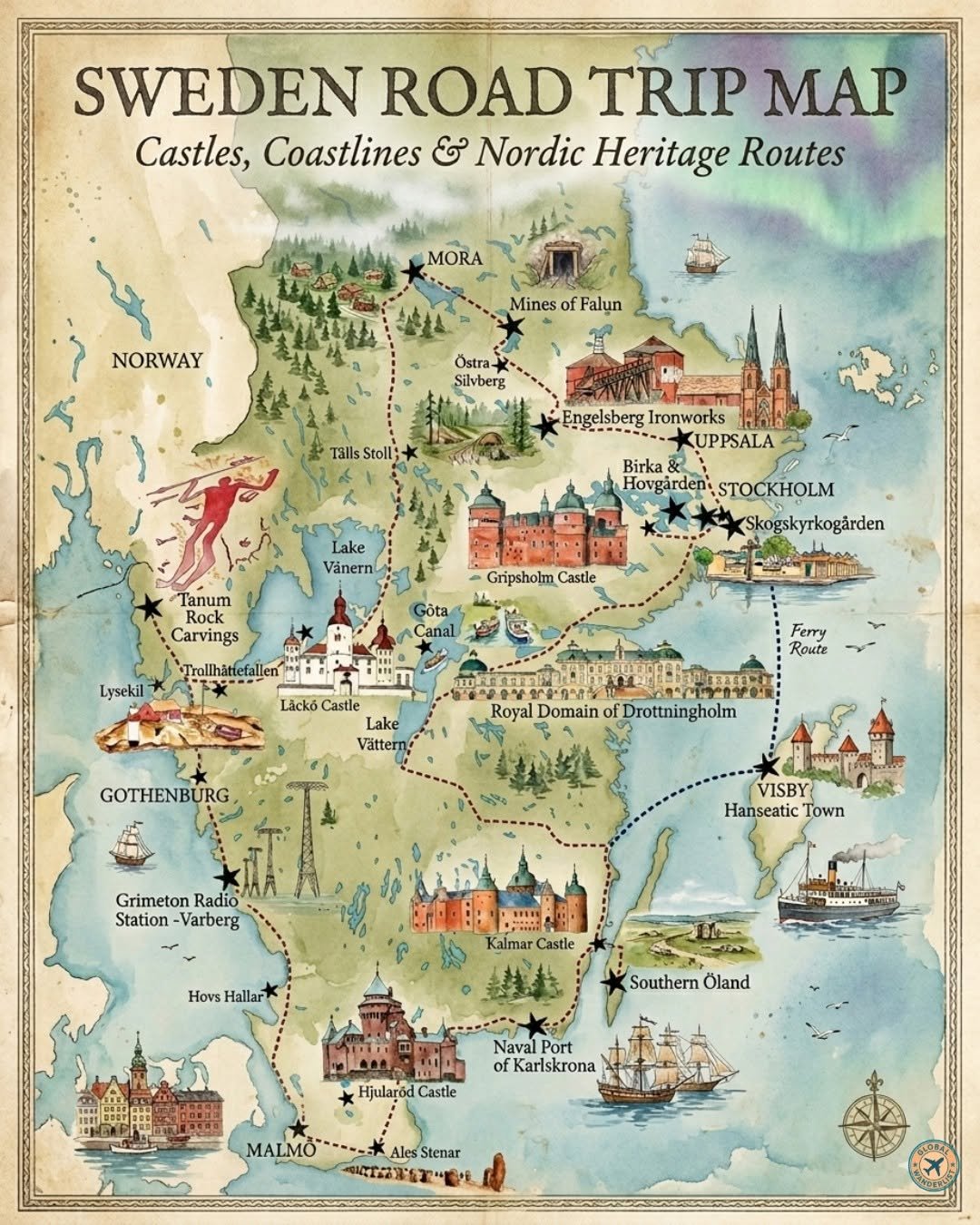
Sweden rewards drivers. Wide lakes, red wooden villages, Viking sites, and salty west coast harbors sit within a few hours of each other. The roads are smooth, well signed, and rarely crowded outside July.
This loop covers UNESCO World Heritage sites, royal palaces, and Baltic islands. It suits history lovers, photographers, and slow travelers who like castles more than nightlife. Plan 14 to 21 days, ideally between late May and September.
| Stop | Distance from Previous Stop | Driving Time | Main Highlights | Recommended Stay Duration |
|---|---|---|---|---|
| Stockholm | Start | Start | Old Town, museums, waterfront | 2 days |
| Skogskyrkogården | 8 km | 15 min | Woodland Cemetery, UNESCO design | 2 hours |
| Birka and Hovgården | Boat from Stockholm | 2 hr by boat | Viking trading town | Half day |
| Uppsala | 70 km | 1 hr | Cathedral, university, castle | 1 day |
| Engelsberg Ironworks | 120 km | 1 hr 40 min | Industrial heritage | 3 hours |
| Östra Silvberg | 90 km | 1 hr 20 min | Mining landscape, forests | 2 hours |
| Falun | 55 km | 50 min | Copper mine, red cottages | 1 day |
| Mora | 105 km | 1 hr 30 min | Zorn’s home, Lake Siljan | 1 day |
| Läckö Castle | 470 km | 5 hr 30 min | Baroque castle on Lake Vänern | 1 day |
| Trollhättan Falls | 100 km | 1 hr 15 min | Waterfalls, canal locks | 3 hours |
| Tanum | 150 km | 1 hr 45 min | Bronze Age rock carvings | 3 hours |
| Lysekil | 100 km | 1 hr 15 min | Granite coast, seafood | 1 day |
| Gothenburg | 120 km | 1 hr 30 min | Harbor, cafés, archipelago | 2 days |
| Varberg (Grimeton) | 80 km | 1 hr | Radio station, fortress | Half day |
| Hovs Hallar | 110 km | 1 hr 20 min | Coastal cliffs, hiking | 2 hours |
| Malmö | 120 km | 1 hr 30 min | Old town, parks, food | 1.5 days |
| Ales Stenar | 75 km | 1 hr | Stone ship monument | 2 hours |
| Hjularöd Castle | 70 km | 1 hr | Neo-Gothic castle | 2 hours |
| Karlskrona | 200 km | 2 hr 20 min | Naval port, archipelago | 1 day |
| Southern Öland | 180 km | 2 hr 30 min | Windmills, alvar plain | 1 day |
| Kalmar | 120 km | 1 hr 30 min | Renaissance castle | 1 day |
| Göta Canal (Lake Vättern) | 300 km | 3 hr 30 min | Canal locks, Vadstena | 1 day |
| Gripsholm Castle | 200 km | 2 hr 15 min | Lakeside castle, Mariefred | 3 hours |
| Drottningholm | 60 km | 50 min | Royal residence, gardens | 3 hours |
| Visby | 60 km plus ferry | 50 min plus 3 hr 15 min ferry | Medieval walls, Hanseatic history | 2 days |
Stockholm
Stockholm spreads across 14 islands, so water views follow you everywhere. The city blends medieval lanes, royal history, and modern Scandinavian design. Leave the car at your hotel, since parking is costly and transit is excellent.
Where to Eat in Stockholm
- Meatballs for the People: Swedish, $$
- Rosendals Trädgårdskafé: Café and bakery, $$
- Pelikan: Traditional Swedish, $$
What to See in Stockholm
- Gamla Stan: Cobbled lanes and pastel buildings make this a perfect first walk. Go early to avoid crowds.
- Vasa Museum: A nearly intact 17th-century warship is displayed in a dedicated hall. Allow two hours.
- Djurgården: This green island holds museums, trails, and waterside paths. Rent a bike to cover it.
- Fotografiska: A photography museum with a strong rooftop view over the harbor.
- Fjäderholmarna: Short boat rides reach this small archipelago island. It is good for a summer lunch.
Skogskyrkogården
The Woodland Cemetery is a UNESCO site and a masterpiece of Nordic landscape design. Pine trees, gentle hills, and simple chapels create a calm, reflective mood. It is a quiet start to the road trip.
Where to Eat in Skogskyrkogården
- Skogskyrkogården visitor center café: Café, $
- Nytorget Urban Deli: Deli and bistro, $$
- Pelikan: Traditional Swedish, $$
What to See in Skogskyrkogården
- Woodland Chapel: Asplund’s small chapel shows the site’s gentle spirit. Its simple porch is a favorite photo spot.
- Hill of Remembrance: A grassy mound crowned by trees offers a quiet view. Walk up slowly.
- Chapel of Resurrection: Look for its columned entrance, a fine example of Nordic classicism.
- Visitor center: Exhibits explain the design story. Guided walks run in summer.
Birka and Hovgården
Birka was a Viking trading town over 1,000 years ago. Along with Hovgården, it forms a UNESCO site on Lake Mälaren. Boats leave from central Stockholm in season, so book ahead.
Where to Eat in Birka and Hovgården
- Birka Värdshus: Swedish, $$
- Blå Porten: Café, $$
- Stadshuset area cafés: Fika, $
What to See in Birka and Hovgården
- Viking Museum: Finds from graves explain trade across Europe. It is compact and well organized.
- Reconstructed Viking houses: Walk through timber homes for a sense of daily life.
- Hillfort ridge: A short climb rewards you with views over the island. Wear good shoes.
- Grave fields: Rolling mounds stretch across the meadows. Read the signs for context.
Uppsala
Uppsala is Sweden’s ancient university city, with a lively student atmosphere. The cathedral towers over the Fyris River. It works well as a relaxed day stop.
Where to Eat in Uppsala
- Ofvandahls Hovkonditori: Café and bakery, $$
- Storgatan 1: Modern Swedish, $$$
- Hambergs Fisk: Seafood, $$
What to See in Uppsala
- Uppsala Cathedral: Scandinavia’s tallest church holds royal tombs. Enter for the soaring Gothic interior.
- Gustavianum: The old university museum has a famous anatomical theater. Its exhibits are compact and fascinating.
- Uppsala Castle: A hilltop fortress with broad views over town.
- Old Uppsala: Giant royal burial mounds sit just north of town. The nearby museum explains Norse myth.
- Botanical Garden: A calm break, especially when the greenhouse is in bloom.
Engelsberg Ironworks
Engelsberg is one of Europe’s best preserved iron-making complexes. Its UNESCO status reflects centuries of industry in the forest. Roads here are quiet, so drive with care for wildlife.
Where to Eat in Engelsberg Ironworks
- Engelsberg Bruk café: Swedish café, $$
- Ängelsberg village eateries: Swedish, $$
- Fagersta lunch spots: Casual Swedish, $
What to See in Engelsberg Ironworks
- Blast furnace: Guided tours reveal how pig iron was made. Check seasonal times.
- Ironworks manor: A handsome yellow mansion sits beside the pond. It photographs well.
- Industrial museum halls: Tools and models show the human side of production.
- Forest paths: Short trails circle the works. They make a pleasant leg stretch.
Östra Silvberg
This small area sits inside Dalarna’s Bergslagen mining landscape. Forests, lakes, and old mine sites tell the region’s industrial story. Expect quiet roads and few services, so fuel up earlier.
Where to Eat in Östra Silvberg
- Local village café: Fika, $
- Borlänge lunch spots: Swedish, $$
- Roadside gårdsbutik: Local produce, $
What to See in Östra Silvberg
- Old mining sites: Spoil heaps and headframes reveal the area’s past.
- Lakeside pullouts: Calm water and reflected pines make simple stops.
- Forest hikes: Marked trails suit an easy hour.
- Local craft shops: Small stores sell wool and wood goods.
Falun
Falun grew rich on copper. Its mine gave Sweden much of its wealth and the classic Falu red paint. The mine is a UNESCO site, and the town feels friendly and easy to navigate.
Where to Eat in Falun
- Falu Gruva café: Fika, $
- Bergslagsgatan area bistros: Swedish, $$
- Town center bakeries: Café, $
What to See in Falun
- Falun Mine tour: Descend underground to see the vast Stora Stöten pit. Bring a warm layer.
- Mining museum: Exhibits explain copper’s role in Swedish power.
- Falu red cottages: The paint that colors Sweden’s villages started here.
- Carl Larsson-gården: The artist’s home in nearby Sundborn is charming. Book ahead in summer.
- Ski stadium area: A scenic spot with strong views, even outside winter.
Mora
Mora sits at the northern edge of Lake Siljan. It is famous for Anders Zorn and for the Vasaloppet ski race finish. The lake makes a lovely place to slow down.
Where to Eat in Mora
- Zornmuseet café: Café, $$
- Vasaloppsmuseet café: Swedish café, $
- Lakeside restaurants: Swedish, $$
What to See in Mora
- Zorn Museum: Paintings capture Dalarna life in luminous color.
- Zorngården: His preserved home shows the artist’s taste. Book a guided tour.
- Vasaloppet finish line: A fun photo stop, even in summer.
- Lake Siljan shoreline: Pull off for easy lakeside walks and open views.
Läckö Castle
Läckö rises from Lake Vänern like a white and gold fairy tale. The Baroque castle dates to the 17th century. Driving here means a long day, so start early from Dalarna.
Where to Eat in Läckö Castle
- Läckö Slott Restaurant: Swedish, $$
- Kajplats 9 (Lidköping): Seafood, $$$
- Lidköping café spots: Fika, $
What to See in Läckö Castle
- State rooms: Ornate interiors show Sweden’s power era.
- Castle courtyard: The inner space is lovely in soft afternoon light.
- Lake Vänern shoreline: Walk out for a view back at the castle.
- Kinnekulle: A nearby hill gives sweeping lake panoramas.
Trollhättan Falls
Trollhättan’s falls powered early Swedish industry. Water still thunders down at scheduled release times. Nearby locks on the Göta Canal make the visit richer.
Where to Eat in Trollhättan Falls
- Canal-side cafés: Fika, $
- Trollhättan town restaurants: Swedish, $$
- Vänersborg lunch spots: Casual, $
What to See in Trollhättan Falls
- Falls viewing paths: Check the spill schedule for the strongest flow.
- Canal locks: Watch boats climb the stepped chambers.
- Innovatum science center: A good family stop with hands-on displays.
- Gorge trails: Short walks give varied angles of the falls.
Tanum
Tanum has one of Europe’s richest concentrations of Bronze Age rock art. Carvings of ships, animals, and people cover the smooth granite. Visit in soft light for the best contrast.
Where to Eat in Tanum
- Vitlycke Museum café: Café, $
- Grebbestad seafood spots: Seafood, $$
- Tanumshede lunch restaurants: Swedish, $$
What to See in Tanum
- Vitlycke: The best known panel shows figures, boats, and a striking couple.
- Rock Art Museum: Displays explain the carvings’ meaning.
- Aspeberget: Quiet outcrops with fewer visitors. Bring water.
- Grebbestad harbor: A short drive to oyster shacks and sea air.
Lysekil
Lysekil sits on pink granite cliffs above the Skagerrak. It is a classic west coast fishing town with sea baths and bright houses. Seafood is the reason to linger.
Where to Eat in Lysekil
- Sjöboden: Seafood, $$
- Fiskhamnen restaurants: Seafood, $$
- Harbor cafés: Fika, $
What to See in Lysekil
- Havets Hus aquarium: Cold-water species are displayed in tidy exhibits.
- Kungsgatan seafront: A pleasant place for an evening stroll.
- Lysekil church: Its tower stands over the town.
- Sea bathing spots: Granite ledges make swimming easy on warm days.
- Sunset cliffs: Face west for glowing sea views.
Gothenburg
Gothenburg is relaxed, creative, and food focused. Canals, tram lines, and harbor life define the city. It is a strong base for archipelago day trips.
Where to Eat in Gothenburg
- Feskekôrka: Seafood, $$
- Kajskjul 8: Seafood, $$$
- Café Husaren: Bakery, $
What to See in Gothenburg
- Haga district: Wooden buildings and cinnamon buns make it a must.
- Slottsskogen: A large park with wildlife and trails.
- Liseberg: A leading amusement park. Best on summer evenings.
- Southern archipelago: Take the tram and ferry to car-free islands.
Varberg (Grimeton Radio Station)
Varberg is a seaside town with a hilltop fortress. Just south, Grimeton Radio Station preserves early transatlantic radio technology. The steel towers are a UNESCO site.
Where to Eat in Varberg (Grimeton Radio Station)
- Fästningsrestaurangen: Swedish, $$
- Kallbadhuset café: Café, $$
- Harbor bistros: Seafood, $$
What to See in Varberg (Grimeton Radio Station)
- Grimeton towers: The 127 meter antennas dominate the flat landscape.
- Alexanderson alternator: A rare machine still runs on select days.
- Varberg Fortress: Explore ramparts and museum displays.
- Kallbadhuset: A Moorish-style bathhouse on the coast.
Hovs Hallar
Hovs Hallar is a dramatic cliff headland on the Kattegat coast. The nature reserve has heath, forest, and long ocean views. Wear sturdy shoes and check the wind.
Where to Eat in Hovs Hallar
- Hotel Hovs Hallar restaurant: Swedish, $$
- Båstad harbor cafés: Fika, $$
- Torekov seafood spots: Seafood, $$
What to See in Hovs Hallar
- Cliff trail: The main path follows dramatic drops to the sea.
- Lighthouse viewpoint: A picture-perfect coastal scene.
- Hallandsås ridge drive: A scenic detour through rolling farmland.
- Torekov: A charming fishing village nearby.
Malmö
Malmö is Sweden’s multicultural southern hub. Parks, canals, and a modern skyline sit beside a compact old town. The Öresund Bridge to Denmark is visible from the coast.
Where to Eat in Malmö
- Falafel No. 1: Middle Eastern, $
- Bastard: Modern Nordic, $$$
- Salt & Brygga: Seafood, $$
What to See in Malmö
- Malmöhus Castle: A Renaissance fortress with museums.
- Lilla Torg: A cobbled square lined with cafés.
- Turning Torso: A twisting skyscraper by the harbor.
- Ribersborg beach: Walk the promenade to the Kallbadhuset.
Ales Stenar
Ales Stenar is a ship-shaped ring of 59 standing stones. It stands on a clifftop above the Baltic near Kåseberga. Arrive at sunrise or sunset for quiet and dramatic light.
Where to Eat in Ales Stenar
- Kåseberga Rökeri: Smoked fish, $$
- Harbor fish shops: Seafood, $
- Ystad restaurants: Swedish, $$
What to See in Ales Stenar
- The stone ship: Walk the perimeter and note the alignment.
- Cliff path: Easy trails run along the sea.
- Kåseberga harbor: Small boats and smokehouses line the quay.
- Ystad old town: Half-timbered houses appear in Wallander tales.
Hjularöd Castle
Hjularöd is a fairy-tale Gothic Revival castle in Skåne’s countryside. It reflects 19th-century romanticism. Check opening details, as access can be limited.
Where to Eat in Hjularöd Castle
- Hörby town restaurants: Swedish, $$
- Countryside farm cafés: Fika, $
- Höör bistros: Casual, $$
What to See in Hjularöd Castle
- Castle exterior: Turrets and red brick reward a slow photo walk.
- Estate grounds: Open lawns suit a short stroll.
- Skåne farm shops: Stock up on local jams and cheese.
- Rolling countryside: Pull off for wide fields and old barns.
Karlskrona
Karlskrona is a UNESCO-listed naval port spread across islands. The baroque city plan was built for Sweden’s fleet. It has a maritime feel and sparkling bays.
Where to Eat in Karlskrona
- Nya Skafferiet: Swedish, $$
- Harbor bistros: Seafood, $$
- Stortorget cafés: Fika, $
What to See in Karlskrona
- Naval Museum: Ship models and a lifelike submarine display.
- Stortorget: The main square holds two grand churches.
- Aspö Island: A short ferry ride reaches a fort and trails.
- Old naval harbor: Warehouses and wooden shipyards are photogenic.
Southern Öland
Southern Öland is a flat limestone plain with windmills and grazing sheep. The Alvar landscape is a UNESCO site. Wind can be strong, so pack layers.
Where to Eat in Southern Öland
- Ottenby restaurants: Swedish, $$
- Farm cafés: Fika, $
- Borgholm area bistros: Seafood, $$
What to See in Southern Öland
- Stora Alvaret: Vast open grassland with rare plants.
- Ottenby lighthouse: Great for birdwatching at the island’s tip.
- Windmills: Historic mills dot the roadsides.
- Eketorp fort: A reconstructed Iron Age fortress.
Kalmar
Kalmar Castle is among Sweden’s best preserved Renaissance castles. It looks out over the Kalmar Strait. The town below is tidy and walkable.
Where to Eat in Kalmar
- Rådhuskällaren: Swedish, $$
- Kalmar harbor restaurants: Seafood, $$
- Old town cafés: Fika, $
What to See in Kalmar
- Kalmar Castle: Moat, towers, and richly decorated rooms.
- Kalmar Cathedral: A baroque church with a domed interior.
- Kalmar Läns Museum: Home to the Kronan shipwreck displays.
- Waterfront walk: Easy evening views of the strait.
Göta Canal (Lake Vättern)
The Göta Canal links lakes across Sweden with lock after lock. Vättern’s shores hold Vadstena and Motala. Stops here feel old, unhurried, and bright.
Where to Eat in Göta Canal (Lake Vättern)
- Vadstena Klosterhotell: Swedish, $$$
- Motala harbor cafés: Fika, $
- Canal-side restaurants: Swedish, $$
What to See in Göta Canal (Lake Vättern)
- Canal locks: Watch boats climb through stone chambers.
- Vadstena Castle: A Renaissance fortress beside the lake.
- Bridget’s Abbey: A medieval convent church.
- Lakeside paths: Easy walks with open water views.
Gripsholm Castle
Gripsholm is a red-brick castle on Lake Mälaren in Mariefred. It houses Sweden’s national portrait collection. The nearby town is delightful for strolling.
Where to Eat in Gripsholm Castle
- Gripsholms Värdshus: Swedish, $$$
- Mariefred bakeries: Café, $
- Lakeside cafés: Fika, $
What to See in Gripsholm Castle
- Portrait Gallery: A striking collection of Swedish faces.
- Castle theater: A rare 18th-century royal theater.
- Mariefred old town: Wooden cottages and small shops.
- Steam train and boat: Vintage transport from Stockholm in summer.
Drottningholm
Drottningholm Palace is the royal family’s private home and a UNESCO site. Its gardens and theater are among the finest in Europe. It is easy to reach by car or boat.
Where to Eat in Drottningholm
- Karlsson’s café: Café, $$
- Palace-area cafés: Fika, $
- Lovön restaurants: Swedish, $$
What to See in Drottningholm
- Palace interiors: Baroque rooms and formal salons.
- Court Theatre: A working 18th-century stage with original machinery.
- Baroque gardens: Symmetrical lawns and fountains.
- Chinese Pavilion: A whimsical royal retreat.
Visby
Visby is a walled Hanseatic town on Gotland. Its medieval ring wall stretches for miles. Roses, ruined churches, and limestone alleys make it feel timeless. Book the ferry well ahead.
Where to Eat in Visby
- Bakfickan: Swedish, $$
- Rosengården: Modern Nordic, $$$
- Fårö-style harbor cafés: Fika, $
What to See in Visby
- Ring wall: Walk the medieval fortifications for sea views.
- St. Mary’s Cathedral: A rare intact Gothic church.
- Botanical Garden: A leafy retreat with roses and sea breezes.
- Gotland Museum: Viking treasures and picture stones.
- Fårö island: A day trip with sea stacks and pine beaches.
Conclusion
This Sweden road trip gathers history, coastline, and everyday charm in one route. Every stop offers something distinct, from Viking sites to royal palaces. Pack layers, book ferries early, and leave room for spontaneous detours.