
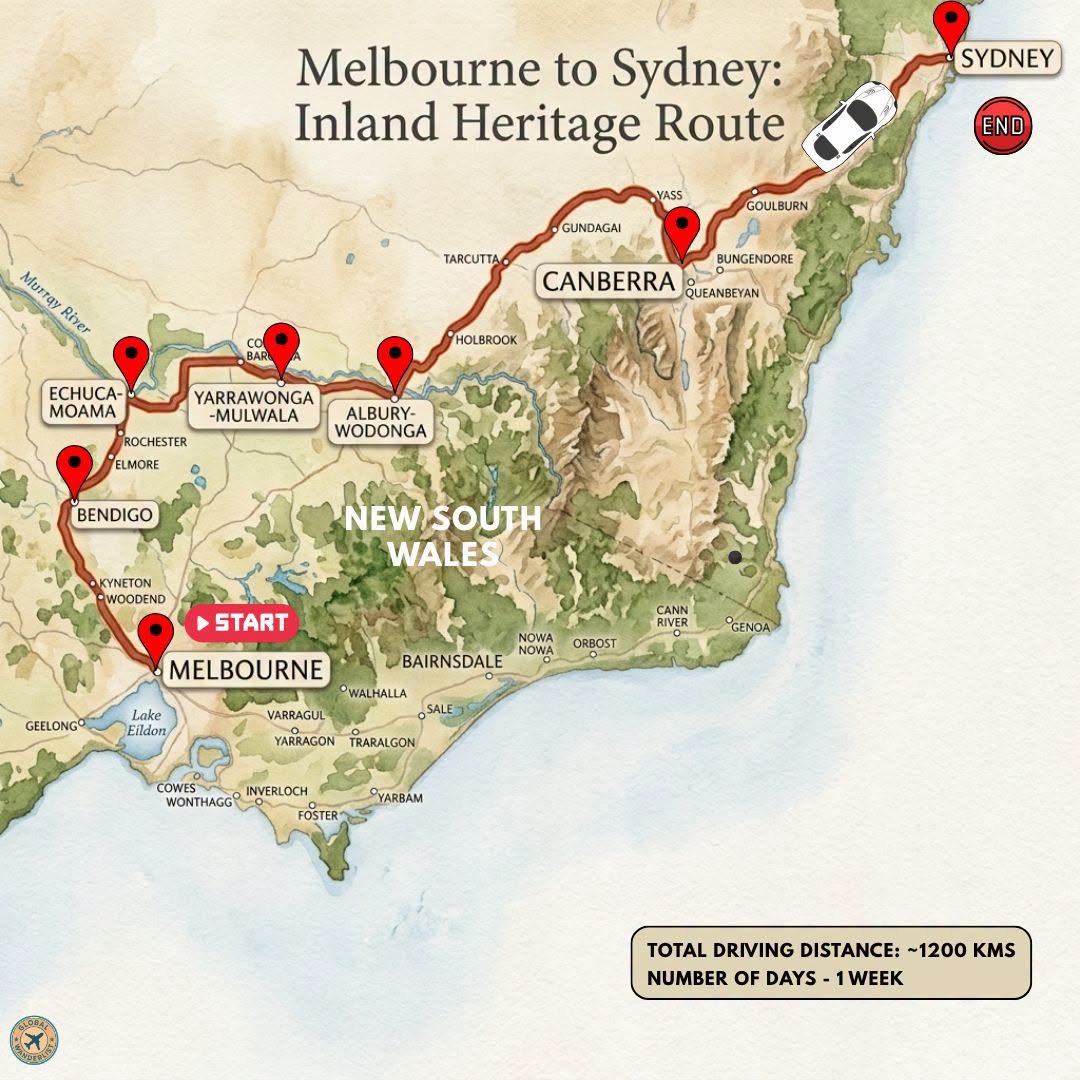
Most travelers driving between Melbourne and Sydney stick to the coast. The inland heritage route tells a different story. It winds through goldfields, riverside towns, wine country, and the nation’s capital before reaching Sydney.
This route covers around 1,200 kilometers. Most people complete it in about a week, though you could easily stretch it longer. Along the way, you will pass through Bendigo, Echuca-Moama, Yarrawonga-Mulwala, Albury-Wodonga, and Canberra.
Each stop has its own character. Some are steeped in gold rush history. Others sit on the Murray River or Lake Hume. Canberra adds a dose of national history before the final push into Sydney.
Below is a full breakdown of the route, including where to eat and what to see at every major stop.
Route Overview
| Stop | Distance from Previous Stop | Best For |
|---|---|---|
| Melbourne (Start) | – | City sights, coffee culture, gallery hopping |
| Bendigo | 150 km | Gold rush history, Victorian architecture |
| Echuca-Moama | 90 km | Paddlesteamers, Murray River charm |
| Yarrawonga-Mulwala | 100 km | Lake life, boating, golf |
| Albury-Wodonga | 90 km | Border town culture, wineries nearby |
| Canberra | 320 km | National museums, lake trails, politics |
| Sydney (End) | 290 km | Harbour views, beaches, iconic landmarks |
Total driving distance sits close to 1,200 kilometers. Spreading the trip across seven days gives you time to explore each town properly, rather than just passing through.
Melbourne
Melbourne kicks off this road trip with laneway culture, world-class coffee, and a compact city center that rewards walking. Before hitting the road, spend a morning wandering Federation Square and the Royal Botanic Gardens. It is worth fueling up here, since the stretch to Bendigo passes through smaller rural towns with fewer dining options.
Insider Tips for Leaving Melbourne
- Leave early to avoid peak morning traffic on the Calder Freeway. Aim to hit the road before 8 a.m. for the smoothest exit from the city.
- Fill your tank in the outer suburbs. Fuel prices climb once you reach smaller towns further along the route.
- Download offline maps before departing. Some stretches of regional Victoria have patchy mobile coverage.
What to See Before You Go
- Visit the National Gallery of Victoria for a quick culture fix. Its permanent collection spans Australian and international art across multiple levels.
- Walk through Hosier Lane to see Melbourne’s famous street art. New murals appear constantly, so no two visits look the same.
- Stroll the Royal Botanic Gardens if you have an extra hour. The lake and lawns offer a calm start before a long day of driving.
Bendigo
Bendigo built its wealth during the 1850s gold rush, and the money shows. Grand Victorian buildings line the main streets, many restored to their original glory. The Central Deborah Gold Mine still offers underground tours for visitors curious about the town’s mining past.
Beyond the history, Bendigo has developed a genuinely strong dining scene in recent years. Cafes and wine bars have opened around the old commercial district. It makes a solid first overnight stop for travelers taking this route slowly.
Where to Eat in Bendigo
- The Woodhouse Bar & Grill is known locally as one of the most romantic dinner spots in town. Their Wagyu porterhouse gets consistent praise, and the wine list covers plenty of regional Victorian drops.
- Whitby overlooks Lake Weeroona and serves breakfast, brunch, and lunch seven days a week. Its lakeside setting makes it a relaxed choice after a morning of sightseeing.
What to See in Bendigo
- Tour the Central Deborah Gold Mine to go 61 meters underground. Guided tours explain how miners worked the shafts during the gold rush era.
- Visit the Bendigo Art Gallery, one of regional Australia’s oldest and largest galleries. Its collection spans colonial paintings through to contemporary works.
- Walk through the Bendigo Joss House Temple, a reminder of the significant Chinese community that shaped the goldfields.
Echuca-Moama
Echuca sits right on the Murray River, and its old port area still runs paddlesteamer cruises daily. The Port of Echuca Wharf was once one of the busiest inland ports in Australia during the riverboat trading era. Original bluestone buildings and timber wharves remain remarkably intact.
Moama, just across the river in New South Wales, adds a quieter, more residential feel. Together, the twin towns make an easy, walkable stop with plenty of river views.
Where to Eat in Echuca-Moama
- Opa Echuca consistently ranks as one of the best-reviewed restaurants in town, known for a menu heavy on Greek flavors and generous portions. Bookings are recommended, especially on weekends.
- MV Mary Ann Cruising Restaurant lets you eat dinner while drifting along the Murray River. Seasonal menus focus on local produce, making it a memorable stop for a special occasion.
What to See in Echuca-Moama
- Take a paddlesteamer cruise along the Murray River. Several historic boats, including PS Adelaide, still operate short scenic trips from the wharf.
- Explore the Port of Echuca Wharf precinct on foot. Interpretive signs explain the town’s role in the riverboat trading economy of the 1800s.
- Visit the Great Aussie Beer Shed and Heritage Farm Museum for a lighthearted look at rural Australian history and memorabilia.
Yarrawonga-Mulwala
Yarrawonga and Mulwala sit on opposite banks of Lake Mulwala, a wide, tree-studded lake formed by a weir on the Murray River. Watersports dominate here, from waterskiing to fishing. The submerged tree stumps scattered across the lake create a striking, slightly eerie landscape at sunset.
This twin town works well as a relaxed midpoint stop. It breaks up the longer drive between Echuca and the New South Wales border comfortably.
Where to Eat in Yarrawonga-Mulwala
- Border Bistro at Yarrawonga Mulwala Golf Club Resort serves everything from pan-fried curries to premium steaks. It is a solid choice if you want a proper sit-down meal after a day on the water.
- Royal Mail Mulwala remains a local favorite for a classic pub meal. Its casual atmosphere and reliable menu suit families and groups passing through.
What to See in Yarrawonga-Mulwala
- Take a scenic cruise on Lake Mulwala to see the striking dead tree stumps rising from the water. Sunset cruises are particularly popular with photographers.
- Visit Byramine Homestead, a heritage-listed 1840s property with an unusual octagonal design. It was built partly for defense against potential conflict with local Aboriginal groups during early settlement.
- Spend an afternoon at the Yarrawonga Mulwala Golf Club Resort. The course is considered one of the best regional golfing destinations in Victoria.
Albury-Wodonga
Albury sits in New South Wales, while Wodonga sits just across the Murray River in Victoria. Together, they form one of the largest inland urban centers on the border. The area’s history is tied closely to the Hume Highway and the old rail line linking Melbourne and Sydney.
Albury-Wodonga also sits close to Rutherglen, one of Australia’s most respected wine regions. Wine lovers often add an extra day here just to explore nearby cellar doors.
Where to Eat in Albury-Wodonga
- Hog’s Australia’s Steakhouse in Albury is a reliable pick for a proper steak dinner. It draws a loyal local following and consistently strong reviews.
- Bonetti’s Pizzeria is widely regarded as the best pizza spot in the twin cities. Thin bases and fresh toppings keep locals coming back regularly.
What to See in Albury-Wodonga
- Walk through the Bonegilla Migrant Experience, a former reception center that welcomed over 300,000 migrants to Australia after World War II. It offers a moving look at the country’s postwar immigration story.
- Visit MAMA, the Murray Art Museum Albury, for a strong rotating collection of contemporary Australian art.
- Take a short detour to Rutherglen for wine tasting. The region specializes in fortified wines and sits only about 25 minutes from Albury.
Canberra
Canberra marks the halfway point between the border towns and Sydney, and it deserves more than a quick pass through. Australia’s capital was purpose-built in the early 1900s as a compromise between rival cities Melbourne and Sydney. Its planned layout, centered around Lake Burley Griffin, still feels distinct from any other Australian city.
The city’s museum precinct alone can fill a full day. Braddon and Kingston Foreshore have also become genuine dining destinations, giving Canberra a food scene that rivals much larger cities.
Where to Eat in Canberra
- Eightysix in Braddon blends casual share plates with a lively atmosphere, and its banoffee pie has become something of a local legend. It works well for groups wanting a fun, sociable dinner.
- Molto Italian on Lonsdale Street pairs a relaxed dining room with an ambitious wine list. It is considered one of Braddon’s standout Italian spots.
What to See in Canberra
- Visit the Australian War Memorial, widely regarded as one of the most moving museums in the country. Its galleries cover Australia’s military history from the Boer War through to recent conflicts.
- Walk or cycle the Lake Burley Griffin foreshore trail. It passes the National Carillon, Captain Cook Memorial Jet, and views of Parliament House.
- Tour Parliament House itself, including its public galleries. Free guided tours run throughout the day and offer insight into how Australian government functions.
Sydney
After Canberra, the drive to Sydney climbs through Goulburn before dropping toward the coast. Arriving in Sydney marks the end of a route that has covered gold rush towns, river ports, lake resorts, and the national capital in a single week.
Sydney needs little introduction. Its harbor, beaches, and skyline reward every kilometer of the drive behind you.
Planning Your Sydney Arrival
- Time your arrival to avoid peak city traffic, ideally reaching Sydney before 3 p.m. on a weekday. The final approach through the M31 can slow considerably during rush hour.
- Book accommodation near the harbor or Circular Quay if this is your first visit. It puts you within walking distance of the Opera House and Harbour Bridge.
- Return your hire car promptly if you rented one for the trip. Sydney’s inner-city parking can be both expensive and difficult to find.
What to See First in Sydney
- Walk across the Sydney Harbour Bridge for sweeping views of the Opera House and harbor. The pedestrian walkway is free and open daily.
- Visit the Sydney Opera House precinct, even if you are not catching a show. The building’s exterior and harborside setting are worth the visit alone.
- Explore The Rocks, Sydney’s oldest neighborhood, for cobblestone laneways and historic pubs dating back to the colonial era.
Final Thoughts
The inland heritage route proves there is more to the Melbourne-Sydney drive than the highway shoulder view of the coast. Gold rush architecture, river towns, lake resorts, and national landmarks fill a week that feels far richer than a straight-line drive. Take your time, book ahead where you can, and let the smaller stops surprise you along the way.