
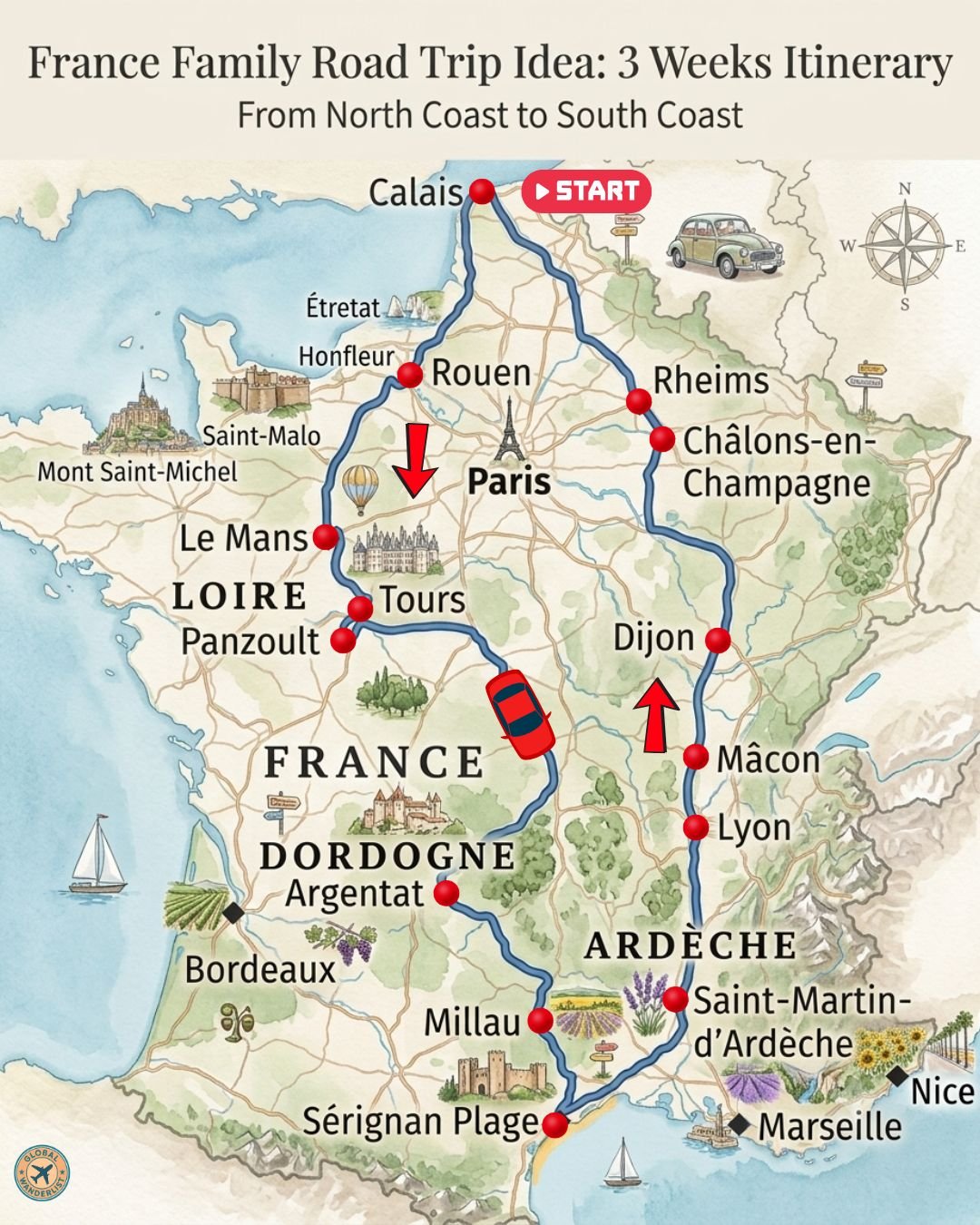
This three week loop takes families from the chalk cliffs of the English Channel down through Loire Valley chateaux, rugged Dordogne countryside, and the turquoise Gorges de l’Ardèche before looping back north through Burgundy and Champagne. It suits families who want variety over a single region, mixing castle visits and river swims with wine country and cathedral cities. Younger kids will love the canoeing stops and ice cream breaks, while older travelers get real depth in history and gastronomy.
The pace is relaxed enough for children, with most driving legs under three hours. Below is a full overview, followed by a detailed stop by stop guide.
| Stop | Distance from Previous Stop | Driving Time | Main Highlights | Recommended Stay Duration |
|---|---|---|---|---|
| Calais | Starting point | N/A | Ferry port, Channel views, historic old town | 1 day |
| Rouen | 220 km | 2.5 hours | Gothic cathedral, medieval old town, Joan of Arc history | 1-2 days |
| Le Mans | 240 km | 2.5 hours | Roman walls, racing history, medieval old town | 1 day |
| Tours | 90 km | 1 hour | Loire Valley gateway, cathedral, riverside old town | 1-2 days |
| Panzoult (Chinon area) | 50 km | 45 minutes | Vineyards, Chinon fortress, cave dwellings | 1-2 days |
| Argentat | 280 km | 3.5 hours | Dordogne riverbanks, traditional gabare boats | 1-2 days |
| Millau | 200 km | 2.5 hours | Millau Viaduct, Gorges du Tarn, canoeing | 1-2 days |
| Sérignan Plage | 150 km | 1.75 hours | Mediterranean beaches, canal boating | 2-3 days |
| Saint-Martin-d’Ardèche | 160 km | 2 hours | Gorges de l’Ardèche, kayaking, Pont d’Arc | 1-2 days |
| Lyon | 180 km | 2 hours | Gastronomic capital, Vieux Lyon, traboules | 2 days |
| Mâcon | 70 km | 1 hour | Burgundy wine country, Saône riverfront | 1 day |
| Dijon | 130 km | 1.5 hours | Ducal Palace, mustard heritage, medieval streets | 1-2 days |
| Châlons-en-Champagne | 200 km | 2.25 hours | Champagne region, canals, Gothic collegiate church | 1 day |
| Reims | 45 km | 45 minutes | Champagne houses, coronation cathedral | 1-2 days |
Calais
Calais opens this loop as both a practical entry point and a destination worth a proper look before hitting the road. Its position on the English Channel gave it centuries of strategic importance, reflected in landmarks like the Rodin sculpture of the Burghers of Calais. The town’s harbor and Channel views offer an easy, low key start to a longer trip.
Where to Eat in Calais
- Le Grand Bleu, French seafood, $$$. A Michelin Guide selected restaurant overlooking the harbor, known for creative dishes like Saint-Jacques boudin.
- L’Entracte, French, $$. A well reviewed spot with Channel views, scoring 4.5 out of 5 across more than 100 reviews.
- Le Channel, French brasserie, $$$. A family run restaurant overlooking the marina with an extensive wine list of over 1,200 references.
What to See in Calais
- The Cité de la Dentelle et de la Mode showcases Calais’s historic lace making industry, once a major export for the region. It offers an interesting, less crowded stop before heading further into France.
- The Burghers of Calais statue by Auguste Rodin commemorates a pivotal moment in the town’s medieval history. It sits near the town hall and makes an easy photo stop.
- The Calais lighthouse offers panoramic Channel views for those willing to climb its stairs. Clear days reveal the English coastline across the water.
- Walking the Calais beach and dunes gives kids a chance to stretch their legs before a long driving day. The wide, sandy stretch stays relatively uncrowded outside peak summer.
Rouen
Rouen anchors Normandy’s historic capital, blending Gothic architecture with centuries of layered history. Its medieval old town survived enough of World War II’s destruction to retain genuine half timbered charm, and its cathedral was famously painted repeatedly by Monet. The city also marks the site of Joan of Arc’s execution in 1431, adding real historical weight to a walk through its streets.
Where to Eat in Rouen
- La Couronne, French, $$$. Recognized as one of France’s oldest inns, dating to 1345, and known for inspiring Julia Child’s love of French cooking.
- Cancan, French, $$. A well reviewed bistro popular for both dinner and takeout, praised for value and flavor.
- L’Odas, French, $$$. A stylish restaurant next to the cathedral offering a contemporary take on regional cuisine.
What to See in Rouen
- Rouen Cathedral’s Gothic facade inspired an entire series of Monet paintings, capturing it under different light. Standing in front of it today reveals why the shifting light captivated him.
- The Gros-Horloge, a Renaissance astronomical clock, spans a pedestrian street in the heart of the old town. Climbing its tower offers views over Rouen’s rooftops.
- Place du Vieux-Marché marks the site of Joan of Arc’s execution, now home to a modern church built in her memory. It anchors much of the old town’s restaurant and shopping scene.
- The half timbered streets of Rouen’s old quarter reward slow, unhurried wandering, especially around Rue du Gros-Horloge and the surrounding lanes.
Le Mans
Le Mans brings a mix of Roman history and motorsport fame to this itinerary. Its well preserved Gallo-Roman walls rank among the best examples in Europe, while the 24 Hours of Le Mans race has made the city a pilgrimage site for racing fans. The medieval old town, known as Cité Plantagenêt, offers a quieter contrast to the city’s racing reputation.
Where to Eat in Le Mans
- Bistrot des Gourmets, French, $$$. A well regarded restaurant popular with locals for classic French cooking.
- La Baraque à Bœuf, French, $$. Located in the heart of the Old Town, known for chic decor and an impressive dessert selection.
- Le Jardin Gourmand, French, $$. A gourmet bistro slightly outside the town center, worth the short trip for its quality.
What to See in Le Mans
- The Cité Plantagenêt old town features cobblestone streets and colorful half timbered houses dating back centuries. It offers an easy, walkable break from the highway.
- The Roman walls surrounding the old town rank among the longest and best preserved in France, dating to the 3rd century. Walking sections of the wall gives a tangible sense of the city’s ancient origins.
- The 24 Hours of Le Mans Museum appeals to racing fans, showcasing historic cars and decades of racing history. It works well as a family stop, even for those without deep racing knowledge.
- Cathédrale Saint-Julien combines Romanesque and Gothic elements, with flying buttresses that rank among the most dramatic in France.
Tours
Tours serves as the natural gateway to the Loire Valley, combining a walkable historic center with easy access to the region’s famous chateaux. Its position along the Loire River made it an important trading hub for centuries, reflected in its elegant squares and cathedral. This makes it an ideal base for families planning to spend a day or two exploring nearby castles.
Where to Eat in Tours
- Les Canailles, French, $$$. A well reviewed restaurant in Tours praised for its refined take on regional cooking.
- La Deuvalière, French, $$. A charming spot combining fine dining with delightful pastries in the heart of Tours.
- Le Chien Fou, French, $$. A romantic, highly rated restaurant with a loyal following among visitors.
What to See in Tours
- Cathédrale Saint-Gatien features intricate Gothic stonework and striking stained glass windows dating back centuries. Its twin spires anchor the city’s skyline.
- The old town’s Place Plumereau offers a lively square lined with half timbered buildings, cafes, and restaurants. Evening hours bring a relaxed, social atmosphere.
- The Loire à Vélo cycling route passes through Tours, offering families an easy way to explore the riverside on two wheels. Bike rentals are widely available in the city center.
- Day trips from Tours reach several major chateaux, including Chenonceau and Chambord, both within an hour’s drive.
Panzoult (Chinon Area)
Panzoult sits in the heart of the Chinon wine region, surrounded by vineyards and troglodyte cave dwellings carved into the region’s soft limestone. Nearby Chinon anchors the area with its dramatic royal fortress overlooking the Vienne River. This stretch of the Loire Valley rewards a slower pace, with wine tastings and castle visits filling a relaxed day or two.
Where to Eat in Panzoult (Chinon Area)
- Les Années Trente, French, $$$. A Michelin recognized restaurant at the foot of Chinon’s fortress, set in a 16th century building with a romantic Belle Époque interior.
- L’Ardoise Chinon, French bistro, $$. A contemporary spot serving traditional bistro cuisine and steaks with a pleasant outdoor terrace.
- Au Chapeau Rouge, French, $$. A well reviewed local favorite in Chinon’s old town.
What to See in Panzoult (Chinon Area)
- Château de Chinon overlooks the Vienne River from a dramatic hilltop position, with deep ties to Joan of Arc’s history. The fortress ruins offer sweeping valley views.
- Chinon’s medieval old town winds through narrow streets lined with wine shops and troglodyte caves cut into the hillside. Many caves still store wine at a naturally cool temperature.
- Wine tastings throughout the Chinon appellation introduce families to the region’s noted cabernet franc reds. Many smaller domaines welcome walk-in visitors.
- The Vienne River offers a scenic backdrop for a relaxed picnic or short riverside walk, especially near the base of the château.
Argentat
Argentat sits along the Dordogne River in the Corrèze department, marking a scenic transition point on this loop. The town’s riverside architecture, with slate roofed houses lining the water, reflects its history as a hub for traditional gabare cargo boats. This stop offers families a quieter, more rural slice of French countryside after the busier Loire Valley towns.
Where to Eat in Argentat
- Le Bistrot des Quais, French, $$$. A riverside restaurant with 168 reviews, praised for its view and consistent quality.
- Restaurant Odivin, French bistronomic, $$$. A traditional gastronomic experience using fresh, regional products.
- Hôtel Fouillade restaurant, French, $$. A reliable hotel restaurant option directly on the riverbanks.
What to See in Argentat
- The riverside promenade along the Dordogne offers postcard views of slate roofed houses reflected in the water. Early morning or sunset brings the best light for photos.
- A traditional gabare boat ride introduces families to the flat bottomed cargo boats once used to transport goods along the river. Several operators run scenic trips throughout summer.
- The old town’s narrow streets reveal centuries of riverside trading history, with stone buildings dating back to the medieval period.
- Nearby villages in the Dordogne valley, including Beaulieu-sur-Dordogne, make an easy half day detour for those wanting to see more of the region.
Millau
Millau anchors the southern stretch of this route, famous worldwide for the Millau Viaduct, one of the tallest bridges on the planet. The town also sits at the entrance to the dramatic Gorges du Tarn, making it a natural base for outdoor activities. Its history as the City of Gloves adds an unexpected artisanal layer to a visit.
Where to Eat in Millau
- Bar du Musée, French, $$. A family run restaurant and cafe known for its consistently high quality.
- Le Bouche À Oreille, French, $$. A well reviewed spot in the town center popular with both locals and visitors.
- Côté Marché, French, $$. A reliable choice near the historic center, praised for fresh, seasonal cooking.
What to See in Millau
- The Millau Viaduct is one of the tallest bridges in the world, with a design so striking it has become an engineering landmark in its own right. A dedicated viewpoint area offers the best photo angles.
- The Gorges du Tarn offer dramatic limestone cliffs and turquoise water, ideal for a family canoe or kayak trip. Several outfitters near Millau rent equipment and offer guided routes.
- Millau’s historic center, known for its glove making heritage, features arcaded squares and a lively Wednesday and Friday market. It makes for an easy, walkable break from outdoor activities.
- The Larzac plateau above Millau offers hiking trails and sweeping views over the surrounding gorges, suitable for families wanting a moderate outdoor challenge.
Sérignan Plage
Sérignan Plage brings this route to the Mediterranean coast, offering wide sandy beaches and calm, family friendly water. The town sits where the Orb River meets the sea, giving visitors both a beach and a riverside setting to enjoy. This stop works well as a longer rest point midway through the loop, especially for families needing a beach break.
Where to Eat in Sérignan Plage
- Latino Beach, French and grill, $$$. A 20 year beachfront institution serving fresh fish, grilled meats, and cocktails with your feet in the sand.
- La Table de Rive Gauche, French, $$. A riverside restaurant along the Orb offering a shaded terrace and relaxed atmosphere.
- Mon Restaurant d’Été, French, $$. A seasonal spot serving fresh, local ingredients from breakfast through dinner on a shaded terrace.
What to See in Sérignan Plage
- The wide sandy beach at Sérignan Plage offers calm, shallow water well suited to families with younger children. Lifeguard stations operate throughout the summer season.
- Cycling or walking along the Orb River provides a scenic, flat route connecting the beach to the town center. Bike rentals are widely available near the campgrounds.
- Boat trips along the nearby Canal du Midi introduce families to this UNESCO listed waterway, lined with plane trees and locks. Several operators run short scenic cruises from nearby towns.
- The Musée Régional d’Art Contemporain in nearby Sérignan offers a cultural break from beach time, showcasing contemporary art in an accessible setting.
Saint-Martin-d’Ardèche
Saint-Martin-d’Ardèche sits at the entrance to the Gorges de l’Ardèche, one of the most dramatic natural landscapes in southern France. The turquoise river winds beneath towering limestone cliffs, culminating in the famous Pont d’Arc natural stone arch. This stop suits active families looking for a memorable canoeing or kayaking day.
Where to Eat in Saint-Martin-d’Ardèche
- Restaurant Les Touristes, French, $$$. A riverside spot with views over the suspension bridge, known for homemade fougasse and charcuterie.
- La Terrasse, French, $$. Rated 4.4 out of 5 from over 100 reviews, offering river views and fresh seafood dishes.
- Guinguette du Moulin, French, $$. A relaxed, riverside favorite popular for casual family meals.
What to See in Saint-Martin-d’Ardèche
- The Gorges de l’Ardèche stretch for miles, with towering limestone cliffs rising above turquoise water. A full day canoe trip through the gorge ranks among the most memorable family activities on this entire route.
- Pont d’Arc, a massive natural stone arch carved by the river, marks one of the most photographed spots in the gorge. Swimming beneath the arch is a popular summer activity.
- The Grotte Chauvet replica cave nearby showcases some of the oldest known cave paintings in the world, offering an educational stop for older kids.
- Riverside beaches throughout Saint-Martin-d’Ardèche offer calm swimming spots away from the more dramatic gorge currents, suitable for younger children.
Lyon
Lyon brings serious culinary depth to this route, widely regarded as France’s gastronomic capital. Its old town, Vieux Lyon, preserves an extensive collection of Renaissance architecture connected by hidden passageways called traboules. The city’s position at the meeting point of the Rhône and Saône rivers adds scenic depth to its historic streets.
Where to Eat in Lyon
- Daniel et Denise, Bouchon Lyonnais, $$$. A certified traditional bouchon serving classic Lyonnaise dishes like quenelle and andouillette.
- Café des Fédérations, Bouchon Lyonnais, $$$. Another certified bouchon known for its authentic, hearty regional cooking.
- La Mère Jean, French, $$$. Rated 4.6 out of 5 across more than 1,600 reviews, serving classics like chicken with vinegar and cervelle de canut.
What to See in Lyon
- Vieux Lyon’s traboules offer a unique way to explore the city’s Renaissance architecture through hidden interconnected passageways. Several are open to the public and clearly marked.
- The Basilica of Notre-Dame de Fourvière sits atop a hill overlooking the city, reachable by a short funicular ride. Its sweeping views make it worth the trip up.
- Les Halles de Paul Bocuse offers a food lover’s market experience, filled with charcuterie, cheese, and fresh produce stalls. It makes for a great grazing lunch stop.
- The Presqu’île district connects the city’s two rivers with elegant squares and shopping streets, offering a good overview of Lyon’s blend of historic and modern character.
Mâcon
Mâcon sits at the southern edge of Burgundy, offering a quieter wine country stop along the Saône River. Its position along the water gives the town a relaxed, riverside atmosphere well suited to a shorter overnight stay. The surrounding Mâconnais region produces some of Burgundy’s most accessible white wines.
Where to Eat in Mâcon
- Au fil de l’Ô, French, $$$. A well reviewed restaurant on the banks of the Saône, praised for seasonal menus and river views.
- Azuki, Asian and French fusion, $$. A popular spot noted for consistent quality and friendly service.
- Brasserie de L’Academie, French, $$. A reliable brasserie option in the town center, good for a relaxed family meal.
What to See in Mâcon
- The Saône riverfront offers a scenic walking route through the heart of Mâcon, with restaurant terraces overlooking the water. Evening strolls here are especially pleasant.
- Mâconnais vineyards surround the town, producing well regarded Chardonnay based whites. Several nearby domaines offer family friendly tastings.
- The Musée des Ursulines showcases regional archaeology and history within a former convent building, offering a quieter cultural stop.
- Saint-Vincent Cathedral’s remaining towers, part of a partially demolished medieval cathedral, offer an interesting historical curiosity in the town center.
Dijon
Dijon serves as Burgundy’s cultural capital, blending mustard heritage with well preserved medieval architecture. Its historic center features colorful glazed tile roofs distinctive to the region, along with the former palace of the Dukes of Burgundy. The city offers an excellent full or half day stop for families interested in history and food.
Where to Eat in Dijon
- Le Pré aux Clercs, French brasserie, $$$. A delightful brasserie offering authentic Burgundian cuisine in a warm, welcoming atmosphere.
- Loiseau des Ducs, French haute cuisine, $$$$. A refined dining experience blending tradition with innovation in the heart of Dijon.
- Le Bistrot des Halles, French, $$. A reliable, well located choice near the historic covered market.
What to See in Dijon
- The Palace of the Dukes of Burgundy anchors the city center, now home to a fine arts museum. Its architecture reflects centuries of regional political power.
- Dijon’s Owl Trail, marked by bronze plaques set into the sidewalk, guides visitors past the city’s key historic landmarks. It makes for an easy, self-guided family walk.
- Les Halles covered market showcases Burgundy’s food culture, filled with cheese, charcuterie, and mustard vendors. Saturday mornings bring the liveliest atmosphere.
- Dijon’s mustard heritage remains deeply tied to its identity, with several shops offering tastings and demonstrations of the traditional production process.
Châlons-en-Champagne
Châlons-en-Champagne offers a quieter, less touristed stop within the Champagne region, known for its canals and Gothic collegiate church. The town’s historic center features half timbered houses and waterways that give it a distinct character compared to busier Champagne towns. It makes for an easy overnight stop before reaching Reims.
Where to Eat in Châlons-en-Champagne
- La Bourse, French, $$$. A real institution in the region, known for its chic atmosphere and consistently excellent cooking.
- Maison Souply, French, $$. A veteran restaurant in the town’s Little Venice district, delighting locals for years.
- Le Petit Pasteur, French, $$. A distinctive spot serving dishes prepared and presented in jars, offering a quality and varied menu.
What to See in Châlons-en-Champagne
- The Collégiale Notre-Dame-en-Vaux features striking Gothic architecture and a cloister museum showcasing medieval sculpture. It ranks among the town’s most significant landmarks.
- Châlons’s canals, sometimes called Little Venice, wind through the historic center, offering a scenic walking route past half timbered buildings.
- Cathédrale Saint-Étienne rounds out the town’s collection of significant religious architecture, with stained glass windows spanning several centuries.
- The town’s central squares and pedestrian streets offer a relaxed, low key atmosphere well suited to a short family stroll before continuing the drive north.
Reims
Reims closes out the Champagne portion of this route, famous both for its Champagne houses and its role in French royal history. Reims Cathedral served as the traditional coronation site for French kings for centuries, and its Gothic architecture ranks among the finest in the country. The city’s underground cellars offer families a fascinating look at how Champagne is actually made.
Where to Eat in Reims
- L’Assiette Champenoise, French haute cuisine, $$$$. A three Michelin star restaurant offering an unforgettable, if formal, dining experience for special occasions.
- Le Parc Les Crayères, French, $$$$. A two Michelin star restaurant set within a stunning château on private parkland, excelling in Champagne pairings.
- Café du Palais, French bistro, $$. A family run spot with eclectic decor, known for its Reims ham and fast, friendly service.
What to See in Reims
- Reims Cathedral served as the coronation site for French kings for centuries, and its Gothic architecture ranks among the finest examples in the country. Guided tours explain its deep royal history.
- Champagne house tours throughout Reims introduce families to the traditional production methods behind the region’s famous sparkling wine. Many tours include cellar visits suitable for all ages.
- The Palace of Tau, once the residence of French kings during coronation ceremonies, sits directly beside the cathedral and holds many of its original sculptures.
- Reims’s underground chalk cellars, some dating back to Roman times, now store millions of bottles of Champagne. Several major houses offer accessible tours through these historic tunnels.
Ready for the Road
This three week loop delivers an extraordinary range of French landscapes and experiences, from Channel ferries to Mediterranean beaches and back through Champagne’s rolling vineyards. Gothic cathedrals, dramatic river gorges, and centuries old wine cellars all sit within a manageable driving distance of each other. Few road trips offer this much variety for a family exploring France for the first time.
Book accommodations and popular restaurants in advance during July and August, since this route passes through several high season destinations. Pack layers and swimwear both, since the climate shifts significantly between the northern coast and the Mediterranean south. With some flexibility in pacing, this loop offers families a genuinely complete introduction to the diversity of the French countryside.