
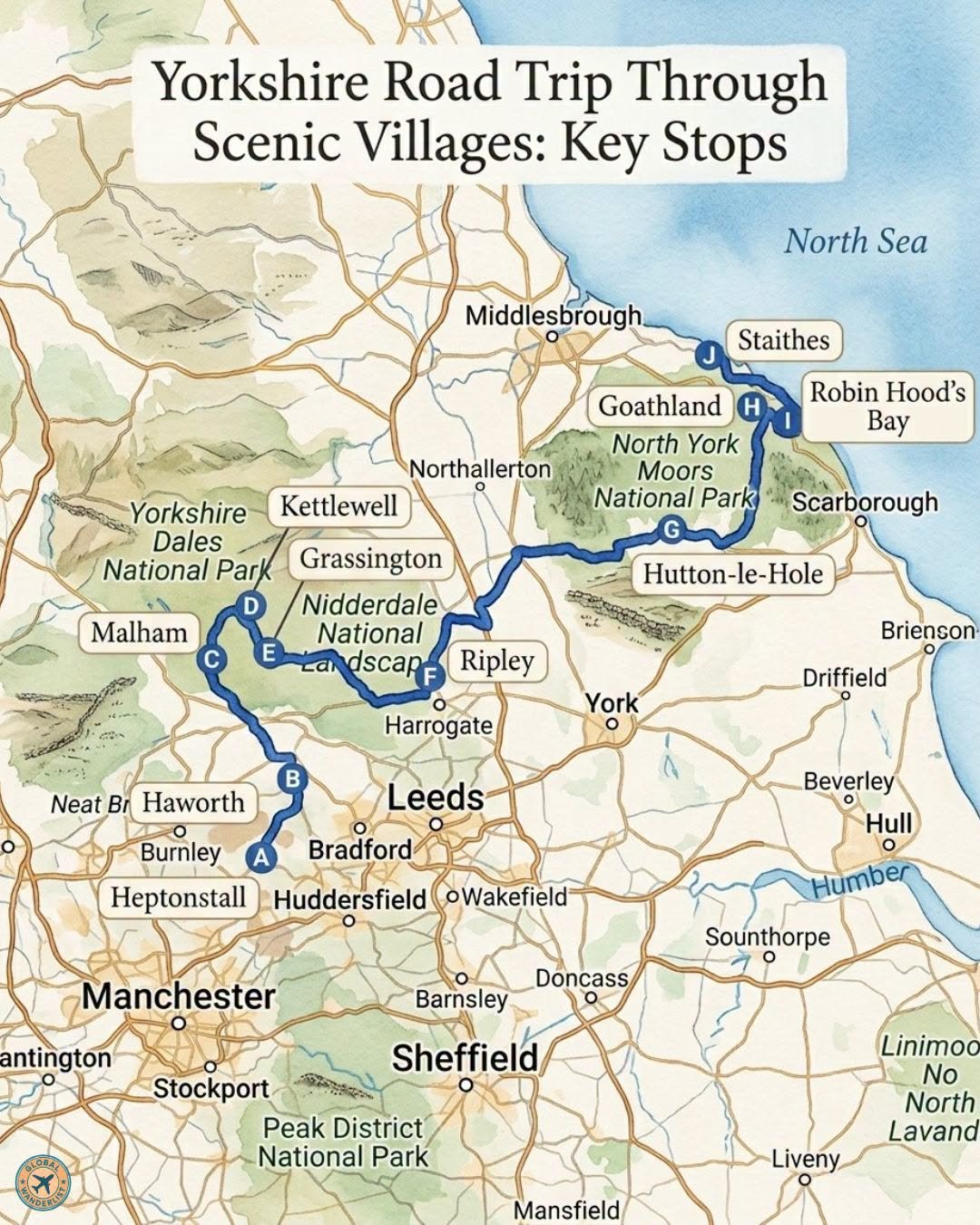
Yorkshire holds some of England’s most varied scenery in one region, from limestone dales to windswept moors and dramatic coastline. This road trip links storybook villages, literary landmarks, and fishing towns that feel frozen in time. It moves from the rolling hills of the Yorkshire Dales to the heather-covered North York Moors before finishing on the North Sea coast.
This route suits travelers who love slow, scenic driving over highway miles. Hikers, photographers, and literature fans will all find plenty to love, from Brontë country to smugglers’ coves. Families will appreciate the mix of easy walks, ice cream stops, and beaches along the way.
Roads range from wide moorland routes to steep, narrow lanes through the Dales. Expect single-track sections near Kettlewell and some sharp descents into the coastal villages. Below is a full stop-by-stop guide, following the route from West Yorkshire to the North Sea.
Trip Summary Table
| Stop | Distance from Previous Stop | Driving Time | Main Highlights | Recommended Stay Duration |
|---|---|---|---|---|
| Haworth | Starting point | – | Brontë Parsonage, cobbled Main Street | Half to full day |
| Malham | 24 miles | 45 minutes | Malham Cove, limestone scenery | Half day |
| Kettlewell | 10 miles | 25 minutes | Riverside village, Dales walking hub | 1-2 hours |
| Grassington | 5 miles | 12 minutes | Cobbled square, Dales market town | 2-3 hours |
| Ripley | 16 miles | 30 minutes | Ripley Castle, estate village | 2-3 hours |
| Hutton-le-Hole | 38 miles | 1 hour 10 minutes | Moorland village, folk museum | 2-3 hours |
| Goathland | 10 miles | 25 minutes | Steam railway, waterfall walks | Half day |
| Robin Hood’s Bay | 10 miles | 25 minutes | Smugglers’ village, tidal beach | Half day |
| Staithes | 11 miles | 25 minutes | Fishing harbor, artist colony history | Half day |
Haworth
Haworth is best known as the home of the Brontë sisters, whose novels drew heavily on the surrounding moorland. The village’s steep, cobbled Main Street is lined with independent shops, tearooms, and pubs that have changed little in appearance for generations. Its literary pull draws visitors from around the world.
Parking is available in a large lot near the top of the village, close to the church and parsonage. The steep streets mean comfortable shoes are essential. Set aside at least half a day to explore the village and nearby moorland trails.
Where to Eat in Haworth
- The Hawthorn – British grill, $$$. Known nationally for its Sunday roasts and Yorkshire-sourced meat.
- Pavé Charcuterie and Bistro – European deli and bistro, $$. A local favorite for cheese boards and light bites.
- Villette Coffee House – Café, $$. A cozy spot for breakfast and coffee near the top of Main Street.
- Old White Lion Hotel – British pub food, $$. A reliable choice for hearty pub classics in a historic building.
What to See in Haworth
- The Brontë Parsonage Museum preserves the family home where the famous novels were written.
- Haworth Main Street offers a steep, atmospheric walk past independent shops and historic pubs.
- Haworth Church and Graveyard holds the Brontë family vault and offers a quiet, reflective stop.
- Penistone Hill Country Park provides moorland walking trails with sweeping views over the village.
- The Keighley and Worth Valley Railway runs vintage steam trains through the surrounding countryside.
Malham
Malham sits at the heart of the Yorkshire Dales, framed by some of the most dramatic limestone scenery in England. The village itself is small, but it serves as the gateway to Malham Cove, a towering natural amphitheater carved by glacial meltwater. The surrounding countryside has drawn hikers and geologists alike for generations.
The walk to Malham Cove takes about 30 minutes each way on a well-marked path. Parking fills quickly on weekends, so arrive early in peak season. Give yourself a half day to properly explore the cove, Gordale Scar, and the village center.
Where to Eat in Malham
- Beck Hall – British, $$$. A charming spot beside a stream, popular for its garden seating and hearty menu.
- The Lister Arms – Gastropub, $$$. A 17th-century coaching inn known as one of Yorkshire’s favorite pubs.
- The Buck Inn – Pub food, $$. A traditional option in nearby Kirkby Malham with easy parking access.
What to See in Malham
- Malham Cove is a massive curved limestone cliff, dramatic enough to have appeared in major film productions.
- Gordale Scar nearby is a steep-sided limestone gorge with waterfalls, reachable by an easy walking trail.
- Janet’s Foss is a small, picturesque waterfall tucked into woodland just outside the village.
- Malham Tarn is a rare upland lake a short drive away, popular for birdwatching and quiet walks.
Kettlewell
Kettlewell sits along the River Wharfe, deep in the heart of Upper Wharfedale. Its stone cottages and arched bridge give it a quintessential Dales feel, and the surrounding hills have made it a popular base for walkers for over a century. The village has appeared in various British films and television productions.
The village is small enough to explore on foot in under an hour. Parking is available near the village green, with additional options along the main road. Longer trails from here lead up into the surrounding fells for those with more time.
Where to Eat in Kettlewell
- The Blue Bell Inn – Pub food, $$. A welcoming village pub with a solid menu of Yorkshire classics.
- The Cottage Tea Room – Café, $$. A small, well-reviewed spot for lunch and homemade cakes.
- The Fox Hole – British, $$$. A popular choice for a proper sit-down meal after a day of walking.
What to See in Kettlewell
- The River Wharfe runs through the village, with stepping stones and a stone bridge worth a photo stop.
- Old Cote Moor and the surrounding fells offer some of the best ridge walking in the southern Dales.
- St Mary’s Church is a modest but historic building at the village center.
- The Village Green makes a pleasant spot to rest before continuing to Grassington.
Grassington
Grassington is the unofficial capital of Upper Wharfedale, with a cobbled market square that has changed little since its Georgian heyday. The town has a lively, welcoming character, with independent shops and a strong local food scene. Its position within the Dales makes it a natural hub for exploring the surrounding countryside.
The town center is compact and walkable, with several public parking lots nearby. Give yourself a couple of hours to browse the shops and grab a meal. Grassington also makes a good base for short walks to nearby Linton Falls.
Where to Eat in Grassington
- Grassington House – Modern British, $$$$. An elegant restaurant known for seasonal Dales produce.
- The Corner House Cafe – Café, $$. A well-loved spot for scones and light lunches.
- The Morral – Modern British, $$$. A relaxed, thoughtfully run restaurant in the village center.
- Plaza Uno – Spanish tapas, $$$. A highly rated option for something different from traditional Dales fare.
What to See in Grassington
- Grassington’s Cobbled Square is lined with independent shops and cafés worth a slow browse.
- Linton Falls is a short, scenic walk from the village center, with a footbridge crossing the cascading water.
- The Old Hall and surrounding lanes preserve the village’s medieval layout.
- Grassington Museum offers a small but interesting look at the area’s lead mining history.
Ripley
Ripley is a rare estate village, built almost entirely by the Ingilby family who have owned the surrounding land for centuries. Its French-inspired market square and turreted castle give it a distinctive character unlike anywhere else on this route. The village feels like stepping into a private slice of English history.
Ripley Castle offers guided tours through its historic rooms and gardens during the visitor season. Parking is available near the village center, within easy walking distance of the castle gates. Plan for two to three hours to see the castle and stroll the village.
Where to Eat in Ripley
- The Boar’s Head Hotel – Modern British, $$$$. An elegant restaurant within the Ripley Castle estate.
- The Old Bakehouse – Café, $$. A charming spot in nearby Pateley Bridge for baked goods and sandwiches.
- Queens Head Inn – British, $$$. A countryside pub a short drive away, known for classic English dishes.
What to See in Ripley
- Ripley Castle has been home to the same family for generations and offers tours through its historic interiors.
- The Walled Gardens at the castle burst with color through spring and summer.
- Ripley’s Market Square was modeled after a French village and features distinctive period architecture.
- All Saints’ Church sits at the edge of the village with a peaceful, well-kept churchyard.
Hutton-le-Hole
Hutton-le-Hole is one of the most photographed villages in the North York Moors, with a stream running through open grassland at its center and sheep often grazing freely nearby. Its scattered stone cottages and open green give it an unusually spacious, relaxed feel compared to other moorland villages. The setting has made it a favorite for artists and photographers.
The Ryedale Folk Museum here offers an excellent look at rural Yorkshire life across the centuries. Parking is available in a small lot near the village center. Plan for a couple of hours to explore the museum and wander the streamside paths.
Where to Eat in Hutton-le-Hole
- The Crown – British, $$$. A traditional country pub known for its Sunday lunches and warm welcome.
- The George and Dragon – Pub food, $$. A friendly option with generous portions.
- The Moors Inn – British, $$$. A reliable choice for a sit-down meal in a moorland setting.
What to See in Hutton-le-Hole
- The Village Stream runs through open common land, with sheep often grazing along its banks.
- Ryedale Folk Museum recreates centuries of rural life through preserved buildings and exhibits.
- The Surrounding Moorland offers excellent short walks with wide views across the North York Moors.
- Lastingham Village nearby has a striking Norman crypt worth the short detour.
Goathland
Goathland sits high on the North York Moors and gained fame as a filming location for popular British television. Beyond its screen credits, the village offers genuine moorland charm, with sheep wandering freely across the green and a working steam railway station. Its elevated position provides some of the best views on this entire route.
The North Yorkshire Moors Railway stops right in the village, making it easy to combine driving with a short heritage train ride. Several waterfall walks begin nearby, including the popular route to Mallyan Spout. Set aside a half day to properly explore both the village and surrounding trails.
Where to Eat in Goathland
- The Homestead Kitchen – Modern European, $$$$. A standout for thoughtfully prepared, moor-sourced dishes.
- Mallyan Spout Hotel – British, $$$. A historic hotel restaurant near the start of the waterfall walk.
- The Goathland Hotel – Pub food, $$. A relaxed spot for a meal after a day on the trails.
What to See in Goathland
- Goathland Station is a beautifully preserved steam railway stop still in regular use.
- Mallyan Spout is a scenic waterfall reached by a moderate streamside walk from the village.
- The Village Green is often dotted with grazing sheep, giving Goathland its distinctive open feel.
- Wade’s Causeway nearby preserves a stretch of ancient paved trackway across the moors.
Robin Hood’s Bay
Robin Hood’s Bay tumbles down a steep cliffside in a maze of narrow lanes and tightly packed cottages. Its history is steeped in smuggling, with hidden passageways once used to move contraband between houses. The tidal beach below reveals extensive rock pools at low tide, rewarding an unhurried visit.
Cars are best left in the parking lot at the top of the village, since the streets below are narrow and often pedestrian only. The walk down is steep, and steeper still on the way back up. Plan for a half day to explore the lanes, beach, and coastal path.
Where to Eat in Robin Hood’s Bay
- The Bay Hotel – British, $$$. A historic pub right on the slipway with stunning coastal views.
- Wayfarer Bistro – Modern British, $$$. A well-reviewed spot for a relaxed sit-down meal.
- Fish Box – Fish and chips, $$. A popular choice with outdoor seating overlooking the bay.
- Brambles Bistro – British, $$$. A cozy, highly rated option in the heart of the village.
What to See in Robin Hood’s Bay
- The Old Village Lanes wind steeply downhill past cottages once used for smuggling contraband.
- The Tidal Beach exposes extensive rock pools at low tide, ideal for exploring with kids.
- The National Trust Old Coastguard Station offers exhibits on local history and geology.
- The Cleveland Way passes right through the village, offering dramatic coastal walking in either direction.
Staithes
Staithes closes out this road trip as one of Yorkshire’s most atmospheric fishing villages. Its tightly clustered cottages, working harbor, and dramatic cliffs once inspired an entire colony of British artists in the early 1900s. Captain James Cook worked here as a young apprentice before his famous voyages.
The village is best explored on foot, with parking available at the top of the steep approach road. The harbor and beach are easily reached by a short walk down. Give yourself a half day to explore the village, harbor, and surrounding cliffside paths.
Where to Eat in Staithes
- The Cod & Lobster – Seafood, $$$. A waterfront pub famous for its catch of the day and harbor views.
- The Royal George – Pub food, $$. The village’s oldest fisherman’s pub, known for affordable classics.
- Dotty’s Vintage Tearoom – Café, $$. A charming spot for scones, cakes, and coffee.
- The Endeavour – Seafood, $$$$. A small, highly praised restaurant named after Captain Cook’s famous ship.
What to See in Staithes
- Staithes Harbor remains an active fishing port, with colorful boats framed by dramatic cliffs.
- Captain Cook and Staithes Heritage Centre explores the explorer’s early years in the village.
- The Staithes Art Trail highlights the village’s history as a hub for the Staithes Group of painters.
- Cowbar Nab offers one of the best photography viewpoints looking back over the village and harbor.
Final Thoughts
This road trip captures Yorkshire at its most varied, from limestone dales to heather moorland and dramatic coastal villages. Each stop carries its own character, whether shaped by literature, geology, or centuries of fishing tradition. Take your time on the narrow lanes, wear good walking shoes, and let this route show you Yorkshire’s quieter, more scenic side.