
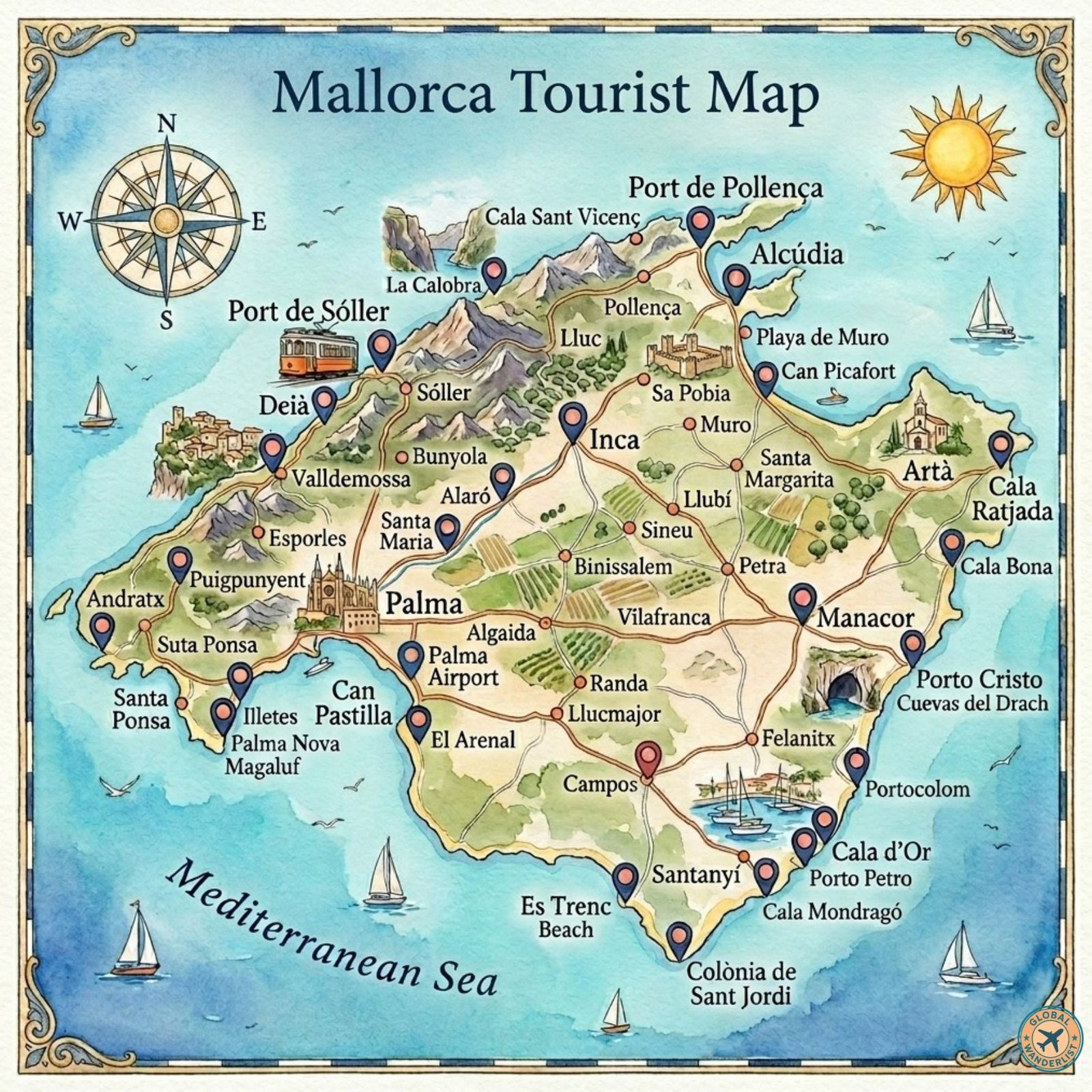
Mallorca offers far more than beach resorts and cheap flights. Dramatic mountains rise above turquoise coves. Medieval villages sit quietly beside Roman ruins and Gothic cathedrals.
Few Mediterranean islands pack this much variety into one place. You can hike a mountain range in the morning and swim in crystal water by afternoon. Every region has its own pace and personality.
This guide walks through Mallorca’s most rewarding destinations, coast to coast. Use it to build an itinerary that goes well beyond the airport transfer strip.
Mallorca Destination Quick Reference
| Place | Category | Best Known For | Recommended Visit Duration |
|---|---|---|---|
| Port de Pollença | Coastal town | Bay views, relaxed harbor | 1-2 days |
| Cala Sant Vicenç | Coastal cove | Quiet beaches, cliffs | Half day |
| Alcúdia | Historic town | Roman ruins, walled old town | 1 day |
| La Calobra | Coastal landmark | Dramatic gorge, mountain road | Half day |
| Port de Sóller | Coastal town | Vintage tram, sheltered bay | 1 day |
| Deià | Mountain village | Artistic history, cliffside views | Half day |
| Valldemossa | Mountain village | Chopin history, stone streets | Half day |
| Alaró | Inland town | Hilltop castle hike | Half day |
| Inca | Inland town | Leather goods, local markets | Half day |
| Puigpunyent | Inland village | Rural charm, mountain scenery | Half day |
| Andratx | Coastal town | Marina, art galleries | 1 day |
| Santa Ponsa | Coastal resort | Family beaches | 1 day |
| Illetes, Palma Nova, Magaluf | Coastal resort area | Nightlife, beach resorts | 1-2 days |
| Can Pastilla | Coastal resort | Long beach, bike paths | Half day |
| Palma | Capital city | Cathedral, old town | 2-3 days |
| El Arenal | Coastal resort | Wide beach, boardwalk | 1 day |
| Manacor | Inland city | Pearl workshops, local life | Half day |
| Cala Bona | Coastal town | Marina, coastal walk | Half day |
| Cala Ratjada | Coastal town | Lighthouse, fishing harbor | 1 day |
| Artà | Historic town | Hilltop sanctuary, caves | Half day |
| Porto Cristo | Coastal town | Cuevas del Drach caves | 1 day |
| Portocolom | Fishing village | Natural harbor, quiet charm | Half day |
| Cala d’Or, Porto Petro, Cala Mondragó | Coastal resort area | Turquoise coves | 1-2 days |
| Santanyí | Inland town | Sandstone architecture, markets | Half day |
| Es Trenc Beach | Natural beach | White sand, Caribbean look | 1 day |
| Colònia de Sant Jordi | Coastal town | Boat trips, quiet beaches | 1 day |
Visit durations assume a traveler splitting time across multiple regions of the island.
Port de Pollença: A Relaxed Bay on the North Coast
Port de Pollença curves gently around a wide, calm bay. Pine trees line the promenade, giving the town a quieter feel than southern resorts. Sailboats and small fishing vessels share the harbor.
This town has attracted painters and writers for over a century. Its mild waters and mountain backdrop still draw a loyal following of returning visitors.
What to See in Port de Pollença
- The seafront promenade offers an easy, scenic walk with mountain views across the bay.
- Boat trips to Formentor Peninsula reveal some of Mallorca’s most dramatic coastal cliffs.
- Local markets on Wednesdays and Sundays sell fresh produce and handmade goods.
- Puig de Maria monastery offers a short, steep hike rewarded by sweeping valley views.
Cala Sant Vicenç: Cliffside Coves Away from the Crowds
Cala Sant Vicenç sits tucked between rocky headlands near Pollença. Four small coves make up this quiet corner of the coast. Clear water and pine-backed cliffs give it a wilder feel than bigger resorts.
Development stays low-key here compared to the island’s busier beaches. This makes it a favorite for travelers seeking a calmer swim.
What to See in Cala Sant Vicenç
- Cala Barques offers calm, sheltered swimming framed by dramatic limestone cliffs.
- Cala Molins provides a slightly larger beach with easy sunbed access.
- Coastal walking paths connect the coves for a scenic half-day hike.
- Nearby cliffs offer excellent sunset photography over the Mediterranean.
Alcúdia: A Walled Town with Roman Roots
Alcúdia’s old town sits behind intact medieval walls, one of the best preserved in Spain. Beneath its cobblestones lie the ruins of Pollentia, a major Roman settlement. Layers of history stack up across just a few compact blocks.
The town balances historic charm with an active market culture. Tuesday and Sunday markets fill the streets with vendors and visitors alike.
What to See in Alcúdia
- The Roman ruins of Pollentia reveal a forum, theater, and residential remains from antiquity.
- Alcúdia’s medieval walls offer a walkable perimeter with views over the old town.
- Santa Anna Church anchors the historic center with centuries-old religious architecture.
- The nearby S’Albufera Natural Park protects wetlands popular with birdwatchers.
La Calobra: A Dramatic Gorge at the Mountain’s Edge
La Calobra sits at the base of a legendary switchback mountain road. The drive alone counts as one of Mallorca’s most thrilling experiences. A narrow gorge called Torrent de Pareis empties into the sea nearby.
Boat trips from Port de Sóller offer an alternative route, avoiding the winding drive. Either way, this landmark rewards the effort required to reach it.
What to See in La Calobra
- The Torrent de Pareis gorge cuts dramatically through limestone cliffs down to the shoreline.
- The switchback road itself offers photography stops with sweeping mountain views.
- A short tunnel walk leads visitors directly to the pebble beach below.
- Boat excursions from Port de Sóller provide a scenic, less strenuous approach.
Port de Sóller: A Sheltered Bay with a Vintage Tram
Port de Sóller wraps around a natural horseshoe bay on the northwest coast. A historic wooden tram connects the port to the inland town of Sóller. Orange groves surround the valley, a legacy of centuries-old trade.
The bay stays calm even when other coasts get choppy. This makes it a reliable swimming spot throughout the season.
What to See in Port de Sóller
- The vintage tram ride to Sóller offers a scenic, slow-paced journey through citrus orchards.
- The lighthouse walk at Cap Gros delivers panoramic views over the harbor.
- Small beaches along the bay provide calm, family-friendly swimming.
- Seafront restaurants serve fresh catch with harbor views at sunset.
Deià: An Artists’ Village Clinging to the Cliffs
Deià rises steeply above the northwest coast, its stone houses stacked against the mountainside. Writers and artists, including Robert Graves, made this village famous throughout the twentieth century. Golden stone buildings glow warmly in late afternoon light.
Despite its small size, Deià carries an outsized cultural reputation. Narrow lanes and a hilltop cemetery add to its quiet, poetic atmosphere.
What to See in Deià
- The Robert Graves House museum explores the writer’s decades living in the village.
- Cala Deià offers a small pebble cove reached by a steep, scenic path.
- The hilltop cemetery provides sweeping sea views alongside centuries of local history.
- Son Marroig estate showcases Mediterranean gardens and a marble viewpoint pavilion.
Valldemossa: A Mountain Village Frozen in Stone
Valldemossa sits high in the Tramuntana mountains, its streets built from pale local stone. Composer Frédéric Chopin famously spent one difficult winter here. The village’s monastery remains its most visited landmark.
Flower boxes and quiet courtyards give Valldemossa a storybook feel. Morning visits help avoid the midday tour bus crowds.
What to See in Valldemossa
- The Royal Carthusian Monastery preserves the cells where Chopin composed during his stay.
- Narrow stone streets invite an unhurried wander past centuries-old facades.
- Costa Nord cultural center offers exhibits on Tramuntana history and film.
- Nearby Port de Valldemossa provides a small, dramatic pebble cove below the cliffs.
Alaró: A Hilltop Castle Hike in the Tramuntana
Alaró sits at the foot of the Tramuntana range, best known for its dramatic hilltop castle ruins. The hike up takes a few hours through pine forest and rocky terrain. Local hospitality remains genuine, away from the coastal crowds.
This inland town moves at its own unhurried pace. Alaró suits travelers who want a real hike paired with mountain views.
What to See in Alaró
- Castell d’Alaró offers ruins perched dramatically above the valley, reachable by a scenic trail.
- The village square hosts a small but lively Saturday market.
- Local restaurants near the castle serve hearty mountain cuisine after the climb.
- Surrounding almond groves bloom spectacularly each February.
Inca: The Island’s Leather Capital
Inca sits inland, historically known for shoemaking and leather production. Thursday’s weekly market ranks among Mallorca’s largest and busiest. The town offers a genuine look at everyday island life.
Fewer tourists linger here compared to coastal towns. Inca rewards visitors interested in local commerce and traditional crafts.
What to See in Inca
- The Thursday market fills the town center with clothing, produce, and leather goods stalls.
- Local leather factories offer outlet shopping on shoes and accessories.
- Santa Maria la Major Church anchors the historic center with Gothic architecture.
- Nearby wineries in the Binissalem region offer easy afternoon tasting visits.
Puigpunyent: Quiet Rural Charm in the Foothills
Puigpunyent sits in a green valley near the Tramuntana foothills. Terraced orchards and stone farmhouses define the surrounding landscape. The village itself stays small, quiet, and largely untouched by mass tourism.
Hiking trails nearby connect to some of the island’s best mountain scenery. This makes Puigpunyent a good base for slower exploration.
What to See in Puigpunyent
- Galatzó Mountain offers challenging hiking trails with rewarding summit views.
- The village church and small plaza provide a peaceful photo stop.
- Nearby Son Net estate showcases restored manor architecture and gardens.
- Local trails connect to Estellencs and other quiet mountain villages.
Andratx: A Working Harbor with an Artistic Edge
Andratx sits near the island’s southwest tip, its harbor town Port d’Andratx lined with yachts and seafood restaurants. The inland town retains an authentic Mallorcan market atmosphere. Contemporary art galleries have grown steadily in recent years.
This area balances upscale marina life with genuine local character. Sunset views over the harbor rank among the island’s best.
What to See in Andratx
- Port d’Andratx offers a scenic marina walk lined with yachts and waterfront dining.
- CCA Andratx contemporary art center hosts rotating exhibitions in a striking setting.
- The Saturday market in town center draws locals for fresh produce and goods.
- Sant Elm village nearby provides ferry access to the protected Sa Dragonera island.
Santa Ponsa: Family-Friendly Beaches on the Southwest Coast
Santa Ponsa offers a wide, sandy beach popular with families. The resort town developed heavily through the twentieth century tourism boom. Calm, shallow water makes it especially suitable for children.
Restaurants and shops line the beachfront promenade. Santa Ponsa works well as a relaxed, low-key base.
What to See in Santa Ponsa
- The main beach offers calm, shallow water ideal for young swimmers.
- A coastal walking path connects Santa Ponsa to nearby Port Adriano marina.
- Golf courses in the surrounding hills attract regular players year-round.
- Sunset views from the rocky point add a scenic close to any beach day.
Illetes, Palma Nova, and Magaluf: The Island’s Resort Belt
This stretch of coast just west of Palma packs in some of Mallorca’s most developed resort towns. Illetes offers calmer, upscale beaches. Palma Nova and Magaluf lean into lively nightlife and big all-inclusive hotels.
Each town suits a different type of traveler despite sitting minutes apart. Bus and bike routes connect the entire strip easily.
What to See in Illetes, Palma Nova, and Magaluf
- Illetes Beach offers calm, clear water framed by pine-covered slopes.
- Palma Nova’s promenade provides family-friendly dining and shallow swimming areas.
- Magaluf’s nightlife strip draws younger crowds with clubs and beach parties.
- Western Water Park nearby offers a full day of slides for families.
Can Pastilla: A Long Beach Near the Airport
Can Pastilla sits just east of Palma, marking the start of a long sandy stretch toward El Arenal. Its proximity to the airport makes it a convenient first or last stop. A paved promenade runs the entire length of the bay.
This area suits travelers who want beach time without straying far from the city. Bike rentals are widely available along the front.
What to See in Can Pastilla
- The beachfront promenade connects seamlessly toward El Arenal for a long coastal walk.
- Palma Bay’s calm water suits swimmers of all levels.
- Nearby restaurants serve seafood with views toward the airport runway and mountains.
- Bike paths make this stretch easy to explore without a car.
Palma: Mallorca’s Historic and Cultural Capital
Palma anchors the island with a skyline dominated by its towering Gothic cathedral. Roman, Moorish, and Christian layers of history sit stacked throughout the old town. Modern shopping and dining fill the streets around historic plazas.
The city rewards slow wandering more than a checklist approach. Palma works well as a base for day trips across the island.
What to See in Palma
- La Seu Cathedral rises dramatically above the harbor, one of Europe’s tallest Gothic naves.
- The Almudaina Palace reveals centuries of royal history beside the cathedral.
- Passeig des Born offers upscale shopping along a grand tree-lined boulevard.
- Santa Catalina neighborhood serves some of the island’s best contemporary dining.
El Arenal: A Wide Beach and Boardwalk Classic
El Arenal stretches along Palma Bay’s southern edge, one of the island’s most popular tourist beaches. German and British visitors have flocked here for decades. The boardwalk stays busy with bars, shops, and beach clubs.
This resort area leans toward lively, budget-friendly tourism. Families and younger travelers both find a fit here.
What to See in El Arenal
- The long sandy beach offers ample space even during peak summer crowds.
- Balneario beach clubs provide loungers, drinks, and water sports rentals.
- The boardwalk stays lively into the evening with casual dining options.
- Nearby Palma Bay views stretch all the way back toward the cathedral skyline.
Manacor: Home of Mallorca’s Famous Pearls
Manacor sits inland, the island’s second largest municipality. It gained global fame for producing high-quality artificial pearls. Tennis fans may also recognize it as Rafael Nadal’s hometown.
The town offers a genuine look at Mallorcan daily life beyond tourism. Factory visits provide an interesting stop between coastal destinations.
What to See in Manacor
- Majorica pearl factory tours reveal the process behind the island’s famous pearl exports.
- The Church of Our Lady of Sorrows features an unfinished but striking Gothic facade.
- Local furniture workshops showcase traditional Mallorcan craftsmanship.
- The weekly market brings the town center to life with local goods.
Cala Bona: A Small Marina on the East Coast
Cala Bona sits quietly beside its busier neighbor, Cala Millor. A working marina gives the town a more authentic, less commercial feel. Coastal paths connect it easily to nearby beaches.
Seafood restaurants line the small harbor. Cala Bona suits travelers who want beach access without heavy resort development.
What to See in Cala Bona
- The marina offers a scenic walk among local fishing boats and small yachts.
- A coastal path connects Cala Bona to Cala Millor’s longer sandy beach.
- Harbor-front restaurants serve fresh, simply prepared seafood.
- Sunrise views over the marina make for an easy, peaceful morning walk.
Cala Ratjada: A Fishing Harbor at the Island’s Edge
Cala Ratjada sits at Mallorca’s easternmost point, still home to an active fishing fleet. A lighthouse marks the rocky headland just outside town. The harbor blends working boats with tourist restaurants.
This town keeps a slightly more local feel than nearby resorts. Coastal trails offer some of the island’s best sunrise viewing.
What to See in Cala Ratjada
- Capdepera lighthouse offers dramatic coastal views at the island’s rugged eastern tip.
- The fishing harbor provides an authentic look at daily catch auctions each morning.
- Son Moll beach offers a convenient, sandy swimming spot near town.
- Nearby Capdepera Castle rewards a short drive with hilltop views over the coast.
Artà: A Hilltop Sanctuary Above the Plains
Artà rises above the surrounding farmland, its hilltop sanctuary visible for miles. The old town preserves narrow streets and a strong sense of local identity. Prehistoric ruins nearby add another historical layer.
This inland town offers a quieter alternative to the busy east coast beaches. Its Tuesday market draws visitors from across the region.
What to See in Artà
- Sant Salvador Sanctuary crowns the hilltop with sweeping views over the plains below.
- Ses Païsses prehistoric site reveals Talayotic-era stone structures near town.
- The old town’s narrow streets invite an easy, scenic wander.
- The Tuesday market fills the center with produce, crafts, and local goods.
Porto Cristo: Gateway to Mallorca’s Famous Caves
Porto Cristo grew around a natural harbor on the island’s east coast. Its biggest draw sits just outside town, a vast underground cave system. The town itself stays relatively low-key compared to bigger resorts.
Boat trips and cave tours dominate most visitor itineraries here. Porto Cristo works well as a half-day stop from nearby beaches.
What to See in Porto Cristo
- Cuevas del Drach features underground lakes and a live classical music performance by boat.
- Cuevas dels Hams offers a quieter, less crowded alternative cave experience.
- The small town beach provides a convenient swim before or after cave tours.
- The harbor promenade offers pleasant views of local fishing boats.
Portocolom: A Quiet Natural Harbor
Portocolom centers on one of the Mediterranean’s largest natural harbors. Fishing traditions remain visible alongside a growing number of seafood restaurants. The town stays notably quieter than nearby Cala d’Or.
A historic lighthouse marks the harbor entrance. Portocolom suits travelers seeking an authentic, unhurried coastal stop.
What to See in Portocolom
- The natural harbor offers a scenic walk past colorful fishing boats.
- Portocolom Lighthouse provides coastal views at the harbor’s entrance.
- Cala Marçal beach offers a sandy, family-friendly swimming spot nearby.
- Waterfront restaurants serve some of the region’s freshest daily catch.
Cala d’Or, Porto Petro, and Cala Mondragó: Turquoise Coves of the Southeast
This stretch of southeastern coast delivers some of Mallorca’s clearest water. Cala d’Or offers whitewashed architecture and a lively marina. Porto Petro stays quieter, while Cala Mondragó sits within a protected natural park.
Together these spots showcase the island’s most photogenic coves. Each suits a slightly different pace of travel.
What to See in Cala d’Or, Porto Petro, and Cala Mondragó
- Cala Mondragó Natural Park protects two pristine coves free from major development.
- Cala d’Or’s marina offers upscale dining with views over anchored yachts.
- Porto Petro’s small harbor provides a peaceful, authentic fishing village atmosphere.
- Coastal walking trails connect several coves for a scenic half-day hike.
Santanyí: Sandstone Streets and a Growing Art Scene
Santanyí sits inland from the southeast coast, built from the same golden sandstone used across historic Palma. Art galleries and boutique shops have transformed the town in recent years. Its Wednesday and Saturday markets remain a local institution.
The town offers a stylish, low-key alternative to nearby beach resorts. Santanyí makes a pleasant stop between coastal stretches.
What to See in Santanyí
- The town’s sandstone architecture glows warmly during golden hour photography.
- Local art galleries showcase both Mallorcan and international contemporary work.
- The Wednesday and Saturday markets draw crowds for produce and crafts.
- Nearby beaches like Es Trenc sit just a short drive away.
Es Trenc Beach: Mallorca’s Caribbean-Style Shoreline
Es Trenc stretches along the southern coast, its white sand and turquoise water drawing frequent comparisons to the Caribbean. Unlike much of the coastline, this beach remains largely undeveloped. Protected status has kept large resorts away.
Shallow water extends far from shore here. Es Trenc ranks among the island’s most photographed natural landmarks.
What to See in Es Trenc Beach
- The main stretch offers powdery white sand rare elsewhere on the island.
- Shallow, calm water makes this a reliable spot for families.
- Dunes and low vegetation behind the beach preserve a natural, undeveloped feel.
- Nearby salt flats add an unusual, scenic backdrop for photography.
Colònia de Sant Jordi: A Launch Point for Island Escapes
Colònia de Sant Jordi sits on the island’s southern tip, a low-key fishing town turned resort. Boats depart here for nearby Cabrera National Park, a protected archipelago. The town itself stays calm and manageable.
Several quiet beaches surround the harbor. This makes Colònia de Sant Jordi a practical base for exploring the south.
What to See in Colònia de Sant Jordi
- Boat trips to Cabrera National Park reveal pristine, protected island scenery.
- Es Dolç and Es Carbó beaches offer quiet, less crowded swimming nearby.
- The small harbor provides an easy, scenic evening stroll.
- Nearby windmills dot the flat coastal landscape, remnants of older irrigation systems.
Beyond the Coastline
Mallorca rewards travelers who look past its famous beaches. Mountain villages, inland markets, and quiet coves all offer something the coast cannot. Renting a car opens up corners most visitors never see.
Give yourself time to slow down in an unfamiliar town. Mallorca’s best moments often happen away from the main tourist routes.