
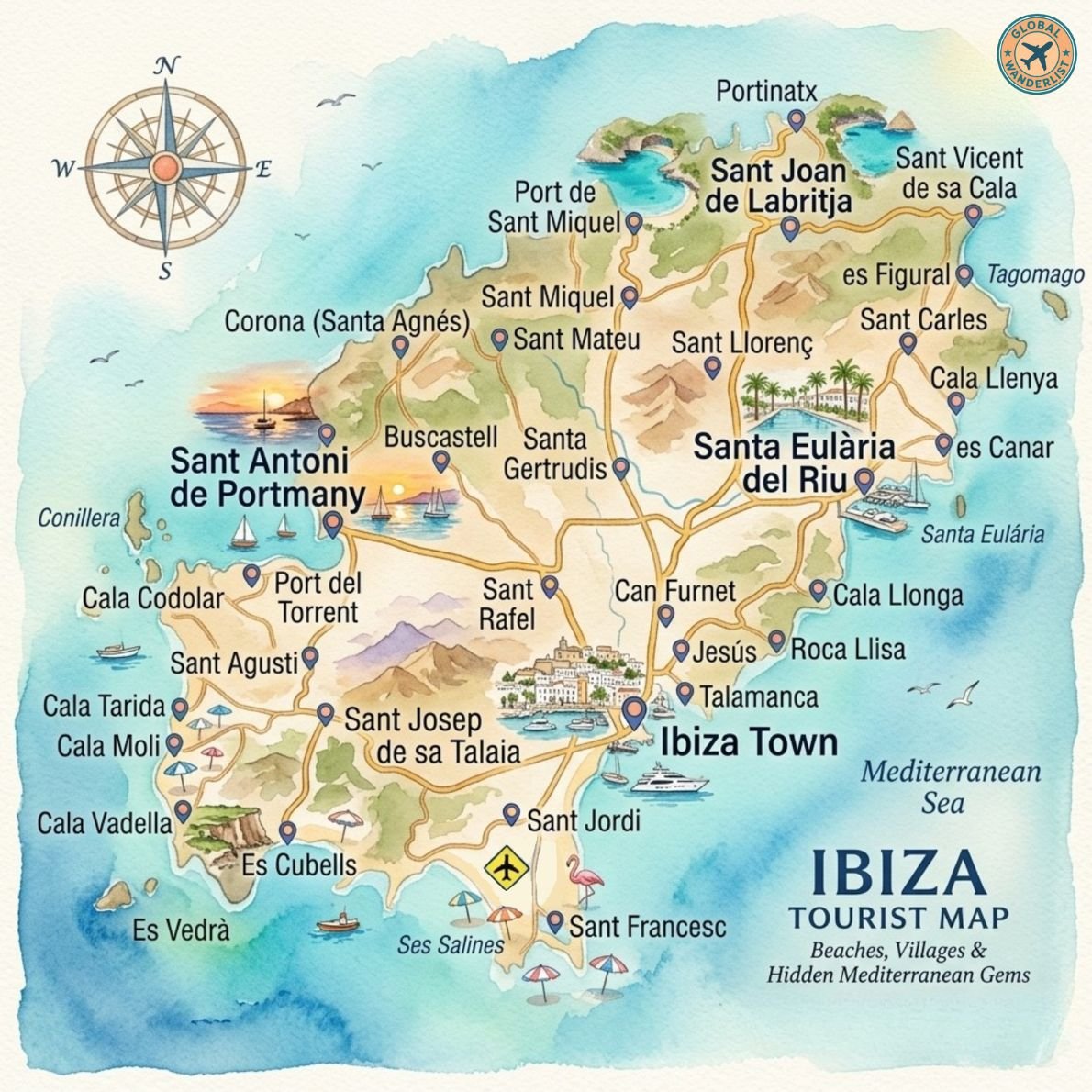
Ibiza is more than a party island. It is a place where 2,700 years of history meet turquoise coves and whitewashed villages. Phoenicians, Romans, Moors, and Catalans all left their mark here. Today that layered past sits alongside pine-covered hills, hidden beaches, and a UNESCO-listed old town.
Travelers come for the nightlife, but they stay for something quieter. Sunset over Es Vedrà, a quiet hike near Santa Agnès, or a plate of fresh fish in a fishing village can be just as memorable as any club. This guide walks through the island’s main towns, coastal villages, and natural landmarks. It gives you a real sense of what each place offers before you plan your route.
Quick Overview
| Place | Category | Best Known For | Recommended Visit Duration |
|---|---|---|---|
| Ibiza Town (Dalt Vila) | Historic Town | UNESCO old town, nightlife, harbor views | 1-2 days |
| Santa Eulària des Riu | Coastal Town | Riverside promenade, family beaches | Half day to 1 day |
| Sant Joan de Labritja | Rural Municipality | Portinatx beaches, quiet countryside | Half day |
| Sant Miquel de Balansat & Santa Agnès | Inland Villages | Church caves, hiking, hilltop views | Half day |
| Santa Gertrudis de Fruitera | Village | Boutique shopping, cafe culture | 2-3 hours |
| Sant Antoni de Portmany | Coastal Town | Sunset strip, superclubs, harbor | Half day to 1 day |
| Sant Josep de sa Talaia & Southwest Beaches | Coastal Region | Cala Vadella, Cala Tarida, cliffside coves | 1 day |
| Es Vedrà & Cala d’Hort | Natural Landmark | Mythical rock island, sunset views | 2-3 hours |
| Ses Salines Natural Park | Nature Reserve | Salt flats, flamingos, protected beaches | Half day |
Ibiza Town
Ibiza Town, known locally as Eivissa, anchors the entire island. Its crown jewel is Dalt Vila, a fortified hilltop old town. Phoenicians first settled this hill around 654 BC, calling it Ibosim.
UNESCO named Dalt Vila a World Heritage Site in 1999. The recognition honors its 16th-century Renaissance walls and its layered Phoenician, Roman, and Moorish history. Steep cobbled lanes wind past whitewashed houses, artisan shops, and candlelit restaurants. Below the walls, the modern port mixes megayachts with old fishing boats.
What to See in Ibiza Town
- Dalt Vila’s fortified walls show off Renaissance military engineering designed by Italian architect Giovanni Battista Calvi. Walking the ramparts gives sweeping views over the harbor and Formentera.
- Ibiza Cathedral sits at the top of the old town. Its Gothic base and Baroque additions reflect centuries of rebuilding.
- Portal de ses Taules is the dramatic main gateway into Dalt Vila, flanked by weathered Roman statues. It sets the tone for the maze of streets beyond.
- Talamanca Beach offers calm, shallow water close to town. It suits families who want a beach without leaving the city.
- Jesús village sits just outside town and holds a 16th-century church with a notable Gothic altarpiece. It makes a quiet stop away from the crowds.
- Cala Llonga and Roca Llisa lie a short drive east. Both offer sheltered swimming and golf access for a slower pace near the capital.
Plan at least a full day for Dalt Vila alone. Wear flat shoes since the streets are steep and uneven. Early morning or early evening light works best for photos of the harbor.
Santa Eulària des Riu
Santa Eulària des Riu takes its name from Ibiza’s only year-round river. The town spreads along a wide promenade lined with palm trees and cafes. It feels calmer than Ibiza Town but still holds real charm.
A hilltop church called Puig de Missa overlooks the town center. Its whitewashed walls and defensive design reflect centuries of pirate raids on the coast. The surrounding countryside holds small farming villages that still feel untouched by tourism.
What to See in Santa Eulària des Riu
- Puig de Missa church crowns a hill above town. Its thick walls once sheltered villagers during pirate attacks, and the terrace offers wide coastal views.
- Santa Eulària’s riverside promenade is lined with restaurants and small boutiques. It is one of the best places on the island for an evening stroll.
- Sant Carles is a laid-back inland village known for its hippy market roots and relaxed cafe scene. It remains a favorite among long-term visitors.
- es Canar holds one of Ibiza’s original hippy markets, still running on Wednesdays. Vendors sell jewelry, leather goods, and local crafts.
- Cala Llenya is a family-friendly cove with fine sand and calm, protected water. It rarely feels crowded even in peak season.
- Sant Llorenç de Balàfia is a tiny inland village with a fortified church tower. It offers a glimpse of rural Ibiza far from the coast.
Santa Eulària works well as a base for travelers who want beach access without constant nightlife noise. Renting a car helps, since many of the best coves sit outside town.
Sant Joan de Labritja and the North Coast
Sant Joan de Labritja is the least developed municipality on the island. Pine forests, terraced farmland, and quiet roads dominate the landscape. This is where Ibiza’s slower, rural character comes through most clearly.
The north coast around Portinatx has drawn visitors since the 1960s, yet it never grew into a party zone. Small hotels and family-run restaurants still define the area.
What to See in Sant Joan de Labritja
- Portinatx has three coves with pale sand and clear, shallow water. It remains one of the best spots on the island for families with young children.
- Sant Vicent de sa Cala sits on a dramatic bay backed by pine-covered cliffs. The beach here is quieter than most on the north coast.
- es Figueral offers a long stretch of reddish sand facing the small island of Tagomago. Snorkeling conditions are usually excellent.
- Port de Sant Miquel combines a working harbor with a sandy beach framed by steep hills. Boat trips to nearby caves depart from here.
- Cala Xarraca, tucked nearby, has reddish clay and mineral-rich mud that some visitors use for a natural skin treatment.
- Winding countryside roads connect small agricultural hamlets, ideal for slow scenic drives away from the coast.
Visit in June or September to avoid peak crowds while still getting warm water. A rental car is almost essential here since public transport is limited.
Sant Miquel de Balansat and Santa Agnès
This northwestern region blends farmland with rugged coastline. Sant Miquel village sits on a hill and holds one of the island’s oldest fortified churches. Nearby Santa Agnès, sometimes called Corona, is known for underground chapels carved into rock.
The area feels remote compared to the south coast. Stone farmhouses, called fincas, dot the hillsides between olive groves and almond trees.
What to See in Sant Miquel de Balansat and Santa Agnès
- Sant Miquel’s fortified church dates to the 14th century and once doubled as a refuge during raids. Folk dance performances still take place here in summer.
- Santa Agnès de Corona holds a small rock-cut chapel believed to date from early Christian times. It draws visitors interested in Ibiza’s quieter spiritual history.
- Sant Mateu d’Albarca produces some of the island’s best wine grapes. A few small wineries welcome visitors for tastings.
- Buscastell is a scattered rural hamlet surrounded by terraced hillsides. It shows traditional Ibicenco farming architecture up close.
- Cova de Can Marçà, near Port de Sant Miquel, is a cave system with stalactites and a small waterfall show. It suits travelers looking for something different from the beach.
- Hiking trails near Santa Agnès wind through pine forest toward sea cliffs, offering some of the island’s best sunset viewpoints.
Give this region at least half a day. The roads are narrow and hilly, so drive carefully and allow extra time between stops.
Santa Gertrudis de Fruitera
Santa Gertrudis sits almost dead center on the island. Once a simple farming village, it has become a favorite stop for design-conscious travelers. Its plaza fills with outdoor cafe tables shaded by old trees.
Art galleries and boutique shops line the small streets around the church. Despite the polish, the village keeps a relaxed, unhurried pace.
What to See in Santa Gertrudis de Fruitera
- The central plaza is the heart of the village, ringed by cafes serving strong coffee and fresh pastries. It is a favorite people-watching spot.
- Local art galleries showcase both Ibicenco and international artists. Many double as cozy wine bars in the evening.
- Boutique shops sell handmade leather sandals, ceramics, and linen clothing inspired by island style.
- The village church, simple and whitewashed, anchors the plaza and reflects classic Ibicenco religious architecture.
- Nearby country lanes lead to small organic farms that supply many of Ibiza’s top restaurants.
A couple of hours here is usually enough. Late morning or early evening offers the best atmosphere, before or after the midday heat.
Sant Antoni de Portmany
Sant Antoni de Portmany sits on a wide bay facing west, which makes it famous for sunsets. The town built its reputation on beach bars and open-air clubs. In recent years it has also worked to soften its image with a renovated seafront promenade.
Sant Antoni’s harbor once served as a key fishing and trading port. That maritime history still shows in the older streets away from the main tourist strip.
What to See in Sant Antoni de Portmany
- The Sunset Strip along Cap Martinet draws crowds nightly for open-air music and unobstructed views over the bay.
- Egg Beach (Caló des Moro) is a small pebble cove near the old town, popular for swimming close to the harbor.
- Cala Codolar offers a quieter stretch of coast with rocky outcrops and clear water, just south of the main resort area.
- Port del Torrent is a compact beach backed by pine trees, easily reached by local bus from town.
- Conillera Island, visible offshore, is a protected islet home to a unique subspecies of wall lizard.
- The renovated seafront promenade links restaurants, ice cream shops, and small squares, making evening strolls easy and scenic.
Visit around sunset for the best experience, ideally with an early dinner reservation facing the bay. Daytime crowds thin out considerably by late morning.
Sant Josep de sa Talaia and the Southwest Beaches
Sant Josep de sa Talaia takes its name from the island’s highest peak, which rises just behind the village. This municipality covers much of Ibiza’s dramatic southwest coastline, known for pine-backed cliffs and small coves.
The village itself is understated, with a striking whitewashed church at its center. It works well as a gateway to some of the island’s most photogenic beaches.
What to See in Sant Josep de sa Talaia
- Sant Josep village church offers panoramic views from its steps, especially at sunset. The surrounding square hosts a lively summer market.
- Cala Tarida has soft white sand and shallow turquoise water, making it a favorite for families and sunset dinners.
- Cala Moli is a smaller, quieter cove tucked between cliffs, ideal for travelers avoiding crowds.
- Cala Vadella sits inside a narrow, sheltered inlet, keeping the water calm even on windier days.
- Es Cubells perches on a clifftop with sweeping sea views and a small 20th-century church worth a quick stop.
- Sant Agustí des Vedrà is a peaceful inland village that makes a good base for exploring the southwest coast.
Base yourself here for two or three days if beach-hopping is your priority. Many coves are a short drive apart, so a car makes the most of your time.
Es Vedrà and Cala d’Hort
Es Vedrà rises 382 meters straight out of the sea off Ibiza’s southwest coast. This uninhabited limestone islet has inspired legends for centuries. Ancient Phoenicians may have linked it to Tanit, their goddess of fertility and the moon.
Some stories connect Es Vedrà to Homer’s sirens or even Atlantis. Scientifically, its high iron content has fueled tales of magnetic anomalies. Whatever you believe, the sight of it at sunset is genuinely striking.
What to See in Es Vedrà and Cala d’Hort
- Cala d’Hort beach gives the classic front-row view of Es Vedrà, especially stunning around sunset.
- Torre des Savinar viewpoint sits on a clifftop trail above Cala d’Hort, reachable by a short uphill walk from a small parking area.
- Es Vedranell, the smaller islet beside Es Vedrà, adds to the dramatic silhouette on the horizon.
- Boat tours from Sant Antoni or Ibiza Town circle the islet, offering close-up views that are not possible from land, since landing is prohibited.
- The surrounding waters form part of a biosphere reserve, home to nesting Eleonora’s falcons each summer.
Arrive at Cala d’Hort at least an hour before sunset to secure a good spot on the beach or nearby restaurant terraces.
Ses Salines Natural Park
Ses Salines Natural Park stretches across Ibiza’s southern tip and connects visually toward Formentera. Salt production here dates back to Phoenician times around the 8th century BC. For centuries, salt was one of Ibiza’s most valuable exports.
The park became a protected nature reserve in 1995. It now shelters over 200 recorded bird species, including hundreds of greater flamingos that gather between summer and winter.
What to See in Ses Salines Natural Park
- The salt flats themselves shift color from pink to white depending on the season, creating striking photo opportunities.
- Flamingo viewing points, especially near Ses Salines beach, offer the best chance to spot flocks up close between July and October.
- Ses Salines Beach combines soft sand with views toward Formentera, making it one of the island’s most scenic swimming spots.
- Sant Jordi de ses Salines is a small village near Ibiza’s airport, useful as a quiet, practical base close to the park.
- Sant Francesc de s’Estany holds a tiny whitewashed church overlooking the salt ponds, worth a brief stop.
- Es Cavallet Beach, just east of the salt flats, offers a more relaxed, less commercial stretch of sand.
Bring binoculars if birdwatching interests you, and visit in the early morning or late afternoon for softer light and active wildlife.
Beyond the Highlights
Ibiza rewards travelers who venture past its famous beaches and clubs. Inland villages like Sant Rafel and hamlets near Can Furnet hold centuries-old churches and quiet countryside worth a detour. Small farm roads connect almost every part of the island, so a rental car opens up places most visitors never see.
Spend at least a week if you can. Split your time between the historic streets of Dalt Vila, the wild coastline near Es Vedrà, and a slow afternoon in a village like Santa Gertrudis. Ibiza’s real character lives in these quieter corners, not just its famous sunsets.