
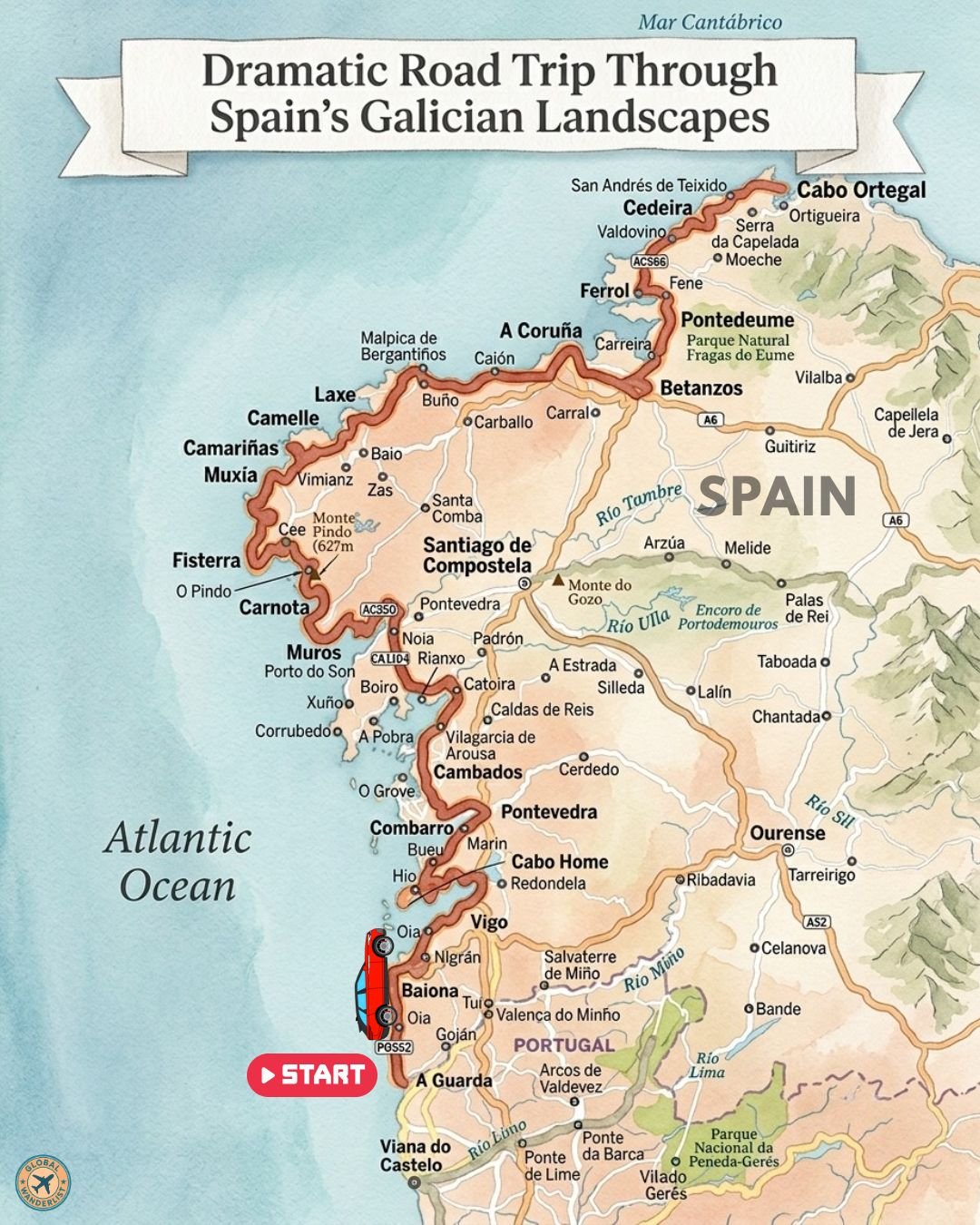
Galicia rewards travelers who love wind-battered cliffs, quiet fishing ports, and food that tastes like the ocean itself. This road trip traces the Rías Baixas up through the legendary Costa da Morte and on to the rugged capes of the north. Along the way you will pass medieval towns, granite lighthouses, and beaches that feel untouched by time.
This route suits travelers who enjoy slow mornings, fresh seafood, and short scenic detours more than fast highway miles. Photographers, foodies, and history lovers will all find plenty to love here. Expect narrow coastal roads, small parking lots, and villages best explored on foot.
Plan for at least seven to ten days to enjoy the full route without rushing. Spring and early fall bring milder weather and fewer crowds than peak summer. Always fill your gas tank in larger towns, since fuel stations thin out along the remote northern capes.
Trip Overview
| Stop | Distance from Previous Stop | Driving Time | Main Highlights | Recommended Stay |
|---|---|---|---|---|
| Baiona | Starting point | – | Medieval fortress, marina, Columbus replica ship | 1 night |
| Vigo | 22 km | 25 min | Old town, Michelin dining, Cíes Islands ferry | 1 night |
| Cabo Home | 35 km | 45 min | Wild headland, lighthouse trail, ocean views | 2 hours |
| Combarro | 45 km | 55 min | Granaries on stilts, stone crosses, seaside walk | 3 hours |
| Pontevedra | 7 km | 10 min | Pedestrian old quarter, plazas, riverside paths | 1 night |
| Cambados | 25 km | 30 min | Albariño wine region, Fefiñáns square | 1 night |
| Muros | 55 km | 1 hr | Arcaded streets, fishing harbor, quiet beaches | 1 night |
| Santiago de Compostela | 45 km | 50 min | Cathedral, pilgrim old town, markets | 1-2 nights |
| Fisterra | 90 km | 1 hr 30 min | “End of the world” lighthouse, sunset cliffs | 1 night |
| Camariñas | 35 km | 45 min | Lace-making tradition, wild coastline | 2 hours |
| Muxía | 25 km | 30 min | Sanctuary church, storm-carved rocks | 2 hours |
| Camelle | 20 km | 25 min | Man of the Sea garden, small cove | 1 hour |
| Laxe | 15 km | 20 min | Sandy beach, surf culture, old church | 1 hour |
| A Coruña | 65 km | 1 hr 10 min | Tower of Hercules, promenade, old town tapas | 1-2 nights |
| Betanzos | 25 km | 30 min | Medieval churches, famous tortilla, park | 3 hours |
| Pontedeume | 15 km | 20 min | Medieval bridge, riverside walk, castle ruins | 2 hours |
| Ferrol | 20 km | 25 min | Naval architecture, modernist district | 1 night |
| Cedeira | 35 km | 45 min | Sandy bay, cliffside hikes, tapas bars | 1 night |
| Cabo Ortegal | 35 km | 50 min | Dramatic sea cliffs, remote lighthouse, birdlife | 2 hours |
Baiona
Baiona feels like the perfect opening chapter for this journey. A hilltop fortress called Monte Real wraps the town in centuries-old stone walls. The marina buzzes with sailboats, and a replica of Columbus’s ship La Pinta sits proudly at the dock, marking the spot where the news of the Americas first reached Europe.
Where to Eat in Baiona
- Tapería La Abuela – Traditional Galician tapas – $$
- Restaurante Enxebre A Pinta (Parador de Baiona) – Regional fine dining – $$$
- El Juliana – Seafood platters – $$
- Casa Dávila – Grilled fish and shellfish – $$
What to See in Baiona
- Monte Real Fortress stretches around the entire peninsula, offering a scenic 3 km walking path with ocean views on both sides.
- La Pinta replica ship lets visitors step aboard and imagine the historic 1493 voyage that ended right here.
- Baiona old town is packed with narrow lanes, stone archways, and small squares perfect for an evening stroll.
- Praia Ladeira gives a quiet beach break just steps from the fortress walls.
Vigo
Vigo is Galicia’s largest city and a working port with real character. Its steep old town climbs from the harbor in a maze of granite streets lined with oyster stands. This is also the gateway to the Cíes Islands, often called one of Europe’s most beautiful archipelagos.
Where to Eat in Vigo
- Restaurante Maruja Limón – Michelin-starred Atlantic cuisine – $$$$
- O Portón – Seafood platters by weight – $$$
- Taberna A Pedra – Traditional Galician tapas – $$
- A’ Curuxa – Rustic tavern fare with live music – $$
What to See in Vigo
- Cíes Islands ferry carries visitors to protected white-sand beaches and turquoise water, best booked in advance during summer.
- Casco Vello (old town) rewards wandering with oyster bars set up right on the cobblestones.
- Vigo Cathedral anchors the historic center with quiet cloisters worth a short visit.
- Castro Fortress park offers sweeping views over the entire bay and is a great sunset photography spot.
Cabo Home
Cabo Home marks a wild, windswept turn on the drive north. This headland sits at the mouth of the Vigo estuary, where the Atlantic swell crashes against dark granite cliffs. Few tour buses make it out here, which keeps the scenery feeling wonderfully untouched.
Where to Eat near Cabo Home
- Restaurante Doniños (Hio) – Local seafood – $$
- Mesón O Solpor (Donón) – Home-style Galician cooking – $
- Bar O Peirao – Casual seaside snacks – $
What to See at Cabo Home
- Cabo Home lighthouse trail winds along dramatic cliffs with views toward the Cíes Islands.
- Praia de Barra offers one of the region’s most photogenic beaches, backed by pine forest.
- Hío cruceiro is a famous 19th-century stone cross considered one of the finest examples in Galicia.
- Donón viewpoint gives an excellent spot to watch the sun set over the open Atlantic.
Combarro
Combarro is one of Galicia’s most photographed villages, and it earns every bit of the attention. Rows of granite hórreos, the traditional raised granaries, line the waterfront on stilts above the tide. Stone crosses and narrow fishing lanes complete a scene that feels frozen in an earlier century.
Where to Eat in Combarro
- Restaurante O Bocoi – Traditional seafood – $$
- Bar Pedramar – Grilled octopus and shellfish – $$
- Arroyo Mar y Tierra – Rice and seafood dishes – $$
What to See in Combarro
- Hórreo row along the harbor forms the most iconic photo spot in the village, especially at low tide.
- Combarro’s granite cruceiros dot the old quarter and reflect centuries of local devotion.
- Waterfront promenade offers easy walking with views across the Pontevedra estuary.
- Praia de Combarro is a small beach ideal for a short break between meals.
Pontevedra
Pontevedra rewards a slower pace with one of the best-preserved old towns in Galicia. Nearly the entire historic center is pedestrian only, which makes wandering its plazas genuinely relaxing. This is a city built for walking, coffee stops, and getting pleasantly lost.
Where to Eat in Pontevedra
- Casa Fidel O’Pulpeiro – Classic octopus tavern – $$
- Restaurante Loaira – Modern Galician cuisine – $$$
- Viñoteca Bagos – Wine bar with tapas – $$
What to See in Pontevedra
- Praza da Ferrería is the social heart of the city, ringed by cafés and the Peregrina church.
- Basilica de Santa María a Maior shows off elaborate Plateresque stonework near the old harbor.
- Museo de Pontevedra houses an impressive collection covering Galician art and archaeology.
- Alameda park offers a shaded, tree-lined space perfect for a break from walking.
Cambados
Cambados sits at the heart of the Albariño wine region, and the town wears that identity proudly. Grand stone mansions surround the central Fefiñáns square, one of the most elegant plazas in rural Galicia. Wine tastings, seafood, and coastal views make this an easy place to linger.
Where to Eat in Cambados
- Yayo Daporta – Michelin-starred Galician cuisine – $$$$
- A Taberna do Trasno – Basque-Galician seafood fusion – $$$
- Cafe Bogart – Casual traditional dishes – $$
What to See in Cambados
- Praza de Fefiñáns is lined with 17th-century palaces and working Albariño wineries.
- A Bodegas Albariño tastings let visitors sample the region’s signature crisp white wine straight from the source.
- Paseo da Calzada follows the waterfront with clear views across the Ría de Arousa.
- A Fortaleza de San Sadurniño ruins add a scenic, quiet stop near the coast.
Muros
Muros feels like a step back in time, with arcaded stone streets that once sheltered fishermen from Atlantic storms. The compact old town spills right down to a working harbor still active with local boats. It is a quieter stop than some of the bigger coastal towns, and that is exactly its charm.
Where to Eat in Muros
- Restaurante O Peirao – Fresh local seafood – $$
- Taberna A Solaina – Traditional Galician tapas – $
- Bar Muradana – Casual harbor-side dining – $
What to See in Muros
- Muros old quarter features covered arcades called soportais that are unique to this stretch of coast.
- Muros harbor stays lively with fishing boats unloading the day’s catch each afternoon.
- Praia de San Francisco offers an easy sandy stop just outside town.
- Monte Louro viewpoint rewards a short hike with panoramic views over the Ría de Muros e Noia.
Santiago de Compostela
No trip through Galicia feels complete without a detour to Santiago de Compostela. This is the legendary end point of the Camino pilgrimage, anchored by a cathedral whose baroque towers dominate the skyline. The old town buzzes with pilgrims, students, and locals crowding narrow granite lanes.
Where to Eat in Santiago de Compostela
- Casa Marcelo – Creative Galician fine dining – $$$
- Abastos 2.0 – Market-fresh seafood tapas – $$$
- Taberna O Gato Negro – Classic no-frills tapas bar – $
- Bar La Tita – Tortilla and casual tapas – $
What to See in Santiago de Compostela
- Santiago Cathedral anchors the Praza do Obradoiro and marks the end of the Camino de Santiago routes.
- Mercado de Abastos offers a lively look at Galician produce, cheese, and seafood.
- Old town streets are packed with stone arcades, bagpipers, and centuries of pilgrim history.
- Parque da Alameda gives sweeping views back toward the cathedral towers through the trees.
Fisterra
Fisterra carries the weight of legend as the “End of the World,” once believed to be the edge of the known map. A lighthouse perches dramatically on the final cliffs, staring straight into the open Atlantic. Watching sunset here, after the Camino pilgrims arrive on foot, is genuinely unforgettable.
Where to Eat in Fisterra
- Restaurante Tira do Cordel – Modern Galician seafood – $$$
- Restaurante O Centolo – Classic seafood and mariscada – $$
- Casa Lourdes (O’Fragón) – Traditional home-style cooking – $$
What to See in Fisterra
- Cabo Fisterra lighthouse offers the single best sunset viewpoint on the entire trip.
- Praia do Rostro delivers dramatic, wild dunes just south of town.
- Fisterra old fishing port is a great spot to watch boats return with the daily catch.
- Camino marker at kilometer zero draws pilgrims completing their long walk from Santiago.
Camariñas
Camariñas is famous across Spain for its delicate handmade lace, a tradition still practiced by local artisans. Beyond the craftwork, the town sits on a wild, rocky stretch of the Costa da Morte. Storms here have wrecked ships for centuries, giving the coastline its haunting name.
Where to Eat in Camariñas
- Restaurante Rústico – Seafood with harbor views – $$
- A Marina Camariñas – Fresh fish and grilled shellfish – $$
- Café Bar O Muro – Casual coastal fare – $
What to See in Camariñas
- Museo do Encaixe showcases the town’s centuries-old lace-making traditions with live demonstrations.
- Cabo Vilán lighthouse stands on a rugged point with sweeping ocean panoramas.
- Praia do Trece offers a peaceful, less crowded stretch of sand nearby.
- Camariñas harbor stays active with small fishing boats worth a quiet stroll.
Muxía
Muxía holds deep spiritual meaning thanks to the Santuario da Virxe da Barca, a church perched right above crashing waves. Wind-carved granite boulders surround the sanctuary, creating one of the most dramatic religious sites in Spain. The town itself remains a working fishing village with real, unpolished charm.
Where to Eat in Muxía
- Lonxa D’alvaro – Seafood facing the harbor – $$
- Pedra D’abalar – Coastal dining with sea views – $$
- A Marina de Muxía – Lively harborside seafood – $$
What to See in Muxía
- Santuario da Virxe da Barca sits directly on the rocks, with waves sometimes splashing the church steps.
- Pedra de Abalar is a legendary rocking stone believed to test the faith of those who touch it.
- Muxía lighthouse provides a scenic short walk with wide Atlantic views.
- Muxía harbor front offers a relaxed spot to watch local fishing life unfold.
Camelle
Camelle is a small, sleepy cove with an unusual claim to fame. German-born artist Manfred Gnädinger, known locally as Man, spent decades building sculptures along the shoreline here. His weathered garden of stone and concrete art still overlooks the sea today.
Where to Eat in Camelle
- Bar O Refuxio – Simple local seafood – $
- Restaurante A Solaina de Camelle – Traditional Galician plates – $$
What to See in Camelle
- Museo Man preserves the eccentric shoreline sculptures left by the artist who once called this cove home.
- Camelle harbor is tiny, quiet, and ideal for an unhurried coffee break.
- Coastal footpath connects Camelle to nearby Arou with scenic cliffside views.
- Praia de Camelle offers a small sheltered spot for a quick dip in calmer months.
Laxe
Laxe brings a change of pace with a wide sandy beach that draws surfers and families alike. The town’s old church and small fishing harbor sit just steps from the sand. It is a relaxed, low-key stop before the route swings toward the busier city of A Coruña.
Where to Eat in Laxe
- Restaurante Aduaneiros – Seafood with beach views – $$
- Bar O Peirao de Laxe – Casual tapas and grilled fish – $
What to See in Laxe
- Praia de Laxe is one of the longest and most popular beaches on the Costa da Morte.
- Iglesia de Santa María da Atalaia stands as a striking Gothic ruin near the shoreline.
- Laxe harbor offers pleasant views and fresh air along a short promenade.
- Soesto viewpoint nearby provides a scenic detour over the coastline for photographers.
A Coruña
A Coruña blends a working port city with genuine seaside glamour. Glassed-in balconies called galerías line the waterfront, earning it the nickname “the city of glass.” A famous Roman lighthouse still guides ships into harbor after nearly two thousand years.
Where to Eat in A Coruña
- Pulpeira O Fiuza – Traditional octopus tavern – $
- Restaurante La Penela – Classic Galician cuisine on Plaza Maria Pita – $$$
- Artabria – Fresh fish and seafood – $$$
What to See in A Coruña
- Tower of Hercules is the only Roman lighthouse still in operation, and it holds UNESCO World Heritage status.
- Paseo Marítimo offers one of the longest waterfront promenades in Europe, ideal for a sunset walk.
- Plaza de María Pita anchors the old town with grand architecture and lively terraces.
- Playa de Riazor gives city dwellers an easy urban beach right downtown.
Betanzos
Betanzos carries the weight of history as one of Galicia’s former provincial capitals. Medieval churches and a well-preserved old quarter make it feel like an open-air museum. The town is also famous nationwide for what many consider Spain’s best Spanish tortilla.
Where to Eat in Betanzos
- Mesón O Pote – Award-winning Spanish tortilla – $$
- Casa Carmen – Traditional Galician home cooking – $$
- Casa Miranda – Classic tortilla and local plates – $
What to See in Betanzos
- Casco histórico de Betanzos preserves narrow medieval streets packed with noble houses.
- Iglesia de Santa María del Azogue shows off striking Gothic architecture in the town center.
- Parque do Pasatempo surprises visitors with unusual 19th-century sculptures and follies.
- Praza dos Irmáns García Naveira serves as the lively central meeting point of the old town.
Pontedeume
Pontedeume sits where a wide river meets the sea, crossed by a long historic bridge. Castle ruins overlook the town from a nearby hilltop, hinting at its strategic medieval importance. The riverside promenade makes for an easy, scenic stop between larger stops.
Where to Eat in Pontedeume
- Restaurante O Muiño – Riverside seafood – $$
- Casa do Castelo – Traditional Galician plates – $$
What to See in Pontedeume
- Puente medieval sobre el río Eume offers a scenic crossing with river views in both directions.
- Torreón dos Andrade remains from the medieval castle that once guarded the town.
- Parque Natural Fragas do Eume lies nearby, protecting one of Europe’s best-preserved Atlantic woodlands.
- Pontedeume waterfront is a relaxed spot for a coffee break overlooking the estuary.
Ferrol
Ferrol grew around Spain’s naval history, and its architecture still reflects that maritime past. The Magdalena district shows off elegant modernist buildings rarely found outside major cities. It is a working town with an authentic, unpolished feel compared to more touristy stops.
Where to Eat in Ferrol
- Cervexaria El Cid – Traditional tapas bar – $
- Il Pincho – Galician-style octopus and tapas – $$
- Restaurante As Termas – Regional seafood – $$
What to See in Ferrol
- Barrio de A Magdalena features some of Galicia’s best-preserved modernist facades.
- Ferrol naval arsenal highlights the city’s centuries-long shipbuilding heritage.
- Castillo de San Felipe guards the harbor entrance and offers coastal views.
- Ferrol old town squares provide a relaxed setting for evening tapas crawls.
Cedeira
Cedeira feels wonderfully removed from the tourist trail, wrapped around a wide sandy bay. Fishing boats still define daily life here, and the surrounding cliffs offer some of the best coastal hiking in Galicia. This is a great overnight stop before pushing on to the wildest capes of the north.
Where to Eat in Cedeira
- Mesón Muiño Kilowatio – Lively local tapas and shark dishes – $$
- Taberna do Puntal – Rustic riverside tavern – $$
- Bar Restaurante O Refuxio – Casual grilled seafood – $
What to See in Cedeira
- Praia de Vilarrube offers dunes and a scenic river mouth just outside town.
- Cedeira old town keeps a genuine fishing village atmosphere along its harbor.
- Garita de Herbeira nearby ranks among Europe’s highest sea cliffs, with jaw-dropping views.
- Cedeira coastal path connects several quiet beaches for an active afternoon.
Cabo Ortegal
Cabo Ortegal marks a fitting, dramatic finale to this coastal journey. Sheer cliffs plunge hundreds of meters into the Atlantic, among the highest in continental Europe. Seabirds circle constantly here, and on clear days the views stretch for miles along the wild northern coast.
Where to Eat near Cabo Ortegal
- Restaurante O Vixía – Simple coastal seafood – $$
- Bar Casa Pepa (Cariño) – Local tapas and grilled fish – $
What to See at Cabo Ortegal
- Cabo Ortegal lighthouse sits at the dramatic meeting point of the Atlantic and Cantabrian seas.
- Os Tres Aguillóns are jagged sea stacks visible just offshore, a favorite for photographers.
- Cariño fishing village nearby offers a peaceful final stop with harbor views.
- Vixía Herbeira viewpoint rounds out the trip with one of the highest cliff panoramas in Europe.
Final Thoughts
This drive through Galicia delivers far more than scenic coastline. Every stop adds its own layer of history, flavor, and character to the journey. Give yourself extra time wherever a view or a plate of octopus tempts you to linger.
Pack layers, since coastal weather shifts quickly even in summer. Book accommodations early in Santiago and A Coruña during peak season. However you plan it, this route stands out as one of the most rewarding road trips in Spain.