
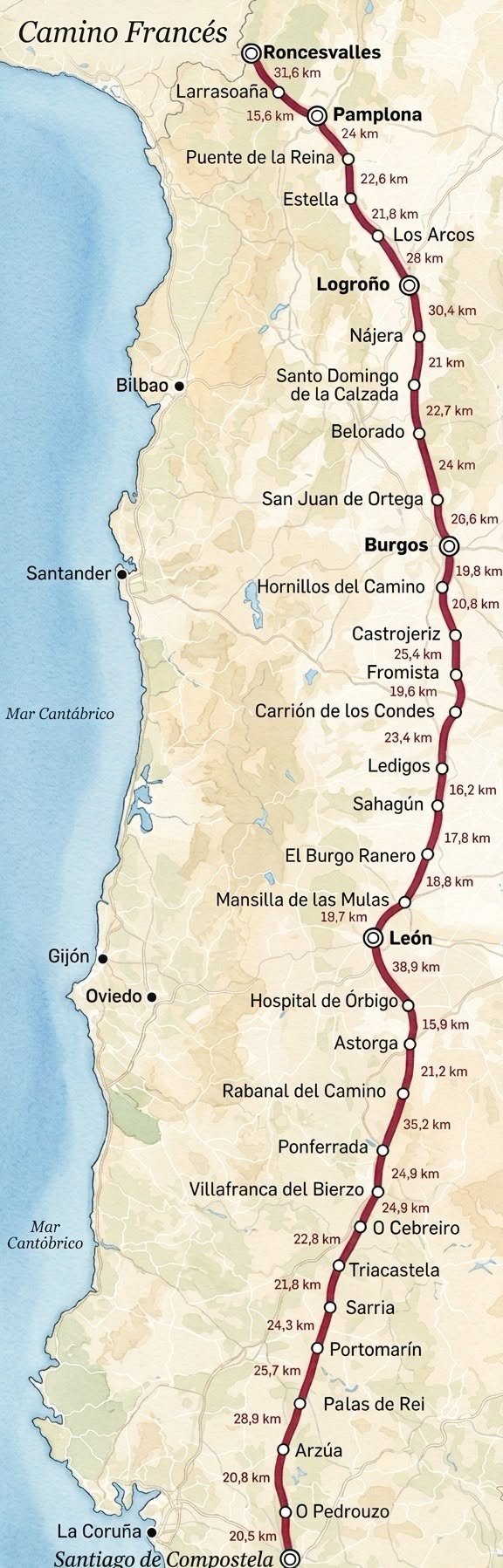
The Camino Francés is the most walked pilgrimage route in the world. It crosses the Pyrenees, the wine country of La Rioja, the wide-open Meseta plateau, and the green hills of Galicia before reaching Santiago de Compostela. Few long-distance trails offer this much variety in one continuous walk.
The terrain shifts constantly along the way. Mountain passes give way to vineyards, then to flat farmland, then to misty Galician forest. Most days involve moderate walking on well-marked paths, though the opening stage over the Pyrenees and the climb into O Cebreiro are genuinely tough.
This route suits hikers who want a long-distance challenge without technical climbing. It works for complete beginners building up gradually and for experienced trekkers seeking a cultural, social walk. Expect crowded albergues in peak summer and quiet, reflective stretches in the shoulder seasons.
Trek Summary Table
| Trek Stop | Elevation | Distance from Previous Stop | Estimated Hiking Time | Overnight Stay |
|---|---|---|---|---|
| Roncesvalles | 900 m | Starting point | N/A | Albergue de Peregrinos or Hotel Roncesvalles |
| Larrasoaña | 480 m | 31.6 km | 7-8 hours | Albergue San Nicolás |
| Pamplona | 449 m | 15.6 km | 3.5-4 hours | Gran Hotel La Perla or Pamplona Catedral Hotel |
| Puente la Reina | 346 m | 24 km | 5.5-6 hours | Albergue Estrella Guía |
| Estella | 426 m | 22.6 km | 5-5.5 hours | Hospedería Chapitel |
| Los Arcos | 444 m | 21.8 km | 5-5.5 hours | Hotel Rural Latorrién de Ane |
| Logroño | 384 m | 28 km | 6.5-7 hours | Áurea Palacio de Correos |
| Nájera | 485 m | 30.4 km | 7-7.5 hours | Hotel Duques de Nájera |
| Santo Domingo de la Calzada | 639 m | 21 km | 5 hours | Parador de Santo Domingo de la Calzada |
| Belorado | 770 m | 22.7 km | 5-5.5 hours | Hotel Rural Verdeancho |
| San Juan de Ortega | 1,010 m | 24 km | 5.5-6 hours | Albergue San Juan de Ortega |
| Burgos | 856 m | 26.6 km | 6-6.5 hours | Hotel Abba Burgos or Palacio de Burgos |
| Hornillos del Camino | 820 m | 19.8 km | 4.5-5 hours | Albergue Santa Brígida |
| Castrojeriz | 808 m | 20.8 km | 5 hours | La Posada de Castrojeriz |
| Frómista | 780 m | 25.4 km | 6 hours | Eco-Hotel Doña Mayor |
| Carrión de los Condes | 830 m | 19.6 km | 4.5 hours | Hotel Real Monasterio San Zoilo |
| Ledigos | 880 m | 23.4 km | 5.5 hours | Albergue La Morena |
| Sahagún | 816 m | 16.2 km | 4 hours | Hostal Domus Viatoris |
| El Burgo Ranero | 881 m | 17.8 km | 4 hours | Pensión La Costa del Adobe |
| Mansilla de las Mulas | 799 m | 18.8 km | 4.5 hours | Hotel Rural La Casa de los Soportales |
| León | 838 m | 18.7 km | 4.5 hours | Parador de León, Hostal de San Marcos |
| Hospital de Órbigo | 820 m | 38.9 km | 8.5-9 hours | Albergue Verde |
| Astorga | 869 m | 15.9 km | 3.5-4 hours | Hotel Astur Plaza |
| Rabanal del Camino | 1,150 m | 21.2 km | 5 hours | Refugio Gaucelmo |
| Ponferrada | 543 m | 35.2 km | 8 hours | AR Ponferrada Plaza |
| Villafranca del Bierzo | 511 m | 24.9 km | 5.5-6 hours | Hotel Ambasmestas |
| O Cebreiro | 1,300 m | 24.9 km | 6.5-7 hours | Casa Navarro or Alberguería do Cebreiro |
| Triacastela | 665 m | 22.8 km | 5.5 hours | Complexo Xacobeo |
| Sarria | 453 m | 21.8 km | 5-5.5 hours | Hotel Alfonso IX |
| Portomarín | 341 m | 24.3 km | 5.5-6 hours | Pousada de Portomarín |
| Palas de Rei | 565 m | 25.7 km | 6 hours | Hotel Casa Benilde |
| Arzúa | 388 m | 28.9 km | 6.5-7 hours | Pensión Rúa |
| O Pedrouzo | 420 m | 20.8 km | 5 hours | Hotel Edreira |
| Santiago de Compostela | 260 m | 20.5 km | 5 hours | Parador Hostal dos Reis Católicos |
Roncesvalles
Roncesvalles sits just south of the French border, wrapped in beech forest at the foot of the Pyrenees. This is where Charlemagne’s rear guard was famously defeated in 778, a battle immortalized in the medieval epic the Song of Roland. The monastery complex here has sheltered pilgrims for nearly nine centuries.
Most hikers arrive exhausted after crossing the mountains from Saint-Jean-Pied-de-Port. The collegiate church, cloister, and pilgrim office give the village a hushed, historic weight before the long walk begins.
Where to Stay in Roncesvalles
The Albergue de Peregrinos, housed inside the old monastery buildings, offers dormitory beds and a genuinely warm welcome from its volunteer staff. Hotel Roncesvalles, rated 4.4 on Google, provides a more comfortable option with spacious rooms and a full breakfast. Both fill quickly in summer, so early booking is wise.
What to See in Roncesvalles
- Real Colegiata de Santa María: This Gothic church anchors the whole complex and holds a revered silver statue of the Virgin Mary.
- Museo de Roncesvalles: Small but rich in medieval artifacts connected to the battle and centuries of pilgrimage.
- Ibañeta Pass: A short walk uphill marks the point where Roland is said to have fallen, with views back toward France.
- Beech forest trails: The surrounding woodland turns brilliant gold in autumn, a peaceful contrast to the mountain crossing.
- Santiago sign: The iconic “790 km to Santiago” marker just outside the village is a favorite first photo stop.
Larrasoaña
The trail from Roncesvalles drops through farmland and small Navarrese villages before reaching Larrasoaña. This stretch passes through Zubiri, known for its old bridge over the Arga River, before continuing to this quiet riverside settlement. It is a long first proper day of walking after the mountain crossing.
Larrasoaña itself is small, with a medieval bridge and a handful of stone houses. Storks nest on rooftops here in spring, adding a distinctive soundtrack to the evening.
Where to Stay in Larrasoaña
Albergue San Nicolás is a modern, privately run hostel with excellent kitchen facilities and hot showers, well reviewed by pilgrims for its cleanliness and friendly owners. It sits slightly off the main path but is worth the short detour. Book ahead in peak season, as beds here go quickly.
What to See in Larrasoaña
- Puente de los Bandidos: This medieval bridge crossing the Arga River takes its name from local legends of highway robbers.
- Zubiri’s La Rabia bridge: Passed earlier in the stage, this bridge has its own folklore involving rabies-curing rituals for livestock.
- Arga River valley: The trail follows this river for much of the day, offering shaded, gentle walking.
- Village storks: Watch for large stork nests atop the church tower and rooftops, a common sight through spring and summer.
- Rural Navarrese architecture: Larrasoaña’s stone facades reflect centuries-old building traditions largely unchanged by tourism.
Pamplona
Pamplona is best known internationally for the Running of the Bulls each July, but it offers far more year-round. The old town is compact and walkable, with a well-preserved citadel and a Gothic cathedral. Ernest Hemingway made the city famous in his writing, and his favorite bars are still open today.
For pilgrims, Pamplona is a welcome dose of city energy after several days of rural walking. It is also a natural resupply point before the route climbs toward the Alto del Perdón.
Where to Stay in Pamplona
Gran Hotel La Perla holds a 4.7 Google rating and occupies a historic building on the main square, offering a memorable splurge night. Pamplona Catedral Hotel, rated 4.4, provides a more modern, budget-friendly alternative near the cathedral. Both are well located for exploring the old town on foot.
What to See in Pamplona
- Catedral de Santa María la Real: A Gothic cathedral with an impressive cloister, considered one of the finest in northern Spain.
- Plaza del Castillo: The city’s social heart, ringed with cafés perfect for people-watching over coffee.
- Ciudadela de Pamplona: This star-shaped fortress and its surrounding parkland offer a green escape from the old town streets.
- Café Iruña: A historic café once frequented by Hemingway, still serving classic Navarrese dishes.
- City walls walk: A scenic path along the old fortifications gives sweeping views over the Arga River valley.
Puente la Reina
The trail leaves Pamplona and climbs to the Alto del Perdón, a windswept ridge lined with wind turbines and a striking iron sculpture of medieval pilgrims. The descent leads into Puente la Reina, named for its elegant six-arched Romanesque bridge. This is also where the French routes from Roncesvalles and Somport historically merged into one path.
The town has been shaped by centuries of pilgrim traffic, with narrow streets designed to funnel foot traffic toward the bridge.
Where to Stay in Puente la Reina
Albergue Estrella Guía is consistently praised by pilgrims for its warm hospitality, homemade cake, and included breakfast. The albergue occupies a beautifully decorated building near the town’s iconic bridge. Reservations are recommended in busy months, as it is considered one of the best private albergues on this stretch.
What to See in Puente la Reina
- Puente románico: This six-arched medieval bridge is the town’s namesake and one of the most photographed spots on the Camino.
- Alto del Perdón: The ridge before town features a famous silhouette sculpture of pilgrims walking into the wind.
- Iglesia del Crucifijo: A Romanesque church built by the Knights Templar, notable for its unusual Y-shaped crucifix.
- Old town street layout: Puente la Reina’s main street was purpose-built to guide medieval pilgrims straight to the bridge.
- Wind turbine ridgeline: The Alto del Perdón’s modern turbines create a striking contrast with the ancient pilgrim path below them.
Estella
Estella grew wealthy in the Middle Ages as a stop on the pilgrim route, and its architecture still reflects that prosperity. Romanesque churches and noble palaces line the streets above the Ega River. The town also sits near the famous Bodegas Irache wine fountain, where pilgrims can sample local wine for free.
Basque and Navarrese culture blend noticeably here, visible in the local cuisine and dialect.
Where to Stay in Estella
Hospedería Chapitel holds a 4.4 Google rating and occupies a restored historic building in the town center. Rooms are comfortable and modern despite the traditional exterior. Its central location makes it easy to reach the old town’s churches and restaurants on foot.
What to See in Estella
- Bodegas Irache wine fountain: A working fountain that dispenses free wine to passing pilgrims, a quirky and much-photographed Camino tradition.
- Iglesia de San Pedro de la Rúa: A Romanesque church with an unusual, asymmetrical staircase entrance.
- Palacio de los Reyes de Navarra: One of the few surviving examples of Romanesque civil architecture in Spain.
- Puente de la Cárcel: A medieval bridge over the Ega River, offering good views of the old town.
- Monasterio de Irache: A former Benedictine monastery near the wine fountain, worth a slow look at its cloister.
Los Arcos
The walk from Estella crosses rolling vineyard country typical of Navarra’s wine region. Los Arcos appears after several hours of open farmland, its skyline dominated by the tower of the Church of Santa María. The town has a worn, authentic feel, shaped by centuries as a pilgrim waypoint rather than a tourist destination.
Storks and swifts are common overhead here, especially around the church tower in warmer months.
Where to Stay in Los Arcos
Hotel Rural Latorrién de Ane, rated 4.6 on Google, sits just north of town in a converted rural property with a traditional, welcoming atmosphere. It is not luxurious but offers clean, comfortable rooms after a long day of vineyard walking. Book ahead, as options in this small town are limited.
What to See in Los Arcos
- Iglesia de Santa María de los Arcos: A richly decorated church blending Gothic, Baroque, and Renaissance styles inside a plain exterior.
- Medieval town walls: Remnants of Los Arcos’ defensive walls still trace parts of the old town perimeter.
- Ega River footpath: A quiet stretch beside the river offers a break from the open vineyard terrain.
- Local vineyards: The surrounding countryside produces well-regarded Navarra wines, visible in every direction from the trail.
- Plaza de Santa María: The town’s main square is a good spot to rest and watch daily life unfold.
Logroño
Logroño is the capital of La Rioja, Spain’s most famous wine region. The old town’s Calle Laurel is packed with tapas bars, making this a favorite rest stop for pilgrims craving good food after days of simpler village fare. The Ebro River runs through the city, crossed by a striking modern footbridge.
Wine culture defines Logroño, from its bodegas to its bustling pintxo scene each evening.
Where to Stay in Logroño
Áurea Palacio de Correos holds a 4.7 Google rating and occupies a beautifully restored historic post office building in the city center. It offers a genuine touch of luxury without straying from the pilgrim route. Budget travelers can also find reliable, well-reviewed pensions throughout the old town.
What to See in Logroño
- Calle Laurel: This famous tapas street is packed with small bars, each known for a signature pintxo.
- Catedral de Santa María de la Redonda: The city’s twin-towered cathedral anchors the old town skyline.
- Puente de Piedra: A historic stone bridge over the Ebro River, marking the traditional entrance to the city.
- Museo de La Rioja: A good option for understanding the region’s wine history and local art.
- Parque del Ebro: A riverside park offering a peaceful walk away from the old town crowds.
Nájera
The trail out of Logroño crosses more vineyard country before reaching Nájera, a town built along the Najerilla River beneath red sandstone cliffs. Nájera once served as capital of the Kingdom of Navarre, and its royal pantheon still holds the remains of medieval monarchs.
The riverside setting, with cliffs rising just behind the old quarter, is one of the more dramatic backdrops on this stretch of the route.
Where to Stay in Nájera
Hotel Duques de Nájera, rated 4.2 on Google, occupies a 17th-century building a short walk from the river and the monastery. Rooms are comfortable and the breakfast buffet is well regarded by guests. Albergue Puerta de Nájera is also highly praised for its riverside patio and welcoming hosts.
What to See in Nájera
- Monasterio de Santa María la Real: This royal monastery holds the pantheon of medieval Navarrese kings and queens.
- Najerilla River cliffs: Red sandstone bluffs rise dramatically behind the old town, riddled with small caves.
- Museo Najerillense: A compact museum covering the town’s royal and religious history.
- Old Jewish quarter: Nájera once had a significant Jewish community, and traces remain in the town’s street layout.
- Riverside promenade: A pleasant walk along the Najerilla offers good views of the cliffs at sunset.
Santo Domingo de la Calzada
This town is named after Saint Dominic, a hermit who built roads, bridges, and a hospital for medieval pilgrims. His legacy is still felt everywhere, most famously in the town’s cathedral, which keeps live chickens inside to commemorate a local miracle legend involving a rooster and a hen.
The old town is compact and easy to explore in an afternoon, with much of its medieval character intact.
Where to Stay in Santo Domingo de la Calzada
Parador de Santo Domingo de la Calzada holds a 4.4 Google rating and occupies part of Saint Dominic’s original pilgrim hospital. The building’s history adds real weight to an already comfortable stay. A second parador in a former monastery, rated 4.3, offers a quieter, equally atmospheric alternative nearby.
What to See in Santo Domingo de la Calzada
- Catedral de Santo Domingo: Famous for the live rooster and hen kept inside, commemorating a medieval miracle story.
- Puente sobre el Oja: The bridge built by Saint Dominic himself, still carrying pilgrims across the river today.
- Muralla medieval: Sections of the old town walls remain walkable, offering views over the surrounding plain.
- Parador cloisters: Even non-guests can often glimpse the historic architecture of the town’s former pilgrim hospital.
- Local bread and pastry shops: The town is known for traditional Riojan baked goods, a good energy boost before the next stage.
Belorado
The Camino continues through gentle farmland into Belorado, a small town beneath eroded sandstone cliffs pocked with old cave dwellings. This stage marks the gradual transition from La Rioja into the province of Burgos, with the terrain becoming slightly drier and more exposed.
Belorado has a relaxed, small-town feel, with a central plaza that comes alive in the evening as pilgrims gather to rest.
Where to Stay in Belorado
Hotel Rural Verdeancho holds a 4.6 Google rating and offers a peaceful, comfortable base with a garden and good regional cooking. It’s a solid step up from the town’s simpler albergues without losing the intimate, small-town feel. Booking ahead is recommended during busy summer weeks.
What to See in Belorado
- Cueva de la Virgen de Belén: Cave dwellings carved into the sandstone cliffs above town, some still in occasional use.
- Iglesia de Santa María: The town’s main church features a striking Baroque altarpiece.
- Plaza Mayor: A lively square lined with arcades, popular for evening drinks among walkers.
- Tirón River: The river running through town offers a shaded, quiet spot to rest tired feet.
- Surrounding cliffside villages: Short detours reveal small hamlets built directly into the eroded rock faces.
San Juan de Ortega
The trail climbs into the Montes de Oca, a forested range that was historically dangerous for medieval pilgrims due to bandits. San Juan de Ortega is little more than a monastery and a handful of buildings, named after the saint who built a causeway and hospital here in the 12th century.
The isolation of this stop feels intentional, a deliberate pause in dense oak forest before the descent to Burgos.
Where to Stay in San Juan de Ortega
The Albergue San Juan de Ortega occupies part of the historic monastery complex and is one of the most atmospheric pilgrim stays on the entire route. Facilities are basic, but the setting and history more than compensate. There are very few alternatives here, so plan to stay at the albergue or continue to a nearby village.
What to See in San Juan de Ortega
- Monasterio de San Juan de Ortega: This Romanesque monastery holds the tomb of the saint who built the original pilgrim causeway.
- Equinox light phenomenon: Twice a year, sunlight aligns perfectly through a capital in the church, illuminating a carved Annunciation scene.
- Montes de Oca forest: Dense oak woodland surrounds the monastery, a quiet contrast to the open plains ahead.
- Historic pilgrim causeway: Remnants of the original stone path built by Saint John still trace parts of the route.
- Village well and fountain: A simple but historic water source that has served pilgrims for centuries.
Burgos
Burgos is one of the great cities of the Camino Francés, home to a UNESCO-listed Gothic cathedral that took over three centuries to complete. The city was also the birthplace of El Cid, Spain’s legendary medieval knight, whose statue stands prominently near the old bridge into town.
Burgos offers a full day’s worth of sightseeing, museums, and excellent regional cuisine, making it a popular rest day stop.
Where to Stay in Burgos
Hotel Abba Burgos is a reliable, comfortable option favored by many pilgrims for its central location and consistent service. For something more memorable, Palacio de Burgos occupies a converted 16th-century monastery with historic architecture and modern comfort. Both require advance booking during the busy summer walking season.
What to See in Burgos
- Catedral de Burgos: A UNESCO World Heritage Gothic masterpiece, with an interior as impressive as its towering facade.
- Museo de la Evolución Humana: A well-regarded museum linked to the nearby Atapuerca archaeological sites.
- Arco de Santa María: A grand stone gate marking the ceremonial entrance to the old town.
- Paseo del Espolón: A tree-lined riverside promenade, popular for an evening stroll.
- El Cid statue: A dramatic bronze monument to Burgos’ most famous historical figure, near the Puente de San Pablo.
Hornillos del Camino
Leaving Burgos, the Camino enters the Meseta, Spain’s high central plateau. Hornillos del Camino is the first true Meseta village, a single street of stone houses surrounded by wide open wheat fields. The landscape here is stark and exposed, a marked change from the wooded hills before Burgos.
Many pilgrims find this stretch meditative, with long horizons and few distractions from the rhythm of walking.
Where to Stay in Hornillos del Camino
Albergue Santa Brígida is well known among pilgrims for its reserved breakfast tables and access to a small spa next door, a rare luxury on the Meseta. Options in this tiny village are limited, so it functions as the natural choice for most walkers. Reservations are strongly recommended in peak months.
What to See in Hornillos del Camino
- Iglesia de San Román: The village’s main church, simple but well maintained, at the heart of the single street.
- Meseta horizon views: The flat, open terrain here offers some of the widest skies on the entire Camino.
- Wheat field walking: Depending on the season, golden or green fields stretch in every direction from the village edge.
- Village well: A traditional stone well still stands as a reminder of the town’s agricultural roots.
- Star-filled night skies: With minimal light pollution, Hornillos offers excellent stargazing after sunset.
Castrojeriz
Castrojeriz stretches out beneath the ruins of a hilltop castle, its single main street lined with old churches and stone facades. The town has ancient roots, having been settled well before the Camino existed, and it retains a slightly faded, historic grandeur.
The following day’s climb over the Alto de Mostelares is one of the steeper short ascents of the Meseta stage.
Where to Stay in Castrojeriz
La Posada de Castrojeriz occupies a restored historic mansion and consistently earns praise for its friendly service and comfortable rooms. Dinner and breakfast are typically served at a nearby partner restaurant. Book ahead, as the village has limited accommodation for its size.
What to See in Castrojeriz
- Castillo de Castrojeriz: The ruined hilltop castle overlooking town offers sweeping views of the Meseta below.
- Colegiata de Santa María del Manzano: A grand Gothic church housing a revered medieval statue of the Virgin.
- Alto de Mostelares: The steep climb just outside town is a memorable, if strenuous, start to the next day’s stage.
- Iglesia de San Juan: Another of Castrojeriz’s several historic churches, notable for its cloister.
- Main street architecture: The town’s long single street preserves centuries of layered building styles.
Frómista
The walk from Castrojeriz crosses more flat farmland before reaching Frómista, home to one of the finest Romanesque churches in Spain. The Iglesia de San Martín is celebrated for its architectural purity, having been carefully restored to its 11th-century appearance.
The town also sits along the historic Canal de Castilla, an 18th-century engineering project originally built to transport grain.
Where to Stay in Frómista
Eco-Hotel Doña Mayor offers a comfortable, sustainably minded stay in the town center, popular with pilgrims looking for a step up from dormitory accommodation. Several well-established albergues also operate nearby for budget travelers. Booking ahead is wise in summer, as Frómista is a popular overnight stop.
What to See in Frómista
- Iglesia de San Martín de Tours: Widely considered one of the purest examples of Romanesque architecture in Spain.
- Canal de Castilla: This 18th-century canal offers a scenic, flat walking detour along its towpath.
- Iglesia de Santa María del Castillo: A Gothic church with an elaborate altarpiece, less visited but worth a stop.
- Meseta farmland views: The surrounding countryside showcases the vast, cultivated plains typical of this stage.
- Canal locks: Historic lock mechanisms along the canal illustrate the engineering ambition of the period.
Carrión de los Condes
Carrión de los Condes was once a major medieval town, and its churches and monasteries reflect a period of real wealth and influence. The Camino passes several notable Romanesque buildings here, including a monastery that now operates as a historic hotel.
Beyond Carrión, the Meseta becomes even more remote, with a long stretch offering few services until the next town.
Where to Stay in Carrión de los Condes
Hotel Real Monasterio San Zoilo occupies a genuine former monastery, complete with a striking cloister and a comfortable clubhouse feel. It is widely regarded as one of the most memorable stays on this section of the Camino. Simpler albergues in the town center also offer reliable, budget-friendly options.
What to See in Carrión de los Condes
- Monasterio de San Zoilo: A Renaissance cloister of real architectural beauty, now partly a hotel open to visiting guests.
- Iglesia de Santa María del Camino: Notable for its Romanesque carvings depicting a local tribute legend involving bulls.
- Iglesia de Santiago: Home to an ornate carved facade showing scenes from medieval craft guilds.
- Convento de Santa Clara: A working convent with a small museum on local pilgrim history.
- Meseta departure views: Leaving town, walkers face one of the longest service-free stretches of the entire Camino.
Ledigos
The long, flat walk beyond Carrión de los Condes passes through Calzadilla de la Cueza before reaching Ledigos, a tiny village that marks a quiet, understated stop on the Meseta. This stretch is one of the most exposed on the whole route, with little shade for hours at a time.
Ledigos itself offers a simple, welcome rest after a demanding, monotonous day of walking.
Where to Stay in Ledigos
Albergue La Morena is a small, well-regarded private albergue known for its home-cooked communal dinners and relaxed atmosphere. Options in the village are limited, so most pilgrims stay here or continue slightly further. Early arrival is recommended in peak season.
What to See in Ledigos
- Iglesia de Santiago Apóstol: A modest village church that reflects the quiet, agricultural character of Ledigos.
- Open Meseta terrain: The surrounding farmland offers a stark, contemplative landscape typical of this stage.
- Communal albergue dinners: A social highlight of small Meseta villages, where pilgrims share stories over a simple meal.
- Rural grain silos: Traditional storage structures dot the landscape, a reminder of the region’s agricultural economy.
- Star visibility: With almost no artificial light, Ledigos offers some of the clearest night skies on the entire Camino.
Sahagún
Sahagún was once a major monastic center, home to a Benedictine abbey that held significant political power in medieval Spain. Little remains of the original abbey, but the town’s brick Mudéjar churches, blending Christian and Islamic architectural styles, are a highlight of this stage.
The town marks roughly the midpoint of the Camino Francés, a small but meaningful psychological milestone for many walkers.
Where to Stay in Sahagún
Hostal Domus Viatoris occupies a converted former convent and offers a memorable, atmospheric stay at a reasonable price. Its historic architecture and central location make it a popular choice among pilgrims. Reservations are recommended, as Sahagún draws steady foot traffic due to its symbolic midpoint status.
What to See in Sahagún
- Iglesia de San Tirso: A striking example of Mudéjar brick architecture, blending Romanesque and Islamic design elements.
- Iglesia de San Lorenzo: Another Mudéjar church, notable for its tall brick tower visible across the plain.
- Camino midpoint marker: A symbolic point marking roughly half the distance walked from Saint-Jean-Pied-de-Port.
- Ruins of the Royal Monastery: Fragments of the once-powerful Benedictine abbey hint at Sahagún’s medieval importance.
- Cea River: A quiet river running past town, offering a peaceful spot to rest before continuing west.
El Burgo Ranero
The Meseta continues with a long, straight stretch toward El Burgo Ranero, a farming village with a distinctly rural, unhurried character. Adobe construction is common here, a building technique suited to the region’s dry climate and reflecting centuries of local tradition.
This stage tests patience more than fitness, with long, flat sections offering plenty of time for reflection.
Where to Stay in El Burgo Ranero
Pensión La Costa del Adobe holds a 4.5 Google rating and provides simple, comfortable rooms with private bathrooms. It is not a luxurious stay, but it is dependable and well suited to tired walkers. Book ahead, as this small village has few alternatives.
What to See in El Burgo Ranero
- Traditional adobe buildings: The village’s mud-brick construction style is a distinctive feature of this part of the Meseta.
- Iglesia de Santa María: A simple village church that anchors the small central plaza.
- Camino straightaways: This stage includes some of the longest, straightest sections of trail on the entire route.
- Rural wildlife: Storks, kestrels, and other birds are commonly seen over the surrounding farmland.
- Village fountain: A traditional water source that has served both residents and pilgrims for generations.
Mansilla de las Mulas
Mansilla de las Mulas sits where the Camino meets the Esla River, still partly enclosed by its medieval town walls. The name references its history as a livestock market town, particularly for mules used in regional trade and transport.
This stop marks the final approach to León, with the terrain becoming gradually more urban.
Where to Stay in Mansilla de las Mulas
Hotel Rural La Casa de los Soportales holds a 4.4 Google rating and offers modern, private-bathroom rooms in a newer building. It is a comfortable, reliable choice before the push into León. Some pilgrims instead continue directly to León by taxi for a luxury parador stay, returning the next morning to resume walking.
What to See in Mansilla de las Mulas
- Medieval town walls: Well-preserved sections of Mansilla’s defensive walls still ring much of the old town.
- Puente sobre el Esla: A historic bridge crossing the Esla River at the edge of town.
- Plaza del Pozo: A charming central square lined with traditional arcaded buildings.
- Iglesia de Santa María: A modest but historic church reflecting the town’s medieval trading roots.
- Riverside walking path: A pleasant stretch along the Esla offers a break from open farmland views.
León
León is one of the great cities of the Camino, anchored by a cathedral famous for its extraordinary stained glass windows. The city also holds the Basilica de San Isidoro, with its remarkably preserved Romanesque frescoes, and a lively old town filled with tapas bars.
Many pilgrims take a rest day here to recover before the demanding stages toward Galicia.
Where to Stay in León
Parador de León, housed in the former Hostal de San Marcos, holds a 4.5 Google rating and ranks among the most spectacular hotels on the entire Camino. Originally built as a monastery and later used as a royal residence, it offers a genuinely memorable stay. More budget-friendly hotels are plentiful throughout the compact old town.
What to See in León
- Catedral de León: Famous for its vast, luminous stained glass windows, considered among the finest in Europe.
- Basílica de San Isidoro: Home to the so-called Sistine Chapel of Romanesque art, with vividly preserved painted ceilings.
- Barrio Húmedo: The old town’s tapas district, where a drink often comes with a free small plate.
- Casa Botines: A striking Gaudí-designed building, a lesser-known work by the famous Catalan architect.
- Roman city walls: Sections of León’s original Roman fortifications remain visible throughout the historic center.
Hospital de Órbigo
This stage covers the longest distance on the entire Camino Francés, crossing quiet farmland west of León. Hospital de Órbigo is famous for its extraordinarily long medieval bridge, the Puente del Paso Honroso, site of a legendary month-long jousting tournament in 1434.
The bridge’s nineteen arches make it one of the most striking man-made landmarks on the whole route.
Where to Stay in Hospital de Órbigo
Albergue Verde is a well-loved, eco-conscious private albergue known for its communal vegetarian dinners and relaxed garden setting. Given the unusually long distance to reach this stop, many pilgrims choose to split the stage and overnight in San Martín del Camino instead. Either way, booking ahead is recommended.
What to See in Hospital de Órbigo
- Puente del Paso Honroso: This nineteen-arch medieval bridge is one of the longest and most photogenic on the Camino.
- Jousting tournament history: The bridge was the site of a famous 1434 chivalric tournament, still celebrated in local festivals.
- Iglesia de San Juan Bautista: A modest church tied to the town’s history as a hospital stop for medieval pilgrims.
- Órbigo River: The slow-moving river beneath the bridge offers a peaceful spot to rest tired legs.
- Surrounding farmland: The long approach to town crosses classic Meseta scenery, quiet and largely unchanged for centuries.
Astorga
Astorga blends Roman, medieval, and modern history in a single compact old town. Roman ruins sit beneath the streets, while above ground the Palacio Episcopal, designed by Antoni Gaudí, gives the city an unexpected architectural flourish. Astorga is also famous for its chocolate-making tradition.
The city marks the gateway to the Maragatería region, known for distinct local customs and hearty regional cooking.
Where to Stay in Astorga
Hotel Astur Plaza is a well-regarded, centrally located option offering comfortable rooms within easy walking distance of the cathedral and Gaudí palace. Posada Real Casa de Tepa is another popular, affordable choice known for its twin-bed rooms. Both are convenient bases for exploring before the climb toward Rabanal del Camino.
What to See in Astorga
- Palacio Episcopal: A fairy-tale-like building designed by Antoni Gaudí, now housing a museum on the Camino.
- Catedral de Santa María: A Gothic cathedral with an ornate facade, standing right beside Gaudí’s palace.
- Museo del Chocolate: A tribute to Astorga’s centuries-old chocolate-making tradition, with tastings available.
- Roman ruins: Underground remains of Roman Astúrica Augusta are open for visits beneath the modern city.
- Maragatería cuisine: Local restaurants serve the hearty cocido maragato, a traditional stew unique to this region.
Rabanal del Camino
Beyond Astorga, the Camino begins its climb into the mountains of León, entering the Maragatería and then the Montes de León. Rabanal del Camino is a small stone village that has become a favorite overnight stop before the demanding push toward the Cruz de Ferro and Ponferrada.
The village retains a strong monastic presence, with Benedictine monks still holding evening vespers open to pilgrims.
Where to Stay in Rabanal del Camino
Refugio Gaucelmo, run by the Confraternity of Saint James, is one of the most respected and well-established albergues on the entire Camino, known for its peaceful garden and volunteer hospitaleros. It has no formal Google rating but is a long-standing, officially recognized pilgrim institution. Book ahead, as this small village has limited capacity.
What to See in Rabanal del Camino
- Iglesia de Santa María: A Romanesque church where Benedictine monks hold evening vespers, open to walking pilgrims.
- Monasterio de San Salvador del Monte Irago: A small monastic community that has revived religious life in the village.
- Montes de León scenery: The surrounding mountains mark a clear shift from the flat Meseta to Galicia’s rugged terrain.
- Village stone architecture: Rabanal’s slate and stone buildings reflect traditional mountain construction of the region.
- Approach to Cruz de Ferro: The following morning’s short climb to this famous iron cross is one of the Camino’s most symbolic moments.
Ponferrada
The descent from the mountains passes the famous Cruz de Ferro, where pilgrims traditionally leave a stone carried from home, before reaching Ponferrada. This city is dominated by the dramatic Castillo de los Templarios, a well-preserved medieval fortress built by the Knights Templar.
Ponferrada also sits at the edge of the Bierzo wine region, known for its distinctive Mencía grape.
Where to Stay in Ponferrada
AR Ponferrada Plaza is a reliable, centrally located hotel offering comfortable rooms within walking distance of the Templar castle and old town. Several well-reviewed budget hotels and albergues also operate near the historic center. Booking ahead is advisable during the busy summer pilgrim season.
What to See in Ponferrada
- Castillo de los Templarios: This imposing medieval fortress is one of the most striking landmarks on the entire Camino.
- Cruz de Ferro: Passed earlier in the stage, this simple iron cross atop a tall pole is one of the Camino’s most emotional stops.
- Basílica de la Encina: The city’s patron church, housing a revered wooden statue of the Virgin.
- Bierzo wine region: The surrounding vineyards produce excellent Mencía wines, worth sampling before continuing west.
- Museo del Bierzo: A regional museum covering the area’s mining, wine, and Templar history.
Villafranca del Bierzo
Villafranca del Bierzo sits in a narrow valley surrounded by vineyards, marking the final major town before the steep climb into Galicia. The town has a graceful, slightly faded elegance, with noble houses and churches reflecting centuries of wealth from the wine and pilgrim trade.
A local tradition allows pilgrims who are too ill or exhausted to continue the chance to receive the same indulgence as those completing the full route, through the Puerta del Perdón at the Church of Santiago.
Where to Stay in Villafranca del Bierzo
Hotel Ambasmestas offers a comfortable, well-located base for exploring the town before the demanding stage ahead. Several traditional casas rurales and albergues in the historic center also provide reliable, welcoming stays. Reservations are recommended, as this stage marks a natural staging point before O Cebreiro.
What to See in Villafranca del Bierzo
- Iglesia de Santiago and the Puerta del Perdón: This door offers a special pilgrim indulgence for those unable to continue to Santiago.
- Castillo de los Marqueses: A private but visually striking fortress overlooking the old town.
- Colegiata de Santa María: The town’s principal church, notable for its ornate interior.
- Bierzo valley vineyards: The surrounding hillsides are covered in vines, producing some of Spain’s most respected reds.
- Río Burbia: A scenic river running alongside town, offering a final flat stretch before the climb into the mountains.
O Cebreiro
The climb from Villafranca del Bierzo into O Cebreiro is one of the toughest single-day ascents on the entire Camino, gaining significant elevation through forested switchbacks. O Cebreiro itself sits high on a ridge in Galicia, marked by traditional round stone pallozas with thatched roofs, structures dating back to pre-Roman times.
Fog and rain are common here even in summer, giving the village an atmospheric, otherworldly feel.
Where to Stay in O Cebreiro
O Cebreiro has a small number of guesthouses and albergues close to the village center, including well-established options like Casa Navarro and the municipal Alberguería do Cebreiro. Given the village’s limited size, beds fill quickly, and advance booking is strongly recommended. The dramatic setting makes staying overnight here a memorable experience.
What to See in O Cebreiro
- Pallozas: These circular, thatched-roof stone dwellings represent one of the oldest surviving building styles in the region.
- Iglesia de Santa María la Real: One of the oldest churches on the entire Camino, linked to a local eucharistic miracle legend.
- Galicia entry point: O Cebreiro marks the symbolic and literal entrance into Galicia, the Camino’s final region.
- Mountain ridge views: On clear days, the surrounding peaks and valleys offer some of the best panoramas on the whole route.
- Traditional Galician cuisine: Local restaurants serve hearty caldo gallego, a welcome meal after the day’s demanding climb.
Triacastela
The descent from O Cebreiro leads through green, misty hills into Triacastela, a small Galician village surrounded by chestnut and oak forest. The landscape here feels distinctly different from the Meseta, lush and damp, with small farms and dairy cattle scattered across the hillsides.
Triacastela offers a genuine sense of arrival into rural Galicia, the Camino’s final and greenest region.
Where to Stay in Triacastela
Complexo Xacobeo is a well-regarded, comfortable option offering modern rooms and a restaurant serving traditional Galician dishes. Several municipal and private albergues also operate in the village center for budget travelers. Reservations are recommended, as Triacastela sees steady pilgrim traffic this close to Santiago.
What to See in Triacastela
- Iglesia de Santiago: A simple Romanesque church marking the village center, a peaceful spot for a quiet moment.
- Galician chestnut forests: The surrounding woodland is especially striking in autumn, when the trees turn deep gold.
- Route split to Samos: Pilgrims can choose an alternate path through the historic Samos monastery, one of the oldest in the West.
- Local dairy farms: Grazing cattle and small farms reflect Galicia’s strong dairy and cheese-making tradition.
- Oribio River: A gentle river running near the village, adding to the area’s lush, green character.
Sarria
Sarria is the most popular starting point on the entire Camino Francés, since it sits just over the required 100 kilometers from Santiago needed to earn the Compostela certificate. This creates a noticeably busier atmosphere from here onward, with many new pilgrims joining the route.
Despite the crowds, Sarria retains genuine charm, with a hilltop old quarter and a small medieval castle.
Where to Stay in Sarria
Hotel Alfonso IX is a well-established, comfortable choice in the town center, popular with pilgrims starting their Camino here. Numerous albergues also operate throughout Sarria to handle the increased foot traffic from this point forward. Booking ahead is essential in summer, as this stretch is the busiest on the entire route.
What to See in Sarria
- Castillo de Sarria: A ruined medieval fortress overlooking the town, with good views from its remaining tower.
- Iglesia de Santa Mariña: A Romanesque church in the town’s historic upper quarter.
- Rúa Maior: The old town’s main pilgrim street, lined with shops, cafés, and albergues.
- Ponte Áspera: A medieval bridge marking the traditional departure point for pilgrims heading toward Santiago.
- 100 km marker: A symbolic milestone just outside town, marking the minimum distance required for the Compostela certificate.
Portomarín
The walk from Sarria crosses green Galician countryside before reaching Portomarín, a town with an unusual modern history. The original village was flooded to create a reservoir in the 1960s, and its most important buildings, including a fortress-like church, were relocated stone by stone to the current hilltop site.
The result is a town that feels both historic and strangely reconstructed, worth a closer look.
Where to Stay in Portomarín
Pousada de Portomarín is a well-regarded, centrally located option offering comfortable rooms with views over the reservoir. Several albergues in town also provide reliable budget accommodation for the growing number of pilgrims on this stretch. Reservations are recommended, particularly in summer.
What to See in Portomarín
- Iglesia de San Nicolás: This fortress-church was moved stone by stone from the original flooded village in the 1960s.
- Belesar Reservoir: The artificial lake that submerged old Portomarín, visible from the bridge into town.
- Relocated old town buildings: Several historic structures were carefully reassembled on the new hilltop site.
- Río Miño: One of Galicia’s major rivers, crossed via a long modern bridge on the approach to town.
- Portomarín bridge views: The bridge offers striking views of the reservoir, especially when water levels are low enough to reveal old ruins.
Palas de Rei
The trail continues through rolling Galician farmland and small hamlets toward Palas de Rei. The town’s name references its legendary role as a royal residence, though little physical evidence of that history remains today. This stage is characteristic of the final week, with frequent small villages, chapels, and dairy farms.
Palas de Rei functions mainly as a practical overnight stop, but its surrounding countryside is genuinely pleasant walking.
Where to Stay in Palas de Rei
Hotel Casa Benilde is a well-regarded, comfortable option in the town center, popular with pilgrims for its consistent service. Numerous albergues also operate throughout Palas de Rei to accommodate the steady flow of walkers this close to Santiago. Booking ahead is recommended during peak summer months.
What to See in Palas de Rei
- Iglesia de San Tirso: A Romanesque church with a simple but well-preserved facade.
- Rolling Galician farmland: This stage passes through classic green countryside dotted with small hórreos, or raised granaries.
- Vilar de Donas: A short detour reveals a historic church linked to the Knights of Santiago order.
- Small pilgrim chapels: Several tiny wayside chapels along this stretch invite brief, quiet stops.
- Local dairy farms: Grazing cattle remain a constant presence, reflecting Galicia’s continued reliance on dairy farming.
Arzúa
Arzúa is famous throughout Spain for its cheese, a soft, tangy variety protected by its own denomination of origin. The town sits amid classic Galician farmland, with the route passing through eucalyptus forest and small rural hamlets on the approach.
This stage is one of the longest remaining before Santiago, so pacing matters here.
Where to Stay in Arzúa
Pensión Rúa offers simple, comfortable rooms in the town center at a reasonable price, well suited to walkers on a budget. Numerous albergues also line the main pilgrim street, reflecting the town’s role as a major overnight hub. Booking ahead is wise, as Arzúa is heavily trafficked in the final stretch.
What to See in Arzúa
- Local cheese shops: Arzúa’s namesake cheese is sold throughout town, a worthwhile souvenir or snack.
- Eucalyptus forest trail: The approach to town passes through fragrant, towering eucalyptus groves.
- Iglesia de Santiago: A modest parish church at the heart of town, reflecting its role as a pilgrim waypoint.
- Rural hamlets: Small farming villages along this stage offer glimpses of everyday Galician country life.
- Main pilgrim street atmosphere: Arzúa’s central street buzzes with tired but excited walkers this close to the finish.
O Pedrouzo
O Pedrouzo, also known as Arca, is the last major overnight stop before Santiago de Compostela. Most pilgrims spend their final night here in a mix of anticipation and quiet reflection, aware that the walk is nearly complete. The village itself is unremarkable but functional, geared almost entirely toward pilgrim needs.
An early start from here allows walkers to reach the cathedral in time for the midday pilgrim mass.
Where to Stay in O Pedrouzo
Hotel Edreira is a well-regarded, comfortable option offering a good night’s rest before the final push into Santiago. Numerous albergues also operate throughout the village, reflecting its role as the standard last stop on the route. Booking ahead is essential, as nearly everyone converges here on their final night.
What to See in O Pedrouzo
- Eucalyptus and pine forest: The surrounding woodland offers a peaceful, fragrant setting for a final night on the trail.
- Monte do Gozo approach: The following day’s route passes this hill, traditionally the first point pilgrims could see Santiago’s towers.
- Village pilgrim atmosphere: O Pedrouzo buzzes with a mix of nerves and excitement on the eve of arrival.
- Local restaurants: Pilgrim menus here are hearty and practical, fuel for the final stage ahead.
- Quiet morning departures: Many walkers leave before dawn to reach Santiago in time for the pilgrim mass.
Santiago de Compostela
The Camino ends at the Cathedral of Santiago de Compostela, believed to hold the remains of the Apostle Saint James. Arriving pilgrims gather in the Praza do Obradoiro, often overwhelmed with emotion after weeks of walking. The city itself is a UNESCO World Heritage site, with a lively old town beyond the cathedral square.
Most pilgrims collect their Compostela certificate at the Pilgrim’s Office before exploring the city more fully.
Where to Stay in Santiago de Compostela
Parador Hostal dos Reis Católicos, located directly on the cathedral square, was originally built as a pilgrim hospital and remains one of the most iconic hotels in Spain. For more budget-friendly options, the old town offers numerous well-reviewed hostals and guesthouses within easy walking distance of the cathedral. Booking ahead is essential, especially around major pilgrim feast days.
What to See in Santiago de Compostela
- Catedral de Santiago de Compostela: The spiritual endpoint of the entire Camino, with a magnificent Baroque facade and the famous Botafumeiro incense ritual.
- Praza do Obradoiro: The grand square where most pilgrims experience their emotional arrival moment.
- Pilgrim’s Office: Where walkers present their credential and receive the official Compostela certificate.
- Mercado de Abastos: A lively food market showcasing Galician seafood, cheese, and produce.
- Parque de la Alameda: A green space offering excellent views back over the cathedral and old town skyline.
Practical Trekking Advice
No permit is required to walk the Camino Francés, but pilgrims need a credential, stamped daily, to receive the Compostela certificate in Santiago. Water refill points are frequent throughout, though the Meseta stages require carrying at least two liters between villages. Trail markings, yellow arrows and scallop shells, are excellent throughout the route.
Pack light, since most albergues offer laundry facilities and long daily distances punish overpacking. Good broken-in footwear matters more than any other gear choice. April through June and September through October offer the most comfortable temperatures, while July and August bring intense heat and crowded albergues.
Final Thoughts
The Camino Francés rewards patience, curiosity, and a willingness to walk through discomfort toward something meaningful. Take rest days when needed, respect fellow pilgrims and local communities, and follow Leave No Trace principles throughout. Whatever your reasons for walking, Santiago’s cathedral square will feel earned after 790 kilometers on foot.