
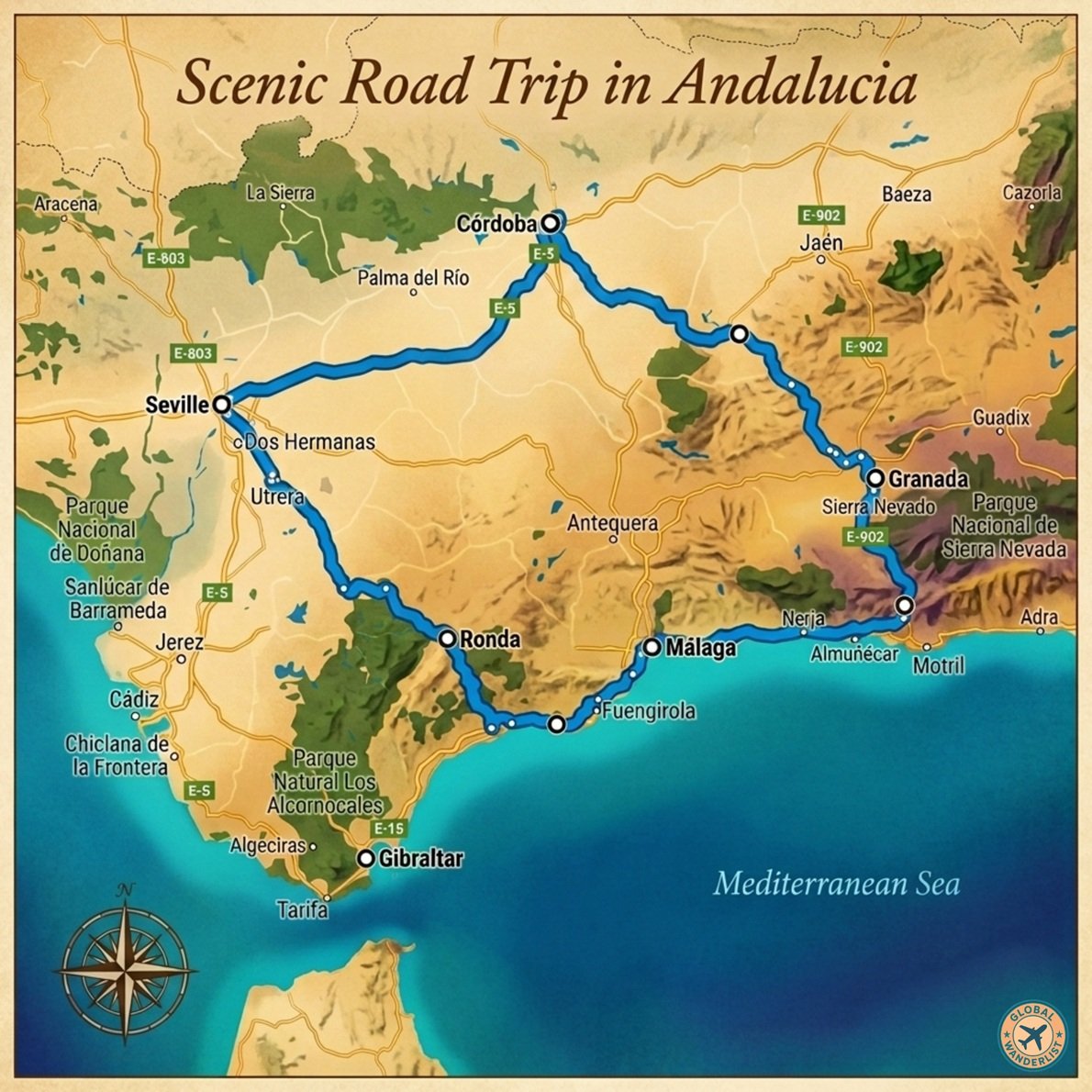
Andalucia packs centuries of history into a single road trip. This loop through southern Spain moves from Moorish palaces to whitewashed clifftop towns to Mediterranean beaches. Few regions in Europe pack this much contrast into such a compact route.
The drive suits travelers who want depth over speed. Each stop rewards at least a full day of exploring, and the food alone justifies slowing down. Photographers, history lovers, and anyone chasing dramatic scenery will find plenty to love here.
This loop covers roughly 550 kilometers and works well over seven to ten days. Roads stay in excellent condition throughout, and rental cars are easy to find at Seville or Málaga airports. Mountain passes near Ronda and Granada demand a bit more attention, but nothing beyond a confident driver’s skill level.
Quick Reference Table
| Stop | Distance from Previous Stop | Driving Time | Main Highlights | Recommended Stay Duration |
|---|---|---|---|---|
| Seville | Starting point | N/A | Alcázar, cathedral, flamenco culture | 2-3 nights |
| Córdoba | 140 km | 1.5 hours | Mezquita, Jewish Quarter, Roman bridge | 1-2 nights |
| Granada | 165 km | 2 hours | The Alhambra, Albaicín, Sierra Nevada views | 2 nights |
| Málaga | 130 km | 1.5 hours | Picasso museum, historic port, beaches | 1-2 nights |
| Ronda | 100 km | 1.5 hours | El Tajo gorge, Puente Nuevo, old bullring | 1 night |
| Gibraltar | 100 km | 1.5 hours | The Rock, Barbary macaques, strait views | 1 night |
Summer traffic can slow the mountain roads near Ronda and Granada. Add extra time in July and August, especially on weekends.
Seville
Seville anchors this route as Andalucia’s capital and one of Spain’s most romantic cities. Moorish rulers governed here for over five centuries before Christian forces retook the city in 1248. That layered history produced some of Spain’s most extraordinary monuments, including the largest Gothic cathedral in the world.
Flamenco developed largely within Andalusian communities, and Seville remains one of the best places to experience it. Orange trees line entire streets, filling the old town with fragrance each spring. The Guadalquivir River splits the city, with the lively Triana neighborhood sitting just across the water from the historic center.
Where to Eat in Seville
- Casa Carlos ($$) is a local favorite for Andalusian classics served in a warm, unpretentious dining room.
- La Brunilda ($$) draws crowds for creative, modern tapas built around seasonal ingredients.
- Bartolomea ($$) offers Mediterranean-leaning small plates with consistently excellent reviews.
- Eslava ($$) has built a loyal following for its tapas bar just off the tourist trail, known for duck and creative bites.
What to See in Seville
- Real Alcázar is a royal palace complex showcasing Mudéjar architecture, still used by the Spanish royal family during visits.
- Seville Cathedral and La Giralda combine a massive Gothic interior with a former minaret tower offering panoramic views.
- Barrio Santa Cruz preserves the old Jewish quarter, with whitewashed alleys and hidden courtyards.
- Plaza de España impresses with a semicircular building, ornate tilework, and a canal visitors can cross by rowboat.
- Triana neighborhood across the river is considered the birthplace of flamenco and traditional Seville ceramics.
- Metropol Parasol, nicknamed Las Setas, offers a modern rooftop walkway with sweeping views over the historic center.
Córdoba
Córdoba served as the capital of Islamic Spain during its golden age in the 10th century, once ranking among the largest and most advanced cities in the world. Its centerpiece, the Mezquita, reflects that era with a forest of red-and-white striped arches built from reused Roman and Visigothic columns. A Renaissance cathedral sits built directly into the mosque’s center, a striking architectural collision of two eras.
The drive from Seville to Córdoba follows the Guadalquivir valley through rolling farmland dotted with olive groves. Córdoba’s historic center, small enough to explore on foot, holds one of Spain’s best-preserved old Jewish quarters just steps from the Mezquita’s walls.
Where to Eat in Córdoba
- Bodegas Mezquita ($$) serves authentic Andalusian tapas just steps from the Mezquita, praised for salmorejo and grilled dishes.
- Restaurante El Churrasco ($$) is a long-running favorite for grilled meats in the heart of the Jewish Quarter.
- Casa Pepe de la Judería ($$) offers traditional Cordovan cooking in a charming historic setting.
- Garum 2.1 ($$$) holds a Michelin Bib Gourmand, known for its inventive take on salmorejo and oxtail dishes.
What to See in Córdoba
- Mezquita-Catedral combines a former mosque’s hypnotic arched hall with a Renaissance cathedral built into its center.
- Juderia (Jewish Quarter) preserves narrow whitewashed streets, along with one of Spain’s few remaining historic synagogues.
- Roman Bridge crosses the Guadalquivir River, offering one of the best views back toward the Mezquita.
- Alcázar de los Reyes Cristianos features terraced gardens and fountains once used by Ferdinand and Isabella.
- Calleja de las Flores is a tiny, flower-draped alley that frames a postcard view of the cathedral tower.
- Palacio de Viana shows off twelve distinct courtyard gardens within a single historic mansion.
Granada
Granada sits below the Sierra Nevada mountains, giving it one of Spain’s most dramatic natural backdrops. The Nasrid dynasty ruled here as the last Muslim kingdom in Iberia until Granada fell to the Catholic Monarchs in 1492. That history produced the Alhambra, one of the most visited monuments in the country and a defining example of Islamic architecture in Europe.
The drive from Córdoba climbs gradually through the Andalusian countryside before descending into Granada’s valley, with the Sierra Nevada peaks rising behind the city. Free tapas still come standard with drink orders in many local bars here, a tradition that has faded elsewhere in Spain.
Where to Eat in Granada
- Los Diamantes ($$) is a beloved tapas bar known for fried fish and generous free tapas with every drink.
- Carmela Restaurante ($$) draws praise for its atmosphere and dependable Andalusian cooking near the city center.
- La Botillería ($$) blends classic recipes with modern touches, popular for its oxtail and pork dishes.
- Bodegas Castañeda ($$) is a historic tavern favorite for meatballs, cured meats, and cheese plates.
What to See in Granada
- The Alhambra combines a fortress, royal palaces, and gardens, representing the peak of Nasrid architecture and design.
- Generalife Gardens sit within the Alhambra complex, offering fountains, courtyards, and views over the city.
- Albaicín quarter climbs a hillside of narrow lanes, keeping much of its medieval Moorish layout intact.
- Mirador de San Nicolás provides the classic postcard view of the Alhambra with the Sierra Nevada rising behind it.
- Granada Cathedral houses the Royal Chapel, where King Ferdinand and Queen Isabella are buried.
- Sacromonte is known for cave dwellings and traditional zambra flamenco performances.
Málaga
Málaga blends beach culture with serious artistic heritage. Pablo Picasso was born here in 1881, and the city has built multiple museums around his legacy. A wave of cultural investment over the past two decades has transformed Málaga’s historic center into one of Spain’s most improved urban destinations.
The drive south from Granada crosses through mountain scenery before reaching the Mediterranean coastline. Málaga’s position along the Costa del Sol makes it a natural bridge between inland Andalucia and the beach towns further along the coast, with its own working port and lively waterfront promenade.
Where to Eat in Málaga
- El Pimpi ($$) is a Málaga institution, known for its lively bodega atmosphere and classic Andalusian dishes.
- Casa Lola ($$) offers a warm, bustling tapas experience just steps from El Pimpi.
- Uvedoble Taberna ($$) serves creative, well-executed Andalusian small plates in the city center.
- La Tranca ($) is a no-frills local favorite for cheap, authentic tapas and cold beer.
What to See in Málaga
- Museo Picasso Málaga houses a substantial collection of the artist’s work inside a restored 16th-century palace.
- Alcazaba fortress offers Moorish architecture and garden courtyards overlooking the city and harbor.
- Gibralfaro Castle sits above the Alcazaba, rewarding the climb with panoramic views over Málaga and the sea.
- Málaga Cathedral, nicknamed La Manquita for its unfinished second tower, dominates the historic skyline.
- Muelle Uno turned the old port into a modern promenade with shops, restaurants, and sea views.
- Atarazanas Market fills a 19th-century iron-and-glass hall with fresh produce, seafood, and tapas stalls.
Ronda
Ronda sits dramatically split by the El Tajo gorge, a canyon carved by the Guadalevín River over millions of years. The 18th-century Puente Nuevo bridge connects the two halves of town, standing nearly 400 feet above the canyon floor. The view alone makes Ronda one of Andalucia’s most photographed towns.
The drive from Málaga climbs into the mountains of the Serranía de Ronda, winding through pine forests and small white villages. Ronda also holds deep roots in Spanish bullfighting tradition, with its 18th-century bullring ranking among the oldest and most historically significant in the country.
Where to Eat in Ronda
- Bardal ($$$$) holds two Michelin stars, offering an ambitious tasting menu from chef Benito Gómez.
- Tragatá ($$$) brings a modern, tapas-style spin on Andalusian cooking from the same acclaimed chef.
- Restaurante Casa Santa Pola ($$$) occupies a historic building with a terrace overlooking the gorge.
- Bodega San Francisco ($$) offers reliably good tapas and a warm, local atmosphere near the old town.
What to See in Ronda
- Puente Nuevo spans the gorge with striking stonework, offering one of Spain’s most dramatic bridge views.
- Plaza de Toros de Ronda is one of Spain’s oldest bullrings, now home to a museum on bullfighting history.
- La Ciudad (Old Town) preserves Moorish-era streets and Renaissance mansions on the gorge’s older side.
- Jardines de Cuenca offer terraced garden paths with sweeping views up toward the bridge and cliffs.
- Baños Árabes are well-preserved Arab bathhouses dating back to the Moorish period.
- Mirador de Ronda provides one of the widest panoramic viewpoints over the surrounding valley and mountains.
Gibraltar
Gibraltar closes out this loop with a completely different atmosphere. This British Overseas Territory sits at the tip of the Iberian Peninsula, guarding the narrow strait that separates Europe from Africa. The Rock of Gibraltar, a massive limestone monolith, dominates the skyline and holds a network of tunnels dug during centuries of military use.
Crossing into Gibraltar from Spain means switching currencies and driving conventions, with English spoken throughout. On clear days, visitors can see across the strait to Morocco, a striking reminder of how close two continents sit at this point on the map.
Where to Eat in Gibraltar
- El Kasbah ($$$) serves Moroccan cuisine in an atmospheric, centuries-old building, a favorite among visitors.
- AquaTerra ($$$) specializes in Iberian ham, grilled meats, and fresh fish in the heart of Casemates Square.
- Little Bay Indian ($$) offers Gibraltar’s most acclaimed Indian food in a large, modern dining room.
- Rendezvous Chargrill ($$) provides waterfront dining with a casual, dependable grilled menu.
What to See in Gibraltar
- Upper Rock Nature Reserve rewards the climb or cable car ride with sweeping views over the strait toward Africa.
- Barbary macaques roam freely near the Rock’s summit, Europe’s only wild population of monkeys.
- St Michael’s Cave is a dramatic limestone cavern once used as a wartime hospital, now open for tours.
- Great Siege Tunnels wind through the Rock, built to defend Gibraltar during 18th-century sieges.
- Casemates Square anchors the town center with restaurants, shops, and views of the surrounding fortifications.
- Europa Point marks the southern tip of Gibraltar, with a lighthouse and clear views across to Morocco on a good day.
Planning Your Drive
Fuel up before heading into the mountains around Ronda, since stations thin out along the winding rural roads. Parking gets tight in historic centers like Córdoba, Granada, and Ronda, so look for a paid lot outside the old town rather than searching for street parking near the sights.
Crossing into Gibraltar involves a border check, since it operates outside the Schengen Area despite sitting on the Iberian Peninsula. Bring a passport, and expect brief delays during peak summer travel times.
Spring and early fall offer the most comfortable driving conditions, with mild temperatures and thinner crowds at major sights. Whichever season you choose, this Andalucia loop delivers a genuine cross-section of southern Spain, from Moorish palaces to mountain gorges to the edge of Africa itself. Pack comfortable shoes, plan flexible days, and let the route’s contrasts do the rest.