
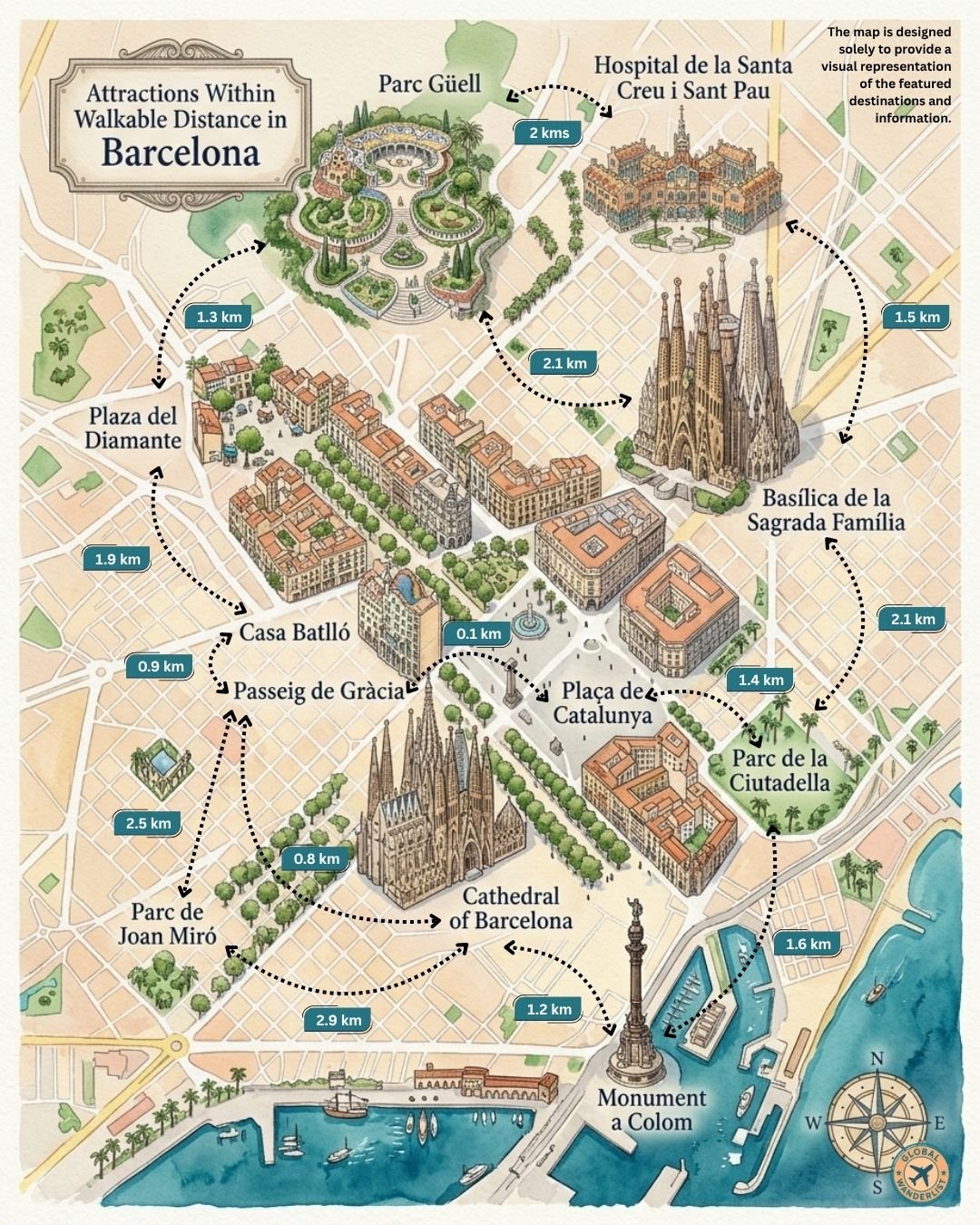
Barcelona rewards visitors who are willing to walk. Many of its most famous sites sit within a few kilometers of each other. You can move from Gaudí’s whimsical parks to Gothic cathedrals to Mediterranean waterfront views, often without ever needing a taxi.
This guide covers eleven landmarks that define the city’s character. Together they trace Barcelona’s story: Roman origins, Gothic ambition, Catalan Modernisme, and a modern love of open public space. Each entry includes practical details so you can plan a route that actually works.
Quick Reference Table
| Attraction | Category | Opening Hours | Entry Ticket |
|---|---|---|---|
| Parc Güell | Park / Gaudí landmark | Daily, 9:30 am to 7:30 pm (seasonal variation) | €18 general; children 7-12 and seniors €13.50; under 7 free |
| Hospital de la Santa Creu i Sant Pau | Modernisme complex | Varies by season, roughly 9:30 am to 4:30 pm or 6:30 pm | €18 standard; €12.60 reduced; under 12 free |
| Plaza del Diamante | Historic square | Always open (public square) | Free |
| Casa Batlló | Modernisme house museum | Daily, 8:30 am to 10:30 pm | From €29 (Blue ticket) |
| Passeig de Gràcia | Boulevard | Always open (public street) | Free |
| Basílica de la Sagrada Família | Basilica | Seasonal, roughly 9:00 am to 6:00 pm or 8:00 pm | From €26 |
| Plaça de Catalunya | City square | Always open (public square) | Free |
| Parc de la Ciutadella | Park | Daily, roughly 10:00 am until dusk or 10:30 pm | Free (Zoo requires separate ticket) |
| Cathedral of Barcelona | Gothic cathedral | Mon-Fri 9:30 am-6:30 pm; Sat 9:30 am-5:15 pm; Sun 2-5 pm | Cultural visit ticket around €8; free during worship hours |
| Parc de Joan Miró | Park | Apr-Oct 8:00 am-9:00 pm; Nov-Mar 8:00 am-7:00 pm | Free |
| Monument a Colom | Monument and viewpoint | Check the official website for the latest timings | Ground level free; elevator ticket, check the official website for the latest price |
Prices and hours change often, especially at ticketed Gaudí sites. Always confirm details on each attraction’s official website before your visit.
Parc Güell
Antoni Gaudí designed Parc Güell between 1900 and 1914 as a housing estate for industrialist Eusebi Güell. The project failed commercially. Only two houses were ever built. The city bought the land in 1922 and turned it into a public park.
Today the park is a UNESCO World Heritage Site. Its Monumental Zone holds the famous mosaic dragon, the wavy serpentine bench, and a forest of stone columns known as the Hypostyle Hall. About 95 percent of the wider park remains free to enter. Only the Monumental Zone requires a paid, timed ticket.
Visit early morning or late afternoon for softer light and thinner crowds. Midday sun between April and October can feel intense on the open terraces.
- Entry Ticket: €18 general admission; €13.50 for children 7-12 and visitors over 65; free for children under 7
- Opening Hours: Daily, 9:30 am to 7:30 pm in summer, shorter hours in winter. Check the official website for exact seasonal times.
Hospital de la Santa Creu i Sant Pau
This former hospital is one of the largest Art Nouveau complexes in the world. Architect Lluís Domènech i Montaner began the project in 1902 as a replacement for Barcelona’s overcrowded medieval hospital. He worked on it until his death in 1923.
Twelve pavilions connect through underground tunnels, a design that kept sick patients away from the noise of construction happening above ground. Stained glass, sculpted stone, and colorful ceramic tiles cover nearly every surface. UNESCO added the site to its World Heritage list alongside Gaudí’s works.
Pair a visit here with the nearby Sagrada Família, since both sites sit within a short walk of each other.
- Entry Ticket: €18 standard admission; €12.60 reduced rate for ages 12-29 and seniors; free for children under 12
- Opening Hours: Varies by season, generally 9:30 am to 4:30 pm in winter and 9:30 am to 6:30 pm in summer. Check the official website for current times.
Plaza del Diamante
This small square sits in the heart of the Gràcia neighborhood, a former independent town that Barcelona absorbed in the late nineteenth century. Gràcia still feels distinct from the rest of the city, with narrower streets and a slower pace.
The square gained fame through Mercè Rodoreda’s 1962 novel “La Plaça del Diamant,” which follows a woman’s life in Barcelona before, during, and after the Spanish Civil War. A bronze sculpture inspired by the book now stands in the square.
Gràcia rewards aimless wandering. Small squares, independent shops, and neighborhood bars fill the surrounding blocks. Visit in the early evening when locals gather outside cafes.
- Entry Ticket: Free
- Opening Hours: Always open, as a public square
Casa Batlló
Gaudí remodeled this building between 1904 and 1906 for textile merchant Josep Batlló. The result abandons straight lines almost entirely. Curved balconies resemble skulls, and the roofline suggests the scaled back of a dragon. Locals nicknamed it Casa dels Ossos, or House of Bones.
Inside, the design continues with wave-like walls, mushroom-shaped fireplaces, and a light well tiled in shades of blue that grow paler toward the ground floor. The building became a UNESCO World Heritage Site in 2005.
Book tickets online in advance. Morning slots and evening rooftop events sell out weeks ahead during peak season.
- Entry Ticket: From €29 for the Blue general admission ticket, which includes an audio guide
- Opening Hours: Daily, 8:30 am to 10:30 pm, with last admission at 9:30 pm
Passeig de Gràcia
This broad boulevard connects Plaça de Catalunya to the Gràcia district and serves as Barcelona’s grandest avenue. Wealthy families built their showcase homes here during the late nineteenth and early twentieth centuries, competing to hire the era’s best architects.
The result is a stretch sometimes called the Illa de la Discòrdia, or Block of Discord, where buildings by Gaudí, Josep Puig i Cadafalch, and Lluís Domènech i Montaner sit side by side in wildly different styles. High-end shops now line the ground floors.
Walk the boulevard slowly and look up. Many of the most interesting architectural details sit above street level, easy to miss if you only glance at shop windows.
- Entry Ticket: Free
- Opening Hours: Always open, as a public street
Basílica de la Sagrada Família
Gaudí took over this project in 1883 and worked on it until his death in 1926. Construction continues today, funded entirely by ticket sales and donations rather than public money. In 2026, the Tower of Jesus Christ reached its full height of 172.5 meters, making the basilica the tallest church in the world.
The interior draws inspiration from forests. Branching stone columns rise toward a ceiling filled with geometric skylights. Stained glass floods the nave with color that shifts through the day, cool blues in the morning and warm oranges in the afternoon.
Book tickets well ahead, especially in 2026, since demand during the centenary year of Gaudí’s death has pushed booking windows out several weeks. A quiet hour runs from 9 to 10 am daily, during which visitors must wear headphones for the audio guide.
- Entry Ticket: From €26 for basic entry with audio guide; from €36 with tower access
- Opening Hours: Roughly 9:00 am to 6:00 pm November through February, and 9:00 am to 8:00 pm April through October. Sunday hours differ slightly. Check the official website for exact seasonal calendars.
Plaça de Catalunya
This vast square marks the meeting point between the old city and the nineteenth-century Eixample expansion. Planners created it in the early twentieth century as Barcelona outgrew its medieval walls, and it now functions as the city’s central transit hub.
Fountains, sculptures, and open plazas fill the space, along with flocks of pigeons that visitors love to photograph. Major shopping streets, including Portal de l’Àngel and the top of La Rambla, radiate outward from here.
Use the square as an orientation point. Nearly every major attraction on this list sits within a twenty- to thirty-minute walk of it.
- Entry Ticket: Free
- Opening Hours: Always open, as a public square
Parc de la Ciutadella
This park occupies the site of an eighteenth-century military fortress built to control the city after the War of the Spanish Succession. Barcelona demolished the citadel in the mid-nineteenth century and converted the grounds into its first public park, designed largely by architect Josep Fontserè.
A young Antoni Gaudí, then still a student, helped design the hydraulic system for the park’s Monumental Cascade, an elaborate fountain with sculpted stone and gilded details. The park also holds the Catalan Parliament building, a boating lake, and the Barcelona Zoo.
Rent a rowboat on the lake for a relaxed afternoon, or simply bring a picnic and find a patch of grass. The park gets busy on weekends, so weekday mornings offer a calmer experience.
- Entry Ticket: Free (Barcelona Zoo requires a separate paid ticket)
- Opening Hours: Daily, roughly 10:00 am until dusk, with later closing in summer. Check the official website for seasonal hours.
Cathedral of Barcelona
Construction on this Gothic cathedral began in 1298 and continued for centuries, though the neo-Gothic main facade was not completed until the twentieth century. It stands on a site used for Christian worship since Roman times, and a Romanesque church once occupied the same spot.
Inside, the cloister houses thirteen white geese, kept in honor of Saint Eulalia, Barcelona’s co-patron saint, who was martyred at age thirteen. A crypt beneath the high altar holds her remains. The cathedral’s rooftop terrace offers views over the Gothic Quarter.
Visit on a weekday morning to avoid the busiest tour group hours around midday. Modest dress is required, so cover your shoulders and knees.
- Entry Ticket: Cultural visit ticket around €8 per person; entry is free during scheduled worship hours
- Opening Hours: Monday to Friday, 9:30 am to 6:30 pm; Saturday, 9:30 am to 5:15 pm; Sunday, 2:00 pm to 5:00 pm. Sunday mornings are reserved for Mass.
Parc de Joan Miró
This park opened in 1983 on the site of Barcelona’s former municipal slaughterhouse, demolished in 1979. Architects Antoni Solanas, Màrius Quintana, Beth Galí, and Andreu Arriola redesigned the space into a modern public park within the dense Eixample grid.
The park’s centerpiece is Dona i Ocell, or Woman and Bird, a 22-meter sculpture by Joan Miró covered in colorful ceramic mosaic. Pine groves, a palm garden, and children’s play areas fill the rest of the grounds, along with a library dedicated to the artist.
This park sees far fewer tourists than Barcelona’s other green spaces, making it a good stop if you want a quiet break between sightseeing.
- Entry Ticket: Free
- Opening Hours: April through October, daily 8:00 am to 9:00 pm; November through March, daily 8:00 am to 7:00 pm
Monument a Colom
Built for the 1888 Barcelona Universal Exposition, this 60-meter column stands at the base of La Rambla, where it meets the harbor. A bronze statue of Christopher Columbus tops the monument, pointing out to sea, though not directly toward the Americas as is often claimed.
An elevator inside the column carries visitors to a small viewing gallery near the top. From there you can see the Gothic Quarter, Montjuïc, and the Mediterranean coastline spread out in different directions.
The base of the monument, with its bronze lions and sculpted reliefs depicting scenes from Columbus’s voyages, is free to view from the surrounding plaza at any time.
- Entry Ticket: Ground-level viewing is free. Check the official website for the latest elevator ticket price.
- Opening Hours: Check the official website for the latest timings.
Planning Your Route
Most of these attractions cluster into two natural walking loops. One loop links Casa Batlló, Passeig de Gràcia, the Cathedral, and Plaça de Catalunya through the city center. The other connects Parc Güell, Hospital de Sant Pau, and the Sagrada Família through the upper Eixample and Gràcia.
Wear comfortable shoes. Barcelona’s grid streets look simple on a map, but the distances between sites add up quickly over a full day. Carry water, especially in summer, and build in time for lunch breaks at neighborhood restaurants rather than tourist-focused spots near the main sights.
Barcelona’s character comes through most clearly on foot. The city’s Modernisme buildings, Gothic landmarks, and open parks were built for people walking through them, not driving past. Lace up your shoes, start at whichever site is closest to your hotel, and let the walkable distances do the rest.