
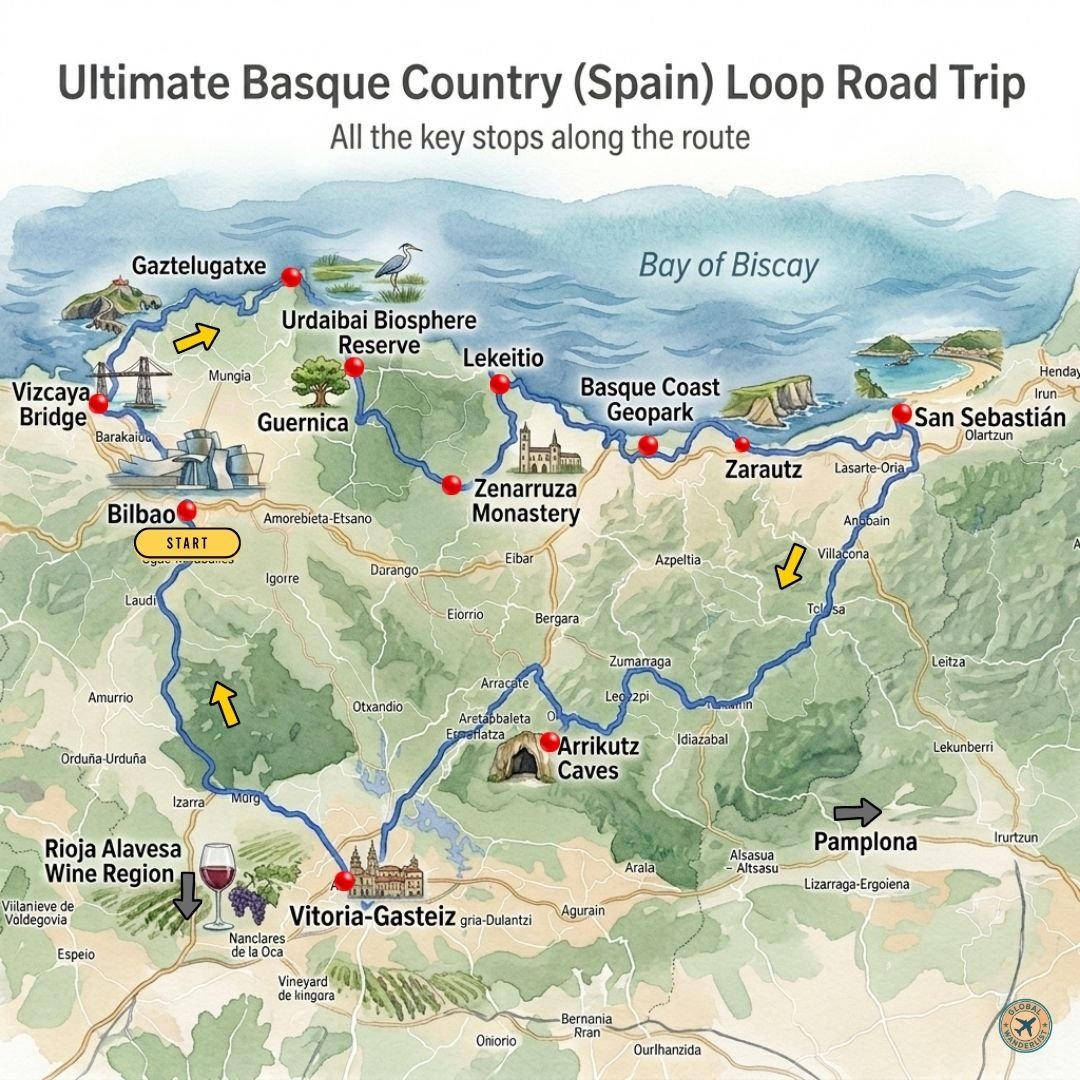
Spain’s Basque Country delivers one of Europe’s most rewarding road trips in a surprisingly compact space. This loop connects dramatic cliffside chapels, medieval fishing villages, cave systems, and two of Spain’s most celebrated food cities. Few regions pack this much scenery and flavor into such a short drive.
The route suits travelers who want variety without long transfers. You will move from world-class museums to rugged coastal trails to green wine country, often within an hour’s drive. Photographers, food lovers, and anyone chasing dramatic natural scenery will find plenty to love here.
This loop covers roughly 350 kilometers and works well over seven to nine days. Roads stay in excellent condition throughout, and rental cars are easy to find at Bilbao Airport. Coastal roads near Gaztelugatxe and Lekeitio wind through cliffs and forest, so budget extra time rather than rushing the drive.
Quick Reference Table
| Stop | Distance from Previous Stop | Driving Time | Main Highlights | Recommended Stay Duration |
|---|---|---|---|---|
| Bilbao | Starting point | N/A | Guggenheim Museum, Casco Viejo, pintxos | 2 nights |
| Vizcaya Bridge | 15 km | 25 minutes | UNESCO transporter bridge, riverside towns | Half day |
| Gaztelugatxe | 35 km | 45 minutes | Cliffside hermitage, dramatic coastal views | Half day |
| Urdaibai Biosphere Reserve | 15 km | 20 minutes | Wetlands, birdwatching, Mundaka surf break | Half day |
| Guernica | 10 km | 15 minutes | Peace history, Basque parliament oak tree | Half day |
| Zenarruza Monastery | 15 km | 20 minutes | Rural medieval monastery, quiet countryside | 1-2 hours |
| Lekeitio | 15 km | 20 minutes | Fishing harbor, tidal island church | 1 night |
| Basque Coast Geopark | 25 km | 30 minutes | Flysch rock formations, coastal hiking | Half day |
| Zarautz | 20 km | 25 minutes | Long surf beach, Michelin dining nearby | 1 night |
| San Sebastián | 20 km | 25 minutes | Pintxos capital, La Concha beach | 2 nights |
| Arrikutz Caves | 55 km | 1 hour | Underground caves, mountain scenery | Half day |
| Vitoria-Gasteiz | 45 km | 45 minutes | Green capital, medieval old town | 1-2 nights |
Summer weekends bring heavier traffic on coastal roads, especially near San Sebastián and Zarautz. Build in extra time during July and August.
Bilbao
Bilbao reinvented itself from an industrial port city into a global cultural destination almost overnight. The 1997 opening of the Guggenheim Museum, designed by Frank Gehry, triggered what became known worldwide as the Bilbao Effect. Cities everywhere have since tried to replicate that formula of architecture-driven urban renewal.
The Basque Country maintains its own language, Euskara, one of Europe’s oldest surviving languages. Basque cuisine ranks among Spain’s most respected, with a dense concentration of pintxos bars packed into Bilbao’s old quarter. Starting a road trip here means beginning with world-class art and food before heading into the region’s wilder coastal scenery.
Where to Eat in Bilbao
- Gure Toki ($$) sits in Plaza Nueva, known for award-winning, creative pintxos in a lively setting.
- Víctor Montes ($$) has served classic Basque pintxos for over a century in an elegant historic room.
- Café Iruña ($$) offers Moorish-style decor and a signature pintxo moruno, open since 1903.
- Bar El Globo ($$) draws locals for its famous crab gratin and lively neighborhood atmosphere.
What to See in Bilbao
- Guggenheim Museum Bilbao anchors the riverside with a titanium-clad building that draws visitors regardless of the current exhibit.
- Casco Viejo (Old Town) holds seven historic streets packed with pintxos bars and small family-run shops.
- Mercado de la Ribera claims to be one of Europe’s largest covered markets, right on the Nervión River.
- Azkuna Zentroa repurposed a former wine warehouse into a cultural center with a striking column-filled interior.
- Artxanda funicular carries visitors up a hillside for sweeping views over the entire city.
- Plaza Nueva provides a graceful, arcaded square that anchors the old town’s pintxos crawl.
Vizcaya Bridge
The Vizcaya Bridge connects the towns of Portugalete and Getxo across the mouth of the Nervión River. Completed in 1893, it holds the distinction of being the world’s oldest transporter bridge still in operation, ferrying both pedestrians and vehicles on a suspended gondola. UNESCO added it to the World Heritage list in 2006, recognizing its innovative iron engineering.
The short drive from Bilbao follows the river estuary past working-class port neighborhoods before opening into the more residential feel of Getxo. Crossing the bridge, either by gondola or by walking the elevated walkway above, gives a striking view over the river and the Bay of Biscay beyond.
Where to Eat Near Vizcaya Bridge
- Txiki ($$) sits on the Portugalete side of the bridge, a well-reviewed pintxo bar known for cod skewers and local cider.
- Restaurante Náuticos ($$) offers fresh seafood with a casual, harbor-side atmosphere.
- La Kazuela ($$) in Getxo serves traditional Basque dishes at fair prices in a relaxed setting.
- Restaurante Mariner ($$) provides dependable Basque cooking close to the waterfront promenade.
What to See Near Vizcaya Bridge
- The transporter gondola carries visitors across the river in under two minutes, a novel way to cross a working waterway.
- The elevated walkway lets visitors cross on foot at height, with panoramic views over the estuary.
- Getxo’s Las Arenas neighborhood shows off elegant early 20th-century mansions built by Bilbao’s industrial families.
- Portugalete’s old town preserves a smaller-scale, working port character on the opposite bank.
- Playa de Arrigunaga offers a sandy beach a short walk from the bridge, popular with local families.
- Puente Colgante viewpoint gives one of the best photo angles of the bridge’s iron latticework structure.
Gaztelugatxe
The islet of San Juan de Gaztelugatxe rises dramatically from the sea, connected to the mainland by a narrow stone footbridge and 241 steps. A small hermitage sits at the summit, built on a site with religious significance dating back centuries. The dramatic setting gained international attention after appearing as a filming location in a major television series.
The climb takes about 20 to 30 minutes round trip, though the site draws large crowds in summer, so early morning visits are best. Beyond the islet itself, the surrounding coastline offers some of the most rugged, photogenic scenery on the entire Basque coast.
Where to Eat Near Gaztelugatxe
- Andeko Bistro ($$) in nearby Bermeo serves excellent marmitako and cod dishes just minutes from the site.
- Tamarises Izarra ($$$) in Bakio offers a beachfront terrace with fresh seafood and sea views.
- Urruti Taberna ($$) provides a relaxed pintxos option in Bakio village.
- Kiroleta Jatetxea ($$) near the site itself offers ocean views alongside a straightforward Basque menu.
What to See Near Gaztelugatxe
- San Juan de Gaztelugatxe hermitage rewards the climb with sweeping views over the Bay of Biscay from its clifftop perch.
- The stone footbridge leading to the islet is itself a dramatic photo subject, especially at sunrise.
- Playa de Bakio offers a long sandy beach nearby, popular with surfers and a good spot to relax after the climb.
- Cabo Matxitxako lighthouse sits a short drive north, marking the northernmost point of Biscay province.
- San Pelayo Hermitage provides a quieter, less crowded alternative viewpoint over the coastline.
- Mirador del Espigón offers a panoramic lookout over Bermeo’s harbor and the open sea beyond.
Urdaibai Biosphere Reserve
Urdaibai protects the estuary where the Oka River meets the Bay of Biscay, forming one of the most important wetland ecosystems in northern Spain. UNESCO designated the area a Biosphere Reserve in 1984, recognizing its role as a stopover for migratory birds traveling between Europe and Africa. Salt marshes, sandbanks, and forested hills give the reserve remarkable ecological diversity within a small area.
The fishing village of Mundaka sits at the reserve’s mouth, famous among surfers worldwide for its powerful left-hand wave. Birdwatchers, hikers, and anyone seeking a quieter pace will find the reserve a welcome change from the region’s busier coastal towns.
Where to Eat in Urdaibai
- Akelarre Taberna ($$) in Bermeo offers a generous daily menu with fresh fish and vegetarian options.
- Bermeoko Kafe Antzokia ($$) serves hearty set menus with traditional dishes like marmitako in a theater setting.
- Casino Bermeo ($$$) occupies a striking 1894 building, offering refined dining with historic character.
- Restaurante Boliña El Viejo ($$$) near Gernika is a longtime favorite for well-executed traditional cooking.
What to See in Urdaibai
- Mundaka’s surf break draws surfers from around the world to watch or ride its famous left-hand wave.
- Urdaibai Bird Center offers observation platforms and exhibits on the reserve’s migratory bird populations.
- Playa de Laida provides a wide, scenic beach at the mouth of the estuary, popular for walks at low tide.
- Santimamiñe Cave holds prehistoric cave art nearby, accessible with a guided visit.
- Cristóbal Balenciaga Museum in Getaria (a short detour) honors the influential fashion designer’s Basque roots.
- Ereñozar viewpoint offers panoramic views over the entire estuary and surrounding hills.
Guernica
Guernica holds a somber but important place in modern history. The 1937 bombing of the town during the Spanish Civil War, carried out by German and Italian forces supporting Franco, became one of the war’s most infamous atrocities. Pablo Picasso’s painting “Guernica,” created in response, remains one of the most powerful anti-war artworks ever made.
Beyond its history, Guernica holds deep symbolic importance for Basque self-governance. The Casa de Juntas building houses the historic Basque parliament, along with the famous Guernica Tree, a symbol of Basque law and autonomy for centuries. The town has rebuilt itself into a peaceful, walkable place that honors its past while looking firmly forward.
Where to Eat in Guernica
- Zallo Barri ($$) is a modern, family-run restaurant offering traditional Basque cuisine with a contemporary twist.
- Arrien Taberna ($) provides an impressive, budget-friendly pintxos selection with warm hospitality.
- Boliña Viejo ($$$) has built a strong reputation for skilled traditional Basque cooking.
- 1000 Kolorau ($$) offers a well-regarded weekend lunch menu with generous portions.
What to See in Guernica
- Museo de la Paz de Guernica examines the 1937 bombing and its lasting message about peace and reconciliation.
- Casa de Juntas and the Guernica Tree preserve the symbolic heart of Basque self-governance across centuries.
- Mural del Guernica de Picasso, a tiled reproduction of the famous painting, stands as a public tribute in the town.
- Parque de los Pueblos de Europa features sculptures by Henry Moore and Eduardo Chillida in a peaceful green setting.
- Santa María Church anchors the town’s rebuilt historic core with Gothic architectural details.
- Gernika market, held on Mondays, offers a lively, traditional look at local produce and Basque farming culture.
Zenarruza Monastery
The Monastery of Santa María de Zenarruza sits in a quiet rural valley, offering a peaceful contrast to the coastal towns nearby. Monks have maintained a religious presence at this site since the 10th century, making it one of the oldest continuously used monastic sites in the Basque Country. A small community still lives and works here today.
The drive to Zenarruza winds through green farmland and forested hills, a scenic detour inland from the coast. Visitors can explore the church, cloister, and surrounding gardens, or simply enjoy the stillness of one of the region’s most tranquil settings.
Where to Eat Near Zenarruza Monastery
- Restaurante Zallo Barri ($$) in nearby Gernika offers a convenient, well-reviewed option for a meal before or after the visit.
- Herriko Taberna Nabarniz ($$) in the small village of Nabarniz serves honest, traditional Basque cooking.
- Landa Berde Erretegia ($$) specializes in grilled meats in a rustic countryside setting.
- Baserri Maitea ($$$) occupies a restored farmhouse, known for classic Basque asador-style dining.
What to See at Zenarruza Monastery
- The Romanesque church preserves architectural details dating back to the monastery’s medieval origins.
- The cloister offers a quiet, contemplative space worth a slow walk before continuing the drive.
- Surrounding farmland gives visitors a genuine look at rural Basque life away from the coast.
- The monastery gardens provide a peaceful rest stop with views over the valley.
- Nearby hiking trails wind through the hills around the monastery, popular with local walkers.
- The small chapel museum displays religious artifacts tied to the site’s long history.
Lekeitio
Lekeitio centers around a picturesque fishing harbor, with a striking Gothic church rising above the waterfront. At low tide, visitors can walk out to the small island of San Nicolás just offshore, a popular local tradition. The town balances an active fishing fleet with a growing reputation as a relaxed beach destination.
Two crescent beaches frame the harbor, drawing families and swimmers throughout the summer. Lekeitio’s compact old town, with narrow streets leading down to the water, rewards an unhurried afternoon of wandering after the drive along the coast.
Where to Eat in Lekeitio
- Kaia ($$) sits along the river, known for fresh grilled seafood and reasonable prices.
- Santi ($) is beloved locally as the town’s best bakery, ideal for breakfast or a coffee stop.
- Lumentza ($$$) impresses with creative small plates and a well-regarded cheesecake.
- Sukha ($$) stands out for craft beer and quality smoked salmon pintxos, a bit different from typical Basque fare.
What to See in Lekeitio
- Basílica de Santa María dominates the harbor with its Gothic facade, one of the finest churches on this stretch of coast.
- Isla de San Nicolás can be reached on foot at low tide, a memorable local ritual worth timing your visit around.
- Playa de Karraspio and the town’s main beach offer calm swimming and views back toward the harbor.
- Lekeitio’s old fishing port remains active, giving visitors a genuine look at the town’s maritime economy.
- Faro de Santa Catalina marks the point beyond the harbor, reachable by a scenic coastal walk.
- Uribarren Abaroa palace, an example of local Basque architecture, adds historic character to the town center.
Basque Coast Geopark
The Basque Coast Geopark protects one of the most striking geological formations in Europe, known as the flysch. These layered rock formations, visible in dramatic cliffside strata along the coast near Zumaia and Deba, record roughly 60 million years of Earth’s history. Scientists have used this exposed rock record to study the mass extinction event that ended the age of dinosaurs.
Coastal trails wind along the clifftops, offering some of the most photogenic hiking on this entire route. The Geopark’s dramatic scenery has also drawn film productions, adding a layer of pop culture interest to its geological significance.
Where to Eat in the Basque Coast Geopark
- Bordatxo Taberna ($$) in Deba is a long-running local favorite for hearty Basque fare and pintxos.
- Itzuli Restaurante ($$$) near Zumaia offers refined coastal dining with strong reviews.
- Restaurante Katxarro ($$) in nearby Elorrio provides solid Mediterranean and Spanish cooking.
- Asador Nicolás ($$$) specializes in grilled meats and seafood in a traditional Basque asador style.
What to See in the Basque Coast Geopark
- Zumaia flysch cliffs display dramatic striped rock layers, best viewed from the coastal walking trail or by boat.
- Playa de Itzurun in Zumaia offers a striking black-and-white striped rock backdrop right at the shoreline.
- Algorri Interpretation Center explains the geological significance of the flysch formations for curious visitors.
- Deba’s old town provides a smaller-scale, charming stop with a Gothic church and riverside promenade.
- Coastal hiking trails connect Zumaia and Deba along dramatic clifftop paths with sweeping sea views.
- San Telmo hermitage, perched on a rocky outcrop near Zumaia, offers a dramatic, wind-swept photo opportunity.
Zarautz
Zarautz stretches along the longest beach in the Basque Country, a wide crescent of sand that has made the town one of Spain’s premier surf destinations. Beyond the waves, Zarautz holds a serious culinary reputation, sitting close to some of the most celebrated restaurants in the world. The town balances a laid-back beach atmosphere with genuinely excellent food.
The promenade fills with locals in the evening, moving between pintxos bars along the seafront. Zarautz makes an easy, relaxed base for exploring the coast between Bilbao and San Sebastián, with a quieter pace than either larger city.
Where to Eat in Zarautz
- Restaurante Kirkilla ($$) has been a local favorite for years, known for reliably excellent seafood.
- Asador Telesforo ($$$) specializes in grilled fish and prime beef, a favorite among longtime visitors.
- Bordatxo Taberna ($$) offers a well-reviewed pintxos and sit-down menu near the beach.
- Martín Berasategui ($$$$) sits just outside town in Lasarte-Oria, holding three Michelin stars and ranking among Spain’s most celebrated restaurants.
What to See in Zarautz
- Playa de Zarautz stretches for nearly three kilometers, the longest beach in the Basque Country and a hub for surf lessons.
- Santa María la Real church anchors the old town with a striking Gothic bell tower.
- Getaria, a short drive away, offers a charming fishing village and the birthplace of designer Cristóbal Balenciaga.
- Photomuseum showcases the history of photography in a dedicated gallery space in town.
- Parque Natural de Pagoeta provides hiking trails and a nature park a short drive inland.
- Zarautz promenade comes alive each evening with locals moving between pintxos bars along the seafront.
San Sebastián
San Sebastián curves around La Concha Bay, often ranked among Europe’s most beautiful urban beaches. The city built its global reputation on food, holding one of the highest concentrations of Michelin stars per capita anywhere in the world. Pintxos bars line the old town, each competing with elaborate small plates and inventive combinations.
Basque culture runs deep here, distinct from the rest of Spain in language and tradition. The city hosts a major international film festival each September, drawing global attention for two weeks and adding a layer of glamour to its culinary fame.
Where to Eat in San Sebastián
- La Cuchara de San Telmo ($$) is a long-standing favorite in the old town, known for slow-cooked veal cheeks and suckling pig.
- Ganbara ($$$) impresses with a striking seafood counter and simply prepared, top-quality ingredients.
- Bar Néstor ($$) draws crowds for its famous potato omelet, made in limited batches twice daily.
- Borda Berri ($$) offers creative pintxos like risotto and rib skewers along the old town’s main pintxos street.
What to See in San Sebastián
- La Concha Beach offers a gently curved, sheltered bay considered one of the finest city beaches in Europe.
- Parte Vieja (Old Town) packs dozens of pintxos bars into a few historic blocks, ideal for bar-hopping through small plates.
- Monte Igueldo rewards a funicular ride with panoramic views over the bay and coastline.
- Monte Urgull holds a hilltop fortress and statue overlooking the harbor, reachable by a scenic walking path.
- Playa de la Zurriola attracts surfers with more consistent waves than the calmer La Concha.
- San Telmo Museum covers Basque history and culture inside a renovated 16th-century monastery.
Arrikutz Caves
The Arrikutz Caves near Oñati offer a striking underground detour from the coastal scenery earlier in the route. Guided tours lead visitors through chambers filled with stalactites and stalagmites formed over thousands of years, along with an underground river running through part of the system. The caves sit within a dramatic mountain landscape at the edge of the Aizkorri-Aratz Natural Park.
The drive inland from the coast climbs steadily into greener, more mountainous terrain, a scenic contrast to the earlier coastal stretches. Oñati itself, the nearest town, holds a beautifully preserved historic center worth combining with the cave visit.
Where to Eat Near Arrikutz Caves
- Restaurante Torre Zumeltzegi ($$) in Oñati offers traditional cuisine with modern touches and scenic dining room views.
- Iturritxo ($$) serves home-style Basque cooking with a well-regarded vegetable stew.
- Restaurante Katxarro ($$) in nearby Elorrio provides a dependable Mediterranean and Spanish menu.
- Arteaga Landetxea ($$$) near Arrasate is known for excellent steak in an international-leaning menu.
What to See Near Arrikutz Caves
- Arrikrutz Caves offer guided underground tours through dramatic rock formations and an underground river.
- Oñati old town preserves a beautifully maintained historic center with Renaissance and Baroque buildings.
- University of Sancti Spiritus stands as one of the Basque Country’s most striking historic academic buildings.
- Santuario de Arantzazu sits high in the mountains nearby, a striking modernist pilgrimage church worth the detour.
- Aizkorri-Aratz Natural Park offers extensive hiking trails through the surrounding mountain range.
- Iglesia de San Miguel Arcángel anchors Oñati’s historic center with notable religious architecture.
Vitoria-Gasteiz
Vitoria-Gasteiz serves as the political capital of the Basque Country, though it draws far fewer tourists than Bilbao or San Sebastián. The city has earned recognition as one of Europe’s greenest capitals, ringed by a network of parks connecting the urban center to the surrounding countryside. Its medieval old town, shaped like an almond, preserves centuries of layered history in a compact, walkable core.
The city’s food scene rivals its more famous coastal neighbors, blending Michelin-level dining with traditional pintxos bars. Vitoria-Gasteiz makes a fitting final stop on this loop, combining culture, green space, and excellent food before heading back toward Bilbao or on to nearby Rioja wine country.
Where to Eat in Vitoria-Gasteiz
- Sagartoki ($$) is a beloved local asador, known for its atmosphere and quality grilled dishes.
- El Siete ($$) draws praise for creative, well-executed tapas at reasonable prices.
- Perretxico Taberna ($$) offers a solid, traditional Basque pintxos experience.
- La Malquerida ($$) serves modern Spanish small plates in a lively, contemporary setting.
What to See in Vitoria-Gasteiz
- Medieval old town winds through an almond-shaped historic core, packed with churches and layered architecture.
- Green Ring parks encircle the city, connecting green spaces for walking and cycling around the urban core.
- Catedral de Santa María offers guided tours through its ongoing restoration, revealing centuries of construction history.
- Plaza de la Virgen Blanca anchors the old town, a lively square framed by historic buildings.
- Artium Museum showcases contemporary Basque and Spanish art in a modern gallery space.
- Parque de la Florida provides a 19th-century French-style garden right in the city center.
Planning Your Drive
Fuel up before heading into the mountain roads around Arrikutz and the rural stretch to Zenarruza Monastery, since stations thin out in these quieter inland areas. Parking gets tight in old town centers like San Sebastián and Bilbao, so look for a paid lot outside the historic core rather than circling for street parking.
Consider extending the trip with two well-known detours. Rioja Alavesa wine country sits a short drive south of Vitoria-Gasteiz, offering vineyard visits and striking modern winery architecture. Pamplona, famous for its July running of the bulls, sits within reach east of Vitoria-Gasteiz for travelers with extra time.
Spring and early fall offer the most comfortable driving conditions, with mild temperatures and thinner crowds at major sights. Whichever season you choose, this Basque Country loop delivers a genuine cross-section of northern Spain, from clifftop hermitages to underground caves to some of the best food in Europe. Pack layers for coastal wind, plan flexible days, and let the route’s contrasts do the rest.