
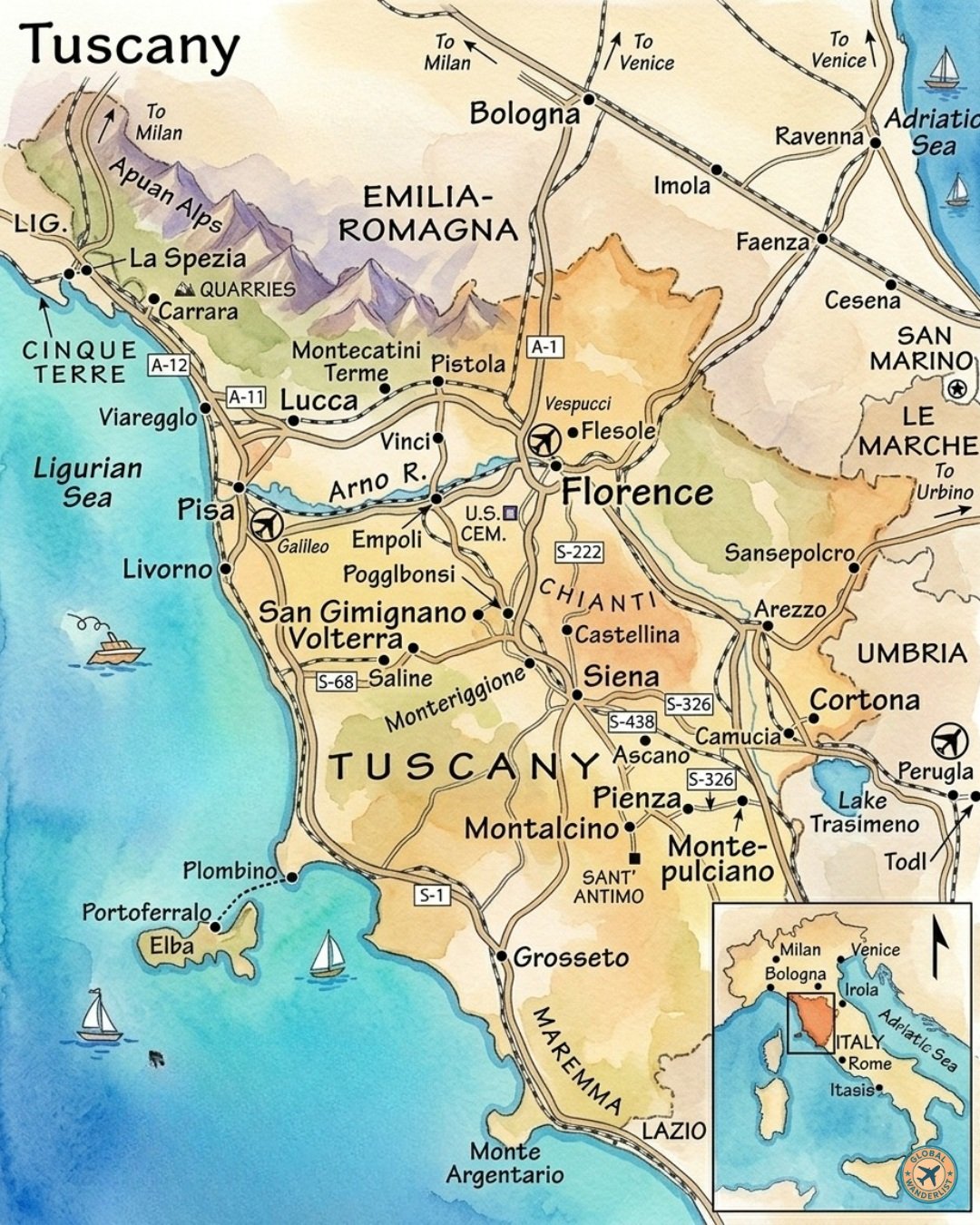
Tuscany looks the way people imagine Italy should look. Cypress-lined roads climb through golden hills. Medieval towers rise above vineyards, and marble mountains meet a turquoise coastline.
This region gave the world the Renaissance. Florence alone produced Michelangelo, Botticelli, and the Medici family who bankrolled it all. Beyond the cities, Tuscany holds Etruscan ruins, thermal springs, and some of Italy’s most prized wines.
A trip here rewards slow travel. Florence and Siena earn their fame, but Volterra’s Etruscan gates and the quiet lanes of Cortona offer just as much reward, minus the crowds.
Quick Reference: Tuscany at a Glance
| Place | Category | Best Known For | Recommended Visit Duration |
|---|---|---|---|
| Florence | City | Renaissance art, the Duomo | 2-3 days |
| Pisa | City | Leaning Tower, Field of Miracles | Half day |
| Lucca | City | Renaissance walls, Puccini | Half to full day |
| Siena | City | Piazza del Campo, the Palio | 1 full day |
| San Gimignano | Town | Medieval towers | Half day |
| Volterra | Town | Etruscan heritage, alabaster | Half day |
| Chianti Region | Wine Region | Chianti Classico wine | Half to full day |
| Montepulciano | Town | Vino Nobile wine | Half day |
| Montalcino | Town | Brunello wine, Sant’Antimo Abbey | Half day |
| Pienza | Town | Renaissance planning, pecorino cheese | 2-3 hours |
| Cortona | Town | Etruscan roots, hilltop views | Half day |
| Arezzo | City | Piero della Francesca frescoes | Half day |
| Monteriggioni | Town | Intact medieval walls | 1-2 hours |
| Elba Island | Island | Beaches, Napoleon’s exile | 1-2 days |
| Carrara | Town | Marble quarries | Half day |
| Cinque Terre | Coast | Cliffside fishing villages | 1 full day |
| Livorno | City | Port, seafood, canals | Half day |
| Maremma | Region | Wild coast, Italian cowboys | Half to full day |
| Vinci | Town | Leonardo da Vinci’s birthplace | 2-3 hours |
| Montecatini Terme | Town | Thermal spas | Half day |
Florence
Florence is where the Renaissance began, and its skyline still proves it. Brunelleschi’s dome crowns the Duomo, a feat that stunned the 15th century and still impresses today. The Medici family funded much of the art that fills the city’s museums.
What to See in Florence
- The Duomo: Brunelleschi’s dome remains the largest brick dome ever built. Climbing it rewards visitors with sweeping views over the city.
- Uffizi Gallery: One of the world’s great art museums, holding works by Botticelli and da Vinci. Book tickets ahead to avoid long lines.
- Ponte Vecchio: A medieval bridge lined with goldsmith shops. It was the only Florence bridge to survive World War II bombing.
- Accademia Gallery: Home to Michelangelo’s original David statue. Reserve tickets in advance during peak season.
Pisa
Pisa is famous for one tilting tower, but the city offers more than a photo opportunity. The tower began leaning almost as soon as construction started in 1173, when the soft, sandy ground gave way. It now sits within the Field of Miracles, a walled complex holding a cathedral and baptistery.
What to See in Pisa
- Leaning Tower: The famous bell tower leans about four meters off vertical. Climb its 296 steps for panoramic views of the city.
- Pisa Cathedral: A Romanesque masterpiece with a striking marble facade. Its interior holds important medieval artwork.
- Baptistery: Italy’s largest baptistery, known for remarkable acoustics. Staff occasionally demonstrate the echo inside.
- Arno Riverfront: A quieter stretch of the city, lined with pastel buildings. Evening walks here offer a calmer side of Pisa.
Lucca
Lucca hides behind massive Renaissance walls that still ring its entire historic center. Built between the 1500s and 1600s, they replaced older fortifications and later became a beloved public park. Composer Giacomo Puccini was born within these walls, and the city still celebrates that link each summer.
What to See in Lucca
- City Walls Promenade: A tree-lined path atop the walls, popular for walking and cycling. The full loop covers about two and a half miles.
- Piazza dell’Anfiteatro: An oval square built over the footprint of a Roman amphitheater. Cafes ring the space, ideal for a coffee break.
- Puccini’s Birthplace: A small museum in the composer’s childhood apartment. It displays his piano and personal belongings.
- Torre Guinigi: A tower topped with holm oak trees growing from its roof. Climbing it offers unusual rooftop views.
Siena
Siena’s Piazza del Campo is one of Italy’s great medieval squares, shaped like a scallop shell and ringed by historic palaces. Twice each summer, the square transforms for the Palio, a bareback horse race between the city’s historic districts. The tradition dates back centuries and remains fiercely important to residents.
What to See in Siena
- Piazza del Campo: The shell-shaped main square and host of the Palio horse race. Its sloped brick paving is one of Italy’s most photographed spots.
- Siena Cathedral: A striped marble cathedral with an ornate facade. Its inlaid marble floor is considered a masterpiece.
- Torre del Mangia: A tall tower offering views over the entire city. The climb up its narrow stairs rewards patience.
- Contrade Neighborhoods: Historic districts with their own flags and traditions. Wandering them reveals Siena’s deep civic pride.
San Gimignano
San Gimignano rises from the hills with a skyline of medieval towers, earning it the nickname “Medieval Manhattan.” Wealthy families once built these towers to show off status and provide refuge during conflicts. Fourteen towers still stand today, down from dozens at the town’s medieval peak.
What to See in San Gimignano
- Torre Grossa: The tallest surviving tower, open for climbing. Views stretch across the Tuscan countryside from the top.
- Piazza della Cisterna: A triangular square paved with brick and centered on an old well. It anchors the town’s medieval layout.
- Collegiata di Santa Maria Assunta: A church with vivid fresco cycles covering its walls. The artwork rewards a slow, careful visit.
- Vernaccia Wine Tastings: San Gimignano’s crisp white wine has ancient roots. Several small wineries near town offer tastings.
Volterra
Volterra predates San Gimignano by centuries, tracing its roots to an important Etruscan settlement. Etruscan walls and gates still stand alongside Roman ruins and medieval palaces. Alabaster carving has shaped Volterra’s economy for generations, and workshops still practice the craft today.
What to See in Volterra
- Porta all’Arco: An Etruscan gate dating back over two thousand years. It remains part of the town’s fortified walls.
- Roman Theater: Well-preserved ruins from the 1st century BC. The site offers a quiet contrast to the busier town center.
- Guarnacci Etruscan Museum: One of Italy’s top collections of Etruscan artifacts. Bronze mirrors and carved urns fill its galleries.
- Alabaster Workshops: Small studios where artisans carve the local translucent stone. Watching the process makes a memorable stop.
The Chianti Region
Chianti stretches between Florence and Siena in a landscape of vineyards, olive groves, and stone farmhouses. Its wine, marked by the black rooster symbol, ranks among Italy’s most recognized reds. Small towns like Greve and Castellina anchor the wine route, each with its own tasting rooms.
What to See in the Chianti Region
- Greve in Chianti: A lively market town with a funnel-shaped piazza. It works well as a base for exploring nearby wineries.
- Castellina in Chianti: A hilltop town with Etruscan tombs nearby. Its medieval fortress anchors the historic center.
- Chianti Wine Route: A signposted drive connecting family-run wineries. Many offer tastings paired with local olive oil.
- Badia a Coltibuono: A former monastery turned working winery. Its gardens and cellar tours draw wine enthusiasts.
Montepulciano
Montepulciano crowns a high ridge in southern Tuscany, its Renaissance streets built from local travertine stone. The town lends its name to Vino Nobile, a Sangiovese-based wine once favored by Tuscan aristocracy. Cellars carved beneath the streets still age wine in cool, vaulted rooms.
What to See in Montepulciano
- Piazza Grande: The town’s summit square, ringed by Renaissance palaces. It offers some of the best views in southern Tuscany.
- Vino Nobile Cellars: Underground cellars where local wine ages for years. Many offer tastings alongside cellar tours.
- Tempio di San Biagio: A Renaissance church just outside the walls. Its symmetrical design makes it a favorite for architecture fans.
- Corso Wine Shops: The main street lined with wine bars and enotecas. It is an easy spot to sample several vintages in one stop.
Montalcino
Montalcino sits above vineyards producing Brunello, one of Italy’s most celebrated and long-aging red wines. Strict rules require Brunello to be made entirely from Sangiovese grapes and aged for years before release. Just outside town, the Romanesque Abbey of Sant’Antimo offers a peaceful counterpoint to the wine tourism.
What to See in Montalcino
- Montalcino Fortress: A 14th-century fortress with panoramic views and a wine bar inside. Its walls are a great spot for sunset.
- Abbey of Sant’Antimo: A Romanesque abbey just outside town, known for its serene setting. Monks sometimes chant Gregorian services here.
- Piazza del Popolo: The town’s central square, lined with cafes. It is a relaxed spot to start a morning of exploring.
- Brunello Wineries: Estates surrounding town offer tastings of the celebrated red. Many combine tastings with vineyard tours.
Pienza
Pienza stands as a rare example of Renaissance urban planning, redesigned in the 15th century at the order of Pope Pius II. Architects rebuilt his home village into an idealized Renaissance town in just a few years. The town also produces some of Tuscany’s best pecorino cheese.
What to See in Pienza
- Piazza Pio II: The Renaissance square at the town’s heart. Its cathedral and palaces form a rare unified architectural plan.
- Pienza Cathedral: A Renaissance church with an unusual crypt built on unstable ground. Its facade reflects careful classical design.
- Via dell’Amore: A scenic lane along the town’s edge. It offers uninterrupted views over the Val d’Orcia.
- Pecorino Cheese Shops: Small shops selling the town’s signature aged sheep’s cheese. Tastings are common and encouraged.
Cortona
Cortona rises steeply above the Valdichiana, its origins tracing back to an important Etruscan settlement. Steep stone streets wind past buildings resting on Etruscan and Roman foundations. The town gained global fame through the book and film “Under the Tuscan Sun.”
What to See in Cortona
- Piazza della Repubblica: The town’s lively main square, framed by the town hall. It is a natural gathering point for visitors and locals.
- Etruscan Academy Museum: A museum holding artifacts from Cortona’s ancient past. Bronze objects and tomb finds fill its collection.
- Fortezza del Girifalco: A hilltop fortress with commanding views. The climb up is steep but well worth the effort.
- Santa Margherita Basilica: A basilica housing the tomb of Cortona’s patron saint. Its position offers wide valley views.
Arezzo
Arezzo traces its roots to the Etruscan era, when it served as an important regional capital called Arretium. The city later produced major cultural figures, including painter Piero della Francesca and writer Giorgio Vasari. Arezzo has long been a center for gold and jewelry making, a trade still visible around town.
What to See in Arezzo
- Basilica of San Francesco: Home to Piero della Francesca’s fresco cycle “The Legend of the True Cross.” The restored paintings rank among Italy’s finest.
- Piazza Grande: A sloped medieval square hosting the monthly antiques market. Its surrounding buildings span several centuries of style.
- Arezzo Cathedral: A Gothic cathedral with stained glass and Renaissance artwork. Its bell tower is visible across the city.
- Vasari’s House: The home of painter and writer Giorgio Vasari, now a museum. It displays his own frescoes and personal collection.
Monteriggioni
Monteriggioni is a tiny walled town that appears almost untouched by time, its circular fortifications visible from the highway below. Sienese forces built the walls in the 13th century as a defensive outpost against Florence. Today the walls enclose just a few streets, a church, and small shops.
What to See in Monteriggioni
- Medieval Walls: Remarkably intact fortifications ringing the entire town. Walking sections of the wall offers views over the Tuscan hills.
- Piazza Roma: The town’s small central square. It hosts a modest church and a scattering of cafes.
- Local Artisan Shops: Small stores selling wine, olive oil, and crafts. They make good stops for regional souvenirs.
- Countryside Views: Panoramas over vineyards and olive groves from the town’s edge. Photographers favor the golden light near sunset.
Elba Island
Elba sits off the Tuscan coast, reachable by a short ferry from Piombino. The island is best known for its beaches and clear water, but history remembers it as Napoleon’s place of exile in 1814. Portoferraio, the island’s main town, holds Medici-era fortresses and Napoleon’s former residences.
What to See in Elba Island
- Portoferraio Fortresses: Medici-built forts overlooking the harbor. Their walls offer sweeping views of the bay.
- Villa dei Mulini: Napoleon’s in-town residence, preserved with original furnishings. It sits between the port’s two main forts.
- Villa San Martino: Napoleon’s countryside retreat, surrounded by gardens. It houses a small gallery of sculpture inside.
- Monte Capanne Cable Car: An open-air lift climbing the island’s highest peak. Clear days offer views toward Corsica.
Carrara and the Apuan Alps
Carrara sits beneath the Apuan Alps, its white marble mountains visible from miles away. Quarries here have supplied stone for two thousand years, including the marble Michelangelo chose for his sculptures. Guided tours take visitors into active quarries, revealing the scale of an industry still shaping global art.
What to See in Carrara
- Marble Quarries: Active quarries offering guided jeep and walking tours. The scale of the cut rock faces is genuinely striking.
- Carrara Cathedral: A marble-clad cathedral in the town center. Its facade shows off the local stone in fine detail.
- Marble Museum: A museum tracing the history of Carrara’s quarrying industry. Exhibits explain extraction techniques across centuries.
- Colonnata: A small mountain village famous for cured lardo aged in marble basins. It makes a scenic lunch stop after visiting the quarries.
Cinque Terre
Just north of Tuscany’s border, the five villages of Cinque Terre cling to cliffs above the Ligurian Sea. Colorful houses stack above terraced vineyards, connected by scenic coastal trails. Monterosso, Vernazza, Corniglia, Manarola, and Riomaggiore each have a distinct character.
What to See in Cinque Terre
- Vernazza Harbor: Considered the most photogenic of the five villages. Its small harbor and colorful buildings draw crowds at sunset.
- Manarola: A cliffside village known for dramatic views and local wine. The path toward the cemetery offers a quieter overlook.
- Sentiero Azzurro: The coastal trail linking several villages. Some stretches require paid permits and moderate fitness.
- Riomaggiore: The easternmost village, with a steep main street leading to the sea. Its harbor is popular for evening swims.
Livorno and the Coast
Livorno serves as Tuscany’s main port city, less polished than Florence but full of authentic character. Canals cut through parts of the historic center, giving it a nickname as “Little Venice.” Nearby Viareggio adds a different coastal flavor, known for its Art Nouveau architecture and beach clubs.
What to See in Livorno
- Fortezza Vecchia: A Medici-era fortress guarding the harbor entrance. Its walls trace Livorno’s long maritime history.
- Venezia Nuova: A canal district built in the 17th century. Boat tours reveal the city from the water.
- Mercato Centrale: A large covered market selling fresh seafood and produce. It is a good stop for an authentic local lunch.
- Viareggio Promenade: An Art Nouveau seafront lined with grand villas. It makes a pleasant walk any time of year.
The Maremma
The Maremma stretches along Tuscany’s southern coast, a wilder region of marshland, beaches, and rolling hills. Local cowboys called butteri still herd cattle on horseback, a tradition dating back centuries. Beaches here tend to be longer and less crowded than those further north.
What to See in the Maremma
- Maremma Regional Park: A protected area of wetlands, forests, and beaches. Wildlife spotting includes deer and wild boar.
- Grosseto’s Old Town: A walled city center with a Renaissance cathedral. Its ramparts offer a pleasant walking loop.
- Butteri Cattle Ranches: Working farms where cowboys still herd cattle. Some ranches offer demonstrations and horseback tours.
- Monte Argentario: A rugged promontory with upscale coastal towns. Its winding roads offer dramatic sea views.
Vinci and Montecatini Terme
Vinci is a small hilltop town best known as the birthplace of Leonardo da Vinci, whose name it shares. A museum near the town center displays models built from his sketches and notebooks. Not far away, Montecatini Terme has drawn visitors to its thermal spas since the 18th century.
What to See in Vinci and Montecatini Terme
- Leonardo da Vinci Museum: A museum with working models based on Leonardo’s inventions. It suits visitors of all ages.
- Santa Croce Church: The church where Leonardo was baptized. It sits at the heart of the small town.
- Montecatini Thermal Baths: Historic spa facilities with mineral-rich waters. Several offer day passes for treatments.
- Montecatini Alto: The old hilltop town above the spa district, reachable by funicular. It offers quiet streets and valley views.
Beyond the Postcards
Tuscany rewards travelers who slow down between its famous stops. Florence and Siena earn every bit of their fame, but Volterra’s Etruscan gates and Elba’s quiet coves hold their own rewards.
Give yourself time to wander without a fixed plan. Tuscany’s smaller corners, from a Chianti back road to a Maremma beach, often leave the strongest impressions.