
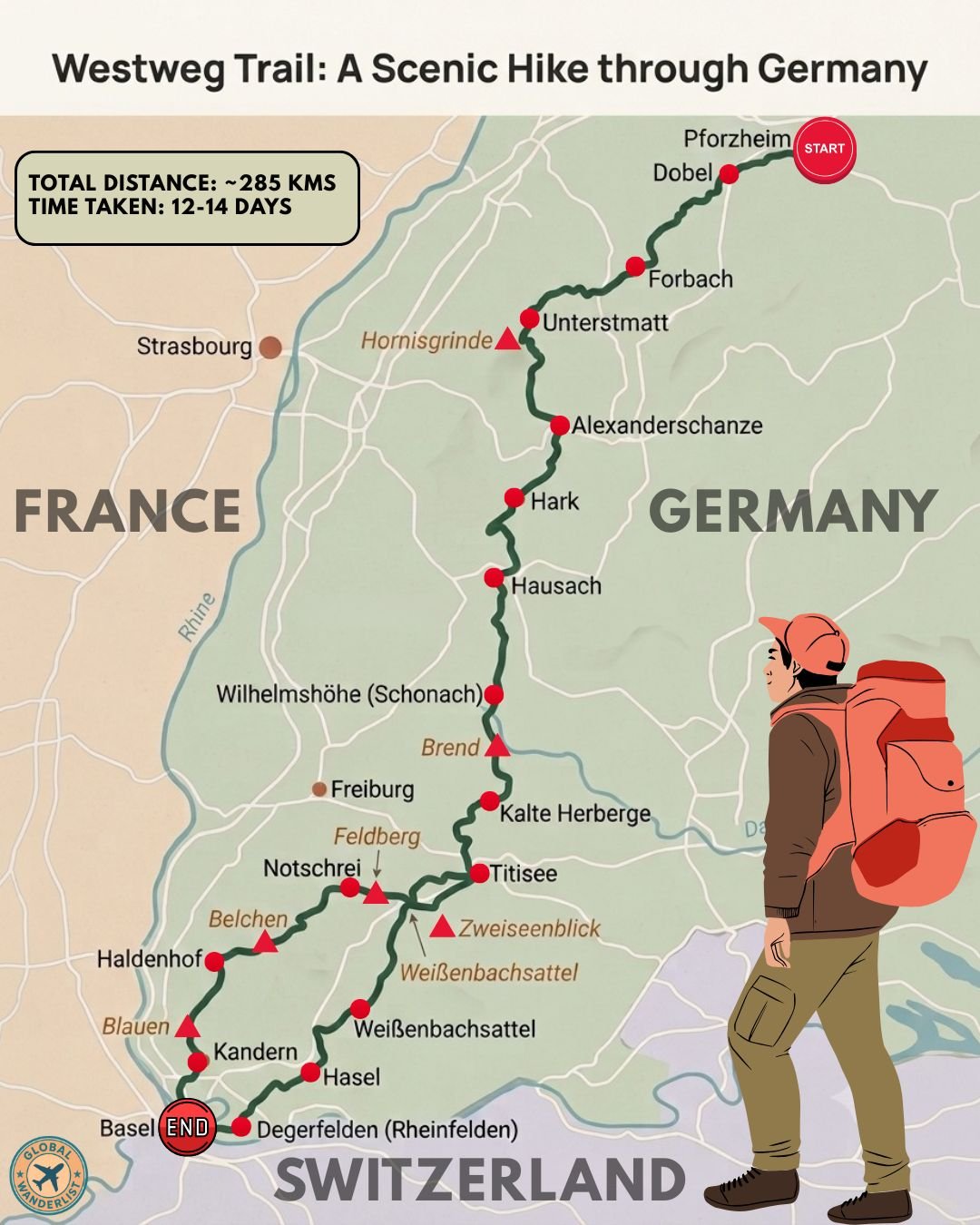
The Westweg is Germany’s oldest long-distance hiking trail. It has connected Pforzheim and Basel since 1900. The route runs almost 285 kilometers straight through the spine of the Black Forest.
Hikers cross open ridgelines, dense spruce forest, and quiet farming valleys. Along the way they pass glacial lakes, granite summits, and centuries-old mountain inns. The scenery shifts constantly, from wide moorland to steep alpine-style climbs near the Belchen.
This trail suits fit, experienced hikers who enjoy multi-day treks with real elevation gain. Beginners with decent stamina can manage it too, since towns break up nearly every stage. Total climbing adds up to more than 6,000 meters over 12 to 14 days.
Trail markings use a red diamond on white, kept up by the Schwarzwaldverein hiking club. Huts, guesthouses, and village hotels line the route closely enough that camping gear is optional. Below is a full stage-by-stage guide to help plan the walk.
Trip Summary
| Trek Stop | Elevation | Distance from Previous Stop | Estimated Hiking Time | Overnight Stay |
|---|---|---|---|---|
| Pforzheim | 254 m | Start point | — | Parkhotel Pforzheim |
| Dobel | 689 m | 24 km | 6-7 hours | Hotel Rössle |
| Forbach | 320 m | 25 km | 7 hours | Das Waldhaus |
| Unterstmatt | 920 m | 20 km | 6 hours | Berghotel Mummelsee |
| Alexanderschanze (Kniebis) | 971 m | 22 km | 6.5 hours | Hotel Waldblick Kniebis |
| Hark | 800 m | 17 km | 5 hours | Gasthaus Hark |
| Hausach | 238 m | 16 km | 4.5 hours | Landhaus Hechtsberg |
| Wilhelmshöhe (Schonach) | 1,000 m | 24 km | 7 hours | Gasthaus Wilhelmshöhe |
| Kalte Herberge | 1,040 m | 22 km | 6 hours | Gasthaus Kalte Herberge |
| Titisee | 850 m | 20 km | 5.5 hours | Treschers Schwarzwald Hotel |
| Notschrei | 1,121 m | 24 km | 7 hours | Waldhotel am Notschreipass |
| Haldenhof | 929 m | 20 km | 6.5 hours | Berggasthof Haldenhof |
| Kandern | 340 m | 20 km | 7 hours | Hotel garni zur Weserei |
| Basel | 260 m | 22 km | 6 hours | Hotel Spalentor |
Pforzheim: The Golden Gateway
Pforzheim marks the true start of three long-distance trails, but the Westweg is the most famous. The city sits where the Nagold, Enz, and Würm rivers meet, earning its nickname as the Golden City for centuries of jewelry making. Hikers begin at a stone archway called the Goldene Pforte, tucked into a quiet courtyard near the old town.
Before setting out, take a moment to explore the rebuilt city center. Pforzheim was heavily bombed in 1945, and much of what stands today reflects postwar rebuilding rather than medieval charm. Still, the jewelry museum and riverside paths make it worth an evening.
Where to Stay in Pforzheim
Parkhotel Pforzheim sits close to the train station and offers spacious rooms with a full-service spa. It is a comfortable, well-reviewed base for a final night of rest before the trail. Budget hikers can also find simple guesthouses near the station.
What to See in Pforzheim
- Schmuckmuseum Pforzheim: This jewelry museum traces the city’s 250-year goldsmithing history. It is one of the largest collections of its kind in Europe.
- Enz River promenade: A paved path follows the Enz through the city center. It offers an easy warm-up walk before the trail climbs begin.
- Wallberg Tower: A short detour from the main route rewards hikers with early forest views. It marks the transition from city streets to Black Forest woodland.
- Reuchlinhaus: This modern building houses rotating art exhibitions. It sits inside a quiet park a short walk from downtown.
Dobel: The Climatic Health Resort
Dobel sits on a plateau above the Enz valley and has been a recognized health resort since the early twentieth century. Clean mountain air and pine forests once drew visitors seeking relief from lung ailments. Today it remains a peaceful overnight stop with sweeping views back toward Pforzheim.
The village is small, but its elevated position gives hikers their first real sense of the Black Forest’s scale. Morning mist often settles in the valleys below while Dobel stays clear and sunny.
Where to Stay in Dobel
Hotel Rössle offers a quiet retreat with an outdoor tennis court and a hearty breakfast. It has earned excellent guest ratings for its calm setting and attentive service. Hotel Pension Heidi is a smaller, well-reviewed alternative nearby.
What to See in Dobel
- Dobel lookout tower: This viewing platform gives panoramic views over the northern Black Forest. On clear days, the Rhine valley is visible far to the west.
- Kurpark Dobel: A landscaped park with walking paths winds through the village center. It is a gentle way to stretch tired legs after the first stage.
- Baumwipfelpfad treetop trail: A short drive away, this elevated walkway lets visitors experience the forest canopy up close. It suits a rest day if hikers pause before continuing.
- Fautsburg ruins: These medieval castle remains sit in the forest nearby. They offer a quiet detour steeped in local history.
Forbach: Gateway to the Murg Valley
Forbach lies in the narrow Murg valley, framed by steep forested slopes. The village is best known for its historic covered wooden bridge, a rare survivor of older Black Forest construction. Hikers arriving here have already crossed Kaltenbronn’s high moorland, so the valley floor feels like a different world.
The Murg River adds a cooling presence after a long descent. Forbach makes a natural rest point before the trail climbs again toward the Hornisgrinde ridge.
Where to Stay in Forbach
Das Waldhaus is a family-run hotel right on the river, with a covered bridge and mountain views nearby. It holds an exceptional guest rating and is popular with hikers finishing this stage. Rooms book quickly in peak summer months, so reserving ahead is wise.
What to See in Forbach
- Historic covered bridge: This wooden bridge dates back centuries and remains a defining landmark of the village. It crosses the Murg right in the town center.
- Black Forest National Park edge: Forbach sits near the park boundary, home to lynx, black woodpeckers, and old-growth stands. Trail signs mark several access points nearby.
- Raumünzach valley: A side valley branching from Forbach offers quieter walking away from the main trail. It is popular with cyclists and casual walkers alike.
- Local Murgtal cuisine: Regional restaurants serve trout pulled straight from the river. It is a fitting reward after a demanding descent.
Unterstmatt and the Mummelsee
Unterstmatt sits high on the Schwarzwald Hochstrasse, the scenic ridge road connecting the northern peaks. This stage climbs past Kaltenbronn’s nature reserve and over the Hornisgrinde, the tallest summit in the northern Black Forest at 1,163 meters. From its tower, views stretch toward the Rhine plain and the Vosges Mountains in France on clear days.
Just below the ridge lies the Mummelsee, a glacial lake wrapped in local legend. Local folklore describes water spirits, or “Mümmelein,” living beneath its dark surface. The lake draws both hikers and day-trippers arriving by road.
Where to Stay in Unterstmatt
Berghotel Mummelsee sits directly on the lakeshore and has built a strong reputation among hikers and passing travelers alike. It offers hearty regional meals and simple, comfortable rooms. Its central position makes it an easy stop even for those not overnighting here.
What to See in Unterstmatt
- Hornisgrinde summit tower: This observation tower marks the highest point in the northern Black Forest. The 360-degree view is one of the trail’s best rewards.
- Mummelsee: This dark glacial lake is wrapped in local folklore about water spirits. A short lakeside path circles its shore in under an hour.
- Herrenwieser See: A smaller, quieter lake sits a short detour from the main trail. It offers a peaceful alternative to the busier Mummelsee.
- Hochmoor Kaltenbronn: This raised bog nature reserve supports rare plant life found nowhere else in the region. Boardwalks protect the fragile peat as visitors pass through.
Alexanderschanze and Kniebis
The Alexanderschanze is a historic mountain pass named for an old fortification. The original roadside hotel here closed in 2015 and now sits abandoned, though the pass itself remains a key trail junction. Nearby Kniebis, a small ski and hiking village, has stepped in as the practical overnight base for this stage.
Kniebis sits at the edge of the Central-North Black Forest Nature Park. Its winter ski lifts sit quiet in summer, leaving trails open for hikers heading toward the Zuflucht and beyond.
Where to Stay near Alexanderschanze
Hotel Waldblick Kniebis, a short walk from the pass, offers indoor pool access and consistently strong reviews. It makes a comfortable four-star stop after a long ridge stage. Smaller guesthouses in the village offer simpler, budget-friendly rooms.
What to See near Alexanderschanze
- Alexanderschanze fortification remains: These earthworks date to defensive structures built centuries ago. Though the old hotel is now a ruin, the site retains historic weight.
- Lothar Path: This educational trail winds through a forest reshaped by a 1999 storm. Raised walkways let visitors see storm-toppled trees up close.
- Schliffkopf viewpoint: A short detour nearby offers wide views across forested ridgelines. It is a favorite sunset spot for those staying overnight in Kniebis.
- Kniebis ski stadium: In winter this area hosts cross-country trails and a lit night course. In summer, the open meadows make pleasant walking.
Hark: The Quiet Farmhouse Stage
Hark is less a village than a scattered cluster of farmhouses on a high, remote saddle. This stage marks the trail’s lowest overall point along its middle section, dropping through forest before climbing again. Hikers pass through the Kreuzsattel and several minor summits on quiet, narrow paths.
The isolation here is part of the appeal. Traffic noise fades completely, replaced by wind through spruce and the occasional cowbell from distant pastures.
Where to Stay in Hark
Gasthaus Hark is a long-established, traditional trail inn sitting right at the Harksattel. It has served Westweg hikers for generations and remains a well-known fixture on this stage. Book ahead, since rooms here are limited.
What to See in Hark
- Harksattel ridge: This high saddle offers quiet views over forested valleys in every direction. It is one of the trail’s more remote and peaceful stretches.
- Brandenkopf lookout tower: A short detour rewards hikers with a classic Black Forest panorama. A rustic summit inn nearby serves simple regional food.
- Kreuzsattel crossing: This junction point connects several regional trails. It marks a good spot to rest before the final descent toward Hausach.
- Remote farmsteads: Scattered timber-frame farmhouses dot this stretch. They reflect centuries-old Black Forest building traditions still in daily use.
Hausach: Into the Kinzig Valley
Hausach sits in the wide Kinzig valley, a sharp contrast after days on high, exposed ridges. The town has its own train station on the Schwarzwaldbahn line, making it a popular access point for hikers walking only part of the Westweg. Rail connections here run all the way to Karlsruhe and Konstanz.
The valley floor brings orchards, vineyards, and a slower pace after the trail’s demanding middle stages. Hausach also sits close to the open-air museum at Gutach, a highlight for anyone with time to spare.
Where to Stay in Hausach
Landhaus Hechtsberg offers a peaceful garden setting and consistently excellent guest feedback. It sits close to hiking trails and the town museum. Blume Hausach, a hotel and restaurant in the center, is another well-rated option.
What to See in Hausach
- Schwarzwälder Freilichtmuseum Gutach: This open-air museum recreates traditional Black Forest farm life. Historic buildings were relocated here from across the region.
- Kinzig River path: A flat riverside walk offers an easy contrast to the trail’s steep sections. It is ideal for stretching legs before the next climb.
- Hausach old town: Timber-frame buildings line the compact historic center. A small castle ruin overlooks the settlement from above.
- Schwarzwaldbahn railway: This scenic rail line is an engineering landmark in its own right. Watching a train cross its viaducts adds context to the valley’s history.
Wilhelmshöhe: The Westweg Portal at Schonach
Wilhelmshöhe sits above Schonach, a traditional winter sports town known for ski jumping. A stone archway here, built specifically to mark the trail, gives the spot its nickname as the Westweg Portal. Information panels describe the route both north to Pforzheim and south to Basel.
This stage is long, crossing the Blindensee raised bog on a wooden boardwalk. Rare plants like sundew and cotton grass grow in the nutrient-poor peat here, protected since 1960.
Where to Stay in Wilhelmshöhe
Gasthaus Wilhelmshöhe is a Westweg classic, serving hearty meals directly at the trail portal. Hikers describe it as reliably busy on weekends, so reserving ahead matters. It offers simple, comfortable rooms suited to trail-worn guests.
What to See in Wilhelmshöhe
- Westweg Portal archway: This stone gateway marks a genuine trail landmark. Information boards detail the route’s full history and layout.
- Blindensee bog: A boardwalk crosses this protected high-moor lake. Rare bog plants thrive in the acidic, nutrient-poor soil.
- Schonach ski jump: This winter sports facility has hosted competitions for decades. Even in summer, its scale is striking to see up close.
- Silberberg summit: A modest peak nearby offers wide views over surrounding farmland. It makes an easy add-on walk for those with extra time.
Kalte Herberge: A Traditional Trail Inn
Kalte Herberge, meaning “cold hostel,” takes its evocative name seriously. It sits exposed on high ground near the source of the Elz River. The inn here has sheltered travelers for generations, long before recreational hiking became popular.
This stage passes the Martinskapelle, a chapel with roots tracing back over a thousand years. Nearby, a short detour leads to the symbolic source of the Danube, marked by a modern bronze figure.
Where to Stay in Kalte Herberge
Gasthaus Kalte Herberge is a well-established traditional inn with strong, consistent guest reviews. Bikers and hikers alike praise its secure parking and generous portions. Its remote setting makes advance booking essential.
What to See in Kalte Herberge
- Martinskapelle: This chapel has stood on this site in some form since around the year 800. It was rebuilt and reconsecrated in the early twentieth century.
- Breg source (Danube source): A short detour leads to the symbolic headwater of the Danube. A bronze figure marks the spot, added in 2017.
- Günterfelsen rock formations: These large, rounded boulders rise unexpectedly from the forest floor. They make a memorable photo stop along the ridge.
- Elz River source: The Elz begins nearby and flows over 100 kilometers to the Rhine. Its headwaters are quiet and easy to reach on foot.
Titisee: The Black Forest’s Iconic Lake
Titisee is one of the Black Forest’s most visited destinations, and for good reason. This glacial lake formed during the last ice age and remains the region’s largest natural body of water. Paddle boats, lakeside cafes, and cuckoo clock shops give the town a livelier feel than most trail stops.
Hikers arriving here split onto two route options toward Basel. The western variant, described in this guide, follows the lake’s edge before climbing again. The eastern variant instead heads toward the Feldberg, the Black Forest’s highest peak.
Where to Stay in Titisee
Treschers Schwarzwald Hotel sits directly beside the lake and offers a private beach with a heated outdoor pool. Its historic character and lakeside setting make it a memorable overnight stop. Hotel Zum Löwen, also highly rated, offers a more modest and budget-friendly alternative nearby.
What to See in Titisee
- Lake Titisee shoreline: A path circles much of the lake’s edge. Rowboat and paddle boat rentals are available for a relaxed afternoon.
- Hochfirst viewpoint: A steep but short climb above town rewards hikers with a full view over the lake. It is best attempted before or after the main trail day.
- Cuckoo clock workshops: Titisee is famous for handcrafted cuckoo clocks sold throughout its center. Several workshops let visitors watch the carving process.
- Feldberg day trip: For those with extra time, the Black Forest’s highest peak sits within reach by bus. Alpine meadows there feel distinct from the forested trail below.
Notschrei: A High Pass Between Peaks
Notschrei sits on a mountain pass connecting the Feldberg massif to the Belchen range. The name translates roughly to “cry of distress,” a nod to the exposed, weather-beaten nature of this crossing. In winter, the pass becomes a small ski area; in summer, it serves purely as a trail junction and overnight stop.
This stage crosses quiet forest and open pasture, with the Feldberg’s rounded summit visible behind on clear days. The Wilhelmer Hütte offers a welcome rest stop partway through the climb.
Where to Stay in Notschrei
Waldhotel am Notschreipass sits directly at the pass, offering an indoor pool and spa facilities after a demanding day. It is the only real overnight option this high on the ridge. Guests consistently note its peaceful forest surroundings.
What to See in Notschrei
- Notschrei pass itself: This exposed high point separates two of the Black Forest’s most famous mountain groups. Weather here can shift quickly, so proper layers matter.
- Wilhelmer Hütte: This trailside hut offers simple refreshments partway through the stage. It is a popular midday stop for hikers heading either direction.
- Belchen approach trail: The path toward Belchen begins climbing steeply from here. Alpine-style rock steps mark the transition to higher terrain.
- Cross-country ski trails: In summer, these winter routes become pleasant walking paths through open meadow. They offer an easy detour away from the steeper main trail.
Haldenhof: Beneath the Belchen
Haldenhof sits on a minor pass in the Kleines Wiesental, just after the trail’s dramatic descent from the Belchen summit. This peak, often called the sacred mountain of the Celts, rises to 1,414 meters and offers what many consider the finest panorama on the entire Westweg. On clear days, the Alps are visible from Austria to Mont Blanc.
The descent from Belchen is steep and rocky in places, with cable handholds assisting hikers over exposed rock. Haldenhof itself feels like a quiet reward after the drama of the summit.
Where to Stay in Haldenhof
Berggasthof Haldenhof is a traditional mountain inn sitting right on the pass, with strong guest ratings for its hospitality. It has served hikers on this stage for decades. Its remote setting means rooms are limited, so early booking helps.
What to See in Haldenhof
- Belchen summit: This is widely considered the trail’s scenic highlight. Ancient Celtic sites once stood here, giving the mountain its sacred reputation.
- Belchenhaus: Built in 1898, this is the highest-situated guesthouse in Baden-Württemberg. It sits just below the true summit on the main path.
- Hohe Kelch rocky slope: This steep, exposed section requires careful footing and occasional handrail use. It is one of the trail’s more technical stretches.
- Kleines Wiesental valley views: The descent opens onto sweeping views of this pastoral valley. Scattered farmhouses dot the green hillsides below.
Kandern: A Historic Ceramics Town
Kandern marks the trail’s final approach toward Switzerland. This charming town built its reputation on ceramics production, a tradition still reflected in its local museum and workshops. Colorful half-timbered buildings line streets that feel notably gentler after days of mountain terrain.
The stage into Kandern passes Sausenburg Castle, a ruined fortress with commanding valley views. From here, the Black Forest’s peaks begin giving way to the rolling vineyards of the Markgräflerland.
Where to Stay in Kandern
Hotel garni zur Weserei holds strong guest ratings and a central, walkable location. Pension Gasthaus zur Schnecke is a well-reviewed alternative near the town’s ceramics museum. Both make comfortable final stops before the last push to Basel.
What to See in Kandern
- Sausenburg Castle ruins: These medieval fortress remains sit on a wooded hilltop above town. Stairs lead up to sweeping valley views from the old walls.
- Kandern ceramics museum: This local museum traces the town’s long pottery-making history. Hands-on demonstrations run during peak season.
- Kandertalbahn railway museum: A restored historic rail line once connected Kandern to the wider valley. The museum here preserves vintage rolling stock.
- Markgräflerland vineyards: South of town, gentle vineyard slopes replace dense forest. They mark a scenic transition toward the Rhine valley.
Basel: Journey’s End at the Rhine
Basel closes the Westweg where Germany, France, and Switzerland meet along the Rhine. The city’s compact old town rewards a final day of exploring after nearly two weeks on trail. Basel Minster’s twin spires and colorful roof tiles dominate the skyline above the river.
Reaching the Badischer Bahnhof, the trail’s official endpoint, brings a genuine sense of accomplishment. From here, hikers can reflect on a journey spanning the entire Black Forest, from quiet northern moorland to alpine southern peaks.
Where to Stay in Basel
Hotel Spalentor sits a short walk from the old town, with strong reviews for its central location and quiet garden. Hotel Märthof Basel, in the historic center, offers a more upscale finish for those celebrating trail’s end. Both are well-established and consistently well-reviewed.
What to See in Basel
- Basel Minster: This red sandstone cathedral dominates the old town skyline. Climbing its tower offers wide views over the Rhine and three-country border area.
- Rhine River promenade: A riverside walk offers a fitting, gentle finish after two weeks of mountain terrain. Locals famously swim downstream here in summer.
- Basel Old Town: Cobblestone lanes wind past colorful guild houses and quiet squares. It rewards slow, unhurried wandering after the trail’s demands.
- Kunstmuseum Basel: This major art museum holds one of Switzerland’s most important collections. It offers a cultural counterpoint to weeks spent in forest and mountain.
Planning Notes for the Trail
Pack layered clothing, since weather shifts quickly on exposed ridges like the Hornisgrinde and Belchen. Sturdy waterproof boots matter more than lightweight trail shoes here, given rocky and sometimes muddy sections. A physical map or GPX file is worth carrying, since fog can obscure trail markers on the highest stretches.
Water refill points are frequent in villages, but pack extra for exposed ridge sections between Kalte Herberge and Notschrei. May through October offers the most reliable hiking weather, with July and August drawing the largest crowds. No special permits are required, since the trail passes through public forest and nature parks throughout.
Luggage transfer services operate along the route, letting hikers walk with only a daypack. This makes the Westweg realistic for those without full backpacking experience. Booking accommodation ahead remains important, especially at smaller trail inns with limited rooms.
Final Thoughts
The Westweg delivers everything a great long-distance trail should. It combines genuine wilderness with the comfort of village inns and centuries-old mountain hospitality. Few trails in Europe pack this much variety into a single, well-marked route.
Walk it with care for the fragile bogs, meadows, and old-growth forest along the way. Stay on marked paths, pack out all trash, and respect the quiet of protected areas like Kaltenbronn and the Bannwald reserves. Leave No Trace principles keep this historic trail wild for the hikers who follow.
Whether tackled in one continuous push or broken into weekend sections, the Westweg rewards patience and preparation. Pforzheim to Basel is more than a hike. It is a full traverse of the Black Forest’s history, culture, and landscape.