
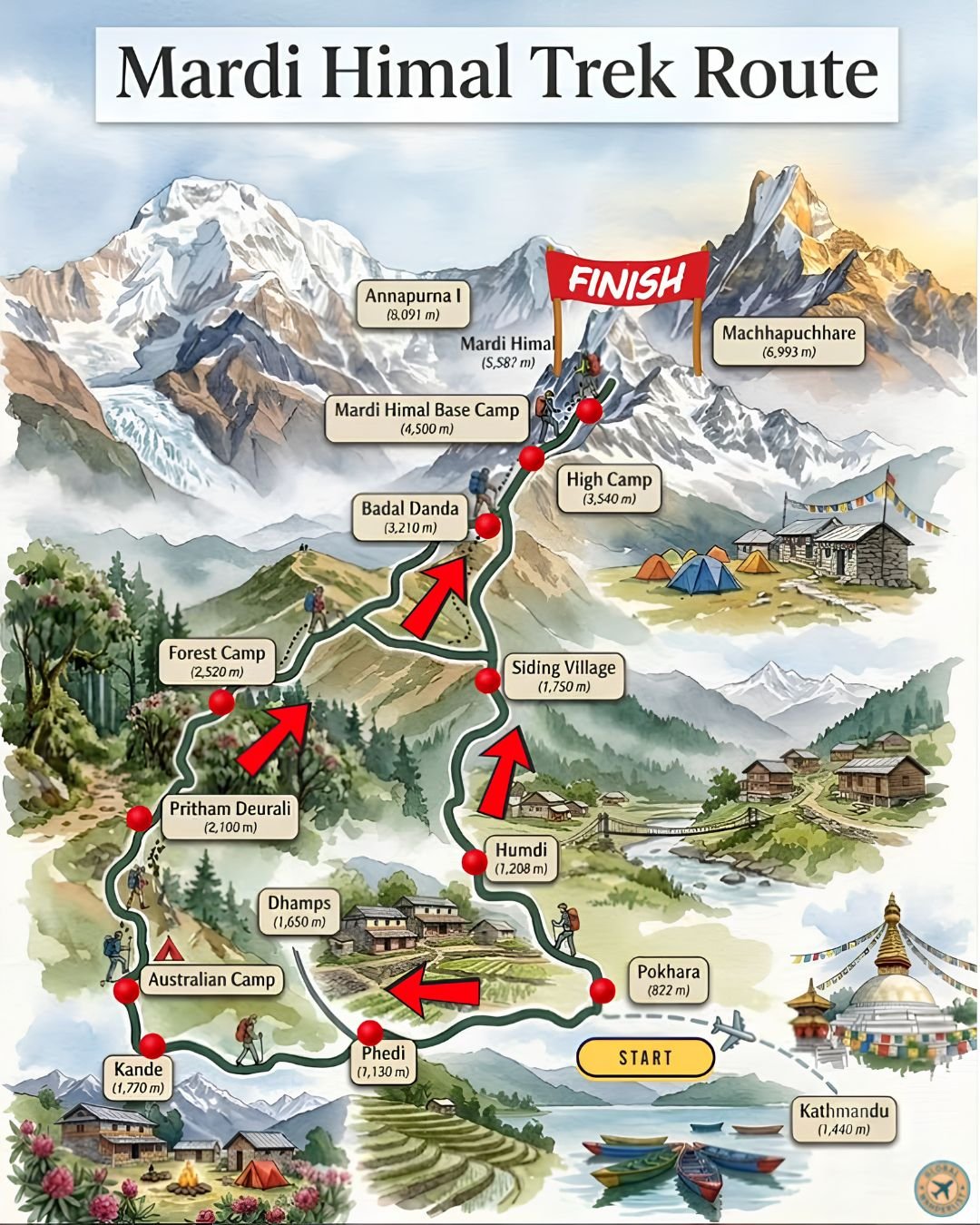
The Mardi Himal Trek is a great introduction to the Annapurna region if you want a Himalayan experience without committing to a long expedition. The trail begins near Pokhara and climbs through villages, farmland, and dense rhododendron forests before reaching an exposed mountain ridge with close views of Machhapuchhre and the Annapurna range. The scenery changes almost every day, which keeps the trek interesting even though the route is relatively short.
The highest point on the route shown here is Mardi Himal Base Camp at around 4,500 meters. Mardi Himal itself rises to 5,587 meters, while the distinctive Machhapuchhre, also known as Fishtail, reaches 6,993 meters. Annapurna I, one of the world’s famous 8,000-meter peaks, rises to 8,091 meters.
The standard trek can be completed in around four to five days of walking, although the exact itinerary varies. Some trekkers start at Kande, while others begin around Dhampus or Phedi. The route also has several teahouses along the way, so you do not need to carry camping equipment for the standard trek.
Mardi Himal Trek Route at a Glance
| Stage | Approx. Elevation | What to Expect |
|---|---|---|
| Pokhara | 822 m | Starting point and gateway to the trek |
| Phedi | 1,130 m | Road access and beginning of the climb |
| Dhampus | 1,650 m | Gurung village and mountain views |
| Kande | 1,770 m | Common trailhead |
| Australian Camp | Around 2,000 m | Open mountain viewpoints |
| Pitam Deurali | 2,100 m | Forest trail and route junction |
| Forest Camp | Around 2,520 m | Dense rhododendron and forest trails |
| Badal Danda | 3,210 m | Open ridge and Himalayan views |
| High Camp | Around 3,540 m | Final overnight stop before Base Camp |
| Mardi Himal Base Camp | 4,500 m | High-altitude viewpoint beneath Mardi Himal |
| Machhapuchhre | 6,993 m | Dramatic Fishtail peak |
| Mardi Himal | 5,587 m | Mountain overlooking the upper trail |
| Annapurna I | 8,091 m | One of the world’s highest mountains |
The elevations can vary slightly between maps and trekking itineraries, particularly around the lower villages and camps. The route commonly follows Kande, Australian Camp, Pitam Deurali, Forest Camp, Low Camp or Badal Danda, High Camp, the upper viewpoint and Mardi Himal Base Camp before descending toward Sidhing and returning to Pokhara.
Pokhara
Pokhara is where the Mardi Himal experience begins. The city sits beside Phewa Lake and has become one of Nepal’s main bases for trekking in the Annapurna region. It is a good place to spend a night or two before setting off because you can sort out permits, gear, transportation, and last-minute supplies without being far from the trailhead.
The atmosphere in Pokhara is also much more relaxed than Kathmandu. The lakeside area is lined with cafes, restaurants, small shops, and trekking agencies, while the mountains become visible beyond the lake on clear mornings. You do not need a packed sightseeing schedule here. A walk around Phewa Lake, a boat ride, or a visit to the World Peace Pagoda can be enough before the trek begins.
The road from Pokhara takes you toward the lower trailheads around Phedi and Kande. From there, the landscape quickly becomes more rural, with terraced fields and mountain villages replacing the city’s streets. The change is surprisingly quick, which is part of the appeal of the Mardi Himal route.
Things to Do in Pokhara
- Phewa Lake: Take a boat across the lake and enjoy views toward the surrounding mountains.
- World Peace Pagoda: Walk or drive up to the hilltop stupa for broad views over Pokhara and the lake.
- Lakeside: Spend an evening exploring the restaurants, cafes, and trekking shops around the waterfront.
- International Mountain Museum: Learn more about Himalayan mountaineering and the communities living in the mountain regions.
- Settle your trek preparations: Pick up any missing equipment and organize transport to the trailhead before leaving Pokhara.
Phedi and Dhampus
Phedi and Dhampus mark the transition from the road to the trail. Phedi sits lower down in the valley, while Dhampus is a mountain village surrounded by terraced farmland and views of the Annapurna range. Some itineraries begin the walk at Phedi, while others use a vehicle to reach a higher starting point such as Kande. The choice depends on how much walking you want to include in the first day.
Dhampus is also a good introduction to the villages of the Annapurna region. The trail passes through farmland and settlements where traditional houses sit among the hills. On clear days, the mountain views begin to open up, giving you an early preview of what lies farther along the ridge.
The walking is not yet at high altitude, but there can be plenty of uphill sections. It is worth taking the first day at a comfortable pace rather than trying to prove how fast you can climb. The real elevation gain comes later, and starting steadily gives your body more time to settle into the trek.
What to Expect
- Village trails: The early route passes through settlements, farmland, and traditional mountain landscapes.
- Stone steps: Expect sections of steps and steady uphill walking.
- Terraced fields: The lower hills are shaped by agriculture, creating broad green terraces across the slopes.
- Mountain views: Annapurna South and other peaks begin appearing between the hills on clear days.
- A gradual start: The lower section gives you time to settle into the rhythm of walking before the higher camps.
Kande and Australian Camp
Kande is one of the most common starting points for the Mardi Himal Trek. The trail climbs from here toward Australian Camp, a popular viewpoint in the lower Annapurna region. The altitude is still modest, but the scenery starts to feel more like a Himalayan trek. Forest paths, open hillsides, and mountain views come together along this section.
Australian Camp is especially popular because it sits on an open ridge with views across the surrounding mountains. It is also connected to several other trekking routes in the area, so you may encounter trekkers heading toward different parts of the Annapurna region. The landscape around the camp is a pleasant mix of forest and open ground, with villages and farmland visible farther down the slopes.
The route then continues toward Pothana and Pitam Deurali. Some itineraries use these settlements as overnight stops, while others continue farther toward Forest Camp. That flexibility makes it possible to adjust the trek depending on your fitness, schedule, and preferred pace.
Highlights of Kande and Australian Camp
- Australian Camp viewpoint: Stop for wide mountain views before heading deeper into the Mardi Himal route.
- Forest trails: Enjoy the shade of the lower mountain forests during the climb.
- Annapurna views: Look across the valley toward the snow-covered peaks when the weather is clear.
- Mountain villages: Walk through small settlements and see how life is organized in the lower Annapurna hills.
- Sunrise and sunset: The open position of Australian Camp makes it a pleasant place for early and late-day mountain views.
Pitam Deurali
Pitam Deurali is a small but important point on the trail. At around 2,100 meters, it sits where the route continues toward Forest Camp and the higher sections of the Mardi Himal ridge. The landscape here is already noticeably different from the lower villages. The trail becomes more wooded, and the surrounding hills feel quieter as you move farther away from the road.
This section is less about a major attraction and more about the experience of walking deeper into the mountains. The trail winds through forest, with occasional openings that reveal the hills beyond. It is also a useful point for judging your pace. If you have started from Kande or Phedi, reaching Pitam Deurali means you have already gained a meaningful amount of elevation.
For many trekkers, this is where the Mardi Himal route starts to feel like a proper mountain trek. The settlements become smaller, the trail becomes more secluded, and the forests begin to dominate the scenery.
What to Look For
- Rhododendron forest: The vegetation becomes thicker as the trail climbs.
- Quiet walking: This section tends to feel more peaceful than the lower village trails.
- Mountain glimpses: Look through breaks in the trees for views of the surrounding peaks.
- Forest paths: The route becomes increasingly shaded and natural.
- Changing altitude: Pay attention to how your body feels as you continue climbing.
Forest Camp
Forest Camp sits around 2,500 meters and marks a noticeable change in the character of the trek. The trail spends much of this section beneath a dense canopy of rhododendron, oak, and other mountain vegetation. Moss-covered trees and occasional mist give the forest a completely different atmosphere from the open viewpoints lower down.
The walk to Forest Camp can feel longer than the distance suggests because the trail continues climbing. Still, the steady ascent is manageable for most reasonably prepared trekkers. There are teahouses at the camp, giving you a place to eat, rest, and spend the night before continuing toward the open ridge.
Forest Camp is also where the altitude begins to matter more. You are still well below the highest sections of the trek, but the elevation gain is continuous. Take your time, drink plenty of water, and avoid turning the climb into a race. The following day brings more open terrain and increasingly close mountain views.
What to Expect at Forest Camp
- Rhododendron forests: Walk through some of the most attractive woodland on the route.
- Moss-covered trees: Moisture and shade create a distinctive forest environment.
- Basic teahouses: Expect simple accommodation and meals rather than hotel-style comforts.
- Cooler evenings: Temperatures drop as you gain altitude, especially after sunset.
- Steady climbing: The trail continues upward, so a relaxed pace is useful.
Badal Danda
Badal Danda is where the Mardi Himal Trek begins to change dramatically. The name is often translated as “cloud hill,” and the landscape is very different from the dense forests around Forest Camp. The trail climbs above the tree line and begins following an exposed ridge. On a clear day, the mountains suddenly seem much closer.
This is one of the most scenic sections of the route. Machhapuchhre stands prominently ahead, while Annapurna South and other peaks appear across the surrounding valleys. The ridge itself becomes part of the attraction. You are walking along an elevated landscape with steep slopes dropping away on either side, so the experience feels quite different from the sheltered forest trails below.
The weather can also change quickly here. Clouds can move across the ridge, and wind tends to become stronger as you climb. Good layers are useful, even when the weather looks comfortable at lower elevations. Badal Danda is a place where it pays to slow down and enjoy the views instead of focusing only on reaching the next camp.
Why Badal Danda Is a Highlight
- Open ridge views: The trail begins to offer wide views instead of being surrounded by forest.
- Machhapuchhre: Fishtail becomes a dominant feature in the landscape.
- Annapurna South: The mountain appears prominently across the surrounding valleys.
- Changing weather: Clouds moving through the ridge can completely alter the scenery within minutes.
- Sunrise and sunset: The exposed position makes this a memorable place to watch the changing light on the mountains.
High Camp
High Camp is the final major overnight stop before the push toward Mardi Himal Base Camp. Sitting at roughly 3,500 meters, it feels much more alpine than the lower camps. Trees become sparse, the ridge becomes more exposed, and the mountains dominate the horizon. This is also where many trekkers begin to appreciate just how close the route brings you to Machhapuchhre.
The accommodation is basic, with simple teahouses providing beds and meals. Nights can be very cold, particularly outside the warmer trekking seasons, so a good sleeping bag and warm layers are important. The exposed ridge also means that wind can make conditions feel colder than the actual temperature suggests.
High Camp is usually an early night because the next section is the most demanding and rewarding part of the trek. Trekkers commonly leave before sunrise to walk toward the upper viewpoint and continue toward Base Camp. Starting early also gives you a better chance of seeing the mountains before clouds build around the peaks later in the day.
What to See Around High Camp
- Machhapuchhre: The distinctive Fishtail peak becomes an enormous presence from the ridge.
- Mardi Himal: Look toward the summit that gives the trek its name.
- Annapurna South: The peak forms part of the impressive panorama to the west.
- Sunrise: An early start can reward you with changing colors across the Himalayan peaks.
- High mountain ridge: Walk a little above camp for a wider view of the surrounding landscape.
Mardi Himal Base Camp
Mardi Himal Base Camp is the high point of the trek and the destination that gives the route its name. At around 4,500 meters, it sits beneath Mardi Himal and offers an extraordinary view of the surrounding peaks. The final approach is very different from the forest trails lower down. The ridge becomes narrower and more exposed, with steep slopes dropping away into the valleys.
The usual approach involves leaving High Camp early and walking toward the upper viewpoint before continuing toward Base Camp. The trail can be demanding at this altitude, particularly because of the elevation gain and the thinner air. A slow pace makes a big difference. The objective is not to reach the top quickly, but to get there safely and still have enough energy to enjoy the scenery.
Once you reach the upper section, the landscape opens dramatically. Machhapuchhre dominates the view, while Annapurna South, Hiunchuli, and other peaks form the wider Himalayan panorama. The summit of Mardi Himal itself rises to 5,587 meters, although the trekking route ends at Base Camp rather than at the mountain summit.
Highlights of Mardi Himal Base Camp
- Mardi Himal: Look directly toward the mountain that towers above the upper ridge.
- Machhapuchhre: The distinctive double summit of Fishtail is one of the defining views of the trek.
- Annapurna range: Several major Himalayan peaks form the backdrop beyond the valleys.
- Upper viewpoint: The viewpoint around 4,200 meters provides an excellent panorama before the final section toward Base Camp.
- Early morning scenery: Clearer conditions are often possible earlier in the day, making a pre-dawn start worthwhile.
Machhapuchhre and Annapurna Views
The mountains are the real reason many people choose the Mardi Himal route. Machhapuchhre, or Fishtail, is particularly impressive because of its distinctive pointed summit and the way it dominates the view from the upper ridge. At 6,993 meters, it rises dramatically above the surrounding landscape. The mountain is considered sacred and climbing it is prohibited.
The wider panorama includes Annapurna South, Hiunchuli, Mardi Himal, and the enormous Annapurna I. At 8,091 meters, Annapurna I is one of the world’s highest mountains. The route does not take you to Annapurna I, but its presence in the panorama gives the upper sections a sense of scale that is difficult to appreciate from the lower valleys.
One of the best things about the trek is how the mountains reveal themselves gradually. Early sections offer glimpses between trees, while the higher ridge opens into much wider views. By the time you reach High Camp and the upper viewpoint, there is very little between you and the peaks.
Mountains You Can See
- Mardi Himal: The mountain rises directly above the upper trekking route.
- Machhapuchhre: The iconic Fishtail peak becomes especially prominent from High Camp and the upper ridge.
- Annapurna I: The 8,091-meter peak forms part of the broader Himalayan panorama.
- Annapurna South: This prominent peak is visible from several sections of the upper route.
- Hiunchuli: Another major peak visible from the Mardi Himal ridge.
What Makes the Mardi Himal Trek Special?
Mardi Himal works well for trekkers who want dramatic Himalayan scenery without spending weeks on the trail. The standard route can be completed in around four to five days of walking, with longer versions available for people who want to take things more slowly. The route is also close to Pokhara, so getting to and from the trail does not require a complicated travel plan.
The scenery is another major advantage. The first part of the trek moves through villages and farmland before entering dense forest. Higher up, the trees thin out and the trail reaches an exposed ridge with much bigger mountain views. That progression makes the trek feel varied rather than repetitive.
The route is often described as moderate, but it should not be treated as an easy hike. The climb to higher elevations, the exposed ridge, and the final walk toward Base Camp can be physically demanding. Altitude also becomes an important consideration once you are above 3,000 meters.
Reasons to Choose Mardi Himal
- It is relatively short: You can experience the Annapurna region without committing to a two-week trek.
- The scenery changes constantly: Forests, villages, ridges, and alpine landscapes all appear along the route.
- The mountain views are excellent: Machhapuchhre and Annapurna South become remarkably close from the upper trail.
- The logistics are manageable: Pokhara is close to the trailheads, and teahouses operate along the route.
- It suits a range of trekkers: The route can be adjusted to create shorter or longer days depending on your schedule and fitness.
Practical Tips for the Mardi Himal Trek
The best trekking periods are generally autumn and spring. October and November tend to bring clear mountain views and dry trails, while March and April are also popular. Conditions can change quickly in the mountains, so the forecast should always be checked before setting out.
Altitude deserves serious attention. The route climbs from around 1,000 meters near the lower trailheads to 4,500 meters at Base Camp. That is a substantial increase in elevation over a relatively short period. Headaches, unusual tiredness, dizziness, nausea, or difficulty breathing should not be ignored. Walk slowly, stay hydrated, and allow yourself time to adjust.
Accommodation along the standard route is mainly in basic teahouses. Rooms are simple, and facilities become more basic as you climb. Food is available along the trail, but choices become more limited at higher camps. Carry snacks that you actually enjoy eating because they can be useful during longer stretches.
Permits are also part of the preparation. Current trekking requirements should be checked before departure because Nepal’s regulations can change. Current trekking sources list the Annapurna Conservation Area Permit and TIMS among the permits associated with the route.
A guide can also make the trek easier, particularly on the upper ridge. Weather can reduce visibility, and the terrain above the tree line is more exposed. Even experienced hikers may appreciate having someone familiar with the route, accommodation, and local conditions.
What to Know Before You Go
- Choose the right season: October-November and March-April are generally regarded as the strongest periods for clear conditions and mountain views.
- Take altitude seriously: The trail reaches around 4,500 meters, so do not treat it like an ordinary day hike.
- Check permits: Confirm the current permit and TIMS requirements before leaving Pokhara.
- Start early: Morning conditions are often better for mountain views, particularly on the upper ridge.
- Carry cash: Smaller teahouses and local services may not have reliable card facilities.
- Pack layers: Temperatures can change dramatically between the lower forest and High Camp.
- Keep your pace comfortable: The goal is to reach the upper ridge with enough energy to enjoy it.
- Consider a guide: A local guide can help with navigation, accommodation, weather, and changing trail conditions.
What to Pack for Mardi Himal
You do not need an expedition-style load for the Mardi Himal Trek, but the upper sections require proper preparation. Good footwear is especially important because the trail includes stone steps, forest paths, uneven ground, and exposed ridge sections. A waterproof outer layer is useful even during the drier seasons because mountain weather can change quickly.
Warm clothing becomes increasingly important as you climb. High Camp is considerably colder than Pokhara, and temperatures can drop sharply after sunset. A sleeping bag suitable for cold mountain nights is worth carrying, even when teahouses provide blankets.
Sun protection is easy to overlook. At higher elevations, the sun can feel intense even when the air is cold. Sunglasses, sunscreen, and a hat should stay accessible rather than buried at the bottom of your bag.
Essential Gear
- Hiking boots: Choose footwear with good grip and enough support for uneven terrain.
- Warm layers: Bring a fleece, insulated jacket, thermal layers, gloves, and a warm hat.
- Waterproof jacket: Keep a rain shell available because mountain weather can change quickly.
- Sleeping bag: A warm sleeping bag makes basic teahouse accommodation much more comfortable.
- Trekking poles: Poles can be particularly useful on steep climbs and the descent.
- Headlamp: An early morning start for the upper viewpoint makes a headlamp very useful.
- Water bottle: Carry enough water and plan where you will refill along the route.
- Sun protection: Sunglasses, sunscreen, and a hat are important at higher elevations.
- Basic first-aid supplies: Carry your usual personal medication along with basic supplies for blisters and minor injuries.
Final Thoughts
The Mardi Himal Trek manages to pack a lot into a relatively short Himalayan journey. The lower trail gives you villages, terraced hills, and forest, while the upper sections open onto a dramatic ridge beneath some of Nepal’s most recognizable peaks. The experience changes again at High Camp, where the landscape becomes colder, more exposed, and much more alpine.
It is not a trek that should be rushed simply because it is shorter than some of Nepal’s famous routes. The altitude still demands respect, and the upper ridge deserves time. For trekkers who want a manageable route with big mountain scenery, simple teahouse stays, and easy access from Pokhara, Mardi Himal is a strong choice.