
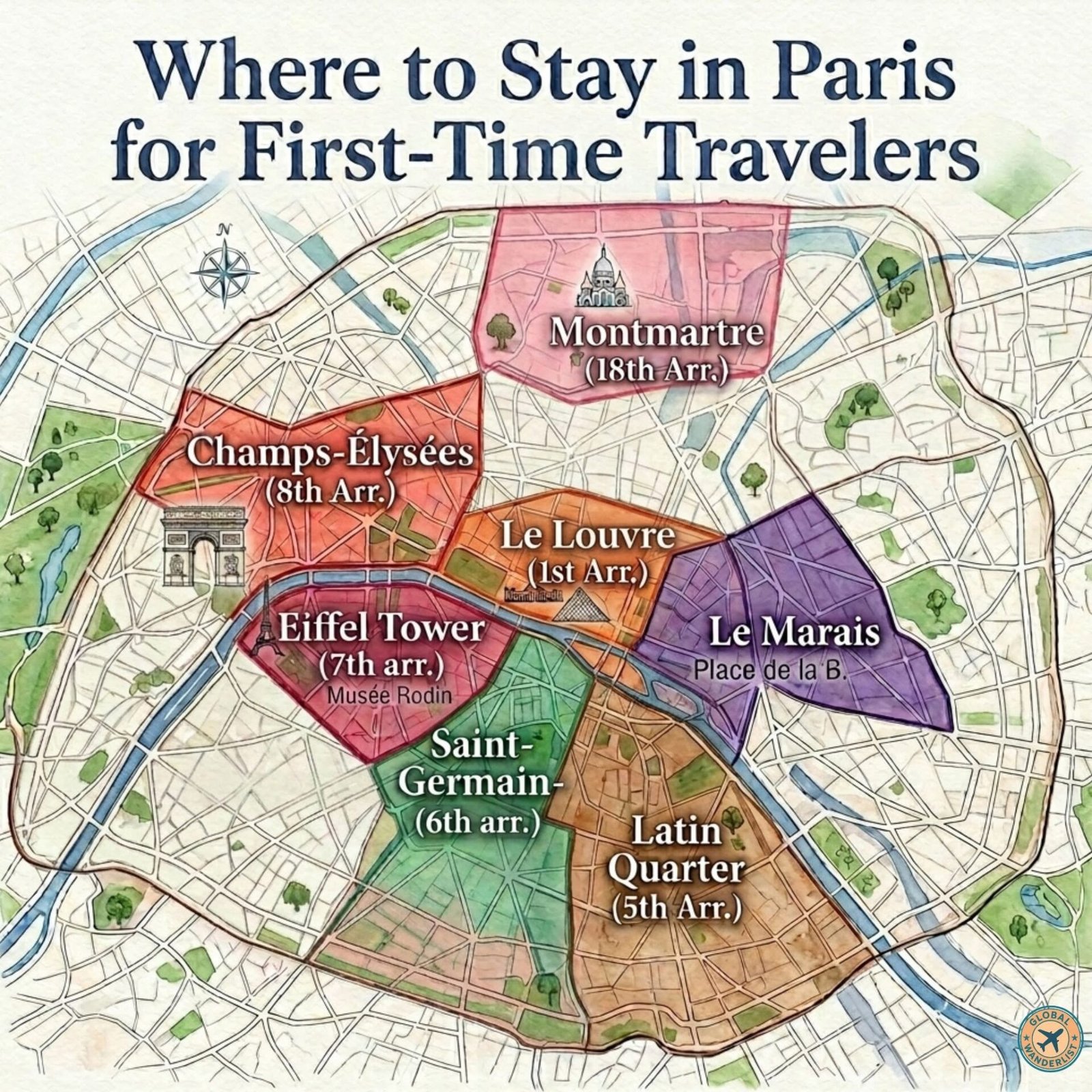
Paris rewards travelers who pick their neighborhood carefully. The right base can put you steps from the Eiffel Tower or the Louvre, cut your commute time in half, and shape the entire feel of your trip. The wrong one can leave you spending precious vacation hours on the metro instead of at a sidewalk cafe.
Each Paris district has its own personality. Some areas favor quiet elegance and museum access, while others hum with nightlife or bohemian charm. This guide breaks down seven of the city’s most popular neighborhoods to help you match your travel style, budget, and interests to the right home base.
| Neighborhood | Best For | Average Budget | Nearby Attractions | Atmosphere |
| Champs-Élysées (8th) | Luxury shopping and grand boulevards | $ to $$ | Arc de Triomphe, Grand Palais | Glamorous and polished |
| Eiffel Tower (7th) | First-time visitors and museum lovers | $ to $$ | Eiffel Tower, Musée d’Orsay, Musée Rodin | Elegant and quiet |
| Le Louvre (1st) | Art lovers and central sightseeing | $ to $$ | Louvre Museum, Tuileries Garden | Grand and central |
| Le Marais (3rd/4th) | Trendy dining and LGBTQ+ nightlife | to $ | Place des Vosges, Jewish Quarter | Historic and hip |
| Saint-Germain-des-Prés (6th) | Literary charm and boutique shopping | $$$ | Luxembourg Gardens, historic cafes | Sophisticated and intellectual |
| Latin Quarter (5th) | Budget travelers and students | $$ | Panthéon, Notre-Dame, Sorbonne | Youthful and academic |
| Montmartre (18th) | Artistic atmosphere and city views | to $ | Sacré-Cœur, Place du Tertre | Bohemian and scenic |
Champs-Élysées: Grand Boulevards and Polished Glamour
The Champs-Élysées sits in the 8th arrondissement, one of Paris’s most prestigious districts. This area suits travelers who want luxury shopping, upscale hotels, and easy access to iconic landmarks like the Arc de Triomphe.
Wide boulevards and manicured storefronts define the neighborhood’s look. It attracts visitors drawn to designer flagship stores, five star hotels, and a more formal Parisian experience. Families and business travelers often gravitate here for its central location and polished infrastructure.
What to Do in Champs-Élysées
- Walk the full length of Avenue des Champs-Élysées, stopping at flagship stores from major fashion houses. The avenue stretches from the Arc de Triomphe to Place de la Concorde.
- Climb the Arc de Triomphe for sweeping views down twelve radiating avenues. Evening visits offer dramatic lighting as the monument glows against the night sky.
- Explore the Grand Palais and Petit Palais, two stunning Beaux-Arts exhibition halls. Both regularly host major art and design exhibitions worth checking in advance.
- Visit the nearby Jacquemart-André Museum for an intimate look at a 19th century private art collection. It offers a quieter alternative to the area’s larger institutions.
- Shop along Avenue Montaigne for high fashion in a slightly calmer setting than the main avenue. This street is known as part of Paris’s Golden Triangle.
Where to Eat in Champs-Élysées
- Le Bistro Marbeuf, French bistro, $$. A classic Parisian brasserie near the Arc de Triomphe known for onion soup and beef bourguignon.
- Le Relais de l’Entrecôte, French steakhouse, $$. A beloved no-menu spot serving just steak frites with a secret sauce, always with a line worth the wait.
- Frivole, contemporary French, $$$. A chic terrace restaurant in the Golden Triangle, popular for lunch and after-work drinks.
- Verde Paris, contemporary European, $$$$. A polished bistro praised for its beef bourguignon and refined atmosphere.
- Le Cinq, French fine dining, $$$$. A three Michelin star dining room inside the Four Seasons George V, ideal for a splurge worthy celebration meal.
Eiffel Tower Area: Elegant, Quiet, and Museum Rich
The 7th arrondissement surrounds the Eiffel Tower and ranks among the best areas for first-time visitors. It suits travelers who want a safe, quiet base within walking distance of major landmarks.
This neighborhood blends government buildings, embassies, and residential streets with world class museums. It works well for couples, families, and anyone prioritizing sightseeing over nightlife, since the area quiets down considerably after dinner.
What to Do in Eiffel Tower Area
- Visit the Eiffel Tower itself, ideally booking timed tickets in advance to skip long lines. Climbing to the top offers the best panoramic views over the city.
- Explore the Musée d’Orsay, home to one of the world’s finest Impressionist art collections. The museum’s former train station architecture is a highlight on its own.
- Wander the Musée Rodin’s sculpture garden, a peaceful spot to see works like The Thinker. The garden alone is worth the visit, even without entering the museum.
- Walk along the Champ de Mars, the long park stretching from the Eiffel Tower toward the Military School. It is a popular spot for picnics with a tower view.
- Browse the Rue Cler market street, a charming pedestrian lane filled with bakeries, cheese shops, and produce stalls. It offers an authentic taste of neighborhood life.
Where to Eat in Eiffel Tower Area
- Chez Ribe, French bistro, $$$. A cozy neighborhood spot near the Eiffel Tower known for comforting, classic dishes and a lovely outdoor patio.
- L’Ami Jean, Basque bistro, $$$. A boisterous, beloved institution serving hearty Basque influenced cooking with legendary rice pudding for dessert.
- Café Constant, French bistro, $$. A relaxed spot from a well known Paris chef, offering quality bistro fare without the fine dining price tag.
- Pertinence, French fine dining, $$$$. An intimate Michelin starred restaurant blending Japanese precision with French technique in an 18 seat dining room.
- Girafe, seafood and Mediterranean, $$$$. A striking restaurant near Trocadéro with one of the best Eiffel Tower view terraces in the city.
Le Louvre: Central, Grand, and Art Focused
The 1st arrondissement surrounds the Louvre Museum and sits at the geographic heart of Paris. This neighborhood suits travelers who want to be close to everything, especially art lovers planning multiple museum visits.
Elegant arcades, formal gardens, and grand architecture define this central district. It works especially well for visitors who want to minimize travel time between major sights, since so many landmarks sit within walking distance.
What to Do in Le Louvre
- Spend at least half a day inside the Louvre Museum, focusing on a few wings rather than trying to see everything. The collection is far too large to cover in one visit.
- Stroll through the Tuileries Garden, the formal park stretching from the Louvre toward Place de la Concorde. It offers a relaxing break between museum visits.
- Explore the Palais Royal gardens, a quieter, more intimate green space surrounded by elegant arcades and boutiques. It feels like a hidden retreat just steps from the crowds.
- Browse Rue Saint-Honoré for high end shopping in a slightly more relaxed setting than the Champs-Élysées. The street mixes flagship boutiques with smaller specialty shops.
- Visit the Musée des Arts Décoratifs, located within the Louvre complex but often overlooked. It showcases design, fashion, and decorative arts across several centuries.
Where to Eat in Le Louvre
- Le Fumoir, French and international, $$$. A relaxed, stylish spot near the Louvre’s Cour Carrée, popular for both meals and cocktails.
- Verjus, contemporary French tasting menu, $$$$. A seasonal tasting menu restaurant near the Palais Royal, drawing ingredients from the team’s own garden.
- Café Marly, French, $$$$. An elegant cafe with a terrace directly overlooking the Louvre’s glass pyramid, ideal for a scenic lunch.
- Le Christine, French bistro, $$$. A cozy, rustic spot just across the Seine, consistently praised for quality and value.
- Frenchie, modern French, $$$$. An influential restaurant from a well known Paris chef, located a short walk from the Louvre in the Sentier district.
Le Marais: Trendy, Historic, and Full of Life
Le Marais spans the 3rd and 4th arrondissements and ranks among Paris’s most dynamic neighborhoods. It suits travelers who want a lively mix of history, shopping, and nightlife within walking distance of their hotel.
Narrow medieval streets house both centuries old buildings and some of the city’s trendiest boutiques and restaurants. The area also has a strong LGBTQ+ nightlife scene and a historic Jewish quarter, making it one of the most culturally layered districts in Paris.
What to Do in Le Marais
- Wander through Place des Vosges, one of the oldest planned squares in Paris. Its symmetrical architecture and central garden make it a favorite spot to relax.
- Explore the historic Jewish Quarter along Rue des Rosiers, known for its bakeries and delis. It reflects centuries of Jewish life in the neighborhood.
- Browse concept stores and boutiques throughout the district, especially around Rue Vieille du Temple. Le Marais has become one of the city’s top shopping destinations for independent labels.
- Visit the Musée Picasso, housed in a beautiful 17th century mansion. It holds one of the largest public collections of the artist’s work.
- Experience the neighborhood’s nightlife scene, particularly around Rue Sainte-Croix de la Bretonnerie. This strip anchors much of the city’s LGBTQ+ social scene.
Where to Eat in Le Marais
- L’As du Fallafel, Middle Eastern, $. A famous falafel stand in the Jewish Quarter, often cited as the best quick bite in the neighborhood.
- Chez Janou, Provençal French, $$. A charming corner bistro serving southern French classics, beloved by locals and visitors alike.
- Au Bourguignon du Marais, French bistro, $$$. A traditional spot specializing in Burgundy region dishes like boeuf bourguignon and escargot.
- Robert et Louise, French bistro, $$. A cozy, rustic restaurant known for its fireplace grilled meats and warm atmosphere.
- Les Philosophes, French brasserie, $$. A classic people watching spot with a large patio, perfect for a relaxed meal between sightseeing.
Saint-Germain-des-Prés: Literary Charm and Left Bank Elegance
Saint-Germain-des-Prés sits in the 6th arrondissement on the Left Bank of the Seine. This neighborhood suits travelers drawn to literary history, boutique shopping, and a more refined, less touristy pace.
Once home to writers and philosophers like Sartre and Hemingway, the area retains an intellectual, artistic character. It appeals to couples and older travelers who want charm and sophistication without the crowds of the more central districts.
What to Do in Saint-Germain-des-Prés
- Relax in the Luxembourg Gardens, one of the most beautiful public parks in Paris. Its manicured lawns and fountains make it perfect for a slow afternoon.
- Visit historic literary cafes like Café de Flore and Les Deux Magots, once frequented by famous writers and philosophers. They remain iconic, if touristy, stops for coffee.
- Browse the neighborhood’s boutique shops and antique dealers, especially around Rue de Buci. The area has long been known for its refined, curated retail scene.
- Explore the Musée d’Orsay from this side of the river, since it sits just at the edge of the neighborhood. It pairs naturally with a Saint-Germain afternoon.
- Visit the Église Saint-Germain-des-Prés, one of the oldest churches in Paris. Its Romanesque architecture reflects the neighborhood’s deep historic roots.
Where to Eat in Saint-Germain-des-Prés
- L’Avant Comptoir, French wine bar, $$. A tiny, always packed spot serving inventive small plates, with a menu that changes daily.
- Bistro des Augustins, French bistro, $$. A comforting neighborhood favorite known for generous portions and classic French dishes.
- La Jacobine, French bistro, $$. A highly rated spot tucked into a historic passageway, popular for both lunch and dinner.
- Café Buci, French brasserie, $$$. A longstanding neighborhood institution serving classic brasserie fare for over 150 years.
- Le Procope, French, $$$. The oldest cafe in Paris, dating to 1686, offering a historic dining experience alongside traditional French dishes.
Latin Quarter: Youthful, Academic, and Budget Friendly
The Latin Quarter occupies the 5th arrondissement, home to the Sorbonne and centuries of academic history. This neighborhood suits students, budget travelers, and anyone who wants a lively, walkable base near major landmarks.
Narrow medieval streets wind past bookshops, cafes, and student hangouts. The area has a younger, more energetic feel than nearby Saint-Germain, while still offering easy access to Notre-Dame and the Panthéon.
What to Do in Latin Quarter
- Visit the Panthéon, a domed mausoleum honoring France’s most celebrated historical figures. Its crypt holds the remains of Voltaire, Rousseau, and Marie Curie.
- Wander Rue Mouffetard, a lively market street lined with food shops, cafes, and bistros. Mornings bring the most authentic market atmosphere.
- Explore Shakespeare and Company, a beloved English language bookstore near Notre-Dame. It remains a gathering spot for writers and readers from around the world.
- Walk across to Notre-Dame Cathedral, which sits just across the river from the neighborhood’s edge. Ongoing restoration work has drawn renewed interest to the site.
- Browse the Sorbonne’s historic courtyard, one of the oldest universities in the world. Visitors can admire the architecture even without stepping inside.
Where to Eat in Latin Quarter
- La Petite Périgourdine, French bistro, $$. A classic spot near the Panthéon serving hearty dishes like duck confit and steak tartare.
- Bolan, Thai, $$. A well regarded spot for Thai food in the 5th arrondissement, offering a flavorful break from French classics.
- Selva, South American and French, $$$. A creative restaurant blending South American influences with French technique, along with a strong cocktail menu.
- La Bûcherie, French and international, $$. A versatile spot near Notre-Dame offering everything from French classics to burgers and salads.
- Le Procope, French, $$$. Also reachable from this side of the river, the historic cafe remains a popular stop for Latin Quarter visitors.
Montmartre: Bohemian, Artistic, and Scenic
Montmartre sits atop a hill in the 18th arrondissement, crowned by the white domes of Sacré-Cœur. This neighborhood suits travelers drawn to artistic history, village like charm, and some of the best skyline views in Paris.
Cobblestone streets wind steeply past artist studios, small squares, and cafes with panoramic views. It appeals to romantics, photographers, and anyone who wants a quieter, more residential base outside the busiest tourist core.
What to Do in Montmartre
- Climb to the Sacré-Cœur Basilica for sweeping views over the entire city. Arriving early in the morning helps you beat the crowds and catch soft morning light.
- Visit Place du Tertre, a small square filled with street artists offering portraits and quick sketches. It captures Montmartre’s long standing artistic identity.
- Explore the neighborhood’s winding streets around Rue Lepic and Rue des Abbesses, lined with independent shops and cafes. Getting lost here is part of the charm.
- Visit the Musée de Montmartre, which traces the neighborhood’s artistic history through the former studios of painters like Renoir. Its garden offers a peaceful break from the crowds.
- Catch a show at Moulin Rouge, the iconic cabaret that has defined Montmartre nightlife for over a century. Booking tickets in advance is essential.
Where to Eat in Montmartre
- Chantoiseau, modern French, $$$. A stylish neo-bistro about a seven minute walk from Place du Tertre, known for its inventive savory tortes.
- La Mascotte, seafood brasserie, $$$. A corner brasserie serving shellfish since 1889, with a terrace perfect for people watching on Rue des Abbesses.
- a.lea, modern French, $$. A well regarded spot from a talented young chef, offering thoughtful, contemporary French cooking.
- Le Coq & Fils, French rotisserie, $$$. A beloved spot known for its roast chicken, drawing both locals and visitors up the hill.
- Sapinho, Portuguese, $$. An authentic Portuguese tavern perched high on the Butte Montmartre, offering a distinctive break from French menus.
Choosing the Right Neighborhood for Your Trip
Each of these seven neighborhoods offers a genuinely different version of Paris. The Champs-Élysées and Le Louvre suit travelers who want grandeur and central convenience, while the Eiffel Tower area balances elegance with a quieter pace ideal for first timers.
Le Marais rewards those chasing nightlife, shopping, and cultural depth in one dense package. Saint-Germain-des-Prés and the Latin Quarter both offer Left Bank charm, though the former leans sophisticated while the latter suits tighter budgets and younger travelers. Montmartre remains the top pick for anyone seeking artistic atmosphere and sweeping views over a more residential, village like setting.
Think about your priorities before booking. Museum lovers should lean toward the Louvre or the Eiffel Tower area, while nightlife seekers will find more energy in Le Marais or Montmartre. Whichever neighborhood you choose, Paris rewards travelers willing to wander its streets slowly, one arrondissement at a time.