
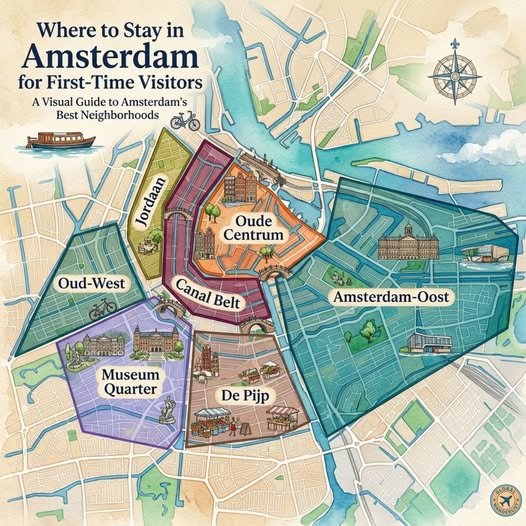
Choosing where to stay in Amsterdam shapes your entire trip more than you might expect. The city’s compact center spreads into distinct neighborhoods, each with its own pace, canals, and local character. Pick the wrong one, and you might spend your visit on longer tram rides rather than exploring on foot.
Amsterdam rewards visitors who stay somewhere walkable or bike-friendly, since the city was practically built for two wheels. Each neighborhood carries its own energy, from postcard-perfect canal houses to buzzing food markets. Picking the right one shapes your daily rhythm just as much as any single museum.
This guide breaks down seven of Amsterdam’s best neighborhoods for first-time visitors. Each one suits a different kind of traveler, from culture seekers to foodies. Read on to find the area that matches your travel style and budget.
Neighborhood Overview
| Neighborhood | Best For | Average Budget | Nearby Attractions | Atmosphere |
|---|---|---|---|---|
| Oude Centrum | First-time visitors, nightlife | $-$$ | Dam Square, Red Light District | Central, lively |
| Canal Belt | Romantics, history lovers | $-$$ | Anne Frank House, canal ring | Elegant, picturesque |
| Jordaan | Foodies, boutique shoppers | -$ | Noorderkerk, Westerkerk | Charming, residential |
| Museum Quarter | Art lovers, families | $-$$ | Rijksmuseum, Van Gogh Museum | Refined, quiet |
| De Pijp | Young travelers, foodies | -$ | Albert Cuyp Market, Sarphatipark | Trendy, multicultural |
| Oud-West | Local charm, food halls | -$ | De Foodhallen, Vondelpark | Residential, eclectic |
| Amsterdam-Oost | Budget travelers, quiet stays | $-$$ | Oosterpark, Tropenmuseum | Relaxed, diverse |
Oude Centrum
Oude Centrum forms Amsterdam’s historic heart, a dense maze of canals, narrow lanes, and centuries-old buildings surrounding Dam Square. This is the most central and walkable base in the city, putting nearly every major landmark within reach on foot. First-time visitors who want everything close by will find no better location.
The neighborhood mixes grand civic architecture with the notorious Red Light District and a genuinely lively nightlife scene. Prices run higher here than in outer districts, reflecting the central location. Centraal Station anchors the northern edge, connecting easily to trains, trams, and ferries.
What to Do in Oude Centrum
- Visit Dam Square, the city’s civic heart, home to the Royal Palace and National Monument.
- Explore the Red Light District’s canals and centuries-old architecture, especially atmospheric at dusk.
- Wander the Nine Streets shopping area for boutiques, vintage shops, and specialty stores.
- Visit the Oude Kerk, Amsterdam’s oldest building, dating back to the 13th century.
- Browse the Bloemenmarkt, the world’s only floating flower market, for tulip bulbs and souvenirs.
- Take a canal cruise departing from near Centraal Station for a relaxed introduction to the city.
Where to Eat in Oude Centrum
- Tempo Doeloe – Traditional Indonesian rijsttafel – $$$
- Choux – Modern European vegetable-forward tasting menu – $$$
- Caldi e Freddi – Italian deli-trattoria with fresh pasta – $$
- Café de Klepel – French bistro with a daily-changing menu – $$
Canal Belt
The Canal Belt, or Grachtengordel, encircles the historic center with 17th-century canal houses lining the Singel, Herengracht, Keizersgracht, and Prinsengracht. This UNESCO World Heritage district represents the pinnacle of Amsterdam’s Golden Age architecture and urban planning. It suits romantics and history lovers who want a picturesque, elegant base.
The Anne Frank House sits along the Prinsengracht, drawing visitors from across the world. Narrow, gabled houses and arched bridges make this one of the most photographed parts of the city. Walking or cycling remains the best way to experience the canal ring’s quiet, tree-lined streets.
What to Do in Canal Belt
- Visit the Anne Frank House, preserving the hiding place described in her famous diary.
- Walk or cycle along the main canals, admiring centuries-old gabled architecture at every turn.
- Explore the Nine Streets, where the canal ring’s boutiques and cafes cluster together.
- Take an evening canal cruise to see the bridges and houses lit up after dark.
- Visit the Museum of Bags and Purses, a quirky collection inside a canal house.
- Browse antique shops along Spiegelgracht, known for art and curiosities.
Where to Eat in Canal Belt
- Singel 101 – Family-run fine dining in a 17th-century canal house – $$$$
- Restaurant DenC – Cozy French-Mediterranean fine dining – $$$$
- Jottum – Tapas-style small plates for sharing – $$
- Christiaan Smit – Canal-side dining with a seasonal Dutch menu – $$$
Jordaan
Jordaan ranks among Amsterdam’s most charming and sought-after neighborhoods, a former working-class quarter turned upscale residential district. Narrow, tree-lined streets and small canals create a village-like atmosphere just steps from the busier center. This area suits foodies and travelers wanting boutique shopping in a quieter setting.
Traditional brown cafes, dating back centuries, still anchor the neighborhood’s social life alongside a genuinely excellent restaurant scene. Noorderkerk and Westerkerk both offer architectural landmarks worth a visit. The Saturday Noordermarkt draws locals for organic produce and antiques.
What to Do in Jordaan
- Browse the Noordermarkt on Saturdays for organic produce, antiques, and local crafts.
- Visit Westerkerk, offering tower climbs with sweeping views over the canal ring.
- Wander the neighborhood’s narrow streets and hidden courtyards, called hofjes, for quiet architecture.
- Stop at a traditional brown cafe for a beer and bitterballen, a genuine local tradition.
- Explore small art galleries and vintage shops scattered throughout the quarter.
- Walk along the Brouwersgracht, often cited as Amsterdam’s most picturesque canal.
Where to Eat in Jordaan
- Toscanini – Long-standing Italian favorite with an open kitchen – $$$
- Moeders – Traditional Dutch home cooking, stamppot and erwtensoep – $$
- La Perla – Wood-fired Neapolitan-style pizza – $
- Café Duende – Amsterdam’s oldest tapas bar with live flamenco – $
Museum Quarter
Museum Quarter anchors Amsterdam’s cultural heart in the Oud-Zuid district, home to the Rijksmuseum, Van Gogh Museum, and Stedelijk Museum within a short walk of each other. Wide, elegant boulevards and grand 19th-century buildings give the area a refined, less crowded feel. This neighborhood suits art lovers and families seeking a quieter, museum-focused stay.
Vondelpark borders the district, offering green space for a relaxed walk or bike ride between museum visits. The Concertgebouw, one of the world’s finest concert halls, sits at the quarter’s center. Trams connect easily to the city center, just a few stops away.
What to Do in Museum Quarter
- Visit the Rijksmuseum for an unmatched collection of Dutch Golden Age masterpieces, including Rembrandt’s Night Watch.
- Explore the Van Gogh Museum, housing the largest collection of the artist’s work in the world.
- Browse the Stedelijk Museum for modern and contemporary art in a striking building.
- Relax in Vondelpark, Amsterdam’s most popular green space, ideal for a picnic or bike ride.
- Catch a performance at the Concertgebouw, renowned for its exceptional acoustics.
- Shop along P.C. Hooftstraat, the city’s premier luxury shopping street.
Where to Eat in Museum Quarter
- Ciel Bleu – Two-Michelin-starred French-international fine dining with panoramic views – $$$$
- MOMO Restaurant, Bar and Lounge – Pan-Asian dining with a stylish terrace – $$$
- Café Loetje – Beloved for its hanging steak, a local institution – $$
- The Seafood Bar – Fresh, casual seafood near the museums – $$$
De Pijp
De Pijp ranks among Amsterdam’s liveliest and most multicultural neighborhoods, long home to Turkish and Moroccan communities alongside a thriving young professional scene. The Albert Cuyp Market, running six days a week, anchors the district with fresh produce and street food. This area suits young travelers and foodies chasing an authentic, less touristed vibe.
Sarphatipark offers a green, relaxed escape from the market’s daily bustle. The neighborhood’s international food scene ranges from Surinamese snacks to Michelin-starred tasting menus. De Pijp connects easily to the center by tram, just minutes from the Museum Quarter.
What to Do in De Pijp
- Browse the Albert Cuyp Market for fresh produce, cheese, and street food six days a week.
- Relax in Sarphatipark, a quieter green space just off the main market street.
- Explore the Heineken Experience, housed in the brewery’s original 19th-century building.
- Wander Ferdinand Bolstraat for boutique shops and a growing concentration of good restaurants.
- Visit De Nieuwe Anita for live music and an alternative, artsy nightlife scene.
- Browse independent bookshops and vintage stores tucked along the neighborhood’s side streets.
Where to Eat in De Pijp
- Ciel Bleu – Two-Michelin-starred dining on the 23rd floor of Hotel Okura – $$$$
- Little Collins – Australian-run brunch spot, a neighborhood pioneer – $$
- Bazar – Middle Eastern cuisine inside a converted church – $$
- De Waaghals – Vegetarian dining with a relaxed, neighborhood feel – $$
Oud-West
Oud-West has transformed from a working-class district into one of Amsterdam’s most eclectic and food-focused neighborhoods. Kinkerstraat and Overtoom, two of the city’s most multicultural streets, anchor a district known for its international restaurant scene. This area suits travelers wanting local charm without straying far from the center.
De Foodhallen, housed in a converted 1902 tram depot, gathers dozens of food vendors under one roof. The neighborhood borders Vondelpark and the last ring of the canal belt, giving it genuine green space and canal views. Nightlife here runs later and feels more relaxed than the busier center.
What to Do in Oud-West
- Browse De Foodhallen, an upscale food hall inside a restored 1902 tram depot.
- Walk or cycle through the edge of Vondelpark, bordering the neighborhood’s eastern side.
- Explore Kinkerstraat and Overtoom for eclectic, multicultural shops and eateries.
- Visit Ten Kate Market for a more local, less touristed alternative to Albert Cuyp.
- Browse independent boutiques and coffee shops scattered through the residential side streets.
- Catch live music or a DJ set at one of the neighborhood’s relaxed bars.
Where to Eat in Oud-West
- De Foodhallen – Diverse food hall with vendors spanning multiple global cuisines – $
- Stacks Diner – Elevated American comfort food with a vintage diner feel – $$
- Waterkant – Surinamese hangout with a canal-view terrace – $
- Restaurant Brut de Mer – Open-fire seasonal cooking in a monumental warehouse – $$$
Amsterdam-Oost
Amsterdam-Oost offers a relaxed, residential alternative to the busier tourist core, spreading east from the center across a diverse, up-and-coming district. Oosterpark provides a genuine local green space, while the Tropenmuseum showcases an outstanding ethnographic collection. This area suits budget-conscious travelers and anyone wanting a quieter, more local stay.
The Indische Buurt, a subsection of Oost, has developed a genuinely strong food scene in recent years. Trams and the metro connect the district to central Amsterdam in minutes. This neighborhood rewards travelers willing to trade postcard canals for everyday Amsterdam life.
What to Do in Amsterdam-Oost
- Relax in Oosterpark, a spacious green escape popular with local residents.
- Visit the Tropenmuseum for an extensive collection exploring global cultures and colonial history.
- Browse Dappermarkt, a vibrant daily street market reflecting the district’s diversity.
- Explore Javaplein in the Indische Buurt for a growing cluster of modern restaurants.
- Walk or cycle along the Amstel River for scenic views away from the busier center.
- Visit Park Frankendael for a quieter, garden-focused green space with a working nursery.
Where to Eat in Amsterdam-Oost
- Restaurant De Kas – Greenhouse dining in a working nursery, garden-to-plate menu – $$$
- Wilde Zwijnen – Flemish-French rotisserie in a former domestic-science school – $$$
- Rijsel – Modern Dutch seasonal dishes on Javaplein – $$
- Hotel de Goudfazant – Industrial-chic dining in a converted car garage – $$$
Final Thoughts
Amsterdam offers something different depending on where you rest your head at night. Oude Centrum and Canal Belt suit travelers who want iconic canal views and everything within walking distance. Jordaan and Museum Quarter work well for those chasing charm, art, and a slightly quieter pace.
De Pijp and Oud-West fit foodies and younger travelers drawn to multicultural energy and excellent food halls. Amsterdam-Oost rewards budget-conscious visitors willing to trade central postcards for genuine local life. Whichever neighborhood you choose, Amsterdam’s compact size and excellent cycling infrastructure mean you are never far from the next one.