
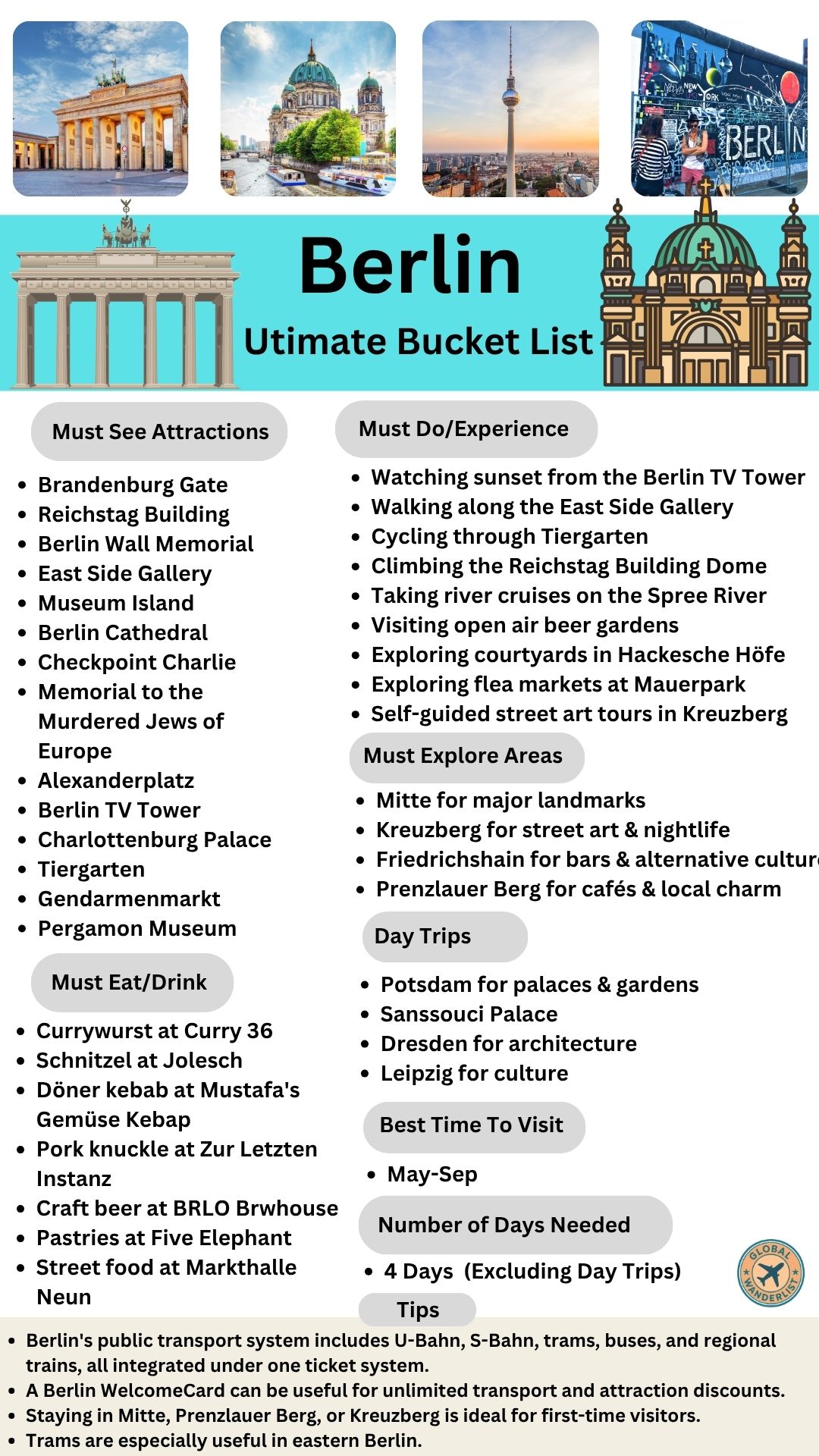
Berlin earns its place on every traveler’s bucket list through a rare mix of history, creativity, and constant reinvention. Cold War monuments sit beside cutting-edge street art, while grand imperial architecture shares the skyline with a genuinely experimental food and nightlife scene. Few European capitals let you trace so much 20th-century history while still feeling this alive today.
This is a destination for travelers who want depth without pretension. History lovers can walk the former path of the Berlin Wall in a single afternoon. Foodies and night owls will find just as much here, from currywurst stands to beer gardens and some of Europe’s most legendary clubs.
Whether you have four days or a full week, Berlin rewards a well-planned mix of landmarks, neighborhoods, and food stops. This bucket list breaks down everything essential, from must-see monuments to practical tips worth building your trip around.
Trip Planning Overview
| Category | Top Recommendation | Best Time | Recommended Duration |
|---|---|---|---|
| Must-See Attractions | Brandenburg Gate, Museum Island | May to September | Half day to full day each |
| Experiences | Sunset from the TV Tower, East Side Gallery walk | Year-round | 1-3 hours each |
| Neighborhoods | Mitte, Kreuzberg, Friedrichshain, Prenzlauer Berg | Year-round | Half day each |
| Day Trips | Potsdam, Dresden, Leipzig | Year-round | Full day each |
| Local Food | Currywurst at Curry 36, döner at Mustafa’s | Year-round | Ongoing |
| Overall Trip | Berlin city stay | May to September | 4 days, excluding day trips |
Must-See Attractions
Berlin’s landmarks trace centuries of Prussian ambition, wartime destruction, and Cold War division. These sites anchor nearly every first-time itinerary. Spacing them across a few days keeps sightseeing enjoyable rather than exhausting.
Places You Shouldn’t Miss
- The Brandenburg Gate stands as Berlin’s most iconic symbol of reunification, marking the former divide between East and West. Built in the late 18th century, it has witnessed some of the most pivotal moments in modern German history. Evening visits offer dramatic lighting and thinner crowds than midday.
- The Reichstag Building houses the German parliament beneath a striking glass dome, open to visitors who book a free timed slot in advance. The dome’s spiral ramp offers panoramic views over the city while explaining the building’s symbolic transparency. Reservations fill up quickly, so book online well before your trip.
- The Berlin Wall Memorial along Bernauer Strasse preserves an original section of the wall alongside the death strip that once separated East and West Berlin. Outdoor exhibits and a documentation center explain the human stories behind the division. This site offers a more sobering, in-depth experience than the shorter East Side Gallery walk.
- The East Side Gallery preserves the longest surviving stretch of the Berlin Wall, covered in murals painted by international artists after reunification. The most famous image, the fraternal kiss between Brezhnev and Honecker, draws steady crowds for photos. Morning visits offer better light and fewer people in your shots.
- Museum Island houses five major museums, including the Pergamon and the Neues Museum, all within a short walk of each other. The collections span ancient Egyptian artifacts to 19th-century European art. Budget at least a half day here if museums are a priority on your trip.
- The Berlin Cathedral rises dramatically over the Spree River, its ornate dome and crypt reflecting Prussian royal ambition. Climbing to the dome’s gallery rewards visitors with sweeping views over Museum Island and the city center. Boat tours departing nearby offer a relaxed way to see the cathedral from the water.
- Checkpoint Charlie marks the former most famous crossing point between East and West Berlin during the Cold War. A replica guard hut and nearby open-air exhibits explain the site’s history in detail. The area draws heavy tourist traffic, so manage expectations about the commercialized surroundings.
- The Memorial to the Murdered Jews of Europe occupies a full city block near the Brandenburg Gate, its field of concrete slabs designed to evoke disorientation and reflection. The underground information center provides deeper historical context. This is a powerful, contemplative stop rather than a typical photo destination.
- Alexanderplatz anchors former East Berlin with its iconic World Time Clock and the nearby TV Tower. The square reflects distinctly Soviet-era architecture, a contrast to Mitte’s more historic streets nearby. It remains a major transit hub, making it a practical orientation point.
- The Berlin TV Tower rises above Alexanderplatz as the tallest structure in Germany, its observation deck offering the best panoramic views in the city. Sunset visits deliver spectacular light across the skyline. Book timed tickets online in advance to skip the longest lines.
- Charlottenburg Palace showcases Berlin’s grandest surviving royal residence, complete with baroque gardens stretching behind the main building. This site sits further from the city center but rewards the trip with genuinely opulent interiors. A relaxed half day covers both the palace and gardens.
- Tiergarten offers Berlin’s largest inner-city park, a sprawling green space ideal for a walk, picnic, or bike ride between sightseeing stops. The Victory Column at its center offers city views after a climb up a spiral staircase. This makes a peaceful break between Charlottenburg and central Mitte.
- Gendarmenmarkt ranks among Berlin’s most beautiful squares, framed by twin domed cathedrals and the Konzerthaus concert hall. This elegant plaza feels notably calmer than busier tourist squares nearby. Evening visits, when the buildings are lit, offer excellent photo opportunities.
- The Pergamon Museum on Museum Island houses monumental reconstructed antiquities, including the Ishtar Gate of Babylon. Parts of the museum remain under long-term renovation, so check current gallery access before visiting. Even with partial closures, the open sections justify the visit for ancient history enthusiasts.
Must Do and Experience
Certain moments in Berlin go beyond typical sightseeing. These experiences connect visitors directly to the city’s history, creativity, and everyday rhythm. Building even a few into your itinerary adds real texture to the trip.
Unforgettable Experiences
- Watching sunset from the Berlin TV Tower delivers one of the city’s most complete skyline views, with the light shifting dramatically across former East and West Berlin. Arrive with enough time before your reserved slot to avoid rushing. This works well as a relaxed way to end a day of sightseeing.
- Walking along the East Side Gallery offers a moving, open-air history lesson stretched across more than a kilometer of preserved wall. Reading the individual artist statements alongside each mural adds real depth to the visit. Pair this walk with a coffee stop in nearby Friedrichshain.
- Cycling through Tiergarten puts you on two wheels in one of Europe’s great urban parks, with paths connecting the Brandenburg Gate to Charlottenburg. Bike rental shops throughout central Berlin make this easy to arrange. A relaxed loop through the park takes about an hour.
- Climbing the Reichstag Building dome combines political history with genuine architectural spectacle, its spiral ramp offering constantly shifting city views. Free entry requires advance online registration, often weeks ahead during peak season. Bring identification matching your registration details.
- Taking river cruises on the Spree offers a relaxed, different perspective on Berlin’s landmarks, floating past the Reichstag, Museum Island, and the TV Tower. Boats depart regularly from several central docks. This works especially well on a warm evening with the city lit up.
- Visiting open air beer gardens connects visitors to one of Berlin’s most beloved traditions, with communal tables scattered beneath chestnut trees across the city. Prater Garten in Prenzlauer Berg ranks among the oldest and most atmospheric. Summer evenings here capture genuine local life.
- Exploring courtyards in Hackesche Höfe reveals a connected series of art nouveau courtyards in Mitte, filled with shops, galleries, and cafes. This hidden network rewards slow, curious wandering away from the main streets. It makes an easy stop between Museum Island and Alexanderplatz.
- Exploring flea markets at Mauerpark offers one of Berlin’s liveliest Sunday traditions, combining vintage shopping with impromptu open-air karaoke sessions. The market draws a mix of locals, expats, and tourists browsing everything from records to furniture. Arrive by late morning for the best selection.
- Taking self-guided street art tours in Kreuzberg lets you explore the neighborhood’s ever-changing murals and graffiti at your own pace. Several apps and printed maps highlight notable pieces throughout the district. This pairs naturally with a stop at one of Kreuzberg’s famous street food stands.
Must Explore Areas
Beyond the major landmarks, Berlin’s individual neighborhoods each carry their own personality. Spending time in a few beyond the historic core rounds out a well-balanced trip. Each one suits a slightly different travel style.
Places You Shouldn’t Miss
- Mitte anchors Berlin’s historic core, home to the Brandenburg Gate, Museum Island, and the city’s grandest boulevards. This area suits first-time visitors who want everything within easy walking distance. Expect higher prices here than in outer neighborhoods, reflecting the central location.
- Kreuzberg delivers Berlin’s most multicultural and alternative energy, shaped by decades of Turkish immigration and a strong street art scene. This neighborhood suits foodies and travelers drawn to genuine, unpolished character. Nightlife here runs late, especially along the canal-side bars.
- Friedrichshain anchors Berlin’s nightlife and club scene, a former East Berlin district now known for its creative bars and the East Side Gallery. This area suits younger travelers and anyone chasing an edgier, more energetic base. It connects easily to Kreuzberg across the Spree.
- Prenzlauer Berg offers a charming, more residential alternative, its restored 19th-century streets filled with independent boutiques and relaxed cafes. This area suits families and travelers wanting a quieter, local-feeling pace. Kollwitzplatz anchors the neighborhood with a popular Saturday market.
Day Trips from Berlin
Several remarkable destinations sit within easy reach of the city, making them ideal for day trips. Each offers a distinct change of pace from Berlin’s urban energy. Trains connect most of these towns directly from central Berlin stations.
Places You Shouldn’t Miss
- Potsdam offers palaces and gardens just a short train ride from central Berlin, anchored by the UNESCO-listed Sanssouci Palace. This former Prussian royal retreat feels genuinely peaceful compared to the capital’s busier streets. A full day allows time for both the palace interior and its expansive terraced gardens.
- Sanssouci Palace served as the summer residence of Prussian King Frederick the Great, surrounded by elaborate baroque and rococo gardens. The palace itself sits within Potsdam, making it easy to combine with a broader day trip. Book timed entry tickets in advance, since visitor numbers are limited daily.
- Dresden showcases baroque architecture rebuilt with remarkable care after World War II destruction, anchored by the reconstructed Frauenkirche. The Zwinger Palace houses one of Germany’s finest art collections. The train from Berlin takes about two hours, making this a manageable full day trip.
- Leipzig offers deep musical history as the city where Bach composed much of his famous work, alongside a thriving, affordable arts and culture scene. St. Thomas Church, where Bach served as choirmaster, still holds regular performances. The city increasingly draws comparisons to Berlin for its creative energy.
Local Food
Berlin’s food scene blends humble street classics with an increasingly serious fine dining reputation. Meals here range from a quick currywurst between sightseeing stops to a full evening at a Michelin-starred table. Trying a mix of casual and sit-down spots gives the fullest picture of the city’s flavors.
What to Eat
- Currywurst at Curry 36 has served this Berlin invention since 1980, sliced sausage topped with curry-spiced ketchup and a dusting of curry powder. The Kreuzberg location stays open late, drawing a steady mix of locals and visitors around the clock. Order it mit Darm, with the sausage skin intact, for the classic snap.
- Schnitzel at Jolesch brings refined Austrian cooking to Kreuzberg, serving a menu of Viennese classics in a warm, wood-paneled dining room. The schnitzel here draws consistent praise for its crisp, golden crust. This makes a satisfying sit-down meal after a day of sightseeing.
- Döner kebab at Mustafa’s Gemüse Kebap has become one of Berlin’s most famous street food institutions, known for its grilled vegetable and chicken kebab piled with feta. Expect a genuinely long line at this Kreuzberg stand, especially during peak hours. Visiting on a weekday morning offers a noticeably shorter wait.
- Pork knuckle at Zur Letzten Instanz comes from Berlin’s oldest restaurant, operating since 1621 in the historic Nikolaiviertel. The eisbein, served with sauerkraut, remains the signature order in this atmospheric, wood-beamed dining room. The restaurant’s history alone makes it worth a visit beyond the food.
- Craft beer at BRLO Brwhouse combines a working microbrewery with a casual restaurant built from repurposed shipping containers. The outdoor beer garden, open spring through fall, ranks among Berlin’s most distinctive drinking spots. Vegetable-forward mains and smoked meats round out the food menu.
- Pastries at Five Elephant pair excellent coffee with a rotating selection of cakes and baked goods, anchored by a devoted following for its cheesecake. This Kreuzberg coffee roastery has built a genuine reputation beyond just its drinks. It makes a relaxed stop between neighborhood sightseeing.
- Street food at Markthalle Neun gathers dozens of vendors inside a restored 19th-century market hall, especially lively during the weekly Street Food Thursday event. Expect everything from Nepalese momos to Vietnamese banh mi under one roof. Arrive early on Thursday evenings, since the crowds build quickly.
Best Time to Visit
Timing your trip well affects both comfort and crowd levels. Berlin experiences cold winters and warm summers, with outdoor culture, including beer gardens and river activities, thriving from late spring through early fall. Shoulder season offers a solid balance for most travelers.
Seasonal Highlights
- May through September brings the warmest temperatures and the fullest run of outdoor activities, from beer gardens to river cruises. This period also lines up with most major festivals and events throughout the city. Book accommodations early, since this remains Berlin’s busiest tourist season.
- Late September and October offer milder temperatures and thinner crowds compared to peak summer. Outdoor dining remains pleasant well into early fall. This window often provides better value on flights and hotels than midsummer.
- November and December bring Berlin’s own Christmas markets to squares throughout the city, creating a festive atmosphere despite colder weather. Markets around Gendarmenmarkt and Alexanderplatz rank among the most popular. Pack warm layers for extended time browsing outdoor stalls.
- Winter months, particularly January and February, offer the quietest travel conditions and the lowest accommodation prices. Shorter daylight hours limit outdoor sightseeing time compared to summer visits. This season suits travelers prioritizing museums, history, and a quieter city experience.
How Many Days Do You Need
Four days covers Berlin’s core attractions comfortably, without counting day trips to Potsdam, Dresden, or Leipzig. This allows time for major landmarks, a couple of neighborhoods, and a relaxed pace rather than constant rushing. Add one day for each major day trip you want to include.
A week-long trip allows a more complete experience, mixing city sightseeing with two or three day trips. This pace also leaves room for a spontaneous return visit to a favorite neighborhood or museum. Travelers with more time often use Berlin as a base for exploring the wider region.
Travel Tips
A few practical details make navigating Berlin noticeably smoother. These tips cover transportation, budgeting, and local logistics worth knowing before you arrive. None require much effort, but all save time or frustration along the way.
Essential Travel Tips
- Berlin’s public transport system includes U-Bahn, S-Bahn, trams, buses, and regional trains, all integrated under one unified ticket system. This makes navigating the sprawling city straightforward once you understand the zone-based fare structure. A single ticket type generally works across all these modes within your chosen zones.
- A Berlin WelcomeCard can be useful for unlimited transport and attraction discounts, particularly for travelers planning to visit several paid sites. Calculate your planned attractions first to confirm the card offers genuine savings over individual tickets. Cards are available for various durations depending on your trip length.
- Staying in Mitte, Prenzlauer Berg, or Kreuzberg is ideal for first-time visitors, given their central location and easy transit access. Each neighborhood puts major landmarks or a strong food scene within easy reach. Consider your priorities, whether that is history, nightlife, or a quieter residential feel, when choosing between them.
- Trams are especially useful in eastern Berlin, covering routes through Prenzlauer Berg and Friedrichshain that the U-Bahn does not directly reach. They offer a scenic, street-level way to see neighborhoods often missed by underground travel. Trams run on the same integrated ticket as buses and trains.
Final Thoughts
Berlin offers enough depth to fill several return trips, from Cold War history to a genuinely thriving contemporary food and art scene. Use this list as a starting point rather than a strict itinerary. Mix well-known landmarks with quieter neighborhoods and a day trip or two, and build a Berlin trip that feels entirely your own.