
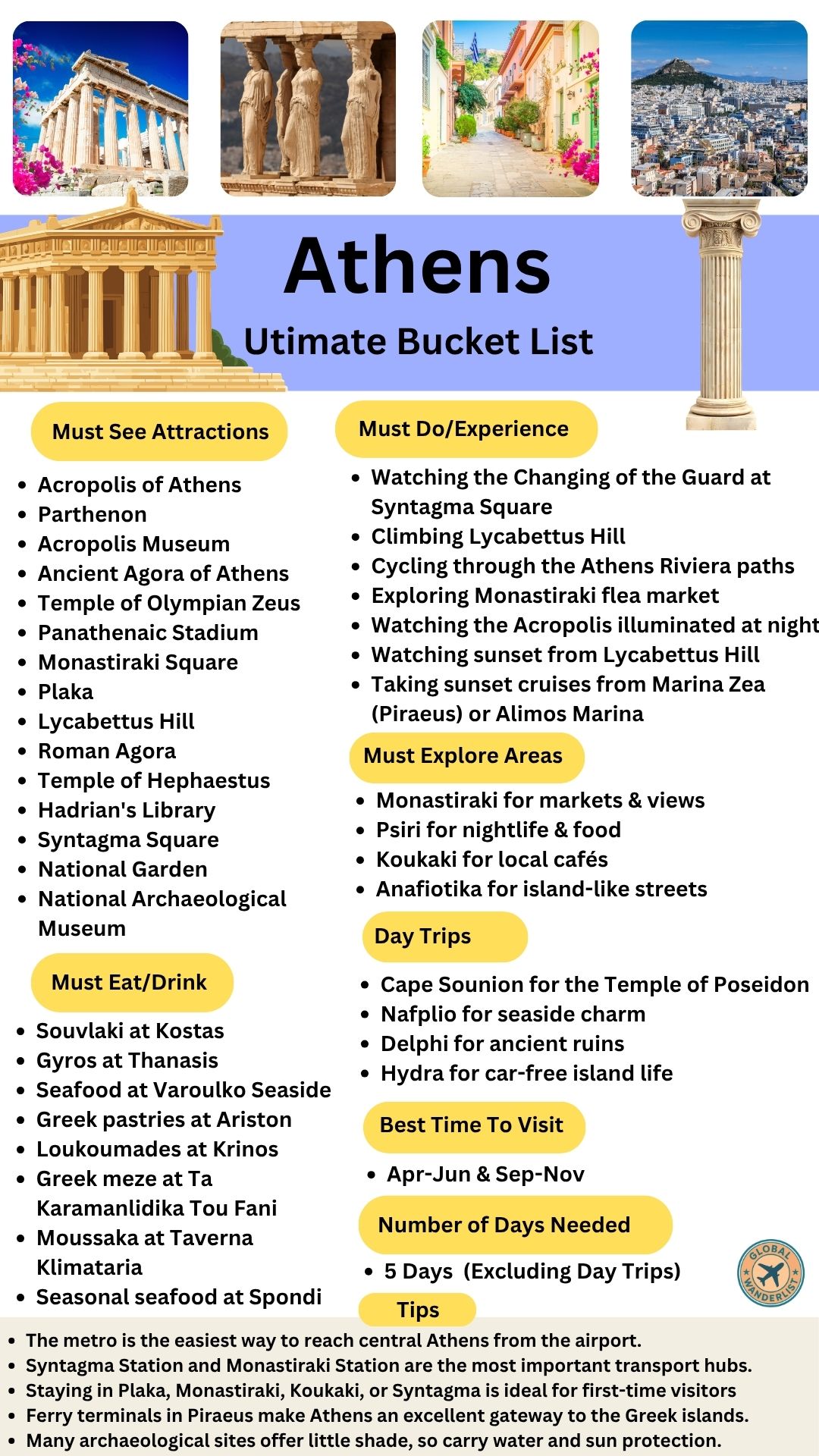
Athens earns its place as the birthplace of Western civilization, where ancient ruins sit alongside a lively, modern city. Marble columns rise above busy neighborhoods filled with markets, tavernas, and rooftop bars. Few cities let you trace the roots of democracy and philosophy while also enjoying genuinely excellent street food.
This is a destination built for history lovers, foodies, and anyone craving a walkable, layered city experience. First-time visitors can cover the essential ancient sites in a few days, while returning travelers will find plenty of neighborhoods and day trips to explore further. Athens rewards both quick city breaks and slower, more immersive stays.
Whether you have five days or plan to use the city as a springboard to the islands, Athens deserves careful planning. This bucket list breaks down the essential landmarks, neighborhoods, food, and practical tips worth building your trip around.
Trip Planning Overview
| Category | Top Recommendation | Best Time | Recommended Duration |
|---|---|---|---|
| Must-See Attractions | Acropolis, Parthenon | Year-round | Half day to full day |
| Experiences | Changing of the Guard, Lycabettus Hill sunset | April to October | 1-2 hours each |
| Neighborhoods | Monastiraki, Psiri, Koukaki, Anafiotika | Year-round | Half day each |
| Day Trips | Cape Sounion, Delphi, Hydra | April to October | Full day each |
| Local Food | Souvlaki at Kostas, seafood at Varoulko Seaside | Year-round | Ongoing |
| Overall Trip | Athens city stay | April to June, September to November | 5 days, excluding day trips |
Must-See Attractions
Athens’s landmarks trace millennia of philosophy, democracy, and architectural achievement. These sites anchor nearly every first-time itinerary. Spacing them across a few days keeps sightseeing enjoyable rather than exhausting.
Places You Shouldn’t Miss
- The Acropolis of Athens crowns the city with ancient temples still standing after thousands of years. Arriving right at opening time, ideally before 8 a.m., helps you avoid both heat and the heaviest crowds. Budget at least two hours to properly explore the hilltop site.
- The Parthenon anchors the Acropolis as the defining symbol of ancient Greek architecture, built in the 5th century BC to honor the goddess Athena. Its Doric columns remain remarkably intact despite centuries of damage and restoration work. This is the single most photographed structure in Greece.
- The Acropolis Museum displays artifacts recovered directly from the hill above, including original sculptures protected from weather damage. The glass floor over active excavations adds a genuinely unique architectural touch. Plan for about ninety minutes to see the collection properly.
- The Ancient Agora of Athens reveals the heart of Athenian civic and philosophical life, where Socrates once debated and citizens gathered for democracy. The well-preserved Temple of Hephaestus sits at its edge, one of the best-preserved ancient Greek temples anywhere. A relaxed visit takes about an hour.
- The Temple of Olympian Zeus once housed one of the largest temples in the ancient Greek world, with towering Corinthian columns still standing near the city center. Construction spanned centuries before its completion under Roman rule. A quick 30 to 45 minute stop fits easily alongside other central sightseeing.
- Panathenaic Stadium hosted the first modern Olympic Games in 1896, rebuilt entirely from white marble on the site of an ancient stadium. Visitors can walk the same track and sit in the original stone seating. It sits within easy walking distance of the National Garden.
- Monastiraki Square anchors the city’s busiest commercial district, surrounded by a sprawling flea market and ancient ruins. Street vendors, souvlaki stands, and constant foot traffic give the area real energy. It connects easily to Plaka, Psiri, and the metro system.
- Plaka preserves Athens’s oldest surviving neighborhood, a maze of narrow, neoclassical streets beneath the Acropolis. Its car-free lanes wind past tiny churches and bougainvillea-draped balconies. Early mornings offer a quieter, more atmospheric version of its cobblestone streets.
- Lycabettus Hill rises as the highest point in central Athens, reachable by funicular or a steep uphill walk. The summit delivers the best panoramic view over the entire city, stretching toward the sea. Sunset here draws a steady crowd, so arrive with time to find a good spot.
- The Roman Agora sits just north of the Acropolis, home to the well-preserved Tower of the Winds, an ancient timekeeping monument. This site offers a quieter, less crowded alternative to the larger Ancient Agora nearby. A visit here takes about 30 minutes.
- The Temple of Hephaestus stands as one of the best-preserved ancient Greek temples in existence, overlooking the Ancient Agora from a small hill. Its remarkable condition owes partly to its later use as a Christian church. The surrounding gardens make a peaceful spot to rest.
- Hadrian’s Library was built by the Roman emperor Hadrian in the 2nd century AD, once housing scrolls and serving as a cultural center. The surviving facade and courtyard columns hint at its original grandeur. It sits just steps from Monastiraki Square.
- Syntagma Square sits at the civic heart of Athens, fronted by the Greek Parliament and the ceremonial changing of the guard. Every major metro line converges here, making it one of the most convenient orientation points in the city. The square buzzes with activity throughout the day.
- The National Garden offers a shaded, peaceful escape directly behind the Parliament building, filled with duck ponds and quiet walking paths. This makes an easy rest stop between Syntagma and the Temple of Olympian Zeus. Entry is free and open daily.
- The National Archaeological Museum houses the most important collection of ancient Greek artifacts anywhere in the world, including the Mask of Agamemnon. Budget at least two hours to see the highlights without rushing. This museum rewards even visitors without deep archaeological interest.
Must Do and Experience
Certain moments in Athens go beyond typical sightseeing. These experiences connect visitors directly to the city’s ceremony, views, and rhythm. Building even a few into your itinerary adds real texture to the trip.
Unforgettable Experiences
- Watching the Changing of the Guard at Syntagma Square offers a genuinely ceremonial moment, performed hourly by the Evzones in traditional uniform. The elaborate Sunday ceremony, involving a full guard and band, draws the biggest crowds. Arrive a few minutes early to get a good view along the barrier.
- Climbing Lycabettus Hill rewards visitors with the single best panoramic view over Athens, stretching from the Acropolis to the sea. The funicular offers an easy alternative to the steep walking path for those short on time. Late afternoon timing sets you up perfectly for sunset at the top.
- Cycling through the Athens Riviera paths takes you along the coastline south of the city center, connecting beaches, marinas, and waterfront cafes. Rental shops throughout the Faliro and Glyfada areas offer bikes by the hour or day. This makes a relaxing half-day change of pace from the historic center.
- Exploring Monastiraki flea market means browsing antiques, records, and secondhand goods spreading out from the main square, especially lively on Sundays. Bargaining is common practice here, so do not hesitate to negotiate prices. Morning visits offer the best selection before crowds build.
- Watching the Acropolis illuminated at night delivers a dramatically different view than the daytime visit, with the ancient site glowing against the dark sky. Several rooftop bars throughout Plaka and Monastiraki offer excellent vantage points. This works well as a relaxed evening activity after a day of walking.
- Watching sunset from Lycabettus Hill ranks among the most popular evening activities in the city, with the entire skyline turning gold as the sun drops toward the sea. Bring a light jacket, since wind picks up noticeably at the summit. The chapel at the top adds a quiet, scenic backdrop.
- Taking sunset cruises from Marina Zea or Alimos Marina offers a relaxed way to see the Athens coastline from the water, often including dinner and drinks on board. These depart from the Piraeus area, about 30 minutes from the city center. Booking ahead is recommended during peak summer months.
Must Explore Neighborhoods
Beyond the major landmarks, Athens’s individual neighborhoods each carry their own personality. Spending time in a few beyond the historic core rounds out a well-balanced trip. Each one suits a slightly different travel style.
Places You Shouldn’t Miss
- Monastiraki anchors the city’s commercial energy, known for its flea market, ancient ruins, and constant foot traffic. This area suits budget-conscious travelers and shoppers who want to be in the middle of everything. The metro station here connects directly to the airport and most major attractions.
- Psiri sits just north of Monastiraki, transformed from a former workshop district into Athens’s late-night dining and bar scene. Small, characterful streets hold everything from century-old tavernas to contemporary kitchens. This neighborhood suits foodies and nightlife lovers willing to trade quiet evenings for constant energy.
- Koukaki spreads out just south of the Acropolis, a leafy, residential neighborhood beloved for its relaxed local cafes. Neoclassical villas mix with mid-century apartment blocks along quiet, tree-lined streets. This area suits couples and travelers seeking a calmer pace close to the major sights.
- Anafiotika offers a tiny, whitewashed Cycladic-style quarter tucked into the hillside above Plaka. Built by island workers in the 19th century, it feels like a small Greek island transplanted into the city. Its narrow, stepped lanes make for one of the most charming short walks in Athens.
Day Trips from Athens
Several remarkable destinations sit within easy reach of the city, making them ideal for day trips. Each offers a distinct change of pace from Athens’s urban energy. Buses, trains, and ferries connect most of these towns directly from central Athens.
Places You Shouldn’t Miss
- Cape Sounion delivers dramatic clifftop views from the Temple of Poseidon, roughly an hour and a half from central Athens. Sunset here ranks among the most striking views in the region, with ancient marble columns framing the Aegean Sea. A half day covers the drive and site visit comfortably.
- Nafplio offers seaside charm and well-preserved Venetian architecture, a former capital of modern Greece. The town’s waterfront promenade and hilltop fortress make for a relaxed, scenic day away from the city. It sits about two hours from Athens by car or bus.
- Delphi held legendary status as the ancient world’s spiritual center, where pilgrims once consulted the Oracle before major decisions. The site sits dramatically on the slopes of Mount Parnassus, about two and a half hours from Athens. Budget a full day given the travel time and site size.
- Hydra offers a genuinely car-free island experience, just a short ferry ride from Piraeus. Donkeys and small boats replace vehicles entirely, giving the island a distinctly slower pace. A day trip covers the harbor town comfortably, though an overnight stay allows for quieter exploring.
Local Food
Athens’s food scene blends humble street classics with generations-old taverna tradition and serious fine dining. Meals here tend to be generous, affordable, and rooted in quality local ingredients. Trying a mix of casual and sit-down spots gives the fullest picture of the city’s flavors.
What to Eat
- Souvlaki at Kostas has served the same simple, excellent pork souvlaki pita since 1946 from a small counter on Agia Irini Square. The line moves quickly, and the shop typically closes once the meat runs out for the day. Cash is preferred, and it stays closed on weekends.
- Gyros at Thanasis ranks among the most beloved gyro spots in Monastiraki, serving pita wraps piled with grilled meat, tomato, and onion. The restaurant sits right on the edge of the square, making it an easy stop between sightseeing. Expect a steady crowd, especially around lunchtime.
- Seafood at Varoulko Seaside showcases the cooking of Lefteris Lazarou, the first Greek chef to earn a Michelin star, now working from a marina-side dining room in Piraeus. The menu focuses entirely on fish, prepared with French technique and Greek ingredients. Book several weeks ahead for a table with marina views during summer.
- Greek pastries at Ariston has baked filo pies since 1910 from a small takeaway counter behind Syntagma Square. The spanakopita remains the signature order, best eaten fresh in the morning before the day’s batch sells out. It operates as a stand-up counter only, closed on Sundays.
- Loukoumades at Krinos has fried these honey-soaked Greek doughnuts since 1923, served at a small seated counter near Syntagma. The warm, crispy exterior and dripping honey make for a genuinely satisfying dessert stop. A portion typically costs just a few euros.
- Greek meze at Ta Karamanlidika Tou Fani offers a deli-style introduction to Asia Minor cured meats and small plates, tied to the culinary traditions carried by refugees from Smyrna. The Karamanli pastourma board makes a memorable order alongside a carafe of tsipouro. It sits at the edge of Psiri, near Monastiraki.
- Moussaka at Taverna Klimataria has served this layered eggplant and meat classic since 1927, in a traditional Psiri dining room with live rebetiko music most evenings. The setting alone makes it worth a visit, beyond the reliably excellent food. Reservations are recommended on weekends given the live music draw.
- Seasonal seafood at Spondi represents the pinnacle of fine dining in Athens, holding two Michelin stars in a quiet Pangrati neighborhood setting. The French-influenced menu changes with the seasons, built around top-quality Greek and international ingredients. This is a special-occasion restaurant, best booked well in advance.
Best Time to Visit
Timing your trip well affects both comfort and crowd levels. Athens stays hot and dry in summer, with milder, more comfortable conditions in spring and fall. Shoulder season generally offers the best overall balance for sightseeing.
Seasonal Highlights
- April through June brings warm, comfortable temperatures and blooming landscapes without the peak summer crowds. This period works especially well for walking tours, day trips, and outdoor dining without excessive heat. Archaeological sites feel noticeably more pleasant to explore during these months.
- September through November offers similarly comfortable weather, plus thinner crowds compared to the August peak. This window often provides better value on flights and hotels than midsummer. Late September still allows for pleasant outdoor dining well into the evening.
- Summer months, particularly July and August, bring the hottest temperatures and busiest crowds, especially around major landmarks like the Acropolis. Archaeological sites offer little shade, so carrying water and sun protection becomes essential. Early morning sightseeing helps you beat both heat and tour groups.
- Winter stays relatively mild by European standards, making it a reasonable option for budget-conscious travelers focused on museums and historic sites. Rain increases during these months, so pack accordingly. This season suits city-focused itineraries better than day trips involving longer drives.
How Many Days Do You Need
Five days covers Athens’s core attractions comfortably, without counting day trips to Cape Sounion, Delphi, or Hydra. This allows time for major landmarks, a couple of neighborhoods, and a relaxed pace rather than constant rushing. Add one day for each major day trip you want to include.
A week-long trip allows a more complete experience, mixing city sightseeing with two or three day trips. This pace also leaves room for a spontaneous return visit to a favorite neighborhood or viewpoint. Many travelers use Athens as a starting or ending point before heading to the Greek islands.
Travel Tips
A few practical details make navigating Athens noticeably smoother. These tips cover transportation, safety, and local logistics worth knowing before you arrive. None require much effort, but all save time or frustration along the way.
Essential Travel Tips
- The metro is the easiest way to reach central Athens from the airport, taking about 40 minutes directly into the city center. It runs reliably and avoids the traffic delays common with taxis during peak hours. Tickets are affordable and available directly at airport stations.
- Syntagma Station and Monastiraki Station are the most important transport hubs, connecting nearly every major sightseeing area in the city. Both sit within walking distance of the historic center’s biggest landmarks. Familiarizing yourself with these two stops makes navigating the rest of the metro system far easier.
- Staying in Plaka, Monastiraki, Koukaki, or Syntagma is ideal for first-time visitors, given their central location and walkability. Each neighborhood puts major landmarks within easy reach on foot. Hilly terrain still applies in parts of Plaka, so comfortable shoes matter regardless of where you stay.
- Ferry terminals in Piraeus make Athens an excellent gateway to the Greek islands, with regular departures to the Cyclades, Saronic Islands, and beyond. The port connects directly to central Athens via metro, making transfers straightforward. Booking ferry tickets in advance is wise during peak summer season.
- Many archaeological sites offer little shade, so carrying water and sun protection matters even on cooler days. The Acropolis in particular has almost no covered areas throughout its hilltop grounds. A hat and sunscreen make a real difference during a multi-hour visit.
Final Thoughts
Athens offers enough depth to fill several return trips, from ancient philosophy to a genuinely excellent modern food scene. Use this list as a starting point rather than a strict itinerary. Mix well-known landmarks with quieter neighborhoods and a day trip or two, and build an Athens trip that feels entirely your own.