
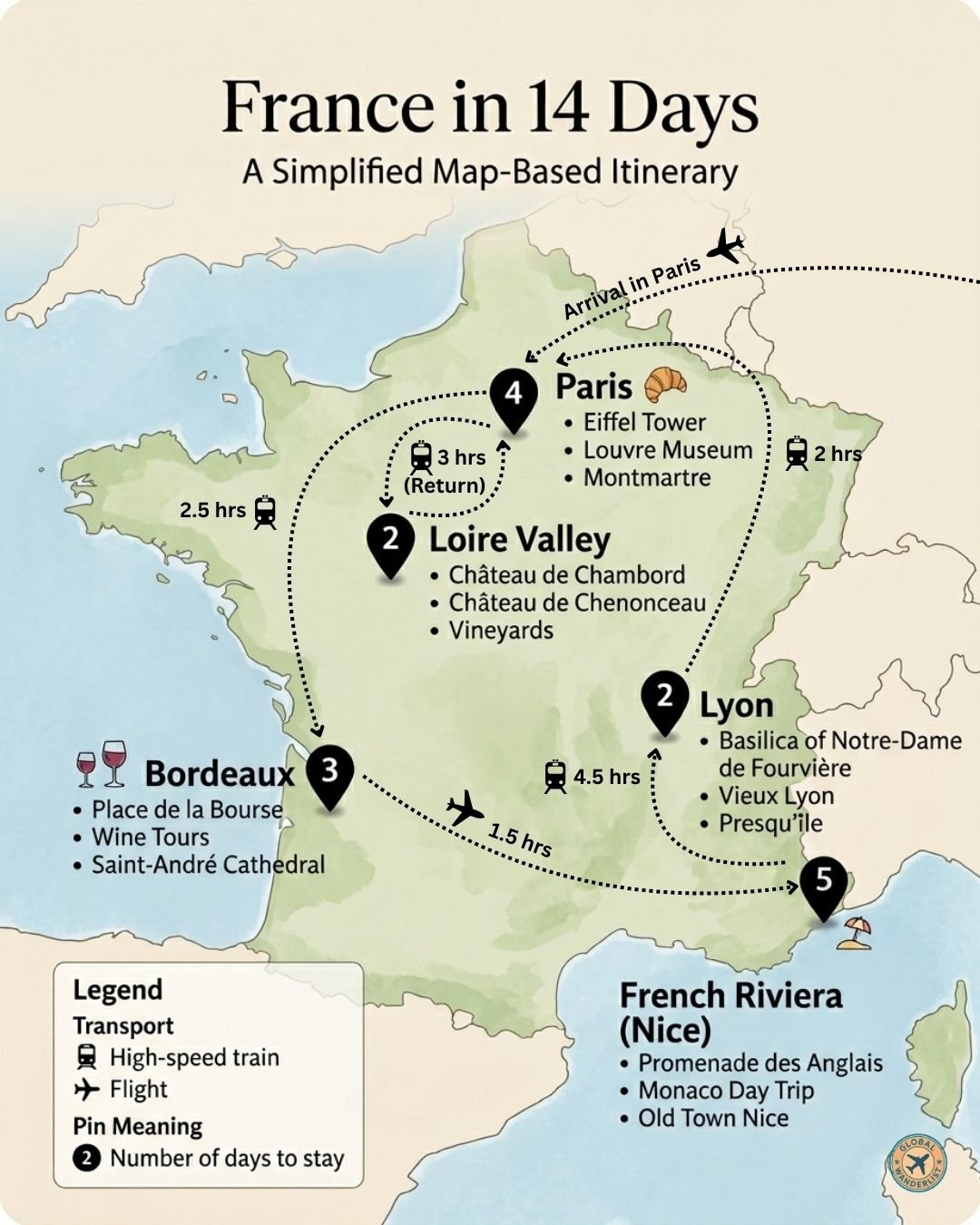
France rewards travelers who move beyond a single city, and this two week route captures the country’s incredible range. Renaissance castles, historic wine capitals, a gastronomic powerhouse, and glamorous Mediterranean coastline all fit within one well paced trip. It suits travelers who want variety over depth, sampling several of France’s most iconic regions rather than settling into just one.
This itinerary balances high speed trains with a couple of flights, keeping travel time manageable between stops. Below is a breakdown of each destination, followed by a full guide to help you plan the details.
| Stop | Recommended Stay | Main Highlights | Travel Time to Next Stop | Best For |
|---|---|---|---|---|
| Paris | 4 days | Eiffel Tower, Louvre Museum, Montmartre | 3 hrs train (round trip to Loire Valley) | First time visitors, art and history lovers |
| Loire Valley | 2 days | Château de Chambord, Château de Chenonceau, vineyards | 3 hrs train back to Paris, then onward travel | Castle enthusiasts, wine lovers |
| Lyon | 2 days | Basilica of Notre-Dame de Fourvière, Vieux Lyon, Presqu’île | 4.5 hrs train to Bordeaux, or connect via Paris | Food lovers, culture seekers |
| Bordeaux | 3 days | Place de la Bourse, wine tours, Saint-André Cathedral | 1.5 hr flight to Nice | Wine enthusiasts, architecture fans |
| French Riviera (Nice) | 5 days | Promenade des Anglais, Monaco day trip, Old Town Nice | Return flight home | Beach lovers, glamour seekers |
Paris
Paris opens this itinerary as both an arrival point and a destination worth savoring on its own. Four days gives enough time to see the major landmarks without rushing through them, while still leaving room for slower moments in a cafe or garden.
Things to Do in Paris
- Visit the Eiffel Tower, ideally with timed tickets booked in advance to avoid long lines. Climbing to the top or simply viewing it from the Trocadéro gardens both offer memorable perspectives.
- Spend at least half a day at the Louvre Museum, focusing on a few wings rather than attempting to see everything. The collection is far too large to properly cover in a single visit.
- Wander the streets of Montmartre, home to the white domed Sacré-Cœur and the artist filled Place du Tertre. The steps below the basilica offer one of the best free viewpoints in the city.
- Walk along the Seine River, stopping at bridges like Pont Neuf and Pont Alexandre III for classic Parisian photo opportunities. An evening river cruise adds a different perspective on the city’s illuminated landmarks.
- Explore the Latin Quarter and Luxembourg Gardens for a quieter, more residential side of Paris. This area pairs well with a stop at Notre-Dame, which reopened to visitors in December 2024 after extensive restoration.
- Try croissants from a neighborhood bakery in Le Marais, one of the city’s most reliably excellent districts for French pastry.
Where to Stay in Paris
- Le Meurice, Luxury. A historic palace hotel opposite the Tuileries Garden, offering an unbeatable central location near the Louvre.
- Hotel Regina Louvre, Luxury. Known for attentive service and views of the Louvre, situated in the heart of the city.
- Hôtel Lutetia, Luxury. A Left Bank landmark with Art Nouveau design, ideal for those wanting a more residential Parisian neighborhood.
- Maison Saintonge, Mid-range. A boutique hotel in the Marais with a playful, distinctive design and easy access to the district’s bakeries and shops.
- The Hoxton Paris, Mid-range. A stylish, affordably priced option popular with younger travelers, located in a lively part of town.
Loire Valley
The Loire Valley offers a dramatic shift in pace after Paris, trading city energy for rolling countryside and Renaissance architecture. Two days allows time to see a couple of major châteaux without feeling rushed, plus a stop at a local vineyard.
Things to Do in Loire Valley
- Visit Château de Chambord, one of the largest and most recognizable châteaux in the entire region. Its distinctive double helix staircase is often attributed to Leonardo da Vinci’s influence, and the surrounding grounds are worth a slow walk.
- Explore Château de Chenonceau, famous for its elegant gallery spanning the River Cher. This château’s history is closely tied to several powerful women in French royal history, adding depth to a visit.
- Tour the region’s vineyards, particularly those producing crisp whites like Sancerre and Vouvray. Many estates offer tastings paired with views of the surrounding countryside.
- Base yourself in Amboise or Tours for easy access to multiple châteaux without excessive driving between stops. Both towns also have charming historic centers worth a slower exploration.
- Consider a hot air balloon ride at sunset for a sweeping view over the valley’s château dotted landscape, a popular and memorable way to see the region from above.
Where to Stay in Loire Valley
- Les Hauts De Loire, Luxury. An elegant château hotel set in expansive grounds, offering a refined base for exploring the region’s castles.
- Le Clos d’Amboise, Mid-range. A charming, family friendly hotel in the heart of Amboise with a highly rated guest experience.
- Château De Pray, Mid-range. A historic château turned hotel near Amboise, combining atmosphere with reasonable rates.
- Westotel Tours Val de Loire, Mid-range. A modern, highly rated option near Tours, convenient for exploring both the city and nearby châteaux.
- Best Western Hotel Le Vinci Loire Valley, Budget. A well reviewed, reasonably priced option just over a mile from Amboise’s royal château.
Lyon
Lyon anchors the middle of this itinerary as France’s culinary capital, a city that rewards travelers who slow down and eat well. Two days offers enough time to explore its historic old town and get a genuine taste of its famous food scene.
Things to Do in Lyon
- Visit the Basilica of Notre-Dame de Fourvière, perched on a hill overlooking the city. A funicular ride up makes the climb easy, and the views over Lyon’s rooftops are well worth the trip.
- Wander through Vieux Lyon, the city’s Renaissance old town, known for its hidden passageways called traboules. Exploring these narrow interconnected corridors reveals a distinctly different side of the city than its main streets suggest.
- Explore Presqu’île, the peninsula between Lyon’s two rivers, home to elegant squares, shopping streets, and the city hall. It offers a good introduction to Lyon’s blend of historic and modern character.
- Eat at a traditional bouchon, Lyon’s signature style of cozy, informal restaurant serving hearty regional specialties. Trying a bouchon meal is considered essential for understanding the city’s culinary reputation.
- Visit the Musée des Confluences, a striking modern building housing science and anthropology exhibits, for a contrast to Lyon’s historic architecture.
Where to Stay in Lyon
- Villa Maïa, Luxury. A five star boutique hotel on Fourvière Hill with sophisticated rooms and a Michelin starred partner restaurant next door.
- Cour des Loges, Luxury. A beautifully restored property in Vieux Lyon offering period furnishings and a Michelin starred restaurant on site.
- Carlton Hotel Lyon – MGallery Collection, Luxury. An Art Deco landmark in the city center, highly rated for its design and amenities.
- OKKO Hotels Lyon Centre, Mid-range. A modern, welcoming hotel with river views, well located for exploring the city center on foot.
- Fourvière Hotel, Mid-range. A former convent turned family friendly hotel with a pool and spa, set near the basilica.
Bordeaux
Bordeaux brings this itinerary to France’s most famous wine region, pairing elegant 18th century architecture with world class vineyards. Three days allows time for both city sightseeing and at least one dedicated day exploring the surrounding wine country.
Things to Do in Bordeaux
- Visit Place de la Bourse, the city’s grand 18th century square, especially striking when reflected in the adjacent Miroir d’Eau water feature. It ranks among the most photographed spots in Bordeaux.
- Take a wine tour through the surrounding countryside, visiting some of the world’s most prestigious vineyards. Many chateaux require advance booking for tastings, so reserve ahead if possible.
- Explore Saint-André Cathedral, a Gothic landmark at the heart of the city with an adjacent bell tower offering sweeping views.
- Walk through the city’s pedestrian friendly center, connecting historic streets with modern tram lines for easy exploration on foot.
- Visit the Cité du Vin museum for an immersive introduction to wine culture and history from around the world, housed in a striking, swirling building along the riverfront.
Where to Stay in Bordeaux
- Hôtel Burdigala by Inwood Hotels, Luxury. A well located property offering a contemporary, comfortable experience popular with both leisure and business travelers.
- Le Palais Gallien Hôtel & Spa, Luxury. A five star property in the historic heart of the city, featuring a glamorous pool and spa.
- Hotel de Sèze, Mid-range. A landmark hotel behind an 18th century façade, offering a small spa and central location.
- Villas Foch, Mid-range. A boutique hotel in the Chartrons district, close to antique shops and public gardens.
- Le Boutique Hôtel, Mid-range. An intimate, centrally located property praised for its elegant atmosphere and comprehensive spa area.
French Riviera (Nice)
The Riviera closes this itinerary with five days of Mediterranean coastline, glamorous towns, and easy day trips. Basing yourself in Nice offers the best balance of transport connections and access to the surrounding coast.
Things to Do in French Riviera (Nice)
- Walk the Promenade des Anglais, Nice’s iconic palm lined waterfront stretching along the Baie des Anges. Sunset here brings some of the best light for photography along the entire coast.
- Take a day trip to Monaco, exploring Monte Carlo’s famous casino and the harbor at Port Hercules. The principality sits just a short train ride from Nice, making it an easy addition to a Riviera stay.
- Explore Old Town Nice, with its narrow cobblestone streets, the Cours Saleya flower market, and the 17th century Cathédrale Sainte-Réparate. It offers a livelier, more local contrast to the polished waterfront.
- Climb Castle Hill for panoramic views over the city and coastline, a popular spot for both sunset and daytime photography.
- Consider extending your Riviera exploration with a drive along the Corniche coastal road toward Monaco, or a visit to nearby hilltop villages like Èze.
Where to Stay in French Riviera (Nice)
- Hôtel Le Negresco, Luxury. An iconic Belle Époque hotel directly on the Promenade des Anglais, one of the most recognizable properties on the entire Riviera.
- Hyatt Regency Nice Palais de la Méditerranée, Luxury. An Art Deco landmark on the promenade, known for its polished service and sea view rooms.
- Hôtel Le Royal, Luxury. A highly rated property directly on the promenade, praised for its balconies and Mediterranean views.
- AC Hotel Nice, Mid-range. A modern hotel a short walk from the promenade, featuring a rooftop pool with sweeping views over the city.
- Albert 1’er Hotel Nice, Budget. A charming, well located option offering good value near the heart of the city.
Following the Route
This fourteen day route captures an extraordinary range of what France has to offer, from the grand boulevards of Paris to the sun soaked coastline of the Riviera. Renaissance châteaux, a world class food city, historic wine country, and Mediterranean glamour all sit within a well connected network of trains and short flights.
Booking high speed train tickets and key accommodations in advance helps keep this itinerary running smoothly, especially during peak summer travel months. Follow this route as written, or adjust the pacing to match your own interests. Either way, it offers a genuinely complete introduction to France’s most celebrated regions.