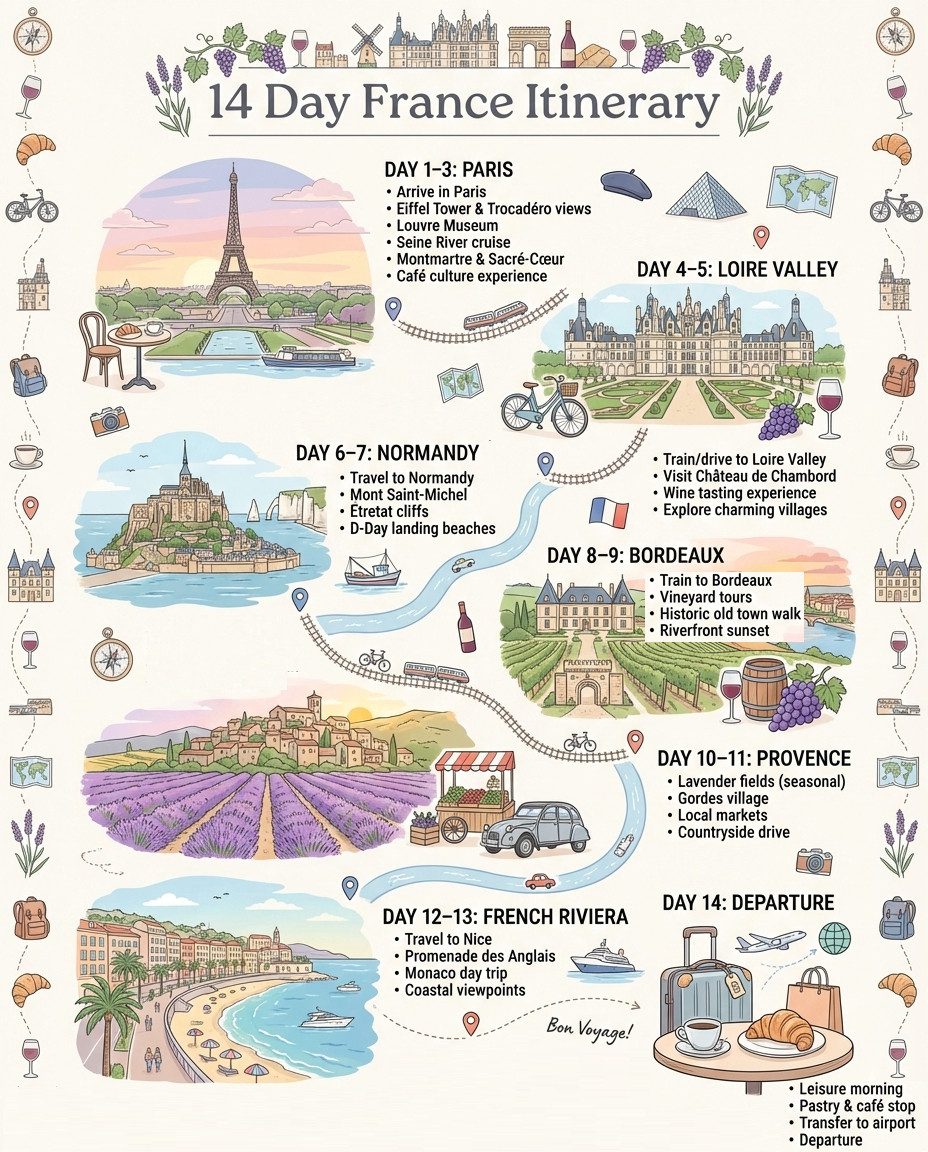
France rewards travelers who move beyond a single city, and this two week route captures the country’s incredible range. Iconic Parisian landmarks, Renaissance castles, D-Day history, world class wine country, lavender scented Provence, and glamorous Mediterranean coastline all fit within one well paced trip. It suits first time visitors who want a genuine introduction to France’s diversity, mixing city culture with countryside, history, and coastline.
The pacing here balances trains and driving, keeping travel days manageable while leaving real time to explore each stop. Below is a full overview, followed by a detailed day by day guide with hotel recommendations to help you plan the trip.
| Stop | Recommended Stay | Main Highlights | Driving Time to Next Stop | Best For |
|---|---|---|---|---|
| Paris | 3 days | Eiffel Tower, Louvre Museum, Montmartre | 2.5 hours by train or car | First time visitors, art and history lovers |
| Loire Valley | 2 days | Château de Chambord, wine tasting, charming villages | 6 hours to Normandy | Castle enthusiasts, wine lovers |
| Normandy | 2 days | Mont Saint-Michel, Étretat cliffs, D-Day beaches | 5.5 hours to Bordeaux | History buffs, coastal scenery seekers |
| Bordeaux | 2 days | Vineyard tours, historic old town, riverfront sunset | 4.5 hours to Provence | Wine enthusiasts, architecture fans |
| Provence | 2 days | Lavender fields, Gordes village, countryside drives | 2.5 hours to the Riviera | Photographers, countryside lovers |
| French Riviera | 2 days | Promenade des Anglais, Monaco day trip, coastal views | N/A, final stop | Beach lovers, glamour seekers |
| Departure | 1 day | Leisure morning, pastry stop, airport transfer | N/A | Everyone, wind down day |
Day 1-3: Paris
Paris opens this itinerary as both an arrival point and a destination worth savoring on its own. Three days gives enough time to see the major landmarks without rushing through them, while still leaving room for slower moments in a cafe or garden.
Things to Do in Paris
- Visit the Eiffel Tower and take in views from Trocadéro, one of the best spots for a classic photo of the tower across the river. Booking timed tickets in advance saves significant waiting.
- Spend at least half a day at the Louvre Museum, focusing on a few wings rather than attempting to see everything in one trip. The collection is far too large to properly cover otherwise.
- Take a Seine River cruise, offering a relaxed way to see many of Paris’s illuminated landmarks from the water. Evening departures typically run about an hour.
- Wander the streets of Montmartre, home to the white domed Sacré-Cœur and the artist filled Place du Tertre. The steps below the basilica offer one of the best free viewpoints in the city.
- Spend an afternoon soaking up café culture on Parisian streets, choosing a small neighborhood spot over a tourist heavy one for a more genuine experience.
- Try croissants from a bakery in Le Marais, one of the city’s most reliably excellent districts for French pastry.
Where to Stay in Paris
- Le Meurice, Luxury. A historic palace hotel opposite the Tuileries Garden, offering an unbeatable central location near the Louvre.
- Hotel Regina Louvre, Luxury. Known for attentive service and views toward the Louvre, well positioned for exploring the city center.
- Hôtel Lutetia, Luxury. A Left Bank landmark with Art Nouveau design, ideal for a slightly quieter Parisian neighborhood.
- Maison Saintonge, Mid-range. A boutique hotel in the Marais with distinctive design and easy access to the district’s bakeries and shops.
- The Hoxton Paris, Mid-range. A stylish, affordably priced option popular with younger travelers, with strong metro connections.
Day 4-5: Loire Valley
The Loire Valley offers a dramatic shift in pace after Paris, trading city energy for rolling countryside and Renaissance architecture. Two days allows time to see a couple of major châteaux without feeling rushed, plus a stop at a local vineyard.
Things to Do in Loire Valley
- Take the train or drive to the Loire Valley, using Tours or Amboise as a convenient base for exploring the region’s castles. Both towns also have charming historic centers worth a slower look.
- Visit Château de Chambord, one of the largest and most recognizable châteaux in the entire region. Its distinctive double helix staircase is often attributed to Leonardo da Vinci’s influence.
- Enjoy a wine tasting experience at a local vineyard, particularly those producing crisp whites like Sancerre and Vouvray. Many estates offer tastings paired with countryside views.
- Explore charming villages throughout the valley, including Amboise and its riverside old town. Wandering without a fixed plan often leads to the most memorable discoveries.
- Consider a hot air balloon ride at sunset for a sweeping view over the valley’s château dotted landscape, a popular and memorable way to see the region from above.
Where to Stay in Loire Valley
- Les Hauts De Loire, Luxury. An elegant château hotel set in expansive grounds, offering a refined base for exploring the region’s castles.
- Le Clos d’Amboise, Mid-range. A charming, family friendly hotel in the heart of Amboise with a highly rated guest experience.
- Château De Pray, Mid-range. A historic château turned hotel near Amboise, combining atmosphere with reasonable rates.
- Westotel Tours Val de Loire, Mid-range. A modern, highly rated option near Tours, convenient for exploring both the city and nearby châteaux.
- Best Western Hotel Le Vinci Loire Valley, Budget. A well reviewed, reasonably priced option just over a mile from Amboise’s royal château.
Day 6-7: Normandy
Normandy brings a dramatic shift in scenery and mood, pairing the fairy tale silhouette of Mont Saint-Michel with the somber history of the D-Day beaches. Two days allows time for both the region’s natural beauty and its modern historical weight.
Things to Do in Normandy
- Travel to Normandy, allowing several hours for the drive or train journey from the Loire Valley. Breaking the trip with a stop in a smaller town helps ease the longer travel day.
- Visit Mont Saint-Michel, the medieval abbey rising dramatically from tidal flats. Checking tide schedules before your visit helps you plan around the causeway’s flooding patterns.
- Explore the Étretat cliffs, famous for their natural rock arches carved by the sea. These formations have inspired painters like Monet and remain one of Normandy’s most photographed landscapes.
- Visit the D-Day landing beaches, including Omaha Beach, where moving memorials honor the Allied forces who landed here in 1944. Several museums throughout the region provide detailed historical context.
- Allow extra time for the drive between Mont Saint-Michel and the D-Day beaches, since the coastal roads offer scenic stops worth a slower pace.
Where to Stay in Normandy
- Auberge Saint-Pierre, Mid-range. A historic 14th century half-timbered inn right on Mont Saint-Michel itself, offering the most atmospheric overnight option near the abbey.
- Le Relais Saint-Michel, Mid-range. A hotel facing the bay just outside the mount, well rated for its views and convenience.
- Hôtel Mercure Mont Saint-Michel, Mid-range. A reliable, well reviewed chain option close to the mount with easy parking access.
- Hôtel Vert, Budget. A pastel colored, budget-friendly option about a mile from the tidal island, praised for clean, cozy rooms.
Day 8-9: Bordeaux
Bordeaux brings this itinerary to France’s most famous wine region, pairing elegant 18th century architecture with world class vineyards. Two days allows time for both city sightseeing and at least one dedicated day exploring the surrounding wine country.
Things to Do in Bordeaux
- Take the train to Bordeaux, arriving in the heart of one of France’s most celebrated wine cities. The city center is compact enough to explore largely on foot.
- Book a vineyard tour through the surrounding countryside, visiting some of the world’s most prestigious wine estates. Many chateaux require advance booking for tastings.
- Walk through Bordeaux’s historic old town, taking in its elegant 18th century architecture and pedestrian friendly streets connected by modern tram lines.
- Watch the riverfront sunset from Place de la Bourse, especially striking when the square is reflected in the adjacent Miroir d’Eau water feature.
- Visit the Cité du Vin museum for an immersive introduction to wine culture and history from around the world, housed in a striking, swirling building along the riverfront.
Where to Stay in Bordeaux
- Hôtel Burdigala by Inwood Hotels, Luxury. A well located property offering a contemporary, comfortable experience popular with both leisure and business travelers.
- Le Palais Gallien Hôtel & Spa, Luxury. A five star property in the historic heart of the city, featuring a glamorous pool and spa.
- Hotel de Sèze, Mid-range. A landmark hotel behind an 18th century façade, offering a small spa and central location.
- Villas Foch, Mid-range. A boutique hotel in the Chartrons district, close to antique shops and public gardens.
- Le Boutique Hôtel, Mid-range. An intimate, centrally located property praised for its elegant atmosphere and comprehensive spa area.
Day 10-11: Provence
Provence introduces a slower, sun soaked pace to this itinerary, centered on hilltop villages and countryside scenery. Two days allows time for a proper wander through Gordes and the surrounding Luberon countryside, plus a stop at a local market.
Things to Do in Provence
- Visit lavender fields if traveling during the seasonal bloom window, typically late June through early August. Timing your visit around this period adds striking color to any countryside drive.
- Explore Gordes village, a picturesque hilltop town known for its stone architecture and sweeping views over the Luberon Valley. The nearby Abbey of Sénanque adds a peaceful stop surrounded by its own lavender fields.
- Browse local markets throughout the region, offering fresh Provençal produce, textiles, and antiques. Morning visits bring the liveliest atmosphere.
- Take a countryside drive connecting Gordes with nearby villages like Roussillon, known for its distinctive red ochre buildings. These winding roads reward unhurried exploration.
- Sample regional specialties like ratatouille and fresh olive oil at a local restaurant, taking advantage of Provence’s reputation for fresh, sun ripened produce.
Where to Stay in Provence
- Le Mas des Herbes Blanches Hotel & Spa, Luxury. A five star Relais & Châteaux property near Gordes, offering an exquisite countryside retreat with spa facilities.
- Les Bories & Spa, Luxury. A distinctive hotel built around traditional stone bories, set within peaceful Luberon countryside.
- Hotel Restaurant La Ferme de la Huppe, Mid-range. A charming countryside property with well kept grounds and a relaxing pool, ideal for exploring nearby villages.
- Hotel Omma, Mid-range. A well reviewed option offering comfortable, Provençal style accommodations near Gordes.
Day 12-13: French Riviera
The Riviera closes out the main sightseeing portion of this itinerary with glamorous coastline and easy day trips. Basing yourself in Nice offers the best balance of transport connections and access to the surrounding coast.
Things to Do in French Riviera
- Travel to Nice, settling into the city that anchors the French Riviera. Its central location makes it a practical base for exploring the wider coastline.
- Walk the Promenade des Anglais, Nice’s iconic palm lined waterfront stretching along the Baie des Anges. Sunset here brings some of the best light for photography along the entire coast.
- Take a day trip to Monaco, exploring Monte Carlo’s famous casino and the harbor at Port Hercules. The principality sits just a short train ride from Nice.
- Explore coastal viewpoints along the Corniche roads connecting Nice to Monaco, ranking among the most scenic drives in Europe.
- Wander Old Town Nice, with its narrow cobblestone streets, the Cours Saleya flower market, and the 17th century Cathédrale Sainte-Réparate.
Where to Stay in French Riviera
- Hôtel Le Negresco, Luxury. An iconic Belle Époque hotel directly on the Promenade des Anglais, one of the most recognizable properties on the entire Riviera.
- Hyatt Regency Nice Palais de la Méditerranée, Luxury. An Art Deco landmark on the promenade, known for its polished service and sea view rooms.
- Hôtel Le Royal, Luxury. A highly rated property directly on the promenade, praised for its balconies and Mediterranean views.
- AC Hotel Nice, Mid-range. A modern hotel a short walk from the promenade, featuring a rooftop pool with sweeping views over the city.
- Albert 1’er Hotel Nice, Budget. A charming, well located option offering good value near the heart of the city.
Day 14: Departure
The final day winds down at a relaxed pace, leaving room for one last stroll and a proper French breakfast before heading to the airport. This structure avoids the stress of a rushed final morning after two packed weeks of travel.
Things to Do on Departure Day
- Enjoy a leisure morning without a fixed agenda, giving yourself space to revisit a favorite spot or simply relax before departure.
- Stop at a local bakery or café for one last pastry, a fitting way to close out a trip built around great food and scenery.
- Allow ample time for your transfer to the airport, particularly if departing from Nice during peak travel season when traffic can add unpredictability.
- Reflect on the trip with a final walk along the coast, since the Riviera’s scenery makes for a memorable last French view before flying home.
