
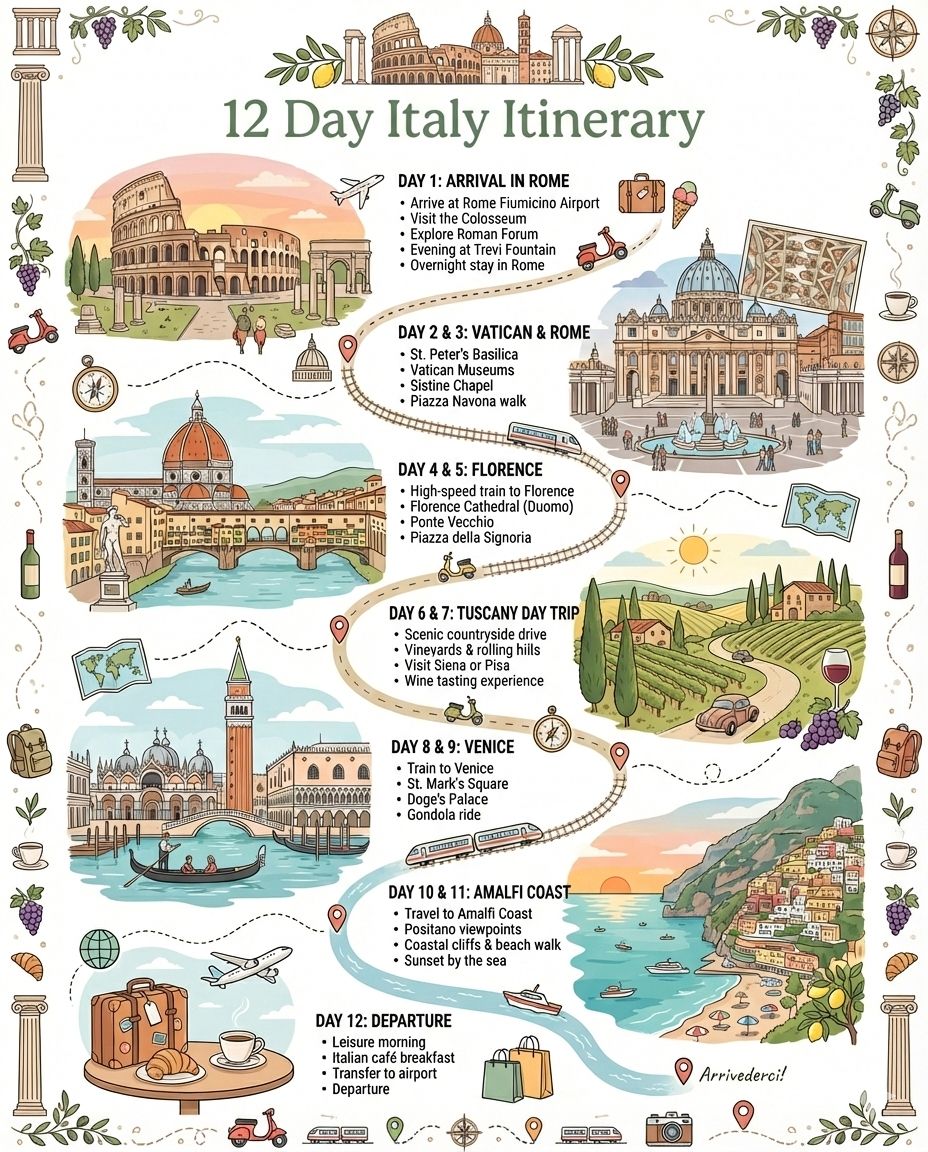
Italy rewards travelers who move slowly enough to absorb each region’s distinct character. This route covers Rome’s ancient ruins, Florence’s Renaissance art, the rolling hills of Tuscany, Venice’s canals, and the cliffside towns of the Amalfi Coast. Few countries pack this much variety into less than two weeks.
This itinerary suits first-time visitors wanting a well-rounded introduction to Italy’s biggest highlights. It works equally well for couples, families with older kids, or friends splitting driving and planning duties. The pace stays reasonable throughout, with two nights in most major stops.
Below is a full breakdown of each stop, along with where to stay and what to prioritize along the way.
Itinerary Summary Table
| Stop | Recommended Stay | Main Highlights | Driving Time to Next Stop | Best For |
|---|---|---|---|---|
| Rome | 3 nights | Colosseum, Vatican, Trevi Fountain | 1.5 hours by high-speed train | History and art lovers |
| Florence | 2 nights | Duomo, Ponte Vecchio, Piazza della Signoria | 1-1.5 hours by car | Renaissance art enthusiasts |
| Tuscany Day Trip | Based in Florence | Siena or Pisa, vineyards, wine tasting | 3 hours by car | Scenic countryside lovers |
| Venice | 2 nights | St. Mark’s Square, Doge’s Palace, gondola ride | 5-6 hours by car | Romantic getaways |
| Amalfi Coast | 2 nights | Positano, coastal cliffs, sunset views | N/A, final stop | Coastal scenery seekers |
Rome
Rome anchors the start of this itinerary, offering nearly three thousand years of layered history within a single walkable city. Ancient ruins sit beside Baroque fountains and Renaissance churches, often within the same block. Three full days here allows time to properly explore both the historic center and the Vatican.
Arriving at Fiumicino Airport, most travelers take a direct train into the city center in about 30 minutes.
Things to Do in Rome
- Colosseum and Roman Forum: These ancient sites anchor day one, best explored with a combined ticket booked in advance. Allow at least three hours to cover both thoroughly.
- Vatican Museums and Sistine Chapel: Reserve timed entry tickets well ahead, especially during peak season. Plan a full morning to see the museums, Sistine Chapel, and St. Peter’s Basilica together.
- Trevi Fountain in the evening: Visiting after sunset offers a quieter, more atmospheric experience than daytime crowds. Toss a coin over your shoulder for the traditional wish for a return trip.
- Piazza Navona walk: This elegant square, built over an ancient stadium, stays lively with street artists and cafés into the evening. It pairs well with a stop at the nearby Pantheon.
- Trastevere for dinner: This cobblestone neighborhood across the Tiber offers some of the city’s best traditional Roman trattorias. Evening hours bring a lively, local atmosphere.
- Roman food tasting: Sample carbonara, cacio e pepe, and Roman-style pizza at neighborhood trattorias rather than tourist-focused restaurants near major landmarks.
Where to Stay in Rome
- J.K. Place Roma – Luxury
- Hotel Artemide – Mid-range
- Albergo del Senato – Mid-range
- Domus Giordano – Budget
Florence
A high-speed train connects Rome to Florence in about 90 minutes, making the transition simple and scenic. Florence sits at the heart of the Renaissance, home to some of the most significant art and architecture in Western history. Two days allows time to see the major sites without feeling rushed.
The historic center is compact and walkable, so a car is unnecessary once you arrive.
Things to Do in Florence
- Florence Cathedral (Duomo): Brunelleschi’s dome remains an engineering marvel, and climbing it rewards visitors with sweeping city views. Book tickets in advance, since same-day entry often sells out.
- Ponte Vecchio: This medieval bridge, lined with jewelry shops, spans the Arno River in the heart of the city. Early morning offers the best photos before crowds gather.
- Piazza della Signoria: This open-air sculpture gallery sits beside the Uffizi Gallery, worth a slow walk to take in the statues. It’s a natural gathering point before or after museum visits.
- Uffizi Gallery: Home to works by Botticelli and da Vinci, advance booking is essential to avoid long lines. Plan at least two hours for a proper visit.
- Oltrarno neighborhood: This quieter district across the river offers artisan workshops and a more local, less touristy atmosphere. It’s a good spot for a relaxed evening walk.
- Piazzale Michelangelo at sunset: This elevated viewpoint offers the city’s best panoramic skyline view. The walk up takes about twenty minutes from the historic center.
Where to Stay in Florence
- Hotel Savoy – Luxury
- Brunelleschi Hotel – Mid-range
- Hotel Calimala – Mid-range
- Hotel Davanzati – Budget
Tuscany Day Trip
Based from Florence, this stretch shifts the pace from city sightseeing to slower countryside exploration. A rental car makes the most sense here, since rural Tuscany has limited public transportation. Rolling hills, vineyards, and hilltop towns define this two-day detour.
Choosing between Siena and Pisa depends on personal priorities, medieval history versus an iconic quick photo stop.
Things to Do on the Tuscany Day Trip
- Siena’s historic center: The shell-shaped Piazza del Campo and striped Gothic cathedral make Siena feel more medieval than Florence. A few hours here covers the main sights comfortably.
- Pisa’s Leaning Tower: If time is limited, Pisa works as a shorter stop, centered almost entirely around the iconic tower and cathedral square. Most visitors spend two to three hours here.
- Chianti vineyard drive: Wine country begins almost immediately outside Florence, with rolling hills and cypress-lined roads. Driving slowly here is part of the experience.
- Wine tasting at a local vineyard: Reservations are recommended at popular producers, especially during harvest season in September and October. Tastings typically run one to two hours.
- San Gimignano detour: This hilltop town, known for its medieval stone towers, makes a scenic add-on if time allows. Golden hour offers the best photography light.
- Countryside lunch stop: Small family-run trattorias throughout the Tuscan countryside often serve the most memorable, unpretentious meals of the entire trip.
Where to Stay for the Tuscany Day Trip
Since this stretch is based from Florence, no separate overnight stay is required. Travelers wanting a deeper countryside experience can extend the trip with one night at a rural agriturismo near Siena, many of which offer excellent, highly rated stays with vineyard views.
Venice
Venice sits roughly five to six hours from Florence by car, though a high-speed train covers the same distance in about two hours. This unusual city, built entirely on a lagoon, offers architecture and atmosphere unlike anywhere else in Italy. Two nights allows time to explore beyond the main tourist path.
Cars cannot enter central Venice, so plan to park at Piazzale Roma or arrive by train directly into the city center.
Things to Do in Venice
- St. Mark’s Square: This grand central plaza is surrounded by Byzantine and Gothic architecture, best visited early morning before tour groups arrive. It anchors most first-time visits to the city.
- Doge’s Palace: This Gothic palace once housed Venice’s ruling government and offers insight into the city’s powerful maritime history. Combined tickets with St. Mark’s Basilica save both time and money.
- Gondola ride: A classic, if touristy, way to experience Venice’s quieter back canals away from the main crowds. Early evening rides often offer better light and fewer other boats.
- Rialto Bridge and market: The oldest bridge crossing the Grand Canal is lined with shops and morning market stalls. It’s a good midday stop between major sights.
- Murano and Burano islands: A short boat ride reaches these nearby islands, one famous for glassblowing, the other for brightly colored houses. Half a day covers both comfortably.
- Cicchetti crawl in Cannaregio: This local neighborhood offers small bacari serving cicchetti, Venice’s answer to tapas, paired with local wine. It’s a favorite way to experience Venice like a local.
Where to Stay in Venice
- Hotel Danieli – Luxury
- Corte di Gabriela – Mid-range
- Dimora Marciana – Mid-range
- Hotel Serenissima – Budget
Amalfi Coast
The final stop shifts from northern Italy’s cities to the dramatic southern coastline. Reaching the Amalfi Coast from Venice typically involves a flight or train back toward Naples, followed by a transfer along the coastal road. Two nights here allows time to properly enjoy Positano’s cliffside scenery.
Driving the coastal road yourself is possible but demanding, with narrow, winding lanes and limited parking. Many travelers prefer hiring a private driver or using the regional ferry and bus network instead.
Things to Do on the Amalfi Coast
- Positano viewpoints: This cliffside town’s tiered pastel buildings offer some of the coast’s most photographed views. Several viewpoints along the main road are worth a short stop.
- Coastal cliffs and beach walk: Spiaggia Grande, Positano’s main beach, offers a relaxed spot to unwind between sightseeing. Morning visits avoid the busiest midday crowds.
- Sunset views over the water: Evening light along this coastline is consistently spectacular, best enjoyed from a terrace restaurant or hillside viewpoint. Many hotels offer excellent sunset views directly from their properties.
- Path of the Gods hike: This scenic trail above the coast offers sweeping views for travelers wanting an active break from sightseeing. The full hike takes about two to three hours.
- Amalfi town day trip: A short ferry or bus ride reaches Amalfi’s cathedral and historic center. It makes an easy half-day addition to a Positano-based stay.
- Fresh seafood dinner: The coast’s restaurants specialize in fresh, simply prepared seafood, best enjoyed at a terrace table overlooking the water.
Where to Stay on the Amalfi Coast
- Le Sirenuse – Luxury
- Palazzo Murat – Mid-range
- Hotel Buca di Bacco – Mid-range
- La Tavolozza Residence – Budget
Practical Travel Advice
Booking major attractions like the Colosseum, Uffizi Gallery, and Vatican Museums well in advance saves significant time and stress. High-speed trains connect Rome, Florence, and Venice efficiently, making them the most practical choice between those three stops. A rental car makes more sense for the Tuscany countryside portion, where public transportation is limited.
Comfortable walking shoes matter more than any other packing item, given the amount of cobblestone and hill walking throughout this route. Many churches, including St. Peter’s Basilica, require covered shoulders and knees. Spring and early fall offer the most comfortable weather across all five stops on this route.
On the final morning, a relaxed Italian café breakfast before transferring to the airport makes a fitting way to close out the trip.
Final Thoughts
This twelve-day route balances major cities with slower, scenic stops, giving travelers a genuine feel for Italy’s range. Follow it as outlined, or adjust the pacing to match your own interests and travel style. Either way, this itinerary delivers an unforgettable introduction to the country’s history, art, and coastline.