
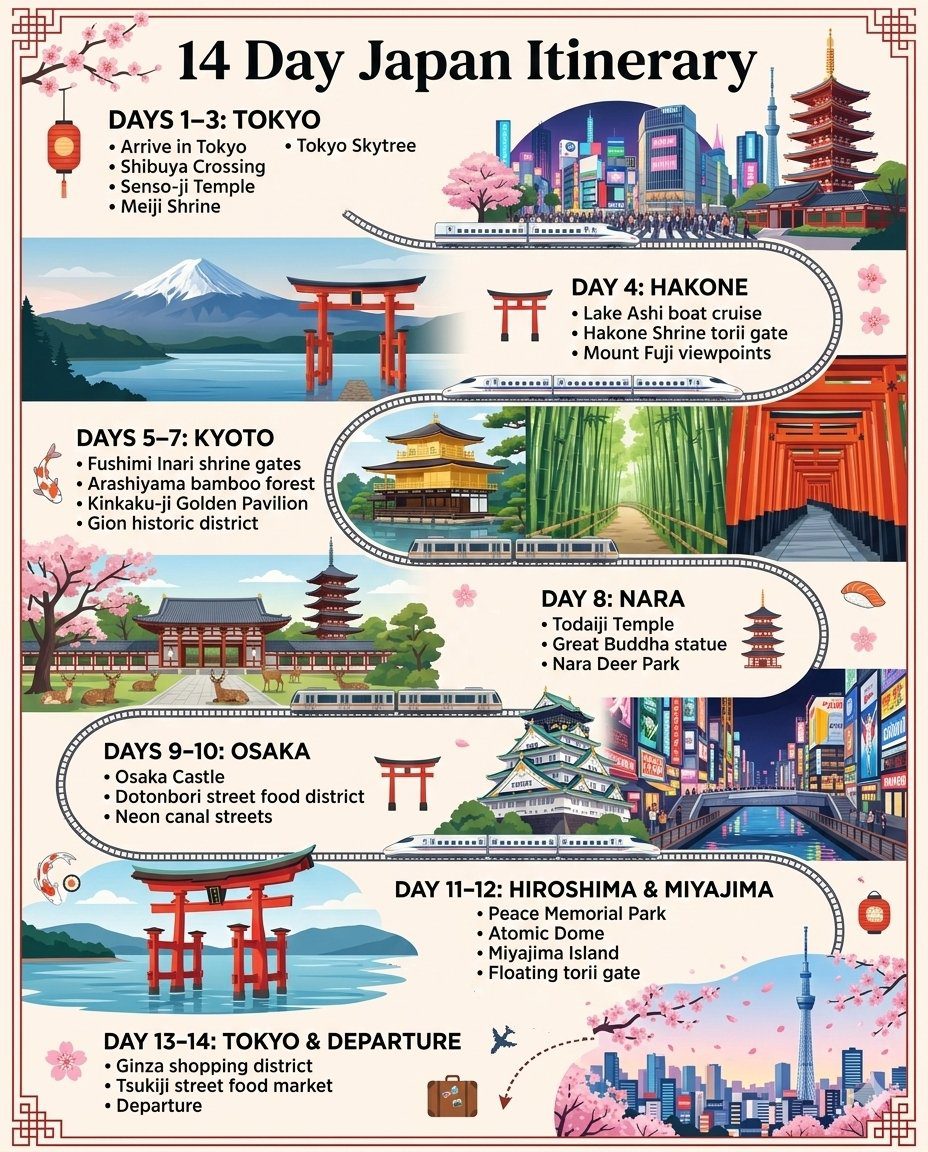
Fourteen days gives you real room to see Japan properly, moving from Tokyo’s neon streets through mountain lakes, ancient temples, and finally Hiroshima’s quiet memorial parks. This itinerary covers Tokyo, Hakone, Kyoto, Nara, Osaka, Hiroshima, and Miyajima before looping back to Tokyo for departure. It works whether this is your first trip to Japan or your third.
Japan’s train network makes this route easy to follow, with the Shinkansen connecting nearly every stop directly. Below is a full breakdown of the fourteen days, including where to eat and practical tips for each leg.
Trip Overview
| Days | Focus | Best For |
| Day 1-3 | Tokyo | City sights, temples, neon streets |
| Day 4 | Hakone | Mount Fuji views, lake cruises |
| Day 5-7 | Kyoto | Temples, bamboo forest, geisha district |
| Day 8 | Nara | Deer park, ancient temples |
| Day 9-10 | Osaka | Street food, castle, nightlife |
| Day 11-12 | Hiroshima & Miyajima | Peace park, floating shrine |
| Day 13-14 | Tokyo & Departure | Shopping, markets, flight home |
Most of this trip runs on JR trains, so buying a Japan Rail Pass before you leave home usually pays off given how much ground this route covers.
Day 1-3: Tokyo
The trip starts in Tokyo, where three days lets you cover the essentials without rushing. Shibuya Crossing and Sensoji Temple anchor the sightseeing, while Meiji Shrine offers a calmer contrast tucked inside its own forest. Tokyo Skytree closes out the stretch with sweeping views over the whole city.
Jet lag hits hard on day one for most travelers, so keeping the first day light works better than packing it full. Save the busier sightseeing for days two and three once you’ve adjusted.
Where to Eat in Tokyo
- Small ramen shops near Shinjuku Station serve some of the city’s best late-night bowls, often with just a handful of seats.
- Tsukiji Outer Market makes a solid stop for a fresh sushi breakfast before a full day of walking.
- Izakaya bars around Shibuya offer small plates and drinks, a good way to sample several dishes in one sitting.
Insider Tips for Tokyo
- Visit Sensoji Temple early morning, ideally before 8am, since it gets packed by midday.
- Buy a Suica or Pasmo card on arrival, since it works across nearly all trains, buses, and even vending machines.
- Book a timed slot for Shibuya Sky if you want crossing views from above without the ground-level chaos.
- Walk from Meiji Shrine straight into Harajuku, since the two sit right next to each other.
- Watch the Skytree light up at dusk from the Sumida River side for the best photo angle.
Day 4: Hakone
A short train ride out of Tokyo brings you to Hakone, a mountain town known for hot springs and Mount Fuji views. Lake Ashi anchors the day, with boat cruises offering rare angles on Fuji when the weather cooperates. The red torii gate at Hakone Shrine, rising right out of the lake, ranks among the most photographed spots in the region.
Weather here shifts fast, so don’t count on a guaranteed Fuji view. Locals will tell you the mountain hides behind clouds more often than it shows itself.
Where to Eat in Hakone
- Small soba restaurants near Lake Ashi serve simple, warming noodle dishes suited to the cooler mountain air.
- Hotels around Hakone often include kaiseki dinners, a multi-course meal built around seasonal ingredients.
- Roadside stalls sell black eggs boiled in the area’s volcanic hot springs, said to add years to your life.
Insider Tips for Hakone
- Check the Fuji forecast the night before, since clear mornings offer the best odds of a visible peak.
- Buy a Hakone Free Pass if you plan to use the boats, cable cars, and buses more than once.
- Time the Lake Ashi cruise for morning, when winds stay calmer and the water sits flatter.
- Pack a light jacket even in warmer months, since Hakone’s elevation keeps it cooler than Tokyo.
- Stay overnight in a ryokan here if your schedule allows, since the hot springs work best after dark.
Day 5-7: Kyoto
Three days in Kyoto covers the city’s biggest draws without feeling rushed. Fushimi Inari’s endless red gates make for one of the most iconic walks in Japan, best tackled early before the crowds arrive. Kinkaku-ji, the Golden Pavilion, and the bamboo forest in Arashiyama round out a stretch packed with temples and quiet green spaces.
Gion, Kyoto’s old geisha district, rewards an evening stroll, when lanterns light up the narrow streets and you might spot a geiko heading to an appointment.
Where to Eat in Kyoto
- Nishiki Market, sometimes called Kyoto’s kitchen, packs dozens of food stalls into one covered street.
- Small tofu restaurants near Arashiyama specialize in yudofu, a simple boiled tofu dish tied to the area’s temple history.
- Gion’s back streets hide small, counter-only restaurants serving Kyoto-style kaiseki at more accessible prices than you’d expect.
Insider Tips for Kyoto
- Climb Fushimi Inari before 7am, since the lower gates fill with tour groups by mid-morning.
- Rent a bicycle to cover Arashiyama’s bamboo forest and nearby temples faster than walking.
- Wear comfortable shoes throughout, since Kyoto’s temples involve a lot of walking on gravel and stone paths.
- Visit Kinkaku-ji on a weekday if possible, since weekends draw significantly larger crowds.
- Walk Gion in the early evening around 6pm, your best window for spotting geiko heading to work.
Day 8: Nara
A short train ride from Kyoto brings you to Nara, home to over a thousand free-roaming deer that wander right through the park. Todaiji Temple houses a massive bronze Buddha statue, one of the largest in Japan, housed inside one of the world’s biggest wooden buildings. The deer here will bow for a cracker, a strange and genuinely charming Nara tradition.
One day covers Nara comfortably, making it an easy add-on to your Kyoto stay rather than a separate overnight stop.
Where to Eat in Nara
- Small restaurants near Nara Park serve kakinoha-zushi, sushi wrapped in persimmon leaves, a local specialty.
- Cafes along the main approach to Todaiji offer a good spot to rest between temple visits.
- Vendors near the park sell deer crackers, technically for the deer, though plenty of visitors snack nearby too.
Insider Tips for Nara
- Buy deer crackers only from official stalls, since the deer can get pushy around food from other sources.
- Visit Todaiji early to see the Great Buddha statue before tour buses arrive in force.
- Keep food out of sight when walking through the park, since the deer notice quickly.
- Combine Nara with Kyoto as a day trip rather than booking a separate hotel here.
- Watch your belongings around the deer, since they’ve been known to nibble at maps and bags.
Day 9-10: Osaka
Two days in Osaka shift the pace entirely, trading Kyoto’s quiet temples for street food and neon canal streets. Dotonbori anchors the visit, its giant glowing signs and packed food stalls running late into the night. Osaka Castle adds a dose of history during the day, set inside a park that’s especially striking during cherry blossom season.
Locals often call Osaka the kitchen of Japan, and a couple of days here makes that reputation easy to understand.
Where to Eat in Osaka
- Dotonbori’s street stalls serve takoyaki, fried octopus balls that originated in this exact neighborhood.
- Okonomiyaki restaurants throughout Osaka let you watch the savory pancakes cooked right at your table.
- Kuromon Ichiba Market offers fresh seafood and produce, a good spot for a mid-afternoon snack.
Insider Tips for Osaka
- Walk Dotonbori at night, when the neon signs and canal reflections look their best.
- Visit Osaka Castle in the morning to avoid both crowds and the afternoon heat.
- Try a few different takoyaki stalls, since locals debate fiercely over which one makes the best version.
- Use the subway rather than walking between Osaka Castle and Dotonbori, since the distance runs longer than it looks on a map.
- Keep cash on hand for smaller food stalls, since not all of them take cards.
Day 11-12: Hiroshima & Miyajima
The trip shifts tone here, moving to Hiroshima’s Peace Memorial Park and the Atomic Bomb Dome, a sobering but important stop on any Japan itinerary. A short ferry ride away, Miyajima Island offers a complete change of mood, its floating torii gate rising out of the water at high tide. Two days gives you time for both without rushing either.
Give yourself space to process Hiroshima before heading straight into sightseeing elsewhere. The Peace Memorial Museum in particular deserves unhurried time.
Where to Eat in Hiroshima and Miyajima
- Hiroshima’s okonomiyaki differs from Osaka’s version, layering noodles into the pancake rather than mixing them in.
- Restaurants near the Peace Memorial Park serve simple, affordable lunches suited to a reflective morning.
- Miyajima’s food stalls sell grilled oysters and momiji manju, a maple-leaf-shaped cake filled with sweet bean paste.
Insider Tips for Hiroshima and Miyajima
- Visit the Peace Memorial Museum with enough time to sit with what you see, rather than rushing through.
- Time your Miyajima trip around high tide, when the floating gate looks its most striking.
- Take the ferry from Miyajimaguchi Station, a short and simple crossing to the island.
- Watch for deer on Miyajima too, since the island has its own free-roaming population similar to Nara.
- Book Hiroshima accommodation a night or two ahead, since the city sees fewer last-minute openings than Tokyo or Osaka.
Day 13-14: Tokyo & Departure
The final two days bring you back to Tokyo by Shinkansen, closing the loop before your flight home. Ginza offers a last round of shopping, while Tsukiji’s street food market gives you one more chance at fresh seafood before departure. Keep the final day light, since travel days rarely leave room for a packed schedule.
Build in buffer time for this last stretch, since delays or last-minute souvenir runs tend to eat into the schedule more than expected.
Where to Eat Before Departure
- Ginza’s department store basements, known as depachika, sell beautifully packaged food perfect for a final Japan meal or gift.
- Tsukiji’s stalls offer one more fresh seafood breakfast before your flight.
- Airport restaurants at Narita or Haneda serve solid ramen if you’re short on time before boarding.
Insider Tips for Departure Day
- Confirm your flight time the day before, and plan your airport departure with extra buffer.
- Pack souvenirs from Ginza’s depachika in your carry-on if they’re food items, to avoid checked-bag damage.
- Arrive at the airport at least three hours early for international flights, since Narita and Haneda can get busy.
- Use the Narita Express or Airport Limousine Bus for a stress-free ride from central Tokyo.
- Double-check your Japan Rail Pass expiration if using it for this final airport transfer.
Final Thoughts
Fourteen days across Tokyo, Hakone, Kyoto, Nara, Osaka, Hiroshima, and Miyajima covers an incredible range of what Japan offers, from mountain lakes to ancient temples to memorial parks. The train network makes the whole route smooth, so most of your energy goes toward the places themselves rather than getting between them. Pack layers for the shift between city heat and mountain air, and let the pace slow down naturally once you reach Kyoto and Hiroshima.