
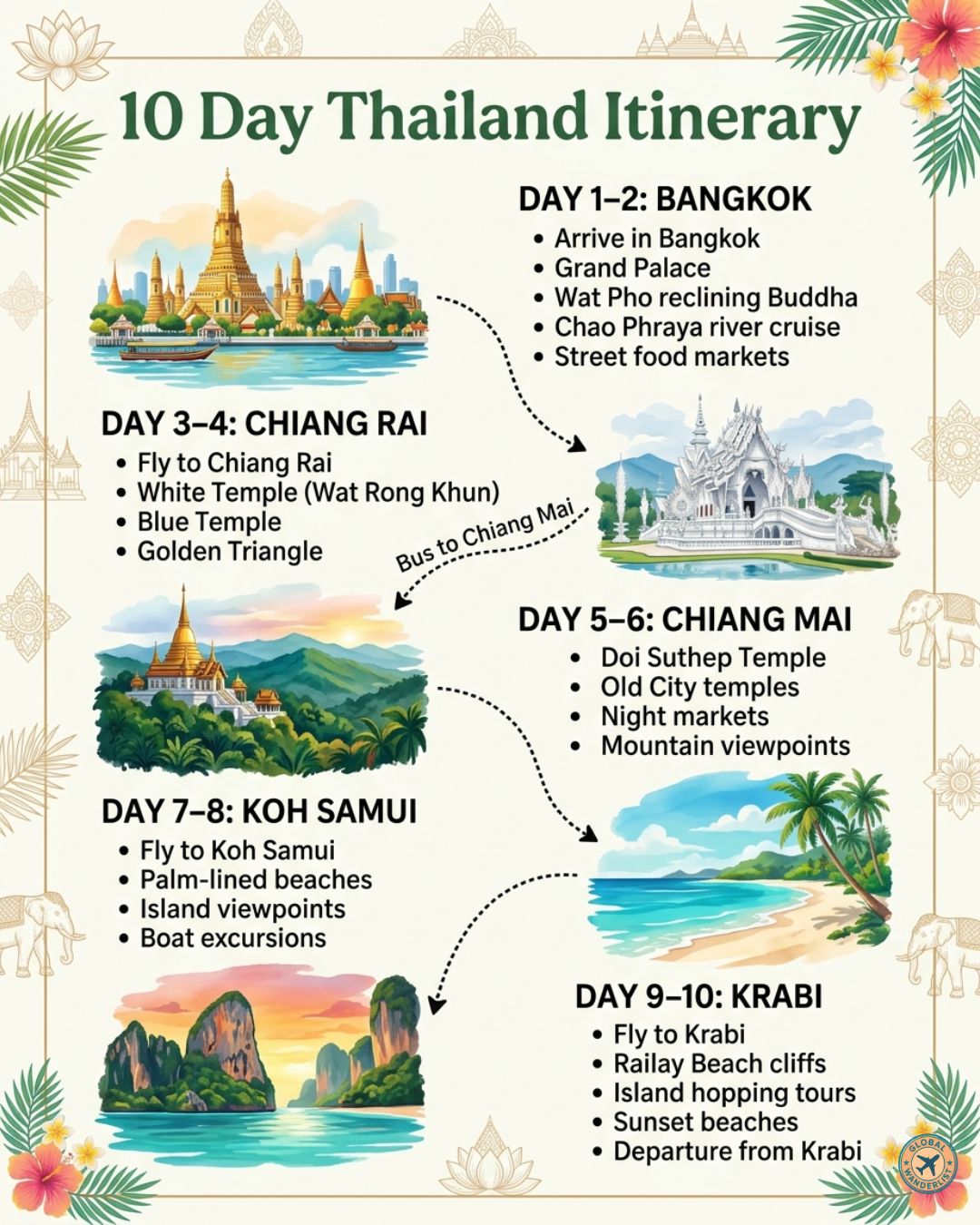
Ten days is enough time to experience Thailand’s essential range, moving from Bangkok’s temples through the northern hill towns and finishing on the Andaman coast’s beaches. This itinerary follows a natural south-to-north-to-south flow, covering Bangkok, Chiang Rai, Chiang Mai, Koh Samui, and Krabi. It works well whether this is your first visit to Thailand or a return trip focused on new regions.
Thailand rewards travelers who plan around its geography rather than trying to force a straight line across the map. This route uses domestic flights strategically to avoid long overland travel days, keeping most of your ten days focused on sightseeing rather than transit. Below is a full breakdown of the trip, including where to eat, practical tips, and everything you need to plan the logistics around it.
Trip Overview
| Days | Focus | Best For |
| Day 1-2 | Bangkok | Temples, river cruises, street food |
| Day 3-4 | Chiang Rai | White Temple, Golden Triangle |
| Day 5-6 | Chiang Mai | Old City temples, night markets |
| Day 7-8 | Koh Samui | Beaches, island viewpoints |
| Day 9-10 | Krabi | Railay cliffs, island hopping |
Most travelers fly between Bangkok, Chiang Rai, Chiang Mai, Koh Samui, and Krabi to keep this itinerary manageable within ten days. Domestic flights within Thailand are generally short, frequent, and affordable, with several budget carriers operating multiple daily departures on these routes.
Before You Go: Planning the Logistics
Getting this itinerary right starts before you land. Since it moves between five distinct regions, booking flights and transport ahead of time saves both money and stress once you are on the ground.
Flights and Transport Between Stops
- Book your Bangkok to Chiang Rai flight early, since this route has fewer daily departures than routes through Chiang Mai.
- Take the overland bus between Chiang Rai and Chiang Mai rather than flying, since the roughly three-hour journey is scenic and no direct flight exists between the two cities.
- Fly from Chiang Mai to Koh Samui via Bangkok if a direct route is unavailable on your travel dates, since this leg sometimes requires a connection.
- Book the Koh Samui to Krabi flight or ferry-and-bus combination in advance during peak season, since seats fill quickly between November and February.
Visa and Entry Requirements
- Check current visa exemption rules for your nationality before booking, since Thailand’s policies periodically change duration and eligibility.
- Carry proof of onward travel and sufficient funds, since immigration officers occasionally request this at entry points.
- Keep a digital and physical copy of your passport and visa documentation throughout the trip, particularly useful when checking into smaller guesthouses.
Day 1-2: Bangkok
Bangkok opens the trip with its dense mix of temples, markets, and river life. Two days allow time to visit the Grand Palace, see the reclining Buddha at Wat Pho, and take a Chao Phraya river cruise. An evening spent at one of the city’s street food markets is a good way to settle into Thailand’s rhythm before heading north.
Bangkok can feel overwhelming on arrival, given its size, traffic, and heat. Breaking the two days into a temple-focused morning and a market-focused afternoon keeps the pace manageable rather than trying to see everything in one exhausting sweep.
Where to Eat in Bangkok
- Street food stalls around Chinatown’s Yaowarat Road offer some of the city’s best casual dining, particularly for stir-fried noodles and fresh seafood.
- Krua Apsorn, a long-running local favorite, specializes in refined Thai home cooking, particularly praised for its crab curry.
- Or Tor Kor Market, near the northern edge of the city, offers an excellent range of fresh fruit and prepared Thai dishes in a more relaxed, less touristy setting than the riverside markets.
Insider Tips for Bangkok
- Visit the Grand Palace early in the morning, ideally before 9 a.m., to avoid both crowds and the harshest midday heat.
- Wear clothing that covers your shoulders and knees when visiting temples, since strict dress codes are enforced.
- Take a river taxi rather than a car to move between riverside temples, since traffic on Bangkok’s roads can be unpredictable.
- Use the BTS Skytrain or MRT subway for longer distances across the city, both efficient and air-conditioned alternatives to sitting in traffic.
- Book your Chao Phraya dinner cruise a day or two ahead, since the more popular operators can fill up during peak tourist season.
Day 3-4: Chiang Rai
From Bangkok, most travelers fly directly to Chiang Rai to see its striking modern temples. Wat Rong Khun, the White Temple, anchors the visit, alongside the lesser-known but equally photogenic Blue Temple. A day trip to the Golden Triangle, where Thailand meets Laos and Myanmar, adds a historical and geographic highlight before continuing south.
Chiang Rai moves at a noticeably slower pace than Bangkok, and two days here works well as a decompression period after the capital’s intensity. The city itself is compact enough to explore without needing extensive transport planning.
Where to Eat in Chiang Rai
- Local night market stalls near the clock tower offer a wide range of northern Thai dishes, including Khao Soi and grilled meats.
- Restaurants along the Kok River serve Thai and international dishes with scenic water views, a relaxed option after a day of temple visits.
- Chivit Thamma Da Coffee House, set along the riverbank, is a popular stop for coffee and light meals in a scenic garden setting.
Insider Tips for Chiang Rai
- Visit Wat Rong Khun in the morning, since the white facade photographs best in soft early light before crowds build.
- Combine the White Temple and Blue Temple into a single day, since both sit within a short drive of central Chiang Rai.
- Book a Golden Triangle day trip in advance if you want a boat ride on the Mekong River included.
- Hire a private driver or join a group tour for the Golden Triangle excursion, since public transport options to this remote border area are limited.
- Set aside time for the Baan Dam Museum, sometimes called the Black House, a striking contrast to the White Temple’s stark purity.
Day 5-6: Chiang Mai
A short bus ride from Chiang Rai brings travelers to Chiang Mai, Thailand’s cultural capital of the north. Doi Suthep, a mountaintop temple overlooking the city, anchors the sightseeing, while the Old City’s moated temples reward a full day of walking. Night markets provide an easy, atmospheric way to spend the evenings here.
Chiang Mai has become one of Thailand’s most beloved cities among long-term travelers, partly due to its manageable size and partly due to its strong food and craft culture. Two days covers the essentials, though it is easy to see why many visitors extend their stay here.
Where to Eat in Chiang Mai
- Huen Phen is a long-established local institution, known for authentic northern Thai dishes served in a homely, welcoming setting.
- Chiang Mai’s Sunday Walking Street market offers an excellent range of street food, from grilled skewers to regional curries.
- SP Chicken, a simple grilled chicken restaurant near the Old City, has built a loyal following for its smoky, tender rotisserie-style chicken.
Insider Tips for Chiang Mai
- Visit Doi Suthep in the early morning or late afternoon to avoid both crowds and the strongest heat of the day.
- Rent a bicycle to explore the Old City’s temples, since distances between them are short but add up over a full day.
- Time your visit around the Sunday or Saturday Walking Street markets, both offering some of the city’s best evening atmosphere.
- Consider a half-day cooking class if you have flexible time, since Chiang Mai is widely regarded as one of Thailand’s best places to learn traditional cooking.
- Book mountain viewpoint tours or a Doi Inthanon day trip in advance if you want to see Thailand’s highest peak, located a couple of hours outside the city.
Day 7-8: Koh Samui
From Chiang Mai, most travelers fly south to Koh Samui for a change of pace built entirely around beaches. Palm-lined stretches of sand and island viewpoints anchor a more relaxed two days, with boat excursions to nearby islands offering an easy day trip. This stop provides a welcome contrast after the temple-heavy northern leg of the itinerary.
The shift from mountains to islands is deliberate in this itinerary, giving the trip a natural rhythm rather than clustering similar experiences together. Koh Samui’s infrastructure also makes it one of the easier islands in Thailand to navigate without a rental car.
Where to Eat on Koh Samui
- Beachfront restaurants along Chaweng and Lamai serve fresh seafood with ocean views, a reliable choice for a relaxed dinner.
- Fisherman’s Village in Bophut offers a lively night market atmosphere with a strong mix of Thai and international food stalls.
- The Larder, a small restaurant tucked away from the busier beach strips, has built a strong reputation for creative, seasonal Thai-inspired dishes.
Insider Tips for Koh Samui
- Book boat excursions to nearby islands like Koh Nang Yuan a day or two in advance during peak season.
- Rent a scooter to explore the island’s viewpoints, though drive carefully given the hilly, winding roads.
- Visit Fisherman’s Village on a Friday evening, when its weekly walking street market is in full swing.
- Consider a day trip to Ang Thong National Marine Park if you want to see more of the surrounding limestone island scenery beyond Koh Samui itself.
- Choose accommodation on the island’s quieter western side if you prefer a more relaxed atmosphere than the busier Chaweng strip.
Day 9-10: Krabi
The final two days shift to Krabi on Thailand’s Andaman coast, known for its dramatic limestone cliffs and island-hopping opportunities. Railay Beach, accessible only by boat, anchors the sightseeing with world-class rock climbing and striking scenery. A final sunset on the beach makes for a fitting close before departure.
Ending the trip on the Andaman coast gives travelers one last dramatic landscape shift, moving from the Gulf of Thailand’s calmer waters to the Andaman Sea’s more rugged, cliff-lined coastline. It is a strong final stop precisely because it feels so different from everywhere else on this itinerary.
Where to Eat in Krabi
- Railay Beach’s beachfront restaurants serve fresh seafood with direct views of the surrounding limestone cliffs.
- Krabi Town’s night market offers an accessible, casual way to sample a wide range of Thai dishes before departure.
- Ao Nang’s restaurant strip includes a strong mix of Thai and international options, useful if you are staying closer to the mainland rather than Railay itself.
Insider Tips for Krabi
- Book island hopping tours a day ahead during peak season, since popular routes can fill quickly.
- Rent climbing shoes locally at Railay Beach if you want to try rock climbing without bringing your own gear.
- Allow extra time for boat transfers to and from Railay Beach, since schedules can shift depending on tides and weather.
- Confirm your departure flight timing carefully, since getting from Railay Beach to Krabi Airport involves both a boat transfer and a road journey.
- Consider staying an extra half day if your schedule allows, since many first-time visitors find Krabi’s scenery worth lingering over.
Budgeting for a 10 Day Thailand Trip
Thailand remains one of the more affordable countries to visit in Southeast Asia, though costs vary considerably depending on your travel style. A backpacker-style trip covering hostels, street food, and public transport can run significantly less than a comfortable mid-range trip with private transfers and hotel stays.
Estimated Daily Costs
- Budget travelers can expect to spend the equivalent of roughly $30 to $50 USD per day, covering hostel accommodation, street food, and local transport.
- Mid-range travelers should budget around $70 to $120 USD per day, allowing for hotel stays, a mix of restaurant and street food, and occasional private transfers.
- Domestic flights between the five regions on this itinerary typically cost between $30 and $80 USD per leg when booked a few weeks in advance.
Money-Saving Tips
- Eat at street food stalls and local markets rather than tourist-oriented restaurants to significantly reduce your daily food budget.
- Book domestic flights several weeks ahead rather than last minute, since prices climb sharply closer to departure.
- Use ride-hailing apps like Grab for local transport, which typically offer more transparent and often lower pricing than negotiating with drivers directly.
Packing and Practical Tips for This Itinerary
Given the shift between northern mountains and southern islands, packing for this itinerary requires balancing lightweight beach essentials with slightly warmer layers for cooler evenings in Chiang Rai and Chiang Mai.
What to Pack
- Bring lightweight, breathable clothing for the majority of the trip, given Thailand’s consistently warm and humid climate.
- Pack a light jacket or long-sleeved layer for cooler evenings in the northern mountains, particularly if traveling between November and February.
- Carry clothing that covers shoulders and knees for temple visits, since strict dress codes are enforced at most religious sites throughout the itinerary.
- Bring reef-safe sunscreen for the Koh Samui and Krabi legs of the trip, both important for protecting the surrounding marine ecosystems.
General Travel Tips
- Learn a few basic Thai phrases like “Sawasdee” for hello and “Khop Khun” for thank you, since locals respond warmly to the effort.
- Carry small cash denominations for street food and local markets, since many vendors do not accept cards.
- Stay hydrated throughout the trip, particularly during the hotter months between March and May when this itinerary can feel more demanding.
Final Thoughts
Ten days across Bangkok, Chiang Rai, Chiang Mai, Koh Samui, and Krabi capture an impressive range of what Thailand offers, from ornate temples to island beaches. Booking domestic flights between the major regions keeps travel time manageable, leaving more time for the experiences that make each stop worthwhile. Pack light, breathable clothing, budget realistically for both flights and daily expenses, and let the itinerary’s shift from temples to islands set the pace of your trip.