
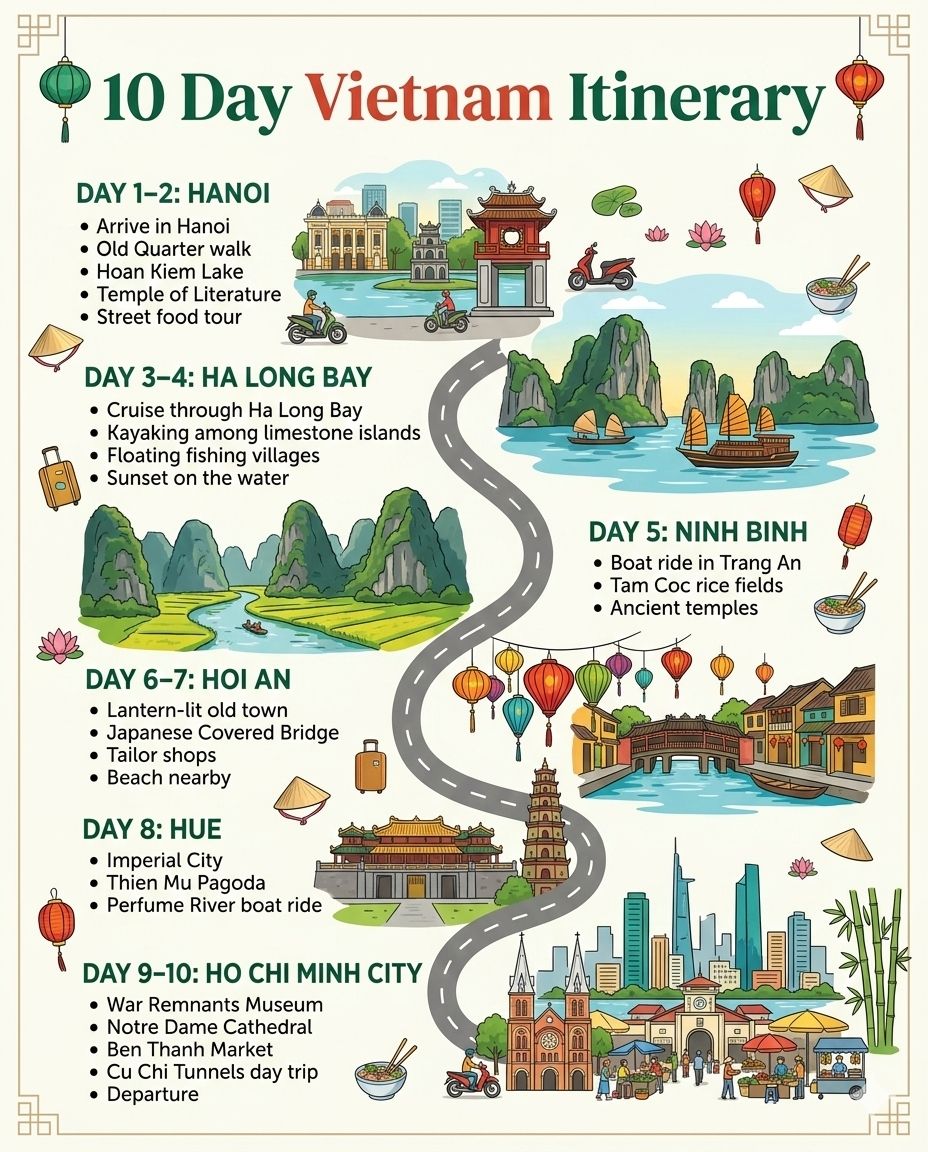
Ten days is enough time to experience Vietnam’s most essential stops without feeling rushed, moving from the northern capital down through central Vietnam’s historic towns and finishing in the energetic south. This itinerary follows a natural south-bound flow, covering Hanoi, Ha Long Bay, Ninh Binh, Hoi An, Hue, and Ho Chi Minh City. It works well whether you are visiting Vietnam for the first time or returning for a deeper look.
Below is a full breakdown of the ten days, including where to eat and practical tips for each stop.
Trip Overview
| Days | Focus | Best For |
|---|---|---|
| Day 1-2 | Hanoi | Old Quarter, street food, temples |
| Day 3-4 | Ha Long Bay | Limestone islands, cruising, kayaking |
| Day 5 | Ninh Binh | Boat rides, rice terraces, ancient temples |
| Day 6-7 | Hoi An | Lantern-lit old town, tailoring, beaches |
| Day 8 | Hue | Imperial history, river cruises |
| Day 9-10 | Ho Chi Minh City | War history, markets, day trips |
Most travelers fly between Hanoi, Da Nang (for Hoi An and Hue), and Ho Chi Minh City to keep this itinerary manageable within ten days. Domestic flights within Vietnam are generally short and affordable.
Day 1-2: Hanoi
Hanoi opens the trip with its dense, motorbike-filled Old Quarter and a strong French colonial influence throughout the city center. Two days is enough time to explore the Old Quarter on foot, visit the Temple of Literature, and take in Hoan Kiem Lake. A street food tour on the first evening is a good way to settle into the city’s rhythm.
Where to Eat in Hanoi
- Tầm Vị, a Michelin-starred restaurant, focuses on Northern Vietnamese cuisine served in an atmosphere resembling a traditional old Hanoi house. Its snail sausage and Malabar spinach soup are standout dishes.
- Bún chả stalls throughout the Old Quarter serve Hanoi’s signature grilled pork and noodle dish, best enjoyed at a small, busy local spot rather than a tourist-oriented restaurant.
Insider Tips for Hanoi
- Cross busy streets slowly and steadily rather than stopping suddenly, since motorbikes are used to flowing around a predictable pace.
- Visit the Temple of Literature in the morning, before tour groups arrive in larger numbers.
- Join a street food tour in the early evening, when stalls throughout the Old Quarter are at their freshest.
Day 3-4: Ha Long Bay
From Hanoi, most travelers head to Ha Long Bay for an overnight cruise through its limestone karsts. Kayaking among the islands and visiting floating fishing villages round out a full day on the water. This stop remains the most photographed part of most Vietnam itineraries, and for good reason.
Where to Eat in Ha Long Bay
- Most overnight cruises include meals prepared on board, often featuring fresh seafood sourced directly from the bay.
- If staying in Bai Chay before or after your cruise, seafood restaurants along the waterfront take full advantage of the bay’s fresh catch, including hand-pounded squid cakes.
Insider Tips for Ha Long Bay
- Book a smaller, higher-rated boutique cruise rather than a mass-market boat for a quieter, more personal experience.
- Pack light for the cruise itself, since cabin storage on most boats is limited.
- Confirm your cruise’s kayaking and cave-visit inclusions before booking, since itineraries vary significantly between operators.
Day 5: Ninh Binh
Ninh Binh, often called Ha Long Bay on land, offers dramatic karst scenery along the Trang An and Tam Coc waterways. A boat ride through Trang An’s limestone caves and past ancient temples makes for a full, rewarding day trip. This stop pairs naturally with the return journey from Ha Long Bay toward Hanoi or onward travel south.
Where to Eat in Ninh Binh
- Local restaurants near Trang An and Tam Coc specialize in goat meat dishes, a regional specialty found throughout Ninh Binh.
- Riverside cafes near the boat docks offer simple, satisfying meals suited to a quick stop between activities.
Insider Tips for Ninh Binh
- Book your Trang An boat ride early in the day to avoid both crowds and the strongest midday heat.
- Combine Trang An with a stop at Bai Dinh Pagoda, one of the largest Buddhist temple complexes in Southeast Asia.
- Wear comfortable shoes, since exploring Ninh Binh’s temples and rice terraces involves a fair amount of walking.
Day 6-7: Hoi An
Hoi An’s Ancient Town remains remarkably preserved, with lantern-lit streets that come alive after dark. Two days allows time to explore the historic center, get custom clothing made by a local tailor, and relax at a nearby beach. This stop consistently ranks among the most beloved on any Vietnam itinerary.
Where to Eat in Hoi An
- Morning Glory Restaurant is a Hoi An institution, renowned for authentic Vietnamese cuisine and a wide-ranging menu that captures the region’s culinary identity.
- The Temple Restaurant offers a more elevated dining experience, known for its lemongrass-infused seabass and citrus-glazed duck in an atmospheric, lantern-lit setting.
Insider Tips for Hoi An
- Visit during the monthly full moon Lantern Festival, when the town turns off electric lighting in favor of candlelit lanterns.
- Order custom clothing early in your stay, since most tailors need at least a day or two to complete fittings.
- Rent a bicycle to reach An Bang Beach, a relaxed stretch of sand just outside the Ancient Town.
Day 8: Hue
Hue served as the seat of Vietnam’s last royal dynasty, and a single day is enough to cover its Imperial City and Thien Mu Pagoda. A boat ride along the Perfume River adds a scenic, relaxed element to what can otherwise be a history-dense day. Hue connects easily to both Hoi An and onward flights south.
Where to Eat in Hue
- Local restaurants throughout Hue specialize in bún bò Huế, the city’s famous spicy beef noodle soup, best sampled at a small, well-established local spot.
- Restaurants near the Perfume River often serve royal-style Hue cuisine, a refined tradition dating back to the imperial court.
Insider Tips for Hue
- Hire a local guide for the Imperial City, since much of its history is not well explained by on-site signage alone.
- Visit Thien Mu Pagoda in the late afternoon, when the light on the river is at its most scenic.
- Allow extra time for the Perfume River boat ride, since it offers a rare, relaxed pause in an otherwise packed itinerary.
Day 9-10: Ho Chi Minh City
The final two days shift to Ho Chi Minh City, Vietnam’s largest and most energetic urban center. The War Remnants Museum and Notre Dame Cathedral anchor the city sightseeing, while a day trip to the Cu Chi Tunnels adds historical depth before departure. Ben Thanh Market offers a final, concentrated dose of the city’s food and shopping culture.
Where to Eat in Ho Chi Minh City
- Anan Saigon, a Michelin-starred restaurant, reimagines Vietnamese street food through a modern lens, set in a converted market building in District 1.
- Ben Thanh Market’s food stalls offer an accessible, casual way to sample a wide range of Vietnamese dishes in one visit.
Insider Tips for Ho Chi Minh City
- Book Cu Chi Tunnels tours in the morning to avoid both crowds and the hottest part of the day.
- Cross streets with the same slow, steady pace used in Hanoi, since Ho Chi Minh City’s traffic follows similar patterns.
- Allow extra time at the airport before departure, since Tan Son Nhat can get busy during peak travel periods.
Final Thoughts
Ten days across Hanoi, Ha Long Bay, Ninh Binh, Hoi An, Hue, and Ho Chi Minh City covers an impressive cross-section of Vietnam without feeling rushed. Booking domestic flights between the major regions keeps travel time manageable, leaving more time for the experiences that make each stop worthwhile. Pack layers for the temperature shifts between north and south, and let the itinerary’s natural south-bound flow carry you from mountain mist to tropical heat.