
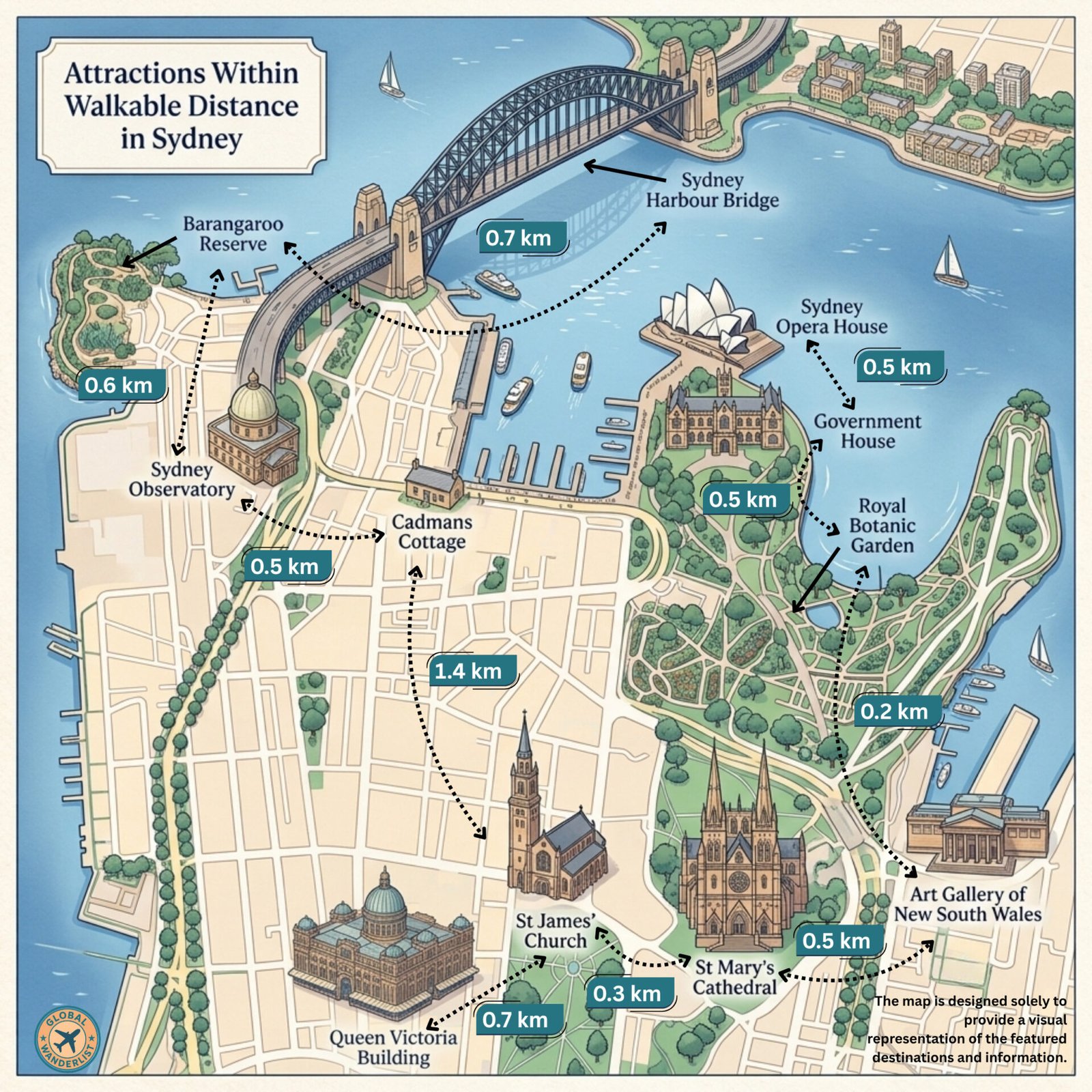
Sydney rewards visitors who are willing to walk. Unlike cities where the major sights are spread across sprawling suburbs, a remarkable cluster of Sydney’s most iconic landmarks sits within a compact stretch of the harbor foreshore, from Barangaroo in the west to the Art Gallery of New South Wales in the east. You can move between the Opera House, the Harbour Bridge, colonial-era cottages, grand cathedrals, and manicured botanic gardens almost entirely on foot, often with harbor views the whole way. This guide walks through eleven of the city’s essential attractions, along with what each one costs and when you can visit.
Quick Comparison Table
| Attraction | Type | Cost | Typical Hours |
|---|---|---|---|
| Barangaroo Reserve | Harbor park | Free | Open 24 hours |
| Sydney Harbour Bridge | Landmark bridge | Free to walk; climbs from around AU$264 | Pedestrian walkway open 24 hours |
| Sydney Observatory | Museum and observatory | Free general admission; guided tours around AU$36 | Daily, hours vary by season |
| Cadmans Cottage | Historic site | Free to view exterior | Exterior viewable anytime |
| Sydney Opera House | Performing arts venue | Public areas free; guided tour around AU$49 | Public concourse open 24 hours; tours daily |
| Government House | Historic residence | Free | Fri–Sun, house and grounds |
| Royal Botanic Garden | Public garden | Free | Daily, 7am until sunset |
| Art Gallery of New South Wales | Art museum | Free general entry | Daily 10am–5pm, Wed until 10pm |
| St Mary’s Cathedral | Cathedral | Free; crypt tour around AU$5 | Daily 6:30am–6:30pm (7pm weekends) |
| St James’ Church | Historic church | Free | Daily 10am–4pm (Sat 9am–1pm, Sun 7:30am–4pm) |
| Queen Victoria Building | Heritage shopping center | Free to enter | Mon–Wed & Fri–Sat 9am–6pm, Thu until 9pm, Sun 11am–5pm |
Barangaroo Reserve
Barangaroo Reserve sits at the northern tip of Sydney’s newest waterfront precinct, and it feels like a genuine escape from the city despite being minutes from the CBD by foot or ferry. This six-hectare headland park was once an industrial container terminal, and its transformation into native bushland, walking trails, and sandstone-lined harbor paths has made it one of the most peaceful places to take in Sydney Harbour without the crowds that gather closer to Circular Quay. The reserve is named after Barangaroo, a powerful Cammeraygal woman from Sydney’s early colonial history, and it includes Marrinawi Cove, a sheltered natural swimming spot, along with the Wulugul Walk connecting through to Darling Harbour.
- Timings: Barangaroo Reserve is open 24 hours a day, every day, making it one of the easiest additions to any Sydney itinerary. Early morning is the quietest time to visit, while sunset draws a livelier crowd for the harbor views back toward the bridge.
- Cost: Free
Sydney Harbour Bridge
Few structures define a city as completely as the Sydney Harbour Bridge defines Sydney. Nicknamed “the Coathanger” for its distinctive steel arch, the bridge connects the CBD to North Sydney and offers some of the best vantage points in the city, whether you are looking at it or from it. For those wanting to go further than the pedestrian walkway, BridgeClimb Sydney is the official operator for guided climbs up onto the arch itself, running about three hours from check-in to finish and including a stretch of 1,332 steps to the summit. Whichever option you choose, the bridge is best appreciated with the Opera House in the same frame, which is easy to arrange from several vantage points along the harbor foreshore.
- Timings: The pedestrian walkway is open 24 hours a day, with access from both the CBD and Milsons Point sides, making it easy to combine with a stroll through The Rocks. BridgeClimb departures run from early morning before sunrise through to night, with twilight and night climbs available at a premium.
- Cost: Walking across the pedestrian pathway is entirely free. Guided BridgeClimb summit climbs typically start from around AU$264 per adult, with prices shifting by day, time, and demand, so it is worth booking ahead if a specific time slot matters to you.
Sydney Observatory
Perched on Observatory Hill above The Rocks, Sydney Observatory is easy to miss amid the harborside landmarks nearby, but it rewards the short uphill walk. Built in 1858, it is Australia’s oldest observatory and now operates as a museum covering the history of astronomy, timekeeping, and meteorology in the colony, with two copper telescope domes still in use for public stargazing sessions. The elevated position also happens to be one of the best free spots in Sydney to photograph the Harbour Bridge and the water below.
- Timings: The museum exhibits and gardens are open daily. Paid guided tours through the historic building and telescope domes typically run Wednesday to Saturday afternoons and evenings. However, operating days and hours shift seasonally. So it is worth checking the current schedule before planning a visit. This particularly true if a night-time telescope session is the goal.
- Cost: General admission to the museum exhibits and surrounding gardens is free. Guided tours are priced at around AU$36 for adults, AU$24 for children, and AU$32 for concession holders.
Cadmans Cottage
Tucked into the waterside courtyard on George Street in The Rocks, Cadmans Cottage is one of the oldest surviving buildings in Sydney, dating back to 1816. It was built to house government coxswains. It was later named after John Cadman, a former convict who became the colony’s superintendent of boats. The cottage’s simple stone facade offers a striking contrast to the towering glass and steel of the modern CBD just a few streets away. It serves as a helpful landmark for orienting yourself within The Rocks, one of Sydney’s most historic and walkable neighborhoods. It also serves as the starting point for The Rocks’ free walking tours. They are run by volunteer guides at scheduled times through the week.
- Timings: The cottage is best appreciated from the outside as a piece of streetscape history, and its exterior is viewable at any time as part of a wider wander through The Rocks.
- Cost: Free. The Rocks’ volunteer-led walking tours that depart from the cottage run on a pay-what-you-think-it’s-worth basis.
Sydney Opera House
No list of Sydney attractions is complete without the Opera House, and for good reason. Jørn Utzon’s sail-shaped roofline, completed in 1973, remains one of the most recognizable buildings on Earth and has held UNESCO World Heritage status since 2007. The standard one-hour guided tour takes visitors through the foyers, one of the largest pillar-free chambers in the world, and behind-the-scenes stories about the building’s controversial construction history, while the Backstage Tour adds breakfast in the Green Room for a more immersive option.
- Timings: The public concourse, forecourt, and outdoor boardwalks are accessible 24 hours a day, meaning you can walk right up to the building and admire its scale and detail at any time. Guided tours run daily, with the interior theatres and foyers otherwise reserved for ticket holders and tour groups. Sunrise is widely considered the best time to photograph the building, when the eastern light wraps around the sails and the crowds have yet to arrive.
- Cost: The public areas are free to access. The standard guided tour costs around AU$49 for adults and AU$30 for children, while the Backstage Tour with breakfast runs closer to AU$199 per person.
Government House
Set within the Royal Botanic Garden, Government House is the official Sydney residence of the Governor of New South Wales and one of the finest examples of Gothic Revival architecture in the country. Completed in 1845, its sandstone turrets and manicured grounds overlook Sydney Harbour. It offers a quieter, more formal counterpoint to the bustle of Circular Quay just a short walk away.
- Timings: Both the house and its grounds are open to the public on Friday, Saturday, and Sunday. There are guided tours through the state rooms typically running on the hour during opening times. The surrounding gardens can usually be explored independently. Because Government House remains a working residence and occasionally hosts official functions, it is worth confirming opening days before visiting, particularly around state occasions.
- Cost: Free
Royal Botanic Garden
Founded in 1816, the Royal Botanic Garden is Australia’s oldest botanic garden. It is one of the most scenic public spaces in Sydney. It spans 30 hectares between the Opera House and the harbor foreshore. Its collection includes the Palm Grove, the Rose Garden, and a fern-filled rainforest gully, along with sweeping lawns that lead out toward Mrs Macquarie’s Chair, a lookout point offering one of the most photographed views of the harbor.
- Timings: The garden is open every day of the year, with hours generally running from 7am until sunset, though exact closing times shift by season, from around 5pm in the depths of winter to as late as 8pm in summer. The adjoining Domain parkland stays open 24 hours and is popular for evening walks and outdoor events.
- Cost: Entry to the garden is completely free. Paid add-ons include the Calyx exhibition space and Aboriginal Heritage Tours, which run for about 90 minutes and include a native bush food tasting for around AU$41 per adult, but the gardens themselves require no ticket at all.
Art Gallery of New South Wales
The Art Gallery of New South Wales sits at the eastern edge of the Domain, overlooking Woolloomooloo Bay, and holds the distinction of being the state’s leading visual arts institution and one of the largest public galleries in the country. Its collection spans historical and contemporary Australian art alongside international works, with the newer Naala Badu building adding significant space for First Nations and contemporary exhibitions since its 2022 expansion.
Timings: The gallery is open from 10am to 5pm daily, with extended hours until 10pm on Wednesdays for its Art After Hours program, which includes free talks, performances, and live music.
Cost: General admission is free every day. Some ticketed exhibitions carry a separate admission fee, but the permanent collection across the gallery’s main levels costs nothing to explore.
St Mary’s Cathedral
Facing Hyde Park, St Mary’s Cathedral is the seat of the Catholic Archbishop of Sydney and one of the largest Gothic Revival cathedrals in the country, notable for its twin spires, which were not actually completed until 2000, nearly 150 years after construction began. Inside, the stained-glass windows, crafted in England from 1881 onward, and the crypt’s intricate mosaic terrazzo floor are the standout details for visitors.
- Timings: The cathedral is open daily from 6:30am to 6:30pm on weekdays and until 7pm on weekends. As an active place of worship, visiting hours can shift around mass times and special services. Free guided tours run on Sunday afternoons. Weekday guided tours through both the cathedral and its crypt run several times a day, Monday through Friday.
- Cost: Entry to the main cathedral is free, with donations welcomed toward its upkeep. Weekday guided tours through the cathedral and crypt cost around AU$5 per person.
St James’ Church
A short walk from St Mary’s, St James’ Church on King Street holds the title of Sydney’s oldest surviving church building. It was consecrated in 1824 and designed by convict architect Francis Greenway, who also designed the neighboring Hyde Park Barracks. Its Georgian proportions and simple brick facade stand in deliberate contrast to the grander Gothic scale of St Mary’s. The interior holds a striking Children’s Chapel in the crypt, painted in vivid colors and gold leaf. There is also a newly installed pipe organ completed in 2024. The church regularly hosts concerts and organ recitals, which are worth checking for if classical music appeals during a visit.
- Timings: St James’ is open to visitors every day of the year. It is open from 10am to 4pm on weekdays, 9am to 1pm on Saturdays, and 7:30am to 4pm on Sundays. Hours can shift around services and special events.
- Cost: Free
Queen Victoria Building
The Queen Victoria Building, universally known as the QVB, occupies an entire block of George Street in the CBD. It is as much an architectural landmark as it is a shopping destination. It was built in 1898 as a produce market and later restored into a five-level retail center. Its Romanesque Revival design features stained-glass windows, ornate ironwork, and a striking central dome that houses a giant Christmas tree each December. More than 180 fashion, jewelry, and specialty stores fill the building. There is also a Tea Room, a popular spot for a traditional afternoon tea service.
- Timings: The QVB is generally open from 9am to 6pm Monday through Wednesday and Friday through Saturday. It extends to 9pm on Thursdays for late-night shopping, and from 11am to 5pm on Sundays. For those interested in its history, 45-minute guided walking tours through the building’s architectural highlights typically run around midday and must be booked at least 48 hours in advance.
- Cost: Entry to browse the building is free. Guided architectural tours carry a separate charge, confirmed at the time of booking.
Final Thoughts
Few cities pack this much history, architecture, and natural beauty into such a walkable stretch of waterfront. In a single day, you can trace a route from the quiet bushland of Barangaroo Reserve, past the sandstone cottages of The Rocks, under the Harbour Bridge, around the sails of the Opera House, through the Royal Botanic Garden, and into the grand interiors of the city’s cathedrals and museums, most of it without spending a dollar on admission. Plan around the free general entry points, save the paid experiences like BridgeClimb or the Opera House tour for the moments that matter most to you, and Sydney’s harbor foreshore will give you one of the richest, most rewarding city walks anywhere in the world.