
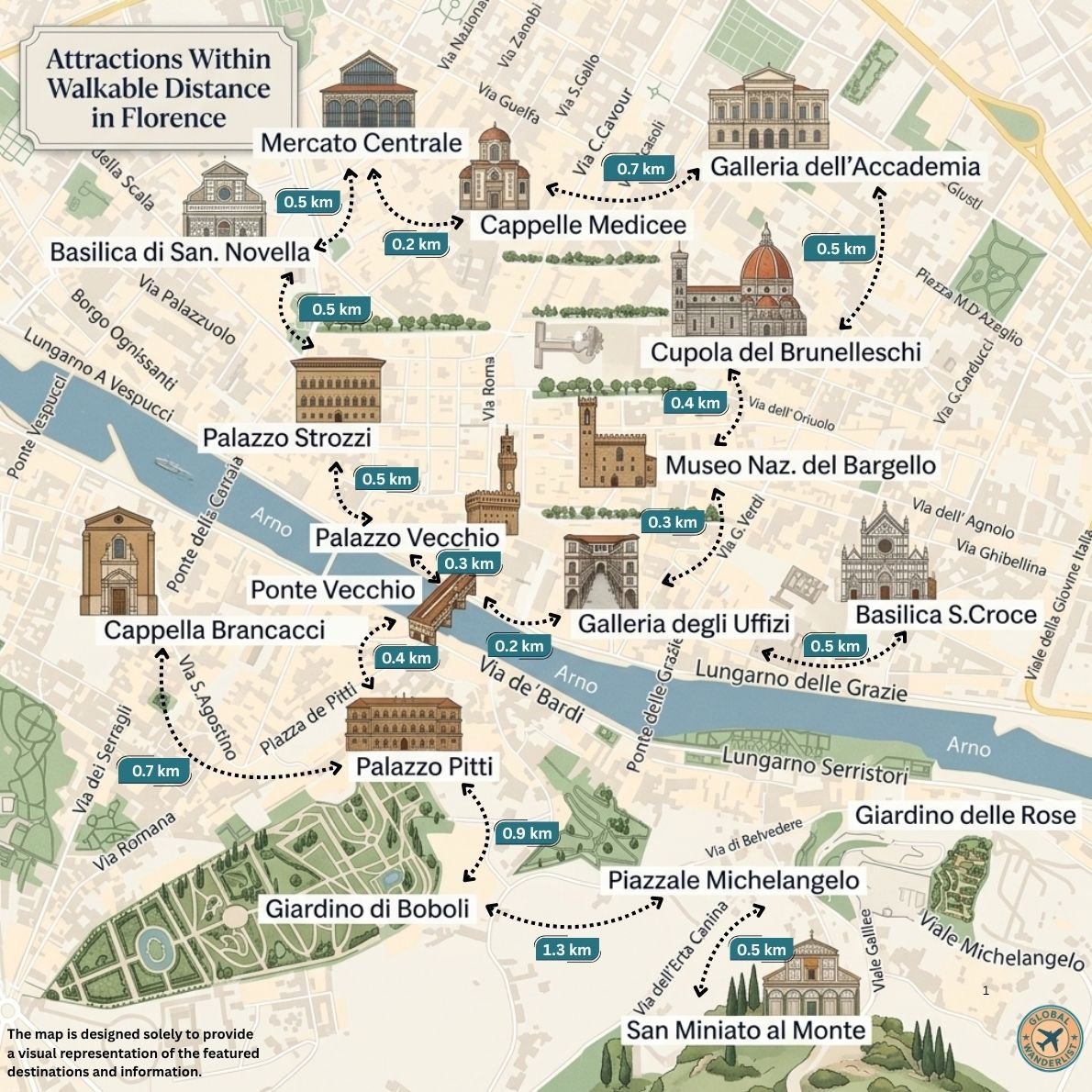
Florence concentrates more Renaissance art and architecture into its historic center than almost anywhere else on earth. Domed cathedrals, Medici palaces, and world-famous galleries sit within a short walk of each other along the Arno River. Few cities let you move between so many masterpieces without needing transit at all.
This guide moves through Florence’s most rewarding sights, nearly all connected by short, walkable distances. It suits art lovers, history enthusiasts, and first-time visitors wanting a thorough, unhurried introduction to the city. Comfortable shoes and advance museum bookings make the biggest difference here, given the crowds these landmarks draw year-round.
Florence Attractions Summary Table
| Attraction | Category | Opening Hours | Entry Ticket |
|---|---|---|---|
| Mercato Centrale | Food market | Check the official website for the latest timings | Free to enter |
| Galleria dell’Accademia | Museum | Tue-Sun 8:15 am-6:50 pm, closed Mondays | €16 full price |
| Basilica di Santa Maria Novella | Church | Check the official website for the latest timings | Check the official website for the latest price |
| Cappelle Medicee | Museum | Tue-Sun 8:15 am-6:50 pm, closed Mondays | Check the official website for the latest price |
| Cupola del Brunelleschi | Dome and monument | Check the official website for the latest timings | Check the official website for the latest price |
| Palazzo Strozzi | Palace and exhibition space | Check the official website for the latest timings | Check the official website for the latest price |
| Museo Nazionale del Bargello | Museum | Check the official website for the latest timings | Check the official website for the latest price |
| Palazzo Vecchio | Palace and museum | Check the official website for the latest timings | From €8.00 |
| Ponte Vecchio | Historic bridge | Always accessible | Free |
| Galleria degli Uffizi | Museum | Tue-Sun 8:15 am-6:30 pm, closed Mondays | €25 high season, €12 low season |
| Basilica di Santa Croce | Basilica | Check the official website for the latest timings | Check the official website for the latest price |
| Cappella Brancacci | Chapel and frescoes | Check the official website for the latest timings | Check the official website for the latest price |
| Palazzo Pitti | Palace and museums | Check the official website for the latest timings | Check the official website for the latest price |
| Giardino delle Rose | Public garden | Daily, seasonal hours | Free |
| Giardino di Boboli | Garden | Check the official website for the latest timings | Check the official website for the latest price |
| Piazzale Michelangelo | Viewpoint | Always accessible | Free |
| San Miniato al Monte | Basilica | Check the official website for the latest timings | Free |
Mercato Centrale
This bustling covered market has served Florence since 1874, housed in an elegant iron-and-glass structure designed by Giuseppe Mengoni. The ground floor sells fresh produce, meat, and cheese, while the upper level holds a lively food hall with vendors serving regional specialties. It offers a genuine taste of daily Florentine life alongside quick, casual meals.
The market makes a natural starting point for exploring the nearby San Lorenzo district. Weekday mornings offer the most authentic, less touristy atmosphere among the produce stalls.
- Entry Ticket: Free to enter and browse.
- Opening Hours: Check the official website for the latest timings.
Galleria dell’Accademia
This museum holds Michelangelo’s David, one of the most recognized sculptures in the world, alongside his unfinished Prigioni figures. Founded in 1784 as a teaching collection for art students, the gallery remains compact but consistently ranks among Florence’s most visited sites. Beyond David, paintings by Botticelli and Ghirlandaio line rooms that many visitors walk past too quickly.
Booking a timed entry well in advance is essential, since tickets for popular morning slots sell out weeks ahead in high season. Allow 60 to 90 minutes for a proper visit.
- Entry Ticket: €16 for a full-price ticket, plus a booking fee for reserved entry.
- Opening Hours: Tuesday to Sunday, 8:15 am to 6:50 pm, closed Mondays.
Basilica di Santa Maria Novella
This Gothic church anchors the piazza of the same name, its green-and-white marble facade considered one of the finest examples of Florentine Renaissance design. Inside, frescoes by Masaccio and Ghirlandaio decorate the walls, including the celebrated Holy Trinity, an early masterwork of linear perspective. The adjoining cloisters add a quieter, contemplative space beyond the main nave.
The church sits directly across from Florence’s main train station, making it a natural first or last stop on a visit. Its historic pharmacy nearby, still selling herbal products, is worth a quick detour.
- Entry Ticket: Check the official website for the latest price.
- Opening Hours: Check the official website for the latest timings.
Cappelle Medicee
This museum houses the funerary chapels built for the Medici family, including Michelangelo’s New Sacristy and the opulent, marble-encrusted Chapel of the Princes. Members of the Medici dynasty are buried here, reflecting the family’s enormous wealth and influence over Florence for centuries. The New Sacristy’s sculptural tombs rank among Michelangelo’s most significant architectural achievements.
Access to the chapels is through the Basilica of San Lorenzo complex, though ticketing is separate. Plan around 45 minutes to an hour for a thorough visit.
- Entry Ticket: Check the official website for the latest price.
- Opening Hours: Tuesday to Sunday, 8:15 am to 6:50 pm, closed Mondays.
Cupola del Brunelleschi
Brunelleschi’s dome remains one of the great engineering achievements of the Renaissance, completed in 1436 without the use of traditional wooden scaffolding. Climbing the 463 steps to the top rewards visitors with close-up views of Vasari’s fresco of the Last Judgment before opening onto a panoramic terrace. The dome’s twin-shell construction was revolutionary for its time and remains the largest brick dome ever built.
Reservations are mandatory and often book out days or weeks ahead, especially during summer. The climb is narrow and physically demanding, so it isn’t well suited for those with mobility concerns.
- Entry Ticket: Check the official website for the latest price.
- Opening Hours: Check the official website for the latest timings.
Palazzo Strozzi
This imposing Renaissance palace, built for the wealthy Strozzi family in the late 15th century, now serves as one of Florence’s leading contemporary and modern art exhibition spaces. Its rusticated stone facade and central courtyard reflect the grandeur that wealthy Florentine families once competed to display. Exhibitions rotate regularly, ranging from Renaissance masters to contemporary installations.
Because programming changes throughout the year, checking current exhibitions before visiting helps set expectations. The courtyard itself is often free to enter even without an exhibition ticket.
- Entry Ticket: Check the official website for the latest price.
- Opening Hours: Check the official website for the latest timings.
Museo Nazionale del Bargello
Housed in a former medieval fortress and prison, this museum holds one of Italy’s finest collections of Renaissance sculpture. Donatello’s bronze David and Michelangelo’s youthful Bacchus are among the standout works on display. The building’s austere, fortress-like architecture adds historical weight to the collection inside.
This museum recently joined a unified institution alongside the Accademia Gallery, creating new combined ticket options for visitors planning to see both. It draws noticeably fewer crowds than the Uffizi or Accademia despite its significant collection.
- Entry Ticket: Check the official website for the latest price.
- Opening Hours: Check the official website for the latest timings.
Palazzo Vecchio
This fortified palace has served as the seat of Florence’s government for over seven centuries, its crenellated tower still dominating the city skyline. Inside, richly decorated rooms display works by Vasari, Bronzino, and Donatello, including his bronze Judith and Holofernes. The building’s Arnolfo Tower offers sweeping views over the city for visitors willing to climb its narrow stairs.
Because the palace still functions as Florence’s city hall, occasional closures occur around civic events. Booking the tower climb separately from the main museum ticket is required.
- Entry Ticket: From €8.00 for the main museum, per the official Florence civic museums ticketing system.
- Opening Hours: Check the official website for the latest timings.
Ponte Vecchio
This medieval bridge, lined with jewelry shops since the 16th century, spans the Arno River at the heart of the city. It survived World War II bombing that destroyed Florence’s other bridges, reportedly spared on direct order due to its historic significance. The elevated Vasari Corridor, once used privately by the Medici family, runs above the shops connecting the Uffizi to Palazzo Pitti.
Early morning offers the best light and fewest crowds for photographing the bridge. Sunset views from the neighboring bridges looking toward Ponte Vecchio are especially popular with photographers.
- Entry Ticket: Free.
- Opening Hours: Always accessible as a public bridge.
Galleria degli Uffizi
This world-renowned museum holds one of the most significant collections of Renaissance painting anywhere, including works by Botticelli, Leonardo da Vinci, and Raphael. Originally built in the 1560s as government offices for the Tuscan state, the building was converted into a gallery under the Medici family. Its long corridors and grand halls now guide visitors through centuries of art history in roughly chronological order.
Booking well ahead is essential, since walk-up tickets often mean hours of waiting during peak season. Prices shift seasonally, with high season running considerably more than the winter months.
- Entry Ticket: €25 full price during high season (March through November), €12 during low season (November through February).
- Opening Hours: Tuesday to Sunday, 8:15 am to 6:30 pm, closed Mondays.
Basilica di Santa Croce
This vast Franciscan basilica serves as the final resting place for numerous notable Italians, including Michelangelo, Galileo, and Machiavelli. Its Gothic interior holds significant fresco cycles, while the adjoining Pazzi Chapel showcases Brunelleschi’s mastery of Renaissance architectural harmony. The basilica’s scale and artistic significance have earned it the nickname “Temple of the Italian Glories.”
The leather school located within the complex offers a unique, lesser-known stop for visitors interested in traditional craftsmanship. Plan at least an hour to see the main basilica and its side chapels properly.
- Entry Ticket: Check the official website for the latest price.
- Opening Hours: Check the official website for the latest timings.
Cappella Brancacci
This small chapel inside the Church of Santa Maria del Carmine holds a fresco cycle considered a turning point in Renaissance painting, largely the work of Masaccio. His use of perspective and naturalistic human figures influenced generations of later artists, including Michelangelo, who reportedly studied the frescoes directly. The chapel’s relatively small scale makes for an intimate, focused viewing experience compared to larger museums.
Visitor numbers are limited at any given time to protect the fragile frescoes, so booking ahead is recommended. The chapel sits across the Arno in the Oltrarno district, slightly off the more crowded tourist path.
- Entry Ticket: Check the official website for the latest price.
- Opening Hours: Check the official website for the latest timings.
Palazzo Pitti
Originally built for a rival Florentine banking family before the Medici acquired it, this vast palace became the primary Medici residence after their move across the river. Today it houses several museums, including the Palatine Gallery’s collection of Raphael and Titian paintings, along with royal apartments and a costume museum. Its scale reflects the immense wealth and political ambition of the families who called it home.
A combined ticket often covers the palace museums alongside the adjoining Boboli Gardens, making it efficient to see both in one visit. Allow at least two to three hours to explore the palace’s various collections.
- Entry Ticket: Check the official website for the latest price.
- Opening Hours: Check the official website for the latest timings.
Giardino delle Rose
This small, peaceful garden sits just below Piazzale Michelangelo, offering a quieter alternative to the busier viewpoint above. Roses bloom here from May through June, though the terraced garden remains a pleasant walk throughout the growing season. A collection of contemporary sculptures adds an unexpected artistic element among the plantings.
The garden provides good partial views over the city without the crowds found at the main piazzale nearby. It works well as a quieter stop on the walk up toward San Miniato al Monte.
- Entry Ticket: Free.
- Opening Hours: Open daily with seasonal variations.
Giardino di Boboli
These expansive formal gardens behind Palazzo Pitti were laid out for the Medici family starting in the 1550s, setting a template for grand European garden design that followed. Sculpted hedges, fountains, and classical statues fill the grounds, along with sweeping views back toward the city. The gardens offer a relaxed, green escape after a morning of dense museum visits.
Comfortable shoes help given the garden’s hilly terrain and gravel paths. A combined ticket with Palazzo Pitti offers better value for those planning to see both.
- Entry Ticket: Check the official website for the latest price.
- Opening Hours: Check the official website for the latest timings.
Piazzale Michelangelo
This elevated viewpoint offers the single best panoramic view over Florence, framing the Duomo, Palazzo Vecchio, and the Arno River in one sweeping vista. A bronze replica of Michelangelo’s David stands at the center of the square, added in the 19th century. Sunset draws the largest crowds, though the view remains rewarding at any time of day.
The walk up from the city center takes about twenty to thirty minutes, or a short bus ride covers the same distance. Arriving early evening secures a good spot before the busiest sunset crowds gather.
- Entry Ticket: Free.
- Opening Hours: Always accessible as a public viewpoint.
San Miniato al Monte
This Romanesque basilica sits on a hilltop above Piazzale Michelangelo, considered by many to be one of the finest examples of Romanesque architecture in all of Tuscany. Its green-and-white marble facade predates Santa Maria Novella’s similar style, dating back to the 11th century. Benedictine monks still maintain the church today, and their occasional chanting adds a genuinely peaceful atmosphere.
The climb up from Piazzale Michelangelo takes only a few extra minutes but sees far fewer visitors than the viewpoint below. Evening visits sometimes coincide with Gregorian chant services, worth checking before your visit.
- Entry Ticket: Free.
- Opening Hours: Check the official website for the latest timings.
Practical Travel Advice
Most of these attractions cluster within a walkable radius of the Duomo, so a few focused days can realistically cover the entire list. Booking ahead is essential for the Uffizi, Accademia, and the Duomo’s dome climb, since all three regularly sell out during peak season. Comfortable shoes matter throughout, given the cobblestone streets and the uphill walk toward Piazzale Michelangelo.
Spring and fall offer the most comfortable temperatures for extended walking days. Many churches, including Santa Croce and San Miniato al Monte, require covered shoulders for entry. Prices and hours at ticketed sites shift seasonally, so confirming details on official websites before visiting helps avoid surprises.
Final Thoughts
Florence rewards travelers willing to move slowly between its churches, palaces, and galleries. This route covers the city’s essential character without requiring transit between stops. Take your time exploring, and this compact, walkable center will reveal far more depth than any single landmark could on its own.