
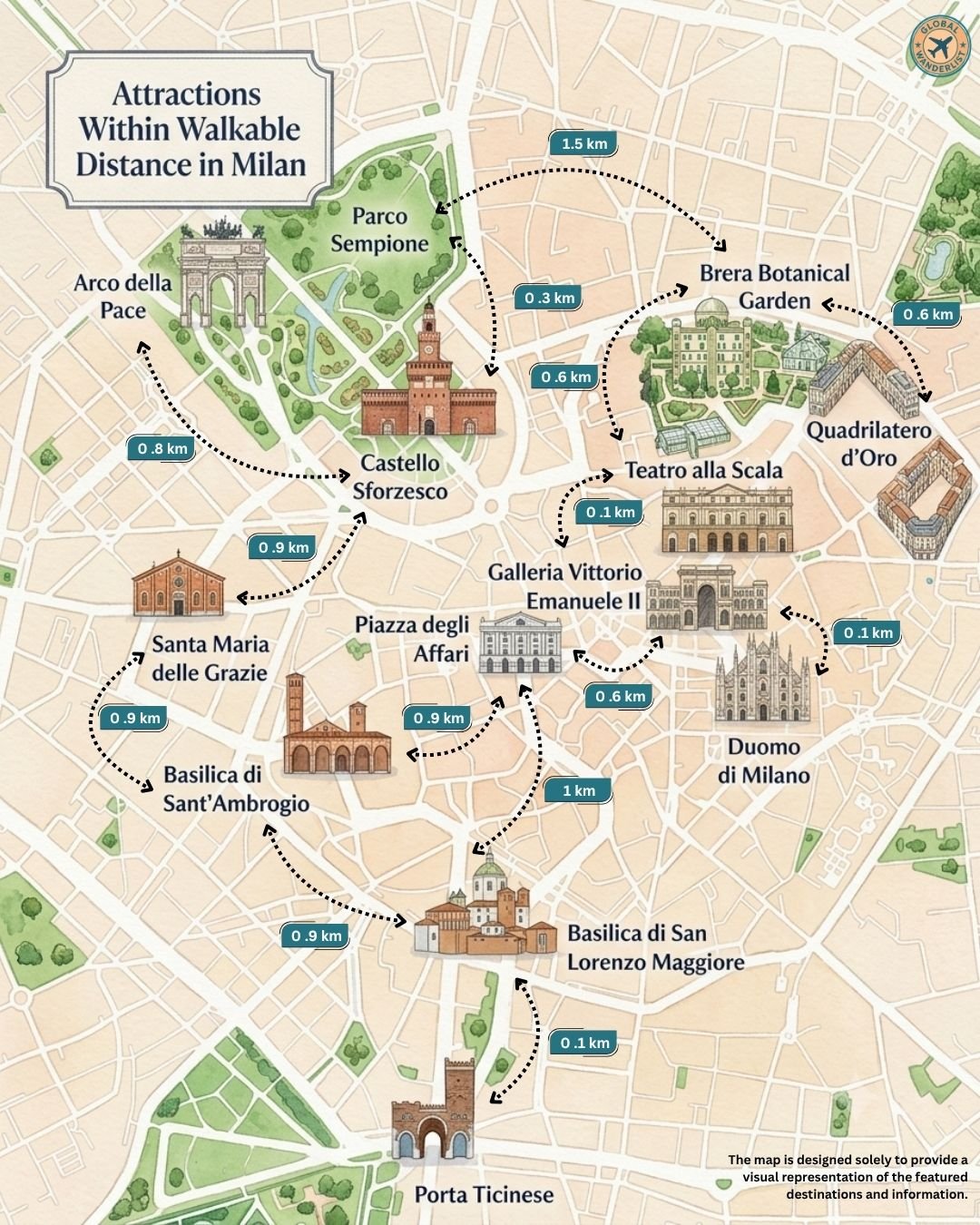
Milan blends centuries of history with sleek, modern energy in a remarkably compact city center. Gothic cathedrals sit steps from Renaissance castles, and quiet botanical gardens hide behind bustling shopping streets. Few cities let you move between such different eras and atmospheres on foot alone.
This guide moves through Milan’s most rewarding sights, nearly all connected by short, walkable distances. It suits first-time visitors, art lovers, and travelers wanting a thorough introduction without relying on taxis or transit. Comfortable shoes and a flexible itinerary make the most of this dense, layered city center.
Milan Attractions Summary Table
| Attraction | Category | Opening Hours | Entry Ticket |
|---|---|---|---|
| Parco Sempione | Public park | Daily, seasonal hours | Free |
| Arco della Pace | Historic monument | Always accessible | Free |
| Brera Botanical Garden | Garden | Mon-Sat, Apr-Oct 10:00 am-6:00 pm, Nov-Mar 9:30 am-4:30 pm | Free |
| Castello Sforzesco | Castle and museums | Museums Tue-Sun 10:00 am-5:30 pm, closed Mondays | €5 museums, courtyards free |
| Quadrilatero d’Oro | Shopping district | Shops follow individual hours | Free to walk |
| Teatro alla Scala | Opera house and museum | Check the official website for the latest timings | Check the official website for the latest price |
| Santa Maria delle Grazie (Last Supper) | Church and mural | Reservation-based time slots | Check the official website for the latest price |
| Galleria Vittorio Emanuele II | Shopping arcade | Always open | Free to walk |
| Piazza degli Affari | Public square | Always accessible | Free |
| Duomo di Milano | Cathedral | Check the official website for the latest timings | Check the official website for the latest price |
| Basilica di Sant’Ambrogio | Basilica | Mon-Sat 10:00 am-12:00 pm, 2:30-6:00 pm, Sun 3:00-5:00 pm | Free |
| Basilica di San Lorenzo Maggiore | Basilica | Daily, morning and afternoon hours | Free |
| Porta Ticinese | Historic gate | Always accessible | Free |
Parco Sempione
This large public park sits directly behind Castello Sforzesco, offering a green escape from the city’s busy streets. Landscaped in the English garden style during the late 19th century, the park includes ponds, tree-lined paths, and open lawns. Its central location makes it a natural stop between the castle and the nearby Arco della Pace.
Locals use the park for jogging, picnics, and weekend relaxation throughout the year. The park connects easily to several other attractions on this list within a short walk.
- Entry Ticket: Free.
- Opening Hours: Open daily with seasonal variations; generally early morning through evening.
Arco della Pace
This triumphal arch anchors the northwestern edge of Parco Sempione, commissioned under Napoleon and completed under Austrian rule in 1838. Its design echoes Rome’s classical triumphal arches, topped with a bronze sculpture of a chariot drawn by six horses. The monument originally celebrated peace following the Napoleonic Wars, a theme reflected in its name.
The surrounding piazza makes a pleasant stop for photography, especially in the late afternoon when light catches the arch’s white marble. It sits within easy walking distance of both the park and Castello Sforzesco.
- Entry Ticket: Free.
- Opening Hours: Always accessible as a public monument.
Brera Botanical Garden
Tucked behind the Pinacoteca di Brera, this historic garden offers a quiet, little-known escape in the heart of the city. Empress Maria Theresa of Austria founded the garden in 1775, originally developed from a vegetable plot tended by Jesuit fathers. Today it houses centuries-old trees, seasonal flower beds, and a peaceful atmosphere rarely found this close to Milan’s busiest streets.
The garden works well as a relaxed midday break between the Brera district’s galleries and boutiques. Its small size makes it easy to fit into a broader walking route through the neighborhood.
- Entry Ticket: Free.
- Opening Hours: Monday to Saturday, April through October 10:00 am to 6:00 pm, November through March 9:30 am to 4:30 pm, closed Sundays.
Castello Sforzesco
This massive Renaissance fortress has watched over the city since the Sforza family rebuilt it in the 15th century atop an earlier Visconti stronghold. The castle now houses several city museums, including collections of sculpture, decorative arts, and Egyptian antiquities. Michelangelo’s final, unfinished sculpture, the Rondanini Pietà, is displayed here in a dedicated space.
The castle’s courtyards remain free to explore even without a museum ticket, making it accessible for a quick visit. Allow at least two hours to properly see the museum collections inside.
- Entry Ticket: €5 full price, €3 reduced, for all museums with a single ticket; courtyards are free.
- Opening Hours: Museums open Tuesday to Sunday 10:00 am to 5:30 pm, closed Mondays; courtyards open daily 7:00 am to 7:30 pm.
Quadrilatero d’Oro
Milan’s famous fashion quarter holds flagship stores from many of Italy’s most recognized luxury brands. Elegant 19th-century buildings line streets like Via Montenapoleone, creating an upscale, polished atmosphere distinct from the rest of the city. Even travelers not planning to shop find the architecture and window displays worth a slow walk.
The district sits within easy reach of both the Duomo and Brera, making it simple to combine with other stops. Weekday mornings offer a quieter, less crowded version of the area.
- Entry Ticket: Free to walk; individual store purchases vary.
- Opening Hours: Shops generally follow standard Italian retail hours, though this varies by store.
Teatro alla Scala
This legendary opera house has anchored Milan’s cultural life since opening in 1778, hosting premieres by composers including Verdi and Puccini. Its ornate auditorium and gilded boxes reflect the grandeur expected of one of the world’s most prestigious opera venues. A small museum adjacent to the theater displays instruments, costumes, and memorabilia from centuries of performances.
Guided museum visits typically allow a glimpse into the auditorium itself when rehearsals are not underway. Attending an actual performance requires booking well in advance, given the theater’s international reputation.
- Entry Ticket: Check the official website for the latest price.
- Opening Hours: Check the official website for the latest timings.
Santa Maria delle Grazie
This Dominican church holds one of the most famous paintings in the world, Leonardo da Vinci’s Last Supper, painted directly onto the refectory wall. The mural has survived over five centuries despite deterioration and wartime bombing damage nearby. Viewing slots are tightly controlled to protect the fragile painting, with visitors admitted in small groups for a strictly timed viewing.
Booking well in advance is essential, since tickets frequently sell out weeks ahead during peak season. The church itself, a UNESCO World Heritage Site alongside the mural, is worth a slower look beyond the famous painting.
- Entry Ticket: Check the official website for the latest price.
- Opening Hours: Viewing is by reserved time slot only; check the official website for the latest timings.
Galleria Vittorio Emanuele II
This stunning glass-domed shopping arcade connects Piazza del Duomo to Teatro alla Scala, ranking among the oldest shopping malls in the world. Elegant mosaic floors and iron-and-glass architecture create a grand, almost cathedral-like atmosphere for browsing high-end boutiques. Local tradition holds that spinning on the mosaic bull beneath the dome brings good luck.
The arcade makes a natural connector between the Duomo and other central attractions, sheltered from weather year-round. Its historic cafés offer a classic, if pricier, spot for a coffee break.
- Entry Ticket: Free to walk through.
- Opening Hours: Always open, though individual shops follow their own hours.
Piazza degli Affari
This square serves as Milan’s financial heart, home to the Italian Stock Exchange building. A striking sculpture by artist Maurizio Cattelan, depicting a giant marble middle finger, stands prominently in front of the exchange, sparking ongoing debate since its installation. The square’s stark, modern character contrasts with the historic architecture found elsewhere in the city center.
It makes a quick, curious stop for those interested in contemporary public art. The piazza sits within a short walk of both Piazza del Duomo and the Quadrilatero d’Oro.
- Entry Ticket: Free.
- Opening Hours: Always accessible as a public square.
Duomo di Milano
This vast Gothic cathedral took nearly six centuries to complete, and its marble facade remains one of the most recognizable landmarks in Italy. Thousands of statues and spires decorate the exterior, while rooftop terraces offer close-up views of the architecture along with sweeping views over the city. The cathedral’s scale and ornamentation reflect Milan’s historic wealth and continued civic pride.
Multiple ticket types cover different combinations of the cathedral, rooftop terraces, archaeological area, and museum, so reviewing current options before purchasing helps avoid overpaying. Visiting early morning on a weekday offers the calmest experience.
- Entry Ticket: Check the official website for the latest price.
- Opening Hours: Check the official website for the latest timings.
Basilica di Sant’Ambrogio
One of Milan’s oldest churches, this basilica was commissioned by Saint Ambrose himself in the late 4th century. Its current Romanesque form dates largely from the 11th and 12th centuries, having become a model for churches built across the region afterward. The crypt holds the remains of Saint Ambrose alongside two other early martyrs, displayed in ceremonial vestments.
Entry to the basilica itself is free, though the adjoining Sacello di San Vittore and treasury may involve a small separate contribution. Sunday guided tours offer additional insight into the basilica’s history and artwork.
- Entry Ticket: Free.
- Opening Hours: Monday to Saturday 10:00 am to 12:00 pm and 2:30 pm to 6:00 pm, Sunday 3:00 pm to 5:00 pm.
Basilica di San Lorenzo Maggiore
Milan’s oldest church traces its origins to the late 4th century, built during the city’s era as capital of the Western Roman Empire. Sixteen ancient Corinthian columns stand in front of the basilica, salvaged from earlier Roman structures and now a popular local gathering spot known simply as “le colonne.” The domed interior reflects a rare, centrally planned design unusual for churches of this age.
The adjoining Chapel of Sant’Aquilino holds notable early Christian mosaics worth a slower look. The surrounding piazza stays lively into the evening, particularly among younger locals gathering near the columns.
- Entry Ticket: Free entry to the basilica.
- Opening Hours: Generally open daily with morning and afternoon hours, though times may shift around religious services.
Porta Ticinese
This medieval gate marks a historic entrance to Milan’s old city walls, standing at the edge of the lively Navigli canal district. The current structure dates from the 19th century, replacing earlier medieval gates that once controlled traffic into the city. Its neoclassical design features columns and a triumphal arch style similar to other Milanese gates.
The surrounding area has become one of Milan’s liveliest nightlife districts, especially along the nearby canals. It sits within easy walking distance of Basilica di San Lorenzo Maggiore, making the two a natural pair.
- Entry Ticket: Free.
- Opening Hours: Always accessible as a public monument.
Practical Travel Advice
Most of these attractions cluster within a walkable radius of Piazza del Duomo, so a single day can realistically cover several stops. Booking ahead is essential for the Last Supper at Santa Maria delle Grazie, since tickets sell out weeks in advance during busy periods. Comfortable shoes matter throughout, given the amount of cobblestone streets and museum walking involved.
Spring and fall offer the most comfortable temperatures for walking between attractions. Many churches, including Sant’Ambrogio and the Duomo, require covered shoulders for entry. Prices and hours at ticketed sites change seasonally, so confirming details on official websites before visiting helps avoid surprises.
Final Thoughts
Milan rewards travelers willing to walk between its historic churches, quiet gardens, and grand piazzas. This route covers the city’s essential character without requiring transit between stops. Take your time exploring, and this compact center will reveal far more depth than its reputation for fashion alone suggests.