
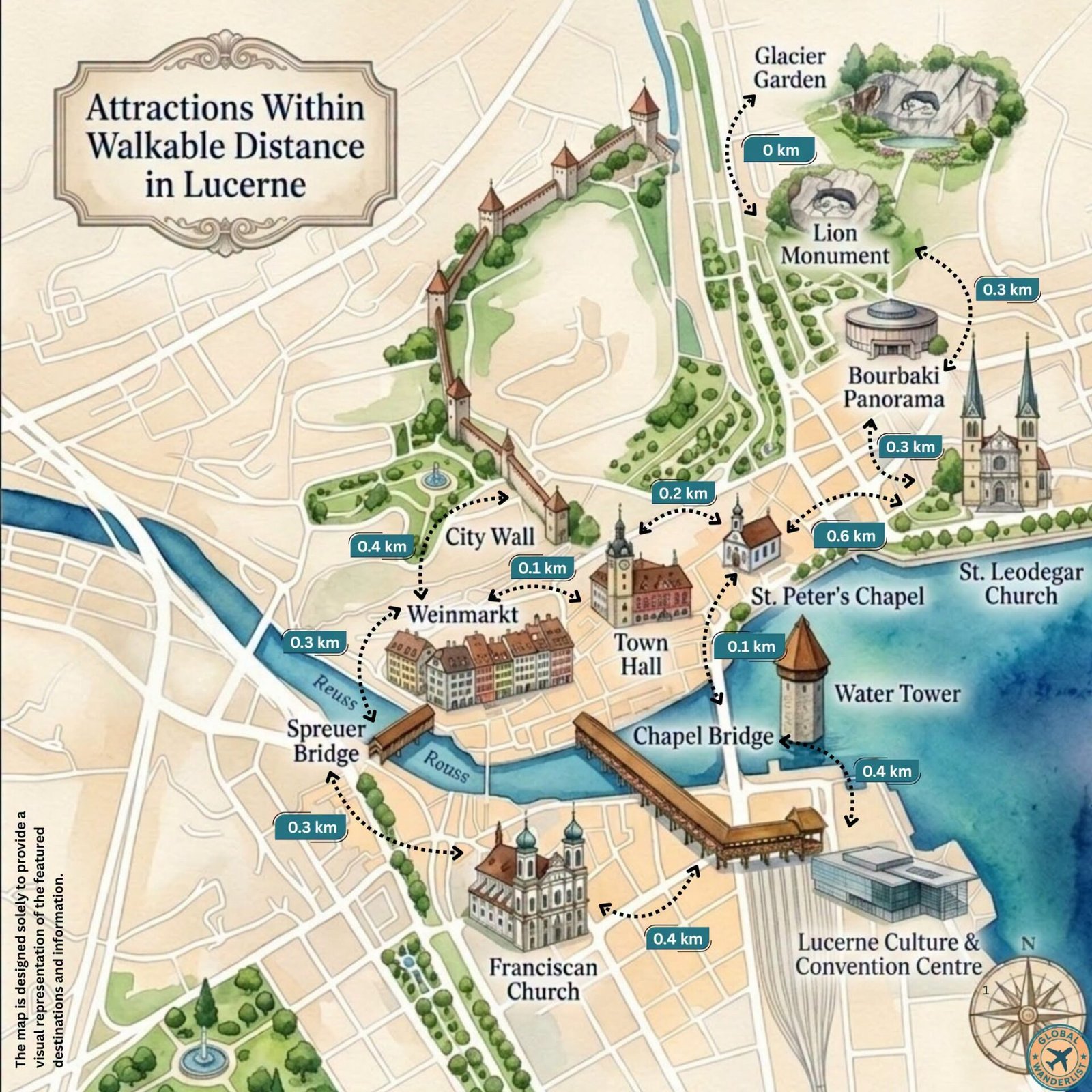
Lucerne packs an impressive number of sights into a small, walkable old town. Medieval towers, wooden bridges, and quiet chapels all sit within a few hundred meters of each other. You can cover most of this list in a single day on foot, moving from the Lion Monument down through the historic center to the lake. This guide walks through each stop, with current opening hours and entry fees pulled from official sources. Whether you have a few hours or a full day, this route covers Lucerne’s best-known landmarks without needing a car or bus.
Glacier Garden
The Glacier Garden sits just beside the Lion Monument, and it tells a very different story about Lucerne’s past. Deep potholes here formed during the last Ice Age, carved out by glacial meltwater over thousands of years. The site also holds fossilized shells and palm leaves from a time when subtropical seas covered this region. A mirror maze from 1896 adds a playful, slightly odd contrast to the geology on display. Inside the museum, a large relief map shows Switzerland’s mountains in remarkable detail. Most visitors spend about an hour here, walking between the potholes, the maze, and the small museum before heading toward the Lion Monument next door.
- Opening hours: Daily, 10am to 6pm (April to October); 10am to 5pm (November to March)
- Entry fee: CHF 15 for adults
Lion Monument
Mark Twain once called this the most moving piece of stone in the world, and many visitors still agree. Carved directly into a sandstone cliff face, the dying lion commemorates Swiss Guards killed defending the French king in 1792. Danish sculptor Bertel Thorvaldsen designed the monument, and Lucerne craftsman Lukas Ahorn carved it into the rock. A small reflecting pond sits in front, adding to the quiet, somber mood of the site. The monument sits inside a small public park just a short walk from the Glacier Garden and Bourbaki Panorama, making it easy to combine with both stops in one visit.
- Opening hours: Open 24 hours, every day of the year
- Entry fee: Free
Bourbaki Panorama
This massive circular painting wraps 112 meters around a dedicated building near the Lion Monument. Painter Edouard Castres finished it in 1881, depicting French soldiers crossing into Switzerland during the Franco-Prussian War. Standing inside the painting’s circle feels genuinely immersive, since the scene surrounds you on every side. The building also houses a small museum with artifacts tied to the war and the soldiers who were interned in Switzerland afterward. A cafe and cultural center share the same space, so you can easily spend an extra hour here beyond just viewing the painting itself.
- Opening hours: Daily, 10am to 6pm (April to October); 10am to 5pm (November to March)
- Entry fee: CHF 12 for adults
St. Leodegar Church
Twin spires mark this church from nearly anywhere in Lucerne, rising above the old town and visible from across the lake. Also known as the Hofkirche, it was rebuilt in the 1630s after fire destroyed the original structure. Inside, an impressive organ with over 7,000 pipes fills the church with sound during regular concerts. Wooden choir stalls and a black marble altar add to the building’s quiet grandeur. The church sits right along the lake promenade, an easy stop as you walk between the old town and the Bourbaki Panorama area.
- Opening hours: Daily, roughly 10am to 12pm and 2pm to 5pm, outside of services
- Entry fee: Free
St. Peter’s Chapel
This tiny chapel claims the title of Lucerne’s oldest church, with roots stretching back to the 12th century. Its name lives on today in the nearby Chapel Bridge, which takes its title directly from this small building. Gothic arches and stone carvings decorate the exterior, while the interior stays simple and calm. The chapel also hosts art exhibitions and community events alongside its regular religious use. Sitting right beside Chapel Bridge, it makes a natural pause point before or after crossing the river.
- Opening hours: Daily, 8:30am to 6:30pm
- Entry fee: Free
Water Tower
This round stone tower rises straight out of the river beside Chapel Bridge, one of the most photographed structures in the city. Built in the 13th century, it has served as a prison, a treasury, and an archive over the centuries. Today it stands as a private space used by a local guild, so visitors can’t go inside. Even from the outside, its thick stone walls and pointed roof capture a real sense of Lucerne’s medieval defenses. Most visitors simply photograph it from the bridge or the riverbank nearby.
- Opening hours: Exterior viewable at any time; interior closed to the public
- Entry fee: Free to view from outside
Chapel Bridge
Chapel Bridge ranks as Lucerne’s most photographed landmark, a covered wooden bridge stretching across the Reuss River. Built in 1333, it counts among the oldest surviving wooden bridges in Europe. Painted panels line the inside of the roof, originally depicting scenes from Swiss history before a 1993 fire destroyed many of them. Restoration work replaced what it could, and walking across still feels like stepping through centuries of local history. The bridge connects directly to St. Peter’s Chapel on one end and the old town’s main square on the other.
- Opening hours: Open 24 hours, every day
- Entry fee: Free
Town Hall
Lucerne’s Town Hall sits right on the river, its Renaissance-style architecture standing out among the surrounding old buildings. Built in the early 1600s, it still houses local government offices today. The building’s steep roof and arched ground floor reflect a style borrowed from Italian architecture of the period. A small museum inside occasionally opens for exhibitions tied to the city’s history. Most visitors admire it from the outside, since the working government offices limit general public access to the interior.
- Opening hours: Exterior viewable at any time; interior access limited to government business hours
- Entry fee: Free to view from outside
Weinmarkt
This small square once served as Lucerne’s wine trading center, and its name still reflects that history. Colorful, frescoed buildings surround the square on nearly every side, some dating back centuries. A central fountain and a small statue add character to the open space. Restaurants and cafes now fill the ground floors of these historic buildings, making it a popular spot to sit and people-watch. Weinmarkt sits just steps from both Chapel Bridge and the Town Hall, an easy addition to any old town walk.
- Opening hours: Open 24 hours, every day
- Entry fee: Free
City Wall
The Museggmauer stretches nearly 900 meters along a ridge above the old town, one of the best-preserved city walls in Switzerland. Built starting in the 13th century, it once held nine watchtowers guarding Lucerne’s northern approach. Four of these towers still open to the public today, including the Zyt Tower, home to one of the oldest working clocks in the region. Walking the wall path rewards you with sweeping views over the old town, the lake, and the mountains beyond. Steep stairs connect each tower, so comfortable shoes matter here.
- Opening hours: Daily, 8am to 7pm, April 1 to November 1 (closed in winter)
- Entry fee: Free
Spreuer Bridge
Spreuer Bridge crosses the Reuss further downstream from Chapel Bridge, carrying far fewer tourists despite its similar age and charm. Built in 1408, it holds a series of painted panels depicting the Dance of Death, a common medieval theme reflecting on mortality. The bridge’s name comes from an old practice of using this crossing point to release river debris, called spreu in German. Its quieter setting makes it a nice contrast to the busier Chapel Bridge nearby. Franciscan Church sits just a short walk from this end of the bridge.
- Opening hours: Open 24 hours, every day
- Entry fee: Free
Franciscan Church
This Gothic church dates back to the 13th century, built as part of a Franciscan monastery that once stood on this site. Inside, a richly carved wooden pulpit and Baroque altars reflect centuries of additions and changes to the original structure. Painted flags on the interior walls commemorate a local military victory over Habsburg knights in 1386, a battle tied closely to early Swiss history. The church sits on its own small square, a quiet contrast to the busier streets nearby. It pairs naturally with a visit to Spreuer Bridge just around the corner.
- Opening hours: Daily, 7:30am to 6pm (please avoid visiting during services)
- Entry fee: Free
Lucerne Culture & Convention Centre
Designed by French architect Jean Nouvel, this modern building sits right on the lakeshore near the train station. Its massive overhanging roof and glass walls create a striking contrast against Lucerne’s older architecture. The concert hall inside is known worldwide for its acoustics, hosting the Lucerne Festival and other major performances throughout the year. Beyond the concert hall, the building also houses an art museum and several restaurants. Visitors can walk through the public foyer and rooftop terraces for free, taking in lake and mountain views without needing a ticket.
- Opening hours: Public foyer and terraces open daily; concert and event times vary by schedule
- Entry fee: Free to enter the foyer and terraces; tickets required for concerts and the art museum
Final Thoughts
Lucerne rewards a slow walk more than a packed schedule. Nearly everything on this list sits within half a kilometer of the next stop, so you can string together a full day without ever needing transport. Start early at the Lion Monument, work your way down through the old town, and finish by the lake at the Culture and Convention Centre. Check opening times before visiting the Musegg Wall towers, since these close for winter between November and April.