
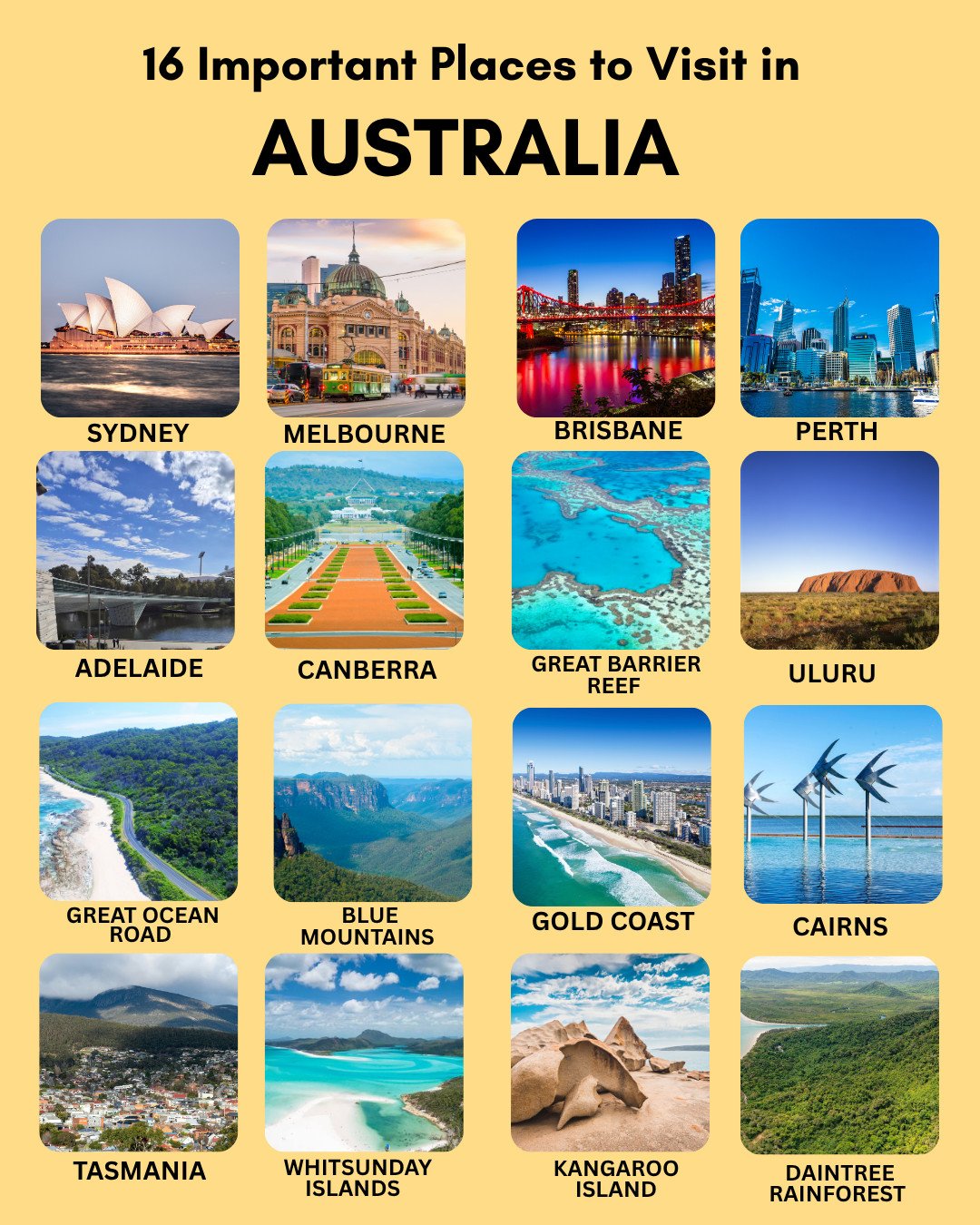
Australia is a country of extremes. It holds the world’s largest living coral reef system, one of its oldest rainforests, a red desert monolith sacred to the world’s oldest continuous culture, and coastal cities that consistently rank among the most livable on the planet. Trying to cover it all in one trip is unrealistic given the distances involved, but knowing which destinations deliver the most memorable experiences makes planning far easier. This list runs through 16 places that define an Australian trip, from major capital cities to natural wonders that draw travelers from every corner of the globe.
Quick Comparison Table
| Place | State or Territory | Known For |
|---|---|---|
| Sydney | New South Wales | Opera House and Harbour Bridge |
| Melbourne | Victoria | Laneway culture and coffee |
| Brisbane | Queensland | Riverside living and South Bank |
| Perth | Western Australia | Kings Park and Swan River |
| Adelaide | South Australia | Wine regions and festivals |
| Canberra | Australian Capital Territory | National monuments and museums |
| Great Barrier Reef | Queensland | World’s largest coral reef system |
| Uluru | Northern Territory | Sacred red desert monolith |
| Great Ocean Road | Victoria | Twelve Apostles coastal drive |
| Blue Mountains | New South Wales | Eucalyptus wilderness near Sydney |
| Gold Coast | Queensland | Beaches and theme parks |
| Cairns | Queensland | Gateway to the reef and rainforest |
| Tasmania | Tasmania | Wild coastlines and food scene |
| Whitsunday Islands | Queensland | Whitehaven Beach |
| Kangaroo Island | South Australia | Concentrated native wildlife |
| Daintree Rainforest | Queensland | World’s oldest tropical rainforest |
Sydney
Sydney is the image most people carry of Australia before they ever set foot in the country, and it rarely disappoints in person. The Opera House and Harbour Bridge anchor a harbor that ranks among the most beautiful in the world, and the city balances that iconic waterfront with beach culture, national parkland, and one of the busiest dining scenes in the Southern Hemisphere.
What to Do in Sydney
Begin at Circular Quay, where you can admire the Opera House’s sail-shaped roofline before walking across the Harbour Bridge for skyline views. The Royal Botanic Garden offers a scenic route toward Mrs Macquarie’s Chair, a favorite photo spot overlooking the harbor. Set aside time for Bondi Beach and the coastal walk toward Coogee, and if your schedule allows a day trip, the Blue Mountains are close enough for a return visit within a single day.
Melbourne
Melbourne consistently competes with Sydney for the title of Australia’s most livable city, and its identity is built around a completely different set of strengths: laneway culture, world-class coffee, and a level of civic investment in art and food that shows up on nearly every street corner. It is the country’s undisputed sporting and cultural capital, hosting everything from the Australian Open to major AFL matches.
What to Do in Melbourne
Wander Hosier Lane and Degraves Street for street art and small-bar culture, then head to Federation Square and Flinders Street Station, both central to the city’s identity. The Queen Victoria Market is Melbourne’s oldest and largest open-air market and worth a slow morning. For a day trip, the Great Ocean Road delivers some of the most scenic coastal driving anywhere in the country.
Brisbane
Brisbane has quietly become one of Australia’s most appealing cities, helped along by its subtropical climate, laid-back riverside lifestyle, and a redevelopment of its South Bank precinct that turned former industrial land into one of the country’s most-loved urban parks. With the city set to host the 2032 Summer Olympics, its skyline and infrastructure are only becoming more visitor-friendly.
What to Do in Brisbane
Spend time at South Bank Parklands, home to Streets Beach, a man-made lagoon beach in the heart of the city, along with the Queensland Art Gallery and Gallery of Modern Art. For a dose of adrenaline, the Story Bridge Adventure Climb takes you 80 meters above the Brisbane River with panoramic views out to the Glass House Mountains. Cap off a visit with an evening at Eagle Street Pier or Howard Smith Wharves, where riverside restaurants and bars look back toward the illuminated skyline.
Perth
Isolated on Australia’s west coast, Perth is one of the most remote major cities on Earth, and that isolation has given it a relaxed, sun-soaked character all its own. The city wraps around the Swan River, with Kings Park offering one of the largest inner-city green spaces in the world and a launching point for day trips to Rottnest Island and the Margaret River wine region.
What to Do in Perth
Walk the Federation Walkway in Kings Park, a glass and steel bridge crossing a canopy of eucalyptus trees with views back over the city skyline. Head to Elizabeth Quay for waterfront dining and a visit to the Bell Tower, then cross the river by ferry to South Perth for a different vantage point of the CBD skyline. Perth is also the gateway to Rottnest Island, a short ferry ride away and home to the famously photogenic quokka.
Adelaide
Adelaide tends to be overlooked in favor of Australia’s bigger cities, which works in its favor for travelers who want a slower pace without sacrificing culture or food. It is the gateway to some of the country’s best wine regions, including the Barossa Valley, and its compact grid layout makes it one of the easiest Australian cities to explore on foot.
What to Do in Adelaide
Walk North Terrace, a tree-lined boulevard lined with Adelaide’s cultural institutions, including Parliament House and the South Australian Museum. Spend a morning browsing the stalls at Adelaide Central Market, one of the largest undercover produce markets in the Southern Hemisphere. From the city, it is an easy day trip out to the Barossa Valley or Adelaide Hills for wine tasting among rolling vineyards.
Canberra
As Australia’s purpose-built capital, Canberra often gets skipped by travelers heading between Sydney and Melbourne, but it holds a concentration of national museums and monuments unmatched anywhere else in the country. Its wide streets and lakeside layout, designed around Lake Burley Griffin, give it a more spacious, planned feel than any other Australian city.
What to Do in Canberra
Visit the Australian War Memorial, one of the most moving tributes to Australian military history anywhere in the country, before crossing to Capital Hill to tour Parliament House, with its grass-covered roof and enormous flagpole. The National Gallery of Australia and National Museum of Australia both reward a few hours of browsing, and a walk or drive up Mount Ainslie at sunset gives a clear view down Anzac Parade to the War Memorial and Parliament House beyond.
Great Barrier Reef
The Great Barrier Reef is the largest coral reef system on the planet, stretching over 2,300 kilometers along the Queensland coast and visible even from space. It supports thousands of species of marine life and remains one of the most requested bucket-list experiences for travelers heading to Australia, whether that means diving, snorkeling, or simply viewing it from a glass-bottom boat.
What to Do at the Great Barrier Reef
Book a day trip from Cairns or Port Douglas out to the outer reef, where operators typically stop at two locations for snorkeling or diving, with equipment and lunch included. Non-swimmers can still experience the reef through semi-submersible vessels or scenic helicopter flights that showcase the reef’s scale and color from above. For a quieter alternative, small coral cays like Green Island offer a mix of rainforest and reef access without the crowds of a full-day boat tour.
Uluru
Uluru is one of the most spiritually significant sites in Australia, sacred to the Anangu people and central to the country’s Indigenous history. Rising dramatically out of the flat red desert of the Northern Territory, its surface shifts color throughout the day, from burnt orange at midday to a deep, glowing red at sunset.
What to Do at Uluru
Watch both sunrise and sunset over the rock, ideally with one viewing paired with a dinner-under-the-stars experience given the exceptionally low light pollution in the surrounding desert. Walk all or part of the Uluru Base Walk, a flat 10.5 kilometer loop that reveals waterholes and rock art invisible from a distance, and stop by the Uluru Cultural Centre to learn about the site’s significance before you explore further. Kata Tjuta, a formation of 36 domed rocks a short drive away, offers an equally striking hike through Walpa Gorge.
Great Ocean Road
The Great Ocean Road is widely regarded as one of the most scenic coastal drives in the world, stretching 243 kilometers along Victoria’s southern coastline. Built by returned World War I soldiers between 1919 and 1932, it is recognized as the world’s largest war memorial as well as a spectacular feat of engineering along a dramatic, shipwreck-strewn coast.
What to Do on the Great Ocean Road
Time your visit to the Twelve Apostles for sunrise or sunset, when the limestone stacks glow against the Southern Ocean and the tour buses have yet to arrive. Walk down the Gibson Steps to sea level for a sense of the cliffs’ true scale, and stop at Loch Ard Gorge for another dramatic formation carved by centuries of coastal erosion. Along the drive, keep an eye out for wild koalas in the tree canopy near the Great Otway National Park.
Blue Mountains
Just a two-hour drive from Sydney, the Blue Mountains take their name from the blue haze created by eucalyptus oil evaporating into the air above the forest canopy. This UNESCO World Heritage wilderness area is one of the most accessible day trips from a major Australian city, offering dramatic cliffside views without requiring an overnight stay.
What to Do in the Blue Mountains
Head to Echo Point in Katoomba for the classic view of the Three Sisters rock formation, then ride the Scenic Railway, the steepest passenger railway in the world, down into the Jamison Valley for a walk through ancient rainforest. The Scenic Skyway cable car offers a gentler way to take in the same valley from above. For a slower pace, the village of Leura offers cafes, gardens, and boutique shopping along its cherry tree-lined main street.
Gold Coast
The Gold Coast is Australia’s classic sun-and-surf destination, stretching roughly 40 kilometers along the Queensland coastline with Surfers Paradise as its high-energy center. Beyond the beaches, the region is home to some of the country’s biggest theme parks, making it a favorite for families as much as sunseekers.
What to Do on the Gold Coast
Spend time on Surfers Paradise Beach before riding the elevator to the SkyPoint Observation Deck on the 77th floor of the Q1 building, the only beachside observation deck in Australia. Thrill-seekers can add the SkyPoint Climb, an external walk around the building’s rooftop edge. Beyond Surfers Paradise, Burleigh Heads offers a quieter, village-like alternative with excellent cafes, and the region’s theme parks, including Movie World and Sea World, are all within easy reach by tram or bus.
Cairns
Cairns serves as the main gateway to both the Great Barrier Reef and the Daintree Rainforest, making it one of the few cities in the world where two UNESCO World Heritage sites sit within an hour of each other. Its relaxed tropical waterfront and free public swimming lagoon give it a distinctly laid-back character compared to Australia’s larger southern cities.
What to Do in Cairns
Take a full-day reef trip out to the outer Great Barrier Reef for snorkeling or diving, then dedicate a second day to Kuranda, a rainforest village reached via the Skyrail Rainforest Cableway, a cable car gliding above the forest canopy, paired with a return journey on the heritage Kuranda Scenic Railway. Back in the city, the Cairns Esplanade offers a free public lagoon and waterfront dining strip that makes for an easy way to unwind between excursions.
Tasmania
Tasmania, Australia’s island state, feels like a different country altogether, with a cooler climate, wilder coastline, and a food and wine scene that has earned a reputation well beyond its small population. Hobart, the state capital, blends colonial architecture with a thriving contemporary art and dining culture, anchored by institutions like MONA, the Museum of Old and New Art.
What to Do in Tasmania
Explore Salamanca Market in Hobart on a Saturday morning, then wander the colonial-era streets of Battery Point nearby. Ride up kunanyi/Mount Wellington for sweeping views over the city and out toward Bruny Island, and take a day trip to Bruny Island itself for dramatic coastal cliffs, fresh oysters, and wildlife-spotting cruises. History enthusiasts should also consider a visit to Port Arthur, one of the most significant convict-era sites in the country.
Whitsunday Islands
The Whitsundays are a collection of 74 islands off the central Queensland coast, set within the Great Barrier Reef Marine Park. They are best known for Whitehaven Beach, whose sand is composed of 98 percent pure silica, giving it an almost luminescent white color that has made it one of the most photographed beaches in the world.
What to Do at the Whitsunday Islands
Take a boat trip from Airlie Beach or Hamilton Island out to Whitehaven Beach, and if possible, walk or take a short boat transfer to the Hill Inlet lookout at the beach’s northern end, where shifting tides create a swirling pattern of white sand and turquoise water. Beyond the beach, the surrounding reef offers excellent snorkeling and sailing, with options ranging from day trips to multi-day catamaran charters through the islands.
Kangaroo Island
Kangaroo Island, off the coast of South Australia, is Australia’s third-largest island and one of the best places in the country to see native wildlife in a genuinely wild setting rather than a zoo enclosure. Kangaroos, koalas, wallabies, and colonies of wild seals share the island with dramatic coastal scenery and a growing reputation for local produce.
What to Do on Kangaroo Island
Visit Seal Bay Conservation Park for a close-up, guided encounter with a colony of wild Australian sea lions, and stop at Flinders Chase National Park to see the wind and wave-sculpted Remarkable Rocks and Admirals Arch. Vivonne Bay, often ranked among Australia’s most beautiful beaches, offers a quieter stretch of coastline with clear water and resident dolphins and seals. Round out a visit with a stop at one of the island’s small producers, known for honey, cheese, and gin distilled from native botanicals.
Daintree Rainforest
The Daintree is believed to be the oldest continuously surviving tropical rainforest on Earth, predating even the Amazon. It sits north of Cairns along Queensland’s coast and is one of the only places on the planet where two UNESCO World Heritage sites, ancient rainforest and coral reef, meet directly at the shoreline.
What to Do in the Daintree Rainforest
Start at Mossman Gorge, where crystal-clear water winds through granite boulders and rainforest, and consider joining a traditional smoking ceremony with the local Kuku Yalanji people for cultural context on the land. Take a wildlife cruise along the Daintree River to spot estuarine crocodiles and native birdlife, then continue north to Cape Tribulation, where the rainforest meets the beach and the Great Barrier Reef lies just offshore. Finish the day with a stop at the Daintree Ice Cream Company, known for scoops made from tropical fruit grown on site.
Final Thoughts
Sixteen destinations across a country the size of Australia is an ambitious list to work through, but each of these places offers something the others do not, from the sacred stillness of Uluru to the coral gardens of the Great Barrier Reef and the laneway energy of Melbourne. Few travelers manage all sixteen in a single trip, and that is part of the appeal: Australia rewards repeat visits, with a new region to explore each time. Whichever combination you choose, you will come away with a clearer sense of just how much variety this one country holds.