France – Must Visit Places

France offers an extraordinary range of experiences within a single country. Snow capped Alps, sun soaked Mediterranean coastline, medieval fortress towns, and world class wine regions all sit within reach of each other. Few destinations pack this much cultural depth and natural beauty into one well connected trip.

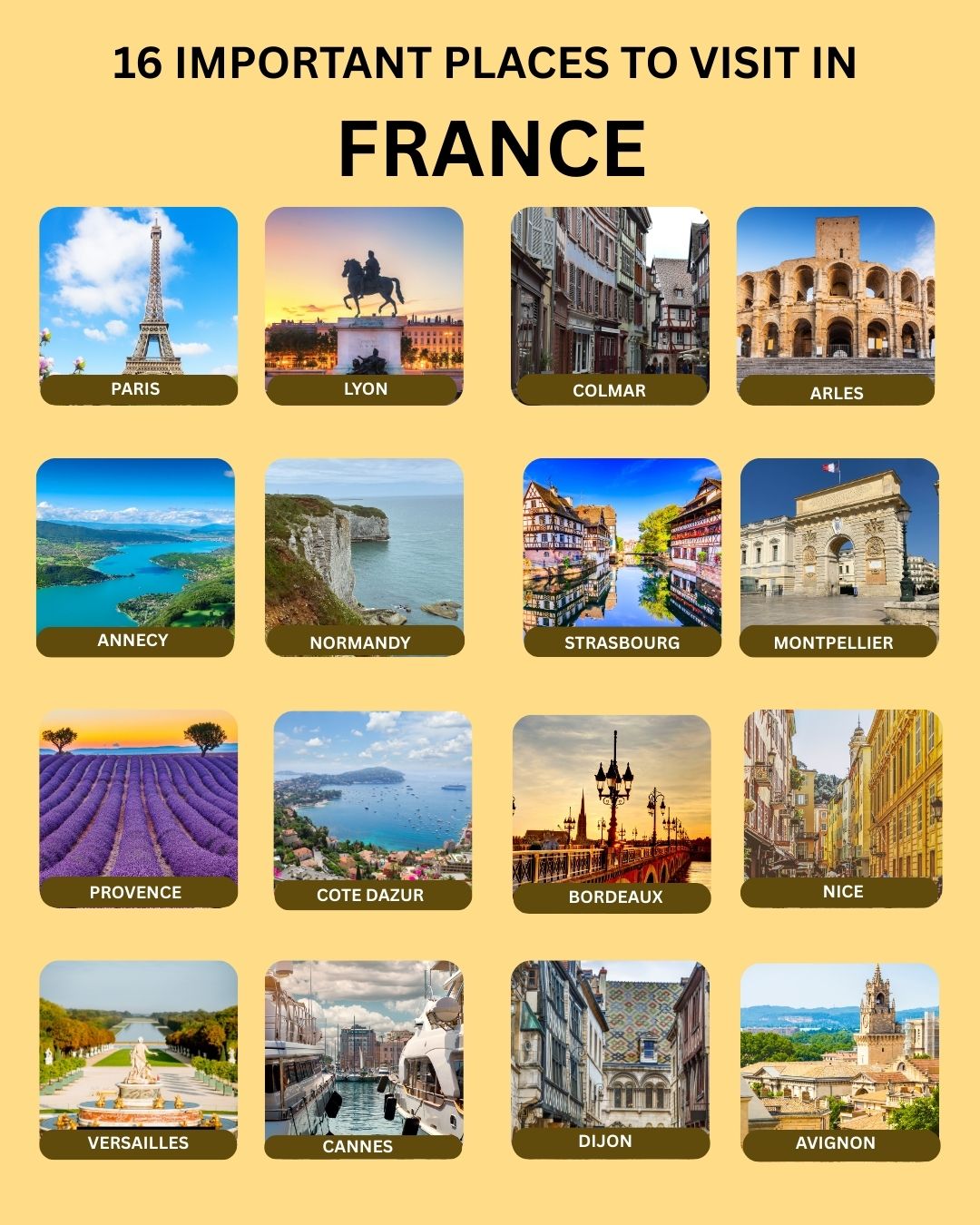
This guide covers 16 of France’s most rewarding destinations, from the boulevards of Paris to the beaches of the Côte d’Azur. Use it to plan a route that fits your interests, whether that means art and history, mountain scenery, or coastal relaxation.

DestinationRegionBest Known ForBest Time to Visit
ParisÎle-de-FranceIconic landmarks, world class museumsApril to June, September to November
LyonAuvergne-Rhône-AlpesCulinary tradition, Renaissance architectureApril to October
ColmarAlsaceHalf timbered houses, canal lined streetsApril to December
ArlesProvenceRoman ruins, Van Gogh’s legacyApril to October
AnnecyAuvergne-Rhône-AlpesAlpine lake, canal filled old townJune to September
NormandyNormandyD-Day history, dramatic coastlineMay to September
StrasbourgAlsaceFranco-German heritage, Christmas marketsMay to December
MontpellierOccitanieMediterranean climate, lively university cultureApril to October
ProvenceProvenceLavender fields, Roman heritageJune to September
Côte d’AzurProvence-Alpes-Côte d’AzurGlamorous coastline, hilltop villagesMay to September
BordeauxNouvelle-AquitaineWorld renowned wine, elegant architectureApril to October
NiceProvence-Alpes-Côte d’AzurPromenade des Anglais, Mediterranean beachesMay to September
VersaillesÎle-de-FranceRoyal palace, formal gardensApril to October
CannesProvence-Alpes-Côte d’AzurFilm festival, luxury harborMay to September
DijonBurgundyMustard heritage, medieval architectureApril to October
AvignonProvencePapal history, medieval fortificationsApril to October

Paris

Paris anchors any French itinerary with centuries of art, architecture, and culinary tradition. The city’s layout, organized into 20 spiraling arrondissements, makes it remarkably walkable for a capital of its size. Its landmarks draw millions of visitors each year, yet quieter neighborhoods still offer a genuine, local pace of life.

What to See in Paris

  • The Eiffel Tower remains France’s most recognizable landmark, best photographed at sunset or with evening lights. Climbing to the top rewards visitors with sweeping views over the entire city.
  • The Louvre houses one of the largest and most significant art collections in the world. Focusing on just a few wings makes a visit far more manageable than trying to see everything.
  • Notre-Dame Cathedral reopened to visitors in December 2024 following extensive restoration after the 2019 fire. Its Gothic architecture remains a defining symbol of the city.
  • Montmartre offers a village like escape atop a hill, crowned by the white domes of Sacré-Cœur. Its winding streets once housed artists like Picasso and Renoir.
  • The Seine River offers a scenic way to see the city from the water, with dinner cruises and daytime boat tours both popular options.
  • The Champs-Élysées stretches from the Arc de Triomphe toward Place de la Concorde, lined with flagship stores and grand architecture.

Lyon

Lyon ranks among France’s most celebrated food cities, sitting at the confluence of the Rhône and Saône rivers. Its old town, Vieux Lyon, preserves an extensive collection of Renaissance architecture largely untouched by wartime destruction. The city’s culinary reputation draws food lovers from around the world.

What to See in Lyon

  • Vieux Lyon features narrow streets and hidden passageways called traboules. Exploring these interconnected corridors reveals a distinctly different side of the city than its main boulevards.
  • The Basilica of Notre-Dame de Fourvière overlooks Lyon from a hilltop, reachable by a short funicular ride. Its views over the city’s rooftops rank among the best in the region.
  • Lyon’s bouchons, traditional local restaurants, serve hearty regional specialties in cozy, informal settings. Trying a bouchon meal is considered essential for understanding the city’s food culture.
  • Presqu’île, the peninsula between Lyon’s two rivers, holds elegant squares, shopping streets, and the city hall. It blends the city’s historic and modern character in one walkable area.
  • The Musée des Confluences showcases science and anthropology exhibits inside a striking modern building. It offers a sharp contrast to the city’s older architecture.

Colmar

Colmar charms visitors with fairytale architecture and canal lined streets in the heart of Alsace. Its blend of French and German influence shows clearly in both its buildings and its cuisine. This small city often ranks among France’s most picturesque, particularly during its popular Christmas markets.

What to See in Colmar

  • Petite Venise, Colmar’s canal district, features colorful half timbered houses reflected in the water. A boat ride through this area offers one of the best ways to see the neighborhood.
  • The old town’s cobblestone streets wind past preserved medieval and Renaissance buildings. Wandering without a fixed plan often leads to the most memorable photo opportunities.
  • Colmar’s Christmas markets, running from late November through December, transform the city into a festive, lantern lit wonderland. Advance planning helps navigate the seasonal crowds.
  • The Unterlinden Museum houses an impressive art collection inside a former convent. Its Isenheim Altarpiece ranks among the most significant works of German Renaissance art.
  • Alsace’s wine route passes near Colmar, offering easy access to nearby vineyards producing the region’s distinctive white wines.

Arles

Arles preserves an exceptionally well kept Roman amphitheater, still used for events today. The town also inspired numerous paintings by Vincent van Gogh during his time living there in the late 1880s. Its position along the Rhône River in Provence adds further historical and scenic depth.

What to See in Arles

  • The Roman amphitheater hosts events to this day, offering a rare chance to experience ancient architecture still in active use. Guided tours explain its nearly 2,000 year history in detail.
  • Van Gogh’s Arles walking trail leads past locations depicted in his famous paintings, including the Café Terrace at Night. Placards throughout the town compare his artwork to the current scene.
  • The Ancient Theatre of Arles sits near the amphitheater, offering another well preserved glimpse into the town’s Roman past. Its remaining columns make for striking photography.
  • Les Alyscamps, a historic Roman necropolis, offers a quieter, tree lined walk away from the town’s busier streets. It has drawn artists and writers for centuries.
  • The Saturday market fills the town with fresh Provençal produce, textiles, and local specialties. It offers an authentic taste of daily life in the region.

Annecy

Annecy combines an alpine lake with a canal filled old town, often compared to Venice. Its clear turquoise water ranks among the cleanest of any lake in Europe. The surrounding mountains add dramatic scenery to what is already one of France’s most photogenic towns.

What to See in Annecy

  • Lake Annecy offers swimming, kayaking, and cycling paths along its shoreline during warmer months. Renting a paddleboard provides a relaxed way to take in the surrounding peaks.
  • The old town’s canals and flower lined bridges create a scene worth wandering slowly, camera in hand. Early morning visits offer the best light and fewest crowds.
  • The Palais de l’Isle, a former prison built directly on the water, has become one of the town’s most photographed landmarks. Its unique island setting makes it stand out even among Annecy’s many scenic spots.
  • Cycling around the lake on the dedicated path offers sweeping mountain views with minimal effort. The full loop takes most of a day, though shorter sections work well too.
  • Nearby mountain trails provide access to panoramic viewpoints over both the lake and town. Even short hikes reward visitors with dramatic alpine scenery.

Normandy

Normandy stretches along France’s northern coast, carrying deep historical weight from World War II alongside charming medieval towns. Its dramatic cliffs and half timbered villages contrast sharply with the region’s somber wartime memorials. Few areas of France combine natural beauty and modern history so directly.

What to See in Normandy

  • The D-Day beaches, including Omaha and Utah Beach, offer moving memorials to Allied forces who landed here in 1944. Several museums throughout the region provide detailed historical context.
  • Mont-Saint-Michel rises dramatically from tidal flats near Normandy’s border with Brittany. Checking tide schedules before visiting helps you plan around the causeway’s flooding patterns.
  • Étretat’s chalk cliffs and natural rock arches have inspired painters for generations, including Claude Monet. Trails along the clifftops offer sweeping coastal views in both directions.
  • Rouen’s medieval old town features half timbered buildings and a Gothic cathedral, once repeatedly painted by Monet. The city also marks the site of Joan of Arc’s execution.
  • Honfleur’s historic harbor remains one of Normandy’s most picturesque, with tall, narrow houses lining the water. A stroll at golden hour captures the town at its most photogenic.

Strasbourg

Strasbourg blends French and German influence more visibly than perhaps any other French city. Its old town, Petite France, features canals and half timbered houses reflecting centuries of shared cultural heritage. The city also serves as an official seat of the European Parliament.

What to See in Strasbourg

  • Petite France’s canal lined streets showcase some of the best preserved half timbered architecture in the region. Boat tours offer a relaxed way to see the neighborhood from the water.
  • Strasbourg Cathedral remains one of the tallest churches built during the medieval period. Climbing its tower rewards visitors with sweeping views over the old town and surrounding countryside.
  • The city’s Christmas markets, among the oldest in France, transform the streets each December. Strasbourg is often called the capital of Christmas for this long standing tradition.
  • The European Parliament building offers guided tours explaining the institution’s role in European governance. It adds a modern, political dimension to an otherwise historic city.
  • Alsace’s wine route extends from Strasbourg, offering easy access to vineyards and storybook villages throughout the surrounding countryside.

Montpellier

Montpellier combines a Mediterranean climate with a lively university atmosphere in southern France. Its historic center blends medieval architecture with a youthful, energetic street life. The city has grown into one of the country’s fastest developing urban centers while retaining its old town charm.

What to See in Montpellier

  • Place de la Comédie serves as the city’s main square, surrounded by cafes and grand 19th century architecture. It remains the natural starting point for exploring the historic center.
  • The Antigone district showcases striking neoclassical inspired architecture built in the 1980s. It offers a distinctive contrast to the city’s older, more traditional neighborhoods.
  • The Jardin des Plantes, France’s oldest botanical garden, provides a peaceful escape near the university district. Its collection reflects centuries of botanical research.
  • Montpellier’s beaches sit just a short tram ride from the city center, offering an easy Mediterranean escape. Palavas-les-Flots is among the most popular nearby options.
  • The city’s vibrant nightlife and student population give it an energetic, youthful atmosphere distinct from many other southern French cities.

Provence

Provence stretches across southeastern France, famous for its lavender fields, Roman ruins, and sun drenched countryside. This region has long inspired artists, including Van Gogh and Cézanne. Its combination of natural beauty and layered history makes it one of France’s most beloved regions.

What to See in Provence

  • Lavender fields bloom in vivid purple from late June through early August, particularly around the Luberon region. Timing a visit around this window adds striking color to any countryside drive.
  • The Pont du Gard, an ancient Roman aqueduct bridge, remains remarkably well preserved after nearly 2,000 years. It offers a detailed look at Roman engineering.
  • Aix-en-Provence charms visitors with its tree lined boulevards and elegant fountains. The city’s connection to painter Paul Cézanne draws art lovers to his former studio.
  • Hilltop villages throughout the Luberon, including Gordes and Roussillon, offer some of the region’s most scenic architecture. Roussillon in particular stands out for its distinctive red ochre buildings.
  • The region’s markets, especially in towns like Isle-sur-la-Sorgue, offer an authentic taste of Provençal produce, textiles, and antiques.

Côte d’Azur

The Côte d’Azur stretches along the Mediterranean coast, encompassing some of France’s most glamorous seaside towns. Villefranche-sur-Mer, Saint-Jean-Cap-Ferrat, and Menton each add distinct character to this stretch of coastline. Its reputation for luxury has drawn artists, celebrities, and travelers for over a century.

What to See in Côte d’Azur

  • Villefranche-sur-Mer offers one of the deepest natural harbors in the Mediterranean, framed by colorful buildings climbing the hillside. It provides a quieter contrast to busier resort towns nearby.
  • Saint-Jean-Cap-Ferrat occupies an exclusive peninsula, home to some of the region’s most impressive villas. Coastal walking paths offer excellent views without requiring entry to any private estate.
  • Menton sits near the Italian border, known for its pastel colored buildings and mild microclimate ideal for growing citrus. The town holds an annual lemon festival each winter.
  • Èze perches dramatically on a clifftop, with a medieval village core and botanical garden offering sweeping coastal views. It makes an easy half day trip from nearby Nice.
  • The Corniche coastal roads connecting several Côte d’Azur towns rank among the most scenic drives in Europe, offering dramatic sea views at nearly every turn.

Bordeaux

Bordeaux anchors southwestern France’s most celebrated wine region, combining elegant 18th century architecture with world renowned vineyards. The city’s riverside setting along the Garonne adds further scenic appeal. Wine lovers from around the globe consider it an essential stop.

What to See in Bordeaux

  • Place de la Bourse reflects the city’s grand 18th century architecture, especially striking when mirrored in the adjacent water feature. It ranks among the most photographed spots in the city.
  • The Cité du Vin museum offers an immersive introduction to wine culture and history from around the world. Its distinctive, swirling architecture stands out along the riverfront.
  • Vineyard tours throughout the Bordeaux region introduce visitors to some of the world’s most prestigious wine estates. Many chateaux require advance booking for tastings.
  • Saint-Émilion, a nearby medieval village surrounded by vineyards, holds UNESCO World Heritage status. Its underground monolithic church is one of the largest of its kind in Europe.
  • Bordeaux’s pedestrian friendly city center makes it easy to explore on foot, with a mix of historic streets and modern tram lines connecting major sights.

Nice

Nice serves as the unofficial capital of the French Riviera, combining a long pebble beach with a lively old town. Its Promenade des Anglais ranks among the most iconic waterfront walkways in Europe. The city’s central location makes it a practical base for exploring the surrounding coastline.

What to See in Nice

  • The Promenade des Anglais stretches along the waterfront, lined with palm trees and grand belle époque architecture. Sunset walks here capture the city at its most scenic.
  • Vieux Nice, the old town, features narrow cobblestone streets and the bustling Cours Saleya flower market. Its Italian influenced architecture reflects the region’s layered history.
  • Castle Hill offers panoramic views over the city and coastline, a popular spot for both sunset and daytime photography. The climb up rewards visitors with one of the best vantage points in the city.
  • The Matisse Museum honors the painter’s deep connection to Nice, where he lived and worked for decades. It offers insight into his later career and artistic evolution.
  • Day trips to Monaco and Èze are easily accessible from Nice by train or car, making the city a convenient base for exploring the wider Riviera.

Versailles

Versailles showcases the extravagance of the French monarchy through its opulent former royal palace. The Hall of Mirrors and sprawling formal gardens remain among the most visited sites in the country. This former seat of royal power sits just outside Paris, making it an easy addition to any capital city visit.

What to See in Versailles

  • The Hall of Mirrors stretches the length of the palace, lined with ornate chandeliers and gilded detail. It remains one of the most photographed interiors in France.
  • The palace gardens spread across nearly 2,000 acres, featuring meticulously designed fountains and sculpture. Renting a bike helps cover the extensive grounds more efficiently.
  • The Grand Trianon and Petit Trianon offer smaller, more intimate royal residences within the estate. Marie Antoinette’s hamlet nearby adds a rustic contrast to the palace’s grandeur.
  • Musical fountain shows run on select days during warmer months, choreographed to classical music throughout the gardens. Checking the schedule in advance helps you plan around these popular events.
  • Allow a full day to properly explore both the palace interior and its expansive grounds, since the site is far larger than many first time visitors expect.

Cannes

Cannes carries international fame thanks to its annual film festival, though its appeal extends well beyond the red carpet. La Croisette, the city’s famous waterfront boulevard, offers upscale shopping and beach clubs year round. Its glamorous reputation has drawn visitors since the 19th century.

What to See in Cannes

  • La Croisette stretches along the waterfront, lined with luxury hotels, boutiques, and beach clubs. Walking its full length offers a strong sense of the city’s polished, upscale atmosphere.
  • The Palais des Festivals hosts the famous film festival each May, with its red carpeted steps recognizable from countless photographs. Even outside festival season, it remains a notable city landmark.
  • Le Suquet, Cannes’ old town, offers a quieter, more historic contrast to the glamorous waterfront. Its hilltop views over the harbor make the climb worthwhile.
  • The Lérins Islands sit just offshore, accessible by a short ferry ride from the harbor. They offer a peaceful, less crowded escape from the busier mainland.
  • Cannes’ beaches range from private club access to public stretches of sand, giving visitors flexibility depending on budget and preference.

Dijon

Dijon serves as Burgundy’s cultural capital, known for its mustard heritage and well preserved medieval architecture. Its historic center features colorful glazed tile roofs distinctive to the region. The city offers an excellent base for exploring the surrounding wine country.

What to See in Dijon

  • Dijon’s historic center features colorful glazed tile roofs and a well preserved medieval core, best explored on foot. The Owl’s Trail, marked by bronze plaques, guides visitors past the city’s key landmarks.
  • The Palace of the Dukes of Burgundy anchors the city center, now home to a fine arts museum. Its architecture reflects centuries of regional political power.
  • Dijon’s mustard heritage remains deeply tied to its culinary identity, with several shops offering tastings and historical context. Trying a range of mustard varieties adds a flavorful dimension to a visit.
  • Nearby Burgundy vineyards produce some of the world’s most celebrated wines, particularly Pinot Noir and Chardonnay. Wine tours range from casual tastings to in depth estate visits.
  • Beaune, a smaller Burgundy town near Dijon, houses the historic Hôtel-Dieu with its distinctive patterned roof, offering an easy day trip focused on wine and architecture.

Avignon

Avignon holds deep historical significance as the seat of the papacy during the 14th century. Its massive Gothic palace and medieval fortifications reflect this unusual chapter in Catholic Church history. The city’s well preserved walls make it one of the most striking fortified towns in France.

What to See in Avignon

  • The Palais des Papes reflects Avignon’s history as the papal residence, with massive Gothic architecture remaining one of the largest medieval palaces in Europe. Guided tours help explain its complex political history.
  • The Pont Saint-Bénézet, Avignon’s famous partially collapsed bridge, has inspired a well known French folk song. Its remaining arches make for an iconic photograph against the Rhône River.
  • Avignon’s medieval ramparts encircle the entire old town, largely intact after centuries of use. Walking sections of the wall offers a tangible sense of the city’s fortified past.
  • The Avignon Festival, held each July, transforms the city into a major hub for theater and performing arts. Booking accommodations early is essential if visiting during this period.
  • The nearby Luberon countryside makes an easy day trip from Avignon, combining hilltop villages with the lavender fields Provence is famous for.

Exploring France’s Diverse Destinations

France rewards travelers who venture beyond its most famous landmarks. Ancient Roman ruins, alpine lakes, and storybook wine villages all sit within reach of a well connected rail network. Few countries offer this much regional diversity within a single, manageable trip.

Whether you come for the châteaux of the Loire, the beaches of the Côte d’Azur, or the mountain scenery around Annecy, France leaves a lasting impression at every turn. Take the time to explore beyond the obvious highlights, and you will find a country far richer than its postcard images suggest.