
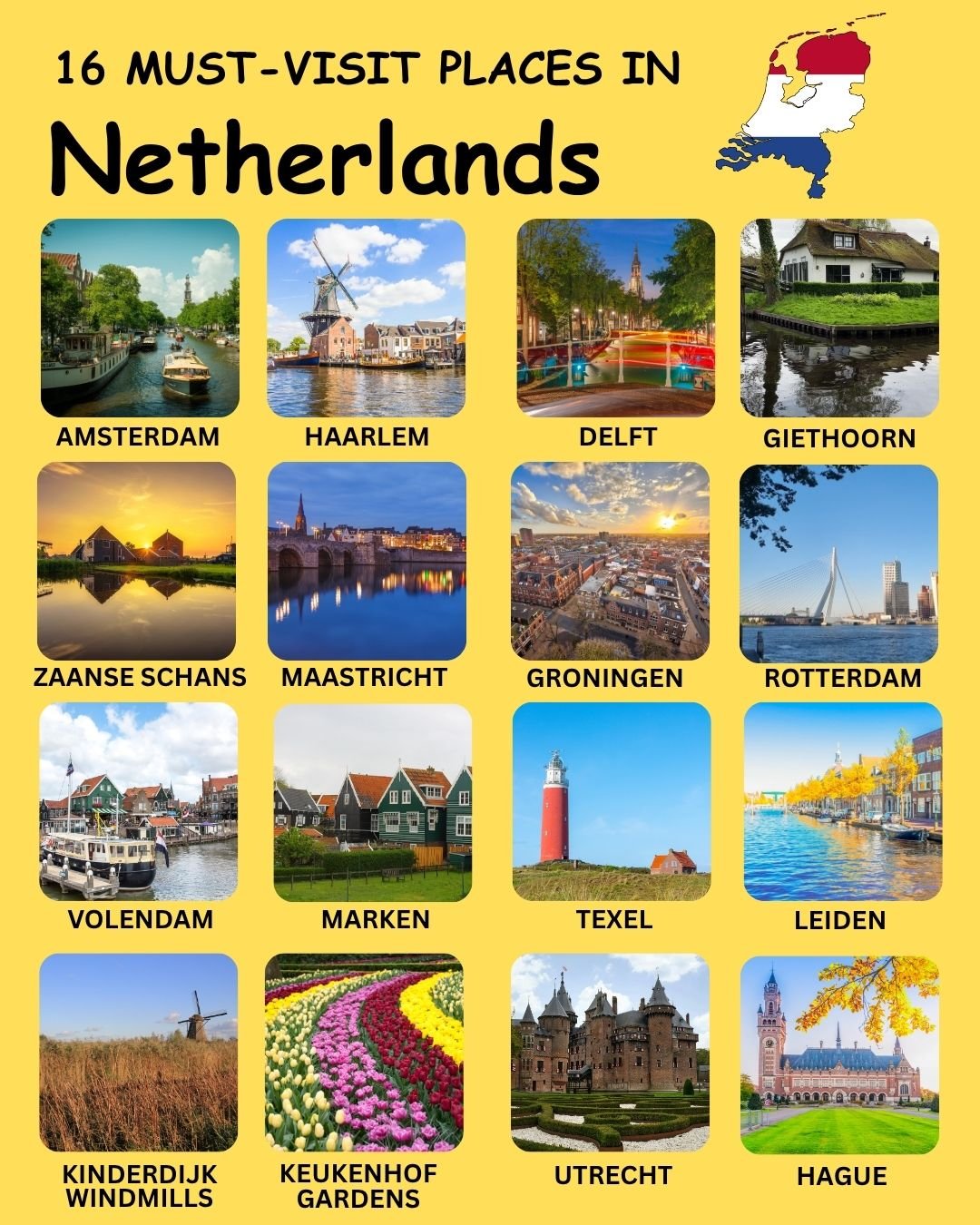
The Netherlands packs canal cities, windmill villages, and vivid tulip fields into a country small enough to cross by train in a few hours. Historic university towns sit close to modern architectural landmarks, while island beaches and rural fishing villages offer a slower, quieter pace. Few countries this compact deliver such consistent variety at every stop.
Dutch history shaped much of this landscape directly, from centuries of land reclaimed from the sea to canal networks built for trade and defense. Some destinations reward travelers with world-class museums and grand architecture. Others offer quiet countryside charm barely touched by mass tourism.
This guide covers the Netherlands’ sixteen most essential destinations, from major cities to countryside villages.
Netherlands Destinations Summary Table
| Destination | Region | Best Known For | Best Time to Visit |
|---|---|---|---|
| Amsterdam | North Holland | Canals, museums | April-June, September-October |
| Haarlem | North Holland | Windmills, historic center | April-October |
| Delft | South Holland | Blue pottery, Vermeer | April-October |
| Giethoorn | Overijssel | Car-free canal village | May-September |
| Zaanse Schans | North Holland | Working windmills | April-October |
| Maastricht | Limburg | Historic center, cross-border charm | April-October |
| Groningen | Groningen | University energy, cycling | May-September |
| Rotterdam | South Holland | Modern architecture | April-October |
| Volendam | North Holland | Fishing village charm | May-September |
| Marken | North Holland | Traditional wooden houses | May-September |
| Texel | Wadden Islands | Beaches, nature reserves | June-September |
| Leiden | South Holland | University history, museums | April-October |
| Kinderdijk Windmills | South Holland | UNESCO windmill network | April-October |
| Keukenhof Gardens | South Holland | Tulip displays | Mid-March-mid-May |
| Utrecht | Utrecht | Wharf-level canals, Dom Tower | April-October |
| The Hague | South Holland | Government seat, museums | April-October |
Amsterdam
Amsterdam anchors the Netherlands as its cultural and historic capital, built around a UNESCO-listed canal ring dating to the 17th century. Narrow gabled houses line the water, reflecting the wealth generated during the Dutch Golden Age of trade. The city blends serious art history with a famously relaxed, bike-friendly atmosphere.
Three days allows time to properly cover Amsterdam’s major museums and quieter neighborhood streets.
What to See in Amsterdam
- Anne Frank House: This preserved hiding place offers a deeply personal look at wartime Amsterdam, requiring advance booking weeks ahead.
- Rijksmuseum: This national museum holds masterpieces by Rembrandt and Vermeer, including The Night Watch.
- Jordaan district: This charming neighborhood offers narrow canal-side streets and a relaxed, local atmosphere.
- Canal cruise: A boat tour along the canal ring offers the best introduction to the city’s layout and architecture.
- Vondelpark: This large city park offers a relaxed green space for a break between sightseeing stops.
Haarlem
Haarlem sits just west of Amsterdam, offering a more traditional Dutch city experience with a well-preserved medieval center. The city’s Grote Markt anchors a compact old town, framed by the towering Church of St. Bavo. Haarlem also holds deep artistic history, having been home to Golden Age painter Frans Hals.
A day trip from Amsterdam works well, or an overnight stay for a quieter alternative base.
What to See in Haarlem
- Grote Markt: This lively central square is framed by historic guild buildings and the Church of St. Bavo.
- Teylers Museum: This is the oldest museum in the Netherlands, holding an eclectic mix of scientific instruments and Old Master drawings.
- Frans Hals Museum: This museum showcases the work of the city’s namesake Golden Age painter.
- Haarlem windmills: Historic windmills along the Spaarne River add scenic character to a riverside walk.
- Old town streets: Wandering the compact historic center reveals canals and independent shops rarely crowded with tourists.
Delft
Delft carries a quiet, refined charm, best known internationally for its distinctive blue and white pottery. The city was also home to painter Johannes Vermeer, whose work captured the same canals and light still visible today. Delft’s compact center makes it an easy, walkable stop between Rotterdam and The Hague.
Half a day covers the main sights, making Delft an easy addition to a Rotterdam or The Hague visit.
What to See in Delft
- Royal Delft factory: This working pottery studio offers tours explaining the centuries-old technique behind Delft Blue ceramics.
- Delft Old Church: This leaning church tower holds the tomb of naval hero Piet Hein.
- Vermeer Centrum Delft: This museum explores the painter’s life and connection to the city’s canals and light.
- Market Square: This central square is framed by the New Church and historic city hall.
- Canal walks: Delft’s quieter canals offer a relaxed, less crowded alternative to Amsterdam’s busier waterways.
Giethoorn
Giethoorn feels like stepping into a storybook, a small village built around canals instead of roads. Thatched-roof cottages line the waterways, and locals still travel by small flat-bottomed boats known as punters. This car-free village ranks among the most peaceful stops in the entire country.
A day trip works for a quick visit, though an overnight stay allows for a quieter evening after crowds disperse.
What to See in Giethoorn
- Canal boat ride: Renting a small electric boat offers the best way to experience Giethoorn’s quiet waterways.
- Wooden footbridges: These bridges connect the village’s islands, making for a peaceful walk past thatched cottages.
- Museum Giethoorn ‘t Olde Maat Uus: This small museum explains the village’s history of peat cutting and farming life.
- De Weerribben-Wieden National Park: This nearby wetland reserve offers hiking and cycling trails through a quieter landscape.
- Sunset over the canals: Evening light on the water offers some of the village’s most photogenic moments.
Zaanse Schans
Zaanse Schans preserves a working collection of historic windmills along the Zaan River, relocated here to showcase traditional Dutch industry. Several mills remain functional today, grinding spices, oil, and pigment using centuries-old methods. This open-air site offers one of the most reliable windmill photo opportunities in the country.
A half day trip from Amsterdam covers the windmills, cheese tasting, and a wooden clog demonstration.
What to See at Zaanse Schans
- Working windmills: Several mills remain open for a closer look at traditional milling processes still in use today.
- Cheese tasting: Local shops offer samples and demonstrations of traditional Dutch cheese-making.
- Clog-making demonstration: Traditional wooden shoe workshops explain a craft still practiced in the region.
- Zaans Museum: This museum covers the region’s industrial and cultural history in more depth.
- Riverside walking paths: Wandering along the Zaan River offers additional photo opportunities beyond the main windmill row.
Maastricht
Maastricht sits in the Netherlands’ southernmost province, closer to Belgium and Germany than to Amsterdam. This border position has shaped a city with noticeably different architecture and culture than the rest of the country. Roman ruins, medieval fortifications, and a lively university scene all coexist within its compact center.
A day and a half allows time for the historic center and the city’s unusual underground tunnel system.
What to See in Maastricht
- Sint Servaasbrug: This historic bridge crosses the Maas River at the heart of the city.
- Maastricht Underground: These extensive tunnel systems, carved from marl stone, once served as wartime shelters.
- Vrijthof square: This lively square hosts cafés and events beneath the towering Basilica of Saint Servatius.
- Bookshop in a former church: The Boekhandel Dominicanen occupies a converted Gothic church, ranked among the world’s most beautiful bookstores.
- Cross-border day trips: Maastricht’s location makes quick trips into Belgium or Germany easy to arrange.
Groningen
Groningen anchors the country’s north, a university city with a youthful, cycling-focused energy. Roughly a quarter of the population consists of students, giving the city a lively, informal atmosphere. Its compact center blends historic architecture with a notably progressive urban planning approach favoring bikes over cars.
A day covers the main historic sights, with the city’s nightlife best experienced with an overnight stay.
What to See in Groningen
- Martinitoren: This towering church bell tower offers sweeping views over the flat northern countryside.
- Groninger Museum: This striking, colorful museum building holds contemporary and historic art collections.
- Vismarkt: This lively market square hosts food stalls and a bustling weekly market.
- Cycling culture: Groningen’s extensive bike infrastructure makes it one of the most cycling-friendly cities in the world.
- Historic university buildings: Wandering the compact center reveals centuries-old academic architecture throughout.
Rotterdam
Rotterdam offers a striking contrast to the rest of the country, rebuilt after wartime destruction into a showcase of bold modern architecture. The city’s harbor remains one of the largest in Europe, shaping its identity as a working port city. Striking bridges and experimental housing designs give Rotterdam a distinctly different character from its historic neighbors.
A day and a half covers the city’s architectural highlights and a Kinderdijk windmill day trip.
What to See in Rotterdam
- Cube Houses: These tilted, cube-shaped homes rank among the most photographed examples of experimental Dutch architecture.
- Markthal: This striking indoor market hall combines food stalls with an enormous painted ceiling mural.
- Erasmusbrug: This distinctive swan-shaped bridge has become a defining symbol of the modern city.
- Euromast: This observation tower offers sweeping views over Rotterdam’s harbor and skyline.
- Museum Boijmans Van Beuningen: This significant art museum holds an extensive collection spanning centuries.
Volendam
Volendam offers a classic Dutch fishing village experience, its harbor lined with traditional wooden houses and seafood stalls. The village has drawn artists and tourists for over a century, developing its own recognizable local dress still worn during festivals. A short ferry ride connects Volendam to nearby Marken, making the two an easy paired visit.
Half a day covers the harbor and village center comfortably.
What to See in Volendam
- Harbor walk: Volendam’s waterfront offers colorful boats, seafood stalls, and views across the IJsselmeer.
- Traditional costume photos: Several studios offer the chance to dress in traditional Volendam attire for a keepsake photo.
- Fresh smoked eel: This local specialty is sold directly from harborside stalls, a distinctly regional treat.
- Volendams Museum: This small museum covers the village’s fishing history and traditional culture.
- Ferry to Marken: A short boat ride connects to the neighboring village for an easy combined day trip.
Marken
Marken sits on a small peninsula in the IJsselmeer, its traditional green wooden houses built on raised mounds to guard against flooding. Once an isolated fishing community, the village retains a quiet, close-knit character despite steady tourist visits. Its architecture offers a distinctly different look from Volendam’s more commercial harbor.
A few hours covers Marken’s compact village center at a relaxed pace.
What to See in Marken
- Traditional wooden houses: Marken’s raised, green-painted homes reflect centuries of adaptation to the region’s flood-prone landscape.
- Marker Museum: This small museum explores the village’s isolated fishing history and traditional dress.
- Harbor views: Marken’s small harbor offers quiet views across the IJsselmeer.
- Lighthouse walk: A short walk leads to a small lighthouse at the peninsula’s edge.
- Cycling path to Volendam: A scenic path connects the two villages for those wanting to explore both by bike.
Texel
Texel, the largest of the Wadden Islands, offers beaches, dunes, and nature reserves reachable by a short ferry from the mainland. This island moves at a distinctly slower pace than the mainland’s cities, popular with cyclists and birdwatchers. Wide sandy beaches along the North Sea coast draw summer visitors seeking a quieter alternative to city sightseeing.
A full day trip works for a taste of the island, though an overnight stay allows for a proper beach visit.
What to See on Texel
- De Slufter nature reserve: This unique tidal marsh landscape offers excellent birdwatching and scenic walking trails.
- Texel beaches: Wide, sandy beaches along the island’s western coast offer a relaxed contrast to mainland sightseeing.
- EcoMare: This nature center and seal sanctuary offers insight into the island’s marine wildlife.
- Texel lighthouse: This red-and-white lighthouse anchors the island’s northern tip.
- Cycling routes: Texel’s flat terrain and extensive bike paths make it ideal for exploring by bicycle.
Leiden
Leiden holds deep academic history as home to the Netherlands’ oldest university, founded in 1575. The city’s canals and gabled houses reflect its Golden Age wealth, while its museums cover everything from Egyptian antiquities to natural history. Rembrandt was born here, adding another layer of artistic significance to the city’s identity.
A day covers Leiden’s compact historic center and at least one of its notable museums.
What to See in Leiden
- Rijksmuseum van Oudheden: This museum holds a significant collection of Egyptian and classical antiquities.
- Leiden University buildings: The historic Academiegebouw reflects the university’s centuries-long academic legacy.
- Burcht van Leiden: This medieval fortification offers views over the city’s canals and rooftops.
- Rembrandt’s birthplace: A marker near the artist’s childhood home commemorates Leiden’s connection to the painter.
- Canal-side old town: Leiden’s canals and gabled architecture rival Amsterdam’s on a smaller, quieter scale.
Kinderdijk Windmills
Kinderdijk holds the largest concentration of historic windmills in the Netherlands, a UNESCO World Heritage Site since 1997. Nineteen windmills line the canals here, built in the 18th century to manage water levels in this low-lying region. The site offers a direct, visible lesson in the engineering that has shaped Dutch land for centuries.
A half day allows time to walk or bike among the windmills and visit at least one open interior.
What to See at Kinderdijk
- Windmill walking path: A flat path connects the site’s nineteen windmills, ideal for a relaxed walk or bike ride.
- Interior windmill tours: Select mills are open to visitors, showing the cramped living quarters once occupied by miller families.
- Boat tour: A short boat ride along the canals offers a different perspective on the windmill row.
- Visitor center exhibits: These displays explain the region’s water management history and the windmills’ engineering.
- Sunset photography: Evening light offers some of the most striking photo opportunities among the windmills.
Keukenhof Gardens
Keukenhof ranks among the most vivid seasonal gardens in the world, displaying millions of blooming tulips each spring. The gardens open for a limited window, typically mid-March through mid-May, timed to the annual tulip bloom. Surrounding countryside fields add even more color, often stretching to the horizon in neat, striped rows.
A half day covers the main garden grounds, with additional time worthwhile for surrounding field visits.
What to See at Keukenhof Gardens
- Tulip displays: Millions of tulips, daffodils, and hyacinths fill meticulously landscaped garden beds.
- Windmill viewpoint: A small windmill within the gardens offers an elevated view over the tulip displays.
- Surrounding tulip fields: The countryside beyond the garden gates offers striped fields worth a scenic drive or bike ride.
- Flower pavilions: Indoor displays showcase additional flower varieties and floral design exhibits.
- Early morning visits: Arriving at opening time helps avoid the heaviest crowds during peak bloom season.
Utrecht
Utrecht offers a quieter, distinctly Dutch city experience centered around wharf-level canals unique among the country’s major towns. The Dom Tower, the tallest church tower in the Netherlands, anchors a walkable historic center shaped significantly by its large student population. This mix of medieval architecture and youthful energy gives Utrecht a different feel than Amsterdam’s more tourist-heavy streets.
A day allows time to climb the tower and explore the canal-level cafés at a relaxed pace.
What to See in Utrecht
- Dom Tower: Climbing this 14th-century tower rewards visitors with sweeping views over the city and countryside.
- Wharf-level canals: Utrecht’s Oudegracht features unique canal-level cafés, a layout distinct from Amsterdam’s street-level waterways.
- Centraal Museum: This museum covers Utrecht’s art and design history, including ties to the De Stijl movement.
- Cycling along the canals: Renting a bike offers an easy way to see more of the compact city center.
- Historic city center: Utrecht’s old town blends medieval architecture with a lively student atmosphere.
The Hague
The Hague serves as the Netherlands’ seat of government and international justice, home to institutions like the International Court of Justice. Despite this formal role, the city also holds a compact museum district and a relaxed North Sea beach nearby. Grand architecture throughout the center reflects its long history as a political and diplomatic hub.
A day covers the city’s museums and government district, with time for a coastal walk at Scheveningen.
What to See in The Hague
- Mauritshuis Museum: This compact museum holds Vermeer’s Girl with a Pearl Earring alongside other Dutch Golden Age masterpieces.
- Binnenhof: This historic government complex remains the seat of the Dutch parliament.
- Peace Palace: This grand building houses the International Court of Justice, reflecting the city’s diplomatic significance.
- Scheveningen beach: This North Sea beach offers a relaxed coastal walk just outside the city center.
- Panorama Mesdag: This immersive 19th-century cylindrical painting offers a unique historical art experience.
Practical Travel Advice
The Netherlands’ train network connects nearly every destination on this list efficiently, making a rental car optional for most travelers. Renting a bike in each city offers a genuinely Dutch way to cover more ground, given the country’s excellent cycling infrastructure. Booking ahead is especially important for the Anne Frank House and Keukenhof Gardens, both of which sell out during peak season.
Spring offers the added bonus of tulip season, though it also brings the year’s biggest crowds to Amsterdam and Keukenhof. Comfortable, waterproof shoes are worth packing regardless of season, given the country’s unpredictable rain. Coastal destinations like Texel suit summer visits best, while historic cities remain rewarding throughout the year.
Final Thoughts
The Netherlands rewards travelers willing to move beyond Amsterdam and explore its full regional range. Windmill villages, university towns, and island beaches all reward the extra effort to reach them. Whatever pace you choose, this country’s compact size makes it easy to see far more than its capital alone.