
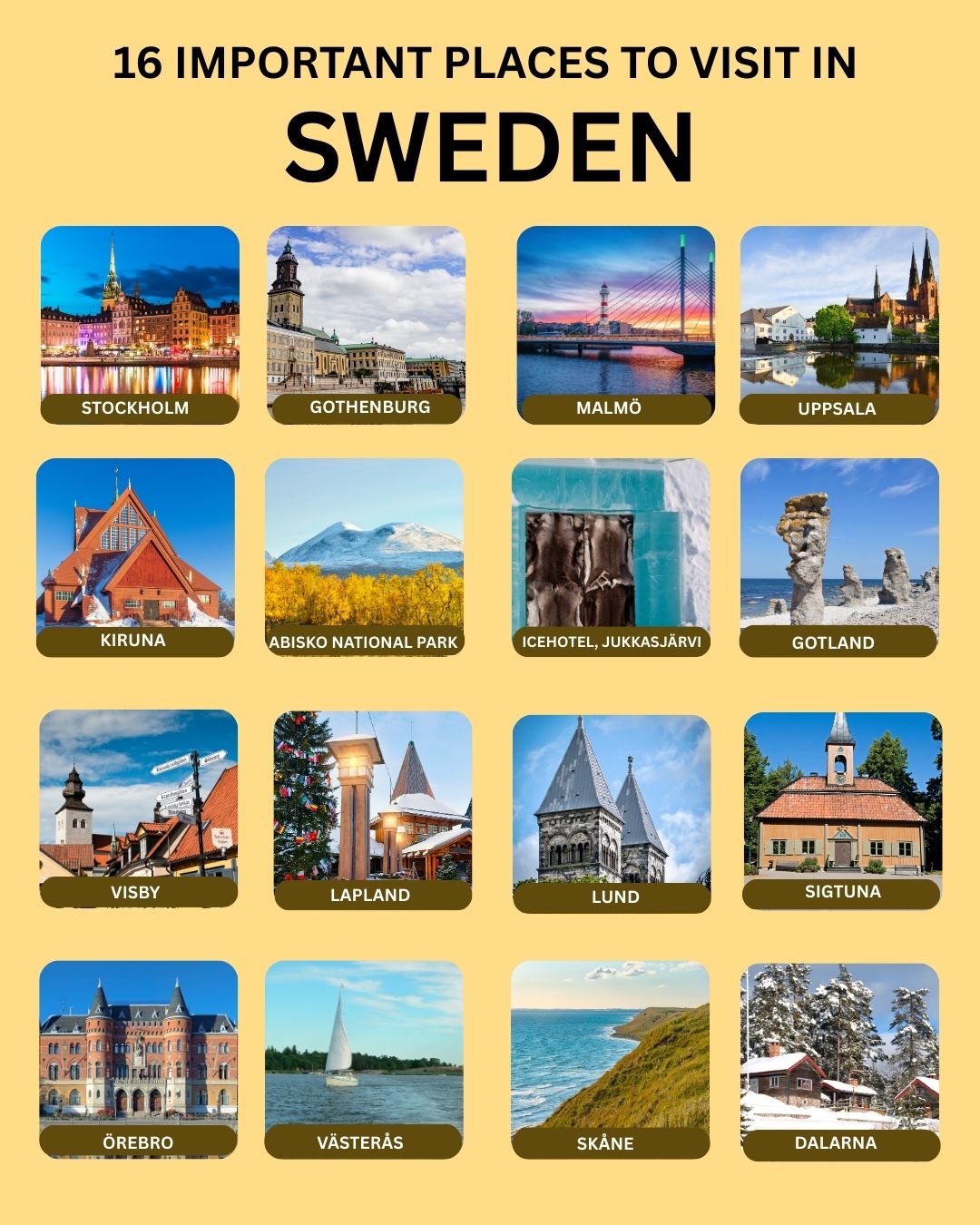
Sweden packs medieval old towns, Arctic wilderness, and genuinely thoughtful design into a country that stretches over a thousand miles from south to north. Colorful waterfront buildings sit beside sleek modern architecture, while the far north offers reindeer, northern lights, and midnight sun. Few countries let you experience such dramatic regional contrast within one well-connected trip.
These sixteen destinations represent the best of what Sweden has to offer, from the design-forward capital to remote Arctic settlements. Each one brings something different, whether that is architecture, natural scenery, or living folk tradition. Together, they form a strong foundation for any first-time trip or a longer, more thorough exploration.
Whether you have one week or a full month, this guide breaks down what makes each place worth visiting. Read on for practical insights and the top sights at every stop.
Destination Overview
| Destination | Region | Best Known For | Best Time to Visit |
|---|---|---|---|
| Stockholm | Uppland | Old town, museums, archipelago | May to September |
| Gothenburg | Vastra Gotaland | Canals, seafood, coastal archipelago | May to September |
| Malmo | Skane | Modern architecture, Oresund Bridge | May to September |
| Uppsala | Uppland | University heritage, cathedral | Year-round |
| Kiruna | Norrbotten | Sami culture, Arctic landscapes | Year-round |
| Abisko National Park | Norrbotten | Northern lights, Arctic wilderness | September to March |
| Icehotel, Jukkasjarvi | Norrbotten | Ice architecture, Arctic adventure | December to April |
| Gotland | Baltic Sea | Rauk rock formations, coastal scenery | May to September |
| Visby | Gotland | Medieval walled city | May to September |
| Lapland | Northern Sweden | Reindeer herding, Sami heritage | Year-round |
| Lund | Skane | Cathedral, university town | Year-round |
| Sigtuna | Uppland | Sweden’s oldest town, runestones | May to September |
| Orebro | Narke | Castle, riverside charm | Year-round |
| Vasteras | Vastmanland | Sailing, lakeside scenery | May to September |
| Skane | Southern Sweden | Rolling farmland, coastal cliffs | May to September |
| Dalarna | Central Sweden | Folk culture, red cottages | Year-round |
Stockholm
Stockholm anchors any trip to Sweden, a capital spread across 14 islands and connected by bridges and ferries. Gamla Stan’s medieval streets sit just steps from the Royal Palace, while the Vasa Museum houses a nearly intact 17th-century warship. Centuries of royal and maritime history sit alongside a genuinely modern, design-conscious city.
Most visitors spend three to four days here, enough time for major museums and a boat trip into the archipelago. Walking and public transit cover the compact center easily. Early mornings offer the quietest, most atmospheric version of Gamla Stan’s cobblestone lanes.
What to See in Stockholm
- Gamla Stan’s medieval streets hold the Royal Palace, the Nobel Museum, and centuries of layered history.
- The Vasa Museum displays a nearly intact 17th-century warship recovered remarkably preserved from the harbor.
- Skansen, an open-air museum, recreates traditional Swedish buildings alongside native wildlife exhibits.
- The Stockholm Archipelago’s scattered islands offer an easy boat trip escape from the city center.
- Sodermalm’s trendy streets showcase the city’s creative, design-forward side.
- Drottningholm Palace, a short boat ride away, showcases royal gardens and baroque architecture.
Gothenburg
Gothenburg serves as Sweden’s second city, a canal-lined port town known for fresh seafood and a genuinely relaxed atmosphere. Dutch-influenced canals date back to the city’s 17th-century founding, giving the historic center a distinct architectural character. The nearby archipelago offers an easy coastal escape from the urban core.
One to two days cover the canals, market halls, and waterfront comfortably. Feskekorka, the city’s fish market housed in a church-like building, offers a genuine taste of local seafood culture. Gothenburg also serves as a practical gateway to the southern archipelago islands.
What to See in Gothenburg
- Feskekorka, the fish market, showcases fresh local seafood inside a distinctive church-shaped building.
- The historic canals reflect Gothenburg’s 17th-century Dutch-influenced city planning.
- Liseberg amusement park offers rides and entertainment for families and thrill-seekers alike.
- The Gothenburg Archipelago’s car-free islands provide an easy ferry-accessible coastal escape.
- Haga district’s cobblestone streets hold cafes famous for oversized cinnamon buns.
Malmo
Malmo anchors southern Sweden, a city transformed in recent decades from an industrial port into a hub of striking modern architecture. The Turning Torso skyscraper, twisting dramatically along the waterfront, has become the city’s defining landmark. The Oresund Bridge connects Malmo directly to Copenhagen, giving the city a genuinely international character.
A single day covers the city center and waterfront comfortably. Malmo’s diverse population has shaped a lively food scene reflecting immigrant communities from across the world. The short train ride to Copenhagen makes Malmo an easy addition to a broader Scandinavian itinerary.
What to See in Malmo
- The Turning Torso skyscraper dominates the skyline, one of the most distinctive buildings in Scandinavia.
- Malmo Castle, a Renaissance fortress, houses several museums covering art and natural history.
- The Oresund Bridge offers a dramatic engineering landmark connecting Sweden to Denmark.
- Lilla Torg, the old town square, anchors a historic district filled with cafes and restaurants.
- Vastra Hamnen, the redeveloped harbor district, showcases the city’s modern architectural ambitions.
Uppsala
Uppsala carries deep academic history as home to Scandinavia’s oldest university, founded in 1477. Uppsala Cathedral, with its twin Gothic spires, ranks as the tallest church in the Nordic countries. This university town sits just a short train ride north of Stockholm.
A single day covers the cathedral, university quarter, and botanical gardens comfortably. The city’s academic atmosphere gives it a livelier, more youthful feel than its historic architecture might suggest. Uppsala also holds the burial mounds of ancient Swedish kings nearby at Gamla Uppsala.
What to See in Uppsala
- Uppsala Cathedral’s twin Gothic spires rank among the tallest church towers in the Nordic region.
- The historic university quarter reflects centuries of Scandinavian academic tradition.
- The Linnaeus Garden and Botanical Garden offer a peaceful, scholarly green space in the city center.
- Gamla Uppsala’s ancient burial mounds mark the resting place of legendary early Swedish kings.
Kiruna
Kiruna anchors Swedish Lapland, a mining town shaped by both Sami heritage and one of the world’s largest underground iron ore mines. The city’s striking wooden church, consecrated in 1913, ranks among the largest and most beautiful wooden buildings in Sweden. This remote northern settlement serves as a gateway to Arctic adventure.
One to two days allow time to explore the town and arrange excursions into the surrounding wilderness. Kiruna sits close to Abisko National Park and the Icehotel in nearby Jukkasjarvi. The town’s far-northern location makes it one of the best places in the world to view the northern lights.
What to See in Kiruna
- Kiruna Church, consecrated in 1913, showcases striking Art Nouveau architecture and an evocative interior altar.
- Guided tours into the surrounding wilderness offer a genuine chance to view the northern lights.
- The nearby LKAB iron ore mine offers tours explaining the industry that built the modern town.
- Local restaurants serve reindeer dishes and other Sami-influenced regional cuisine.
Abisko National Park
Abisko National Park ranks among the best places in the world to view the northern lights, thanks to a unique microclimate that keeps skies clearer than much of the surrounding region. The Aurora Sky Station offers a dedicated viewing platform above the treeline. This park also marks the starting point of the famous Kungsleden hiking trail.
One to two days allow time for hiking and at least one evening aurora viewing attempt. The park’s minimal light pollution enhances night sky visibility considerably. September through March offers the darkest skies and best conditions for viewing the lights.
What to See in Abisko National Park
- The Aurora Sky Station, reached by chairlift, offers an elevated platform for northern lights viewing.
- The Kungsleden trail begins here, stretching roughly 440 kilometers through Arctic wilderness.
- Lake Tornetrask provides dramatic Arctic scenery for daytime hiking and photography.
- Guided aurora photography tours help visitors capture the lights with proper technique and equipment.
Icehotel, Jukkasjarvi
The Icehotel in Jukkasjarvi rebuilds itself entirely from ice and snow each winter, offering rooms, an ice bar, and an ice chapel that exist only for a single season. This unique structure has drawn visitors from around the world since opening in 1989. Staying overnight here ranks among the most distinctive lodging experiences anywhere.
A half day covers a tour of the ice sculptures and art suites even without an overnight stay. Book well in advance if you plan to stay overnight, since rooms sell out quickly during peak winter months. December through April offers the full ice hotel experience before the structure melts each spring.
What to See in Icehotel, Jukkasjarvi
- Elaborate ice sculptures throughout the hotel showcase work from international artists each season.
- The ice bar serves drinks in glasses carved entirely from ice, a genuinely unique novelty.
- The ice chapel hosts weddings and ceremonies inside a structure built fresh each winter.
- Guided tours explain the annual construction process behind this seasonal architectural marvel.
Gotland
Gotland floats in the Baltic Sea, Sweden’s largest island known for dramatic rauk rock formations and a distinctly Mediterranean-feeling summer climate. These limestone sea stacks, shaped by centuries of erosion, create an otherworldly coastal landscape. The island’s relatively flat terrain makes cycling a popular way to explore.
Two to three days allow time to explore both the coastline and the walled city of Visby. Summer draws the biggest crowds, when the island’s beaches and outdoor cafes come alive. The short ferry or flight from the mainland makes Gotland an accessible island getaway.
What to See in Gotland
- The rauk rock formations along the coastline create a dramatic, otherworldly limestone landscape.
- Cycling the island’s flat terrain offers an easy way to explore beyond the main town.
- Gotland’s beaches draw summer visitors for swimming in the relatively warm Baltic waters.
- Medieval church ruins scattered across the island reflect centuries of religious and trading history.
Visby
Visby anchors Gotland as one of the best-preserved medieval walled cities in Northern Europe, its city wall stretching over three kilometers around the historic center. Cobblestone streets and rose-covered ruins give the town a fairy-tale atmosphere unlike anywhere else in Sweden. This UNESCO World Heritage Site rewards a full day of unhurried wandering.
A full day covers the town’s compact but richly layered historic center. Almedalen Week, a major political and cultural gathering, draws crowds each July. Visby’s medieval character makes it one of the most photographed towns in the entire country.
What to See in Visby
- Walking the medieval city wall offers views over Visby’s red rooftops and the Baltic Sea beyond.
- Church ruins scattered throughout the old town reflect the city’s once-thriving medieval trading wealth.
- Cobblestone streets lined with rose bushes create some of the most photographed scenes in Sweden.
- The Gotland Museum explains the island’s Viking, medieval, and maritime trading history.
Lapland
Lapland stretches across northern Sweden, home to the indigenous Sami people and their centuries-old tradition of reindeer herding. This vast region offers genuine Arctic wilderness, from dense forest to open tundra. Sami cultural centers throughout the region offer insight into a way of life still practiced today.
Multiple days allow time to properly experience the region’s scale and remoteness. Winter brings snow activities and aurora viewing, while summer offers hiking under the midnight sun. Lapland’s size means most visitors focus on one particular area rather than attempting the whole region.
What to See in Lapland
- Sami cultural centers explain the traditions and history behind this indigenous northern culture.
- Reindeer herding demonstrations offer a genuine look at a livelihood still practiced today.
- The midnight sun during summer months allows for round-the-clock daylight exploring.
- Vast forests and tundra provide some of the last genuine wilderness remaining in Europe.
Lund
Lund anchors southern Sweden as a historic university town, home to one of Scandinavia’s oldest and most significant cathedrals. Lund Cathedral, dating to the 12th century, features an astronomical clock that still performs a daily medieval melody. This academic city carries a lively, youthful energy alongside its deep historic roots.
A single day covers the cathedral and university quarter comfortably. Lund’s compact size and abundance of bicycles reflect its strong university culture. The city makes an easy day trip from nearby Malmo or even Copenhagen across the Oresund Bridge.
What to See in Lund
- Lund Cathedral’s astronomical clock performs a daily medieval melody, a genuine crowd draw.
- The university quarter reflects centuries of Scandinavian academic tradition and student life.
- Kulturen, an open-air museum, showcases historic Swedish buildings within the city center.
- The botanical garden offers a peaceful green space just steps from the cathedral.
Sigtuna
Sigtuna holds the distinction of being Sweden’s oldest town, founded around 980 AD as one of the country’s earliest urban settlements. Runestones scattered throughout the town add a tangible connection to Viking Age history. This small, charming lakeside town offers a genuine step back into early Swedish history.
A half day covers the compact historic center comfortably. Sigtuna’s church ruins and main street reflect centuries of continuous settlement. The town sits within easy reach of both Stockholm and Uppsala, making it a convenient addition to either itinerary.
What to See in Sigtuna
- Runestones scattered throughout the town offer a tangible link to Viking Age Swedish history.
- Church ruins in the town center reflect Sigtuna’s long religious and civic history.
- The main street, Stora Gatan, ranks among the oldest streets still in use in Sweden.
- Lake Malaren’s shoreline offers a scenic, peaceful walk just outside the historic center.
Orebro
Orebro anchors central Sweden, a riverside city known for its striking hilltop castle overlooking the Svartan River. Orebro Castle, with its round towers, has served roles ranging from fortress to prison across its long history. This underrated city offers genuine charm without the crowds of Sweden’s larger tourist destinations.
A single day covers the castle and riverside center comfortably. The city’s compact size makes it easy to explore entirely on foot. Orebro’s central location makes it a practical stop for travelers moving between Stockholm and Gothenburg.
What to See in Orebro
- Orebro Castle’s round towers offer a striking riverside landmark with centuries of layered history.
- The Svartan River runs directly through the city center, framed by pleasant walking paths.
- Wadkoping, an open-air museum area, recreates historic Swedish town life within the city.
- The city’s compact, walkable center makes for an easy, relaxed day of exploring.
Vasteras
Vasteras sits on the shores of Lake Malaren, a lakeside city known for sailing and a lively waterfront scene. This practical, less touristed city offers genuine Swedish charm away from the busier capital. Vasteras Cathedral anchors the historic center with centuries of religious history.
A single day covers the cathedral, waterfront, and historic center comfortably. Sailing and boating remain popular activities given the city’s lakeside position. Vasteras makes an easy day trip or stopover between Stockholm and destinations further west.
What to See in Vasteras
- Lake Malaren’s waterfront offers scenic sailing and boating opportunities throughout the summer.
- Vasteras Cathedral anchors the historic center with centuries of religious architectural history.
- The Vallby Open Air Museum recreates traditional Swedish rural life within the city limits.
- Djakneberget park provides green space and walking trails just outside the city center.
Skane
Skane occupies Sweden’s southernmost region, a landscape of rolling farmland, coastal cliffs, and charming small towns distinct from the country’s more forested north. This region’s milder climate supports extensive agriculture, giving it a noticeably different character from central and northern Sweden. Skane also holds several of the country’s most significant castles and manor houses.
Multiple days allow time to explore the region’s coastline, countryside, and historic towns. Ale’s Stones, a Viking Age stone monument resembling a ship, sits along the dramatic southern coast. Skane’s proximity to Copenhagen makes it an easy extension to a broader Scandinavian trip.
What to See in Skane
- Ale’s Stones, a Viking Age stone ship monument, sits dramatically along the southern coastline.
- Rolling farmland throughout the region reflects Sweden’s most agriculturally productive area.
- Coastal cliffs and beaches offer scenic stops along Skane’s extensive shoreline.
- Historic castles and manor houses throughout the countryside reflect centuries of noble landholding.
Dalarna
Dalarna carries deep cultural weight as the heart of traditional Swedish folk life, its red-painted cottages and Lake Siljan villages appearing on postcards throughout the country. Traditional Dala horse workshops still produce the iconic carved and painted wooden horses by hand. This region offers genuine countryside scenery and centuries-old craft traditions.
Two to three days allow time to explore several villages around Lake Siljan at a relaxed pace. Midsummer celebrations here rank among the most traditional and picturesque in the entire country. Dalarna’s folk culture and pastoral scenery make it one of Sweden’s most quintessentially charming regions.
What to See in Dalarna
- Villages around Lake Siljan showcase Sweden’s iconic red-painted traditional cottages.
- Dala horse workshops demonstrate the hand-carving and painting process behind this beloved craft.
- Midsummer celebrations in Dalarna rank among the most traditional and photographed in Sweden.
- Lake Siljan offers scenic boat cruises and countryside views throughout the surrounding region.
Final Thoughts
Sweden’s sixteen essential destinations reveal a country far richer than its most famous postcards suggest. From Stockholm’s island-spanning elegance to the Arctic wilderness of Abisko and Kiruna, each stop offers a genuinely different experience. History, coastline, and folk culture sit within reach of one another throughout the country.
Build a trip that mixes major cities with smaller, lesser-known towns for the most rewarding experience. Give yourself time to wander without a fixed schedule at each stop. Sweden rewards curiosity, and its diverse regions make every visit feel worth repeating.