
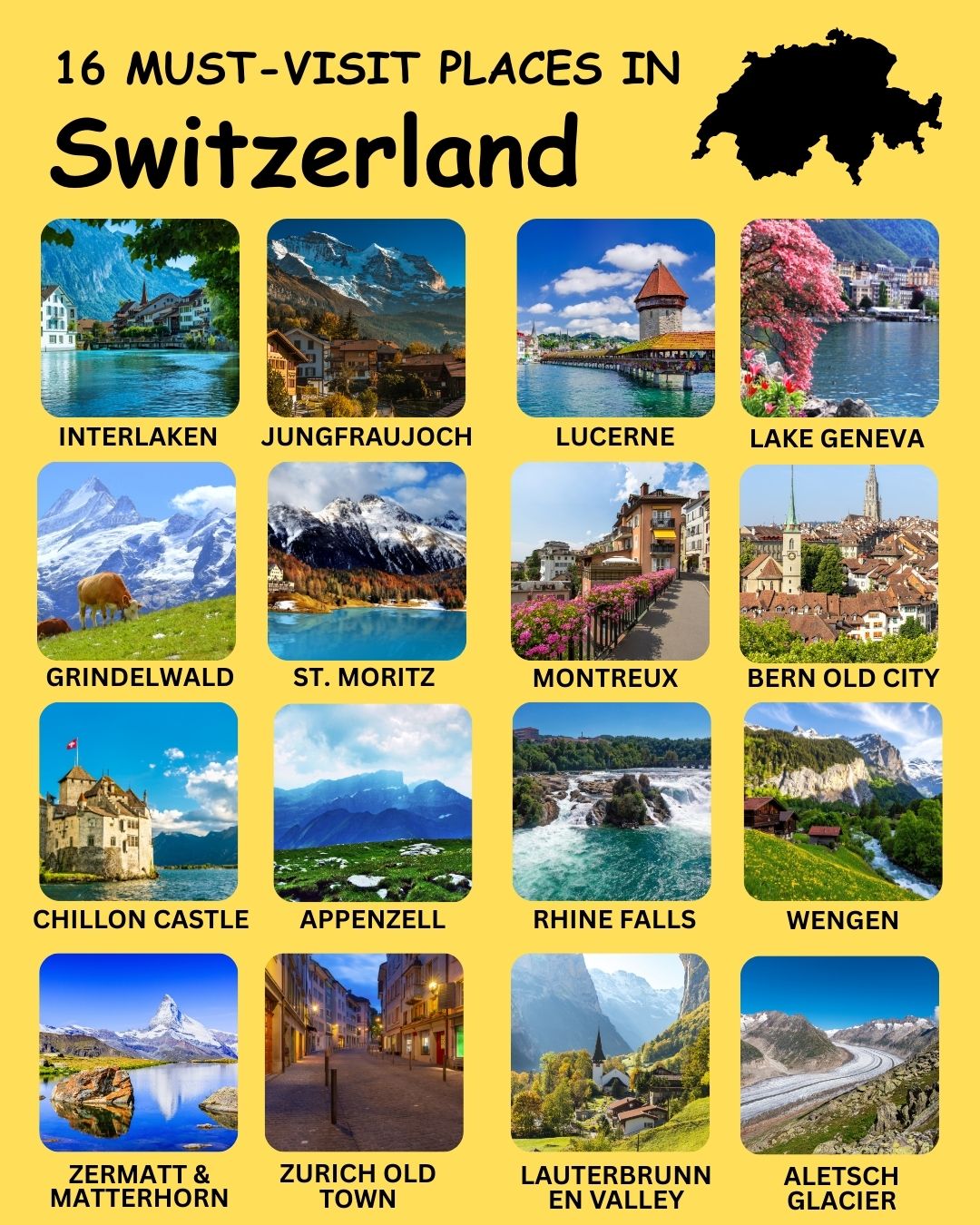
Switzerland packs an extraordinary amount of scenery into a small country, from glacier trains to lakeside castles to villages tucked beneath the Matterhorn. Every region here brings something genuinely different, whether that’s a medieval old town, a stretch of vineyard-covered lakeshore, or a mountain summit reachable by cogwheel train. This list walks through sixteen places worth building a Swiss trip around, covering both the famous names and a few spots first-time visitors sometimes miss.
1) Interlaken
Interlaken sits between two lakes with the Jungfrau massif rising directly behind it, making it the natural base for Switzerland’s most popular alpine excursions. The town itself stays small and easy to navigate, with Höhematte Park offering unobstructed mountain views right in the center. Paragliders regularly launch from the surrounding hills and land in this same park, adding constant movement to the skyline above town. Beyond the mountain access, Interlaken sits close to both Lake Thun and Lake Brienz, each offering boat cruises and lakeside villages worth a slower afternoon. Most visitors use it as a launch point for Jungfraujoch, though the town holds plenty of charm on its own.
2) Jungfraujoch
Nicknamed the Top of Europe, Jungfraujoch sits at over 3,400 meters and holds the record for the highest railway station on the continent. The train climbs through tunnels carved directly into the mountain, with a stop partway up offering views through windows cut straight into the rock. At the summit, an Ice Palace carved into the Aletsch Glacier itself adds a strange, sculptural detour to the visit. Views from the observation platforms stretch out over glaciers and surrounding peaks on clear days, though weather here shifts fast and can obscure everything within minutes. Book tickets well ahead, since this ranks among the most visited single excursions in the entire country.
3) Lucerne
Lucerne combines a beautifully preserved medieval old town with easy lake and mountain access, making it one of Switzerland’s most complete city stops. Chapel Bridge, a covered wooden structure dating to 1333, remains the city’s defining image, painted panels lining its interior roof. Beyond the bridge, narrow streets wind past frescoed buildings and a round water tower rising straight out of the river. Mount Pilatus sits within easy reach, reachable by the steepest cogwheel railway in the world, adding genuine alpine scenery without needing to travel far from the city center. Lake Lucerne itself rounds out the visit with boat cruises and quiet lakeside villages.
4) Lake Geneva
Lake Geneva stretches along Switzerland’s southwestern border, its shores lined with vineyards, castles, and a string of lakeside towns worth exploring individually. Geneva itself anchors the western end, known for its towering Jet d’Eau fountain and international diplomatic history. Further east, the lake’s northern shore climbs into the Lavaux vineyards, a UNESCO-listed terraced wine region with sweeping water views. Montreux and Chillon Castle sit closer to the lake’s eastern tip, both drawing visitors for very different reasons. The lake’s mild climate, unusual for Switzerland, gives this entire region a noticeably different character from the colder alpine areas further north.
5) Grindelwald
Grindelwald sits directly beneath the Eiger’s dramatic north face, one of the most recognizable mountain walls in the Alps. The village itself stays walkable and relaxed, with cable cars and cogwheel trains fanning out toward several nearby viewpoints. First, reachable by cable car, adds a cliff walk and a striking suspension bridge for those wanting a bit more adventure. Cows graze in meadows right at the edge of town during summer months, their bells adding a familiar soundtrack to the alpine setting. Grindelwald works well as either a standalone base or a day trip from nearby Interlaken, given the short train connection between the two.
6) St. Moritz
St. Moritz built its reputation on winter sports, having hosted the Winter Olympics twice, and the town still carries that polished, high-altitude glamour today. Its lake freezes solid enough in winter to host events directly on the ice, including horse racing and golf tournaments unique to this region. In summer, the same lake turns a striking turquoise, ringed by hiking trails and surrounded by jagged peaks. The town itself leans upscale, with designer boutiques and grand hotels reflecting its long history as a destination for wealthy European travelers. St. Moritz sits in the Engadin valley, one of the sunniest regions in Switzerland despite its elevation.
7) Montreux
Montreux sits right on Lake Geneva’s shore, its mild microclimate supporting palm trees and flowers rarely seen elsewhere in Switzerland. A long lakeside promenade runs through town, lined with sculptures and benches perfect for a slow evening walk. The town gained international fame through its annual jazz festival, drawing major musicians each July for weeks of performances. Just outside town, Chillon Castle sits dramatically on a small island connected to shore, one of the most photographed castles in the country. Montreux pairs naturally with a day trip into the nearby Lavaux vineyards, given how close the terraced hillsides sit to the lake.
8) Bern Old City
Bern, Switzerland’s capital, holds one of the best-preserved medieval old towns in Europe, earning it UNESCO World Heritage status. Sandstone buildings line arcaded streets stretching for kilometers, offering shelter from rain while browsing shops and cafes. The Zytglogge, an elaborate medieval clock tower, still performs a small mechanical show each hour, drawing a crowd of visitors checking their watches beforehand. Bears have a long association with the city, and a bear park along the river continues that tradition today. Bern moves at a noticeably calmer pace than Zurich or Geneva, making it a good stop for travelers wanting fewer crowds alongside genuine history.
9) Chillon Castle
Chillon Castle rises directly from Lake Geneva’s edge, connected to the shore by a short causeway that makes its island setting even more dramatic. Dating back to the 12th century, the castle has served as a residence, a fortress, and a prison over its long history. Lord Byron’s poem about a prisoner held here added a layer of literary fame that still draws visitors today. Inside, visitors can walk through vaulted halls, a Great Hall, and dungeons carved directly into the rock the castle sits upon. Its setting against the lake and surrounding mountains makes it one of the most photographed landmarks in the entire country.
10) Appenzell
Appenzell sits in one of Switzerland’s most traditional rural regions, known for rolling green hills, painted farmhouses, and a strong sense of local custom. The canton famously held out until 1991 before granting women voting rights at the local level, a detail that still comes up in conversations about the region’s conservative streak. Cheese production runs deep here, with Appenzeller cheese ranking among the country’s most recognized exports. Hiking trails wind through the surrounding Alpstein range, passing traditional villages where cows still wear elaborately decorated collars during seasonal processions. Appenzell offers a quieter, more rural side of Switzerland compared to the busier lake cities.
11) Rhine Falls
Rhine Falls near Schaffhausen ranks as the largest waterfall in Europe by volume, a genuinely thunderous sight up close. Viewing platforms and a small boat service let visitors get remarkably near the falling water, close enough to feel the spray on a windy day. A rock formation sits right in the middle of the falls, accessible by boat, offering a viewpoint surrounded by rushing water on nearly every side. The falls sit an easy day trip from Zurich, making them accessible even for travelers with limited time in the country. Summer months bring the highest water volume, making the falls at their most dramatic during warmer weather.
12) Wengen
Wengen sits perched above the Lauterbrunnen Valley, reachable only by train or cable car since the village bans private cars entirely. That restriction keeps the streets quiet, giving Wengen a noticeably calmer feel than some of the busier mountain towns nearby. Views from the village stretch across the valley toward the Jungfrau, Mönch, and Eiger peaks, all visible without needing to hike anywhere. In winter, Wengen becomes a serious ski destination, while summer shifts the focus toward hiking trails winding through surrounding meadows. The car-free setting makes it a genuinely peaceful base for exploring the wider Jungfrau region.
13) Zermatt & Matterhorn
Zermatt sits directly beneath the Matterhorn, one of the most recognizable mountain silhouettes in the world, and the village itself bans combustion-engine cars entirely. Electric taxis and horse-drawn carriages handle transport within town, adding to the quiet, pedestrian-friendly atmosphere throughout the streets. The Gornergrat Railway climbs to a viewpoint facing the Matterhorn directly, offering one of the best close-up perspectives on the peak anywhere in the region. Glacier Paradise, reachable by cable car, pushes even higher, adding a second high-altitude excursion for those wanting more time above the clouds. Zermatt draws serious hikers and climbers alongside casual visitors simply chasing that iconic mountain view.
14) Zurich Old Town
Zurich’s old town spreads across both banks of the Limmat River, its narrow streets holding centuries of layered history within a genuinely walkable core. Grossmünster and Fraumünster, the city’s two most recognizable churches, sit facing each other across the water, each holding significant stained glass work inside. Bahnhofstrasse, one of the world’s most expensive shopping streets, runs alongside the old town, giving the area a mix of historic charm and polished luxury. Lindenhof hill offers a free, elevated viewpoint over the rooftops and river below, a popular spot for a quiet break during sightseeing. The old town stays lively well into the evening, particularly around Niederdorf’s restaurants and bars.
15) Lauterbrunnen Valley
Lauterbrunnen Valley cuts a dramatic path through the Bernese Alps, its steep limestone cliffs lined with waterfalls cascading directly into the valley floor. Staubbach Falls drops nearly 300 meters right beside the village, visible from almost anywhere in town without needing to hike at all. The valley serves as the gateway to both Wengen and Mürren, two car-free mountain villages perched on the cliffs above. Traditional Swiss chalets and green meadows fill the valley floor, giving it a storybook quality that has drawn filmmakers and photographers for decades. Trümmelbach Falls, a series of waterfalls running inside the mountain itself, adds an unusual underground detour for visitors.
16) Aletsch Glacier
The Aletsch Glacier ranks as the largest ice stream in the Alps, stretching over 20 kilometers through a UNESCO World Heritage landscape. Viewing points reachable from Jungfraujoch or nearby villages like Fiescheralp offer sweeping perspectives over the ice as it winds between surrounding peaks. The glacier has retreated significantly in recent decades, a visible and sobering marker of broader climate shifts affecting the entire Alpine region. Hiking trails run along sections of the glacier’s edge, giving more adventurous visitors a closer look than the standard viewing platforms allow. Its scale is difficult to fully grasp from photos alone, making an in-person visit genuinely worth the effort for anyone interested in Alpine geography.