
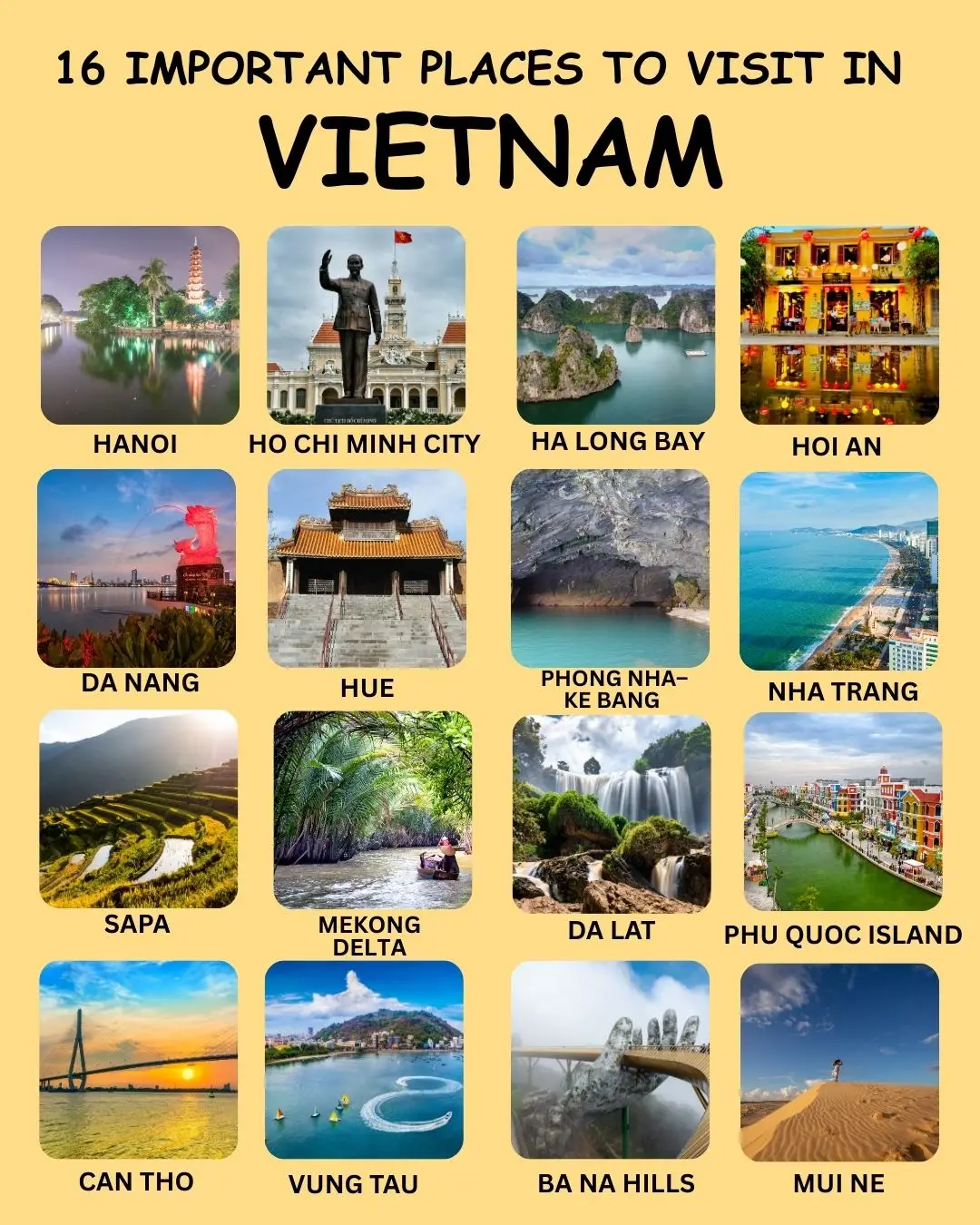
Vietnam packs an extraordinary range of landscapes and experiences into one narrow, S-shaped country. From misty northern mountains to tropical southern islands, deciding where to go can feel overwhelming for first-time visitors. This guide breaks down sixteen of the country’s most important destinations, each offering something genuinely different from the rest.
Whether you are planning a two-week trip or a longer journey, this list should help you prioritize. Below is a closer look at each destination, along with what makes it worth visiting and one practical tip for making the most of your time there.
1) Hanoi
Vietnam’s capital blends French colonial architecture with a chaotic, motorbike-filled Old Quarter that has changed little in character over the decades. Hoan Kiem Lake sits at the city’s heart, surrounded by temples, cafes, and street food stalls.
Travel Tips
- Walk through the Old Quarter’s 36 streets, each historically tied to a specific trade or craft.
- Visit the Temple of Literature, Vietnam’s first national university, dating back to 1070.
- Join a street food walking tour in the early evening, when stalls are freshest and the Old Quarter comes alive.
2) Ho Chi Minh City
Formerly known as Saigon, Ho Chi Minh City is Vietnam’s largest and most economically dynamic urban center. Its skyline and nightlife contrast sharply with the country’s more traditional northern capital.
Travel Tips
- Visit the War Remnants Museum for a powerful, unfiltered look at the Vietnam War.
- Explore Notre Dame Cathedral and the nearby Central Post Office, both striking examples of French colonial architecture.
- Cross busy streets slowly and steadily rather than stopping suddenly, since motorbikes are trained to flow around a predictable pace.
3) Ha Long Bay
Thousands of limestone karsts rise from the Gulf of Tonkin, making Ha Long Bay Vietnam’s most iconic natural landmark. Most visitors experience it via an overnight cruise through the islands.
Travel Tips
- Cruise past the bay’s limestone formations, many named for their resemblance to animals or mythical figures.
- Kayak through hidden lagoons and sea caves accessible only by small boat.
- Book a smaller, higher-rated boutique cruise rather than a mass-market boat for a quieter, more personal experience.
4) Hoi An
Hoi An’s Ancient Town has remained remarkably preserved since its days as a major trading port. Colorful lanterns line its streets, particularly striking after dark during the monthly Lantern Festival.
Travel Tips
- Walk the Ancient Town at dusk, when lanterns illuminate the riverside streets and buildings.
- Get custom clothing made by one of Hoi An’s many skilled tailors, often ready within 24 hours.
- Visit during the full moon Lantern Festival, when the town turns off electric lighting in favor of candlelit lanterns.
5) Da Nang
Da Nang has grown into one of central Vietnam’s most popular destinations, known for its beaches and dramatic Golden Bridge at Ba Na Hills. It also serves as a convenient base for exploring Hoi An and Hue.
Travel Tips
- Ride the cable car to Ba Na Hills to see the Golden Bridge held aloft by giant stone hands.
- Relax at My Khe Beach, consistently ranked among Vietnam’s best stretches of sand.
- Visit Ba Na Hills on a weekday to avoid the heavier domestic tourist crowds that fill the complex on weekends.
6) Hue
Hue served as the seat of Vietnam’s last royal dynasty, and its Imperial City remains one of the country’s most significant historical sites. The Perfume River winds through the city, adding a scenic backdrop to its temples and tombs.
Travel Tips
- Explore the Imperial City, a walled complex modeled loosely on Beijing’s Forbidden City.
- Take a boat ride along the Perfume River to visit the Thien Mu Pagoda.
- Hire a local guide for the Imperial City, since much of its history is not well explained by on-site signage alone.
7) Phong Nha-Ke Bang National Park
This UNESCO World Heritage Site is home to some of the largest cave systems in the world, including Son Doong, the largest known cave on Earth. The park’s dramatic karst landscape draws serious adventure travelers.
Travel Tips
- Tour Phong Nha Cave by boat, one of the more accessible cave systems within the park.
- Book a Son Doong Cave expedition if you have significant time and budget, since access is tightly regulated.
- Book cave tours well in advance, since the most sought-after expeditions have limited annual permits.
8) Nha Trang
Nha Trang anchors Vietnam’s south-central coast, known for diving, snorkeling, and a lively beachfront strip. Several nearby islands offer some of the clearest water accessible from mainland Vietnam.
Travel Tips
- Dive or snorkel around Nha Trang’s offshore islands, among the best diving conditions in the country.
- Visit the Po Nagar Cham Towers, an ancient Hindu temple complex overlooking the bay.
- Book diving trips through a certified local operator rather than a street-side agent for better safety standards.
9) Sapa
Sapa sits high in Vietnam’s northern mountains, known for its dramatic rice terraces and strong ethnic minority culture. Hmong and Dao communities throughout the surrounding valleys welcome visitors on guided treks.
Travel Tips
- Trek through Sapa’s terraced rice fields, particularly vivid during the June planting or September harvest seasons.
- Take the cable car to Fansipan, the tallest peak in Indochina.
- Book a homestay with a local family for a more immersive experience than a standard hotel stay.
10) The Mekong Delta
South of Ho Chi Minh City, the Mekong Delta unfolds in a maze of rivers, canals, and floating markets. Can Tho serves as the region’s main hub for exploring this distinctly different side of Vietnam.
Travel Tips
- Visit Cai Rang floating market near Can Tho, one of the largest and most active in the delta.
- Take a smaller canal boat tour to see fruit orchards and riverside village life up close.
- Arrive at the floating market before 7 a.m., since vendor activity dies down significantly by mid-morning.
11) Da Lat
Da Lat’s elevation gives it a cooler, spring-like climate rare elsewhere in Vietnam. French colonial architecture and surrounding waterfalls give the town a distinctly different character from the rest of the country.
Travel Tips
- Visit Datanla Falls or Elephant Falls, both offering dramatic waterfall scenery just outside town.
- Walk through the town’s flower farms, which supply much of Vietnam with fresh blooms and produce.
- Pack a light jacket regardless of season, since Da Lat’s evenings stay noticeably cooler than the rest of the country.
12) Phu Quoc Island
Phu Quoc sits off Vietnam’s southwestern coast, offering clear water and a rapidly growing resort scene. It has become one of the country’s most popular beach destinations for both domestic and international travelers.
Travel Tips
- Relax or snorkel at one of Phu Quoc’s beaches, known for some of the clearest water in the country.
- Ride the Hon Thom Cable Car, one of the longest three-rope cable cars in the world.
- Visit between November and March, since the island’s wet season can bring frequent afternoon downpours the rest of the year.
13) Can Tho
Can Tho serves as the largest city in the Mekong Delta, functioning as both a practical hub and a destination in its own right. Its riverside setting reflects the broader delta’s dependence on its waterways.
Travel Tips
- Explore Cai Rang floating market at sunrise, when vendors are at their busiest.
- Walk along Can Tho’s riverside promenade for a relaxed evening after a day on the water.
- Combine a Can Tho visit with an overnight homestay in the surrounding countryside for a deeper look at delta life.
14) Vung Tau
Vung Tau offers an easy beach escape from Ho Chi Minh City, popular with locals for weekend trips. A giant statue of Jesus overlooking the coastline has become one of the town’s most recognizable landmarks.
Travel Tips
- Climb to the Christ of Vung Tau statue for panoramic views over the coastline.
- Relax at one of Vung Tau’s beaches, a convenient option without needing to travel far from Ho Chi Minh City.
- Visit on a weekday if possible, since Vung Tau draws significant crowds from Ho Chi Minh City on weekends.
15) Ba Na Hills
Ba Na Hills, accessible from Da Nang, has become one of Vietnam’s most photographed attractions thanks to its Golden Bridge, held aloft by two giant stone hands. A cable car journey through cloud forest adds to the experience.
Travel Tips
- Walk across the Golden Bridge, particularly striking in early morning mist.
- Explore the hilltop complex’s French village-themed area, complete with a wine cellar and gardens.
- Take the first cable car of the day up the mountain to avoid both crowds and midday heat at the summit.
16) Mui Ne
Mui Ne, part of the broader Phan Thiet area, is known for its striking red and white sand dunes. The town has also developed a reputation for kitesurfing, given its consistently strong coastal winds.
Travel Tips
- Visit the white sand dunes at sunrise, when the light is softest and temperatures most comfortable.
- Try kitesurfing or windsurfing, both popular given Mui Ne’s reliable wind conditions.
- Book a jeep tour to reach the dunes before sunrise, since walking from town takes considerably longer.