
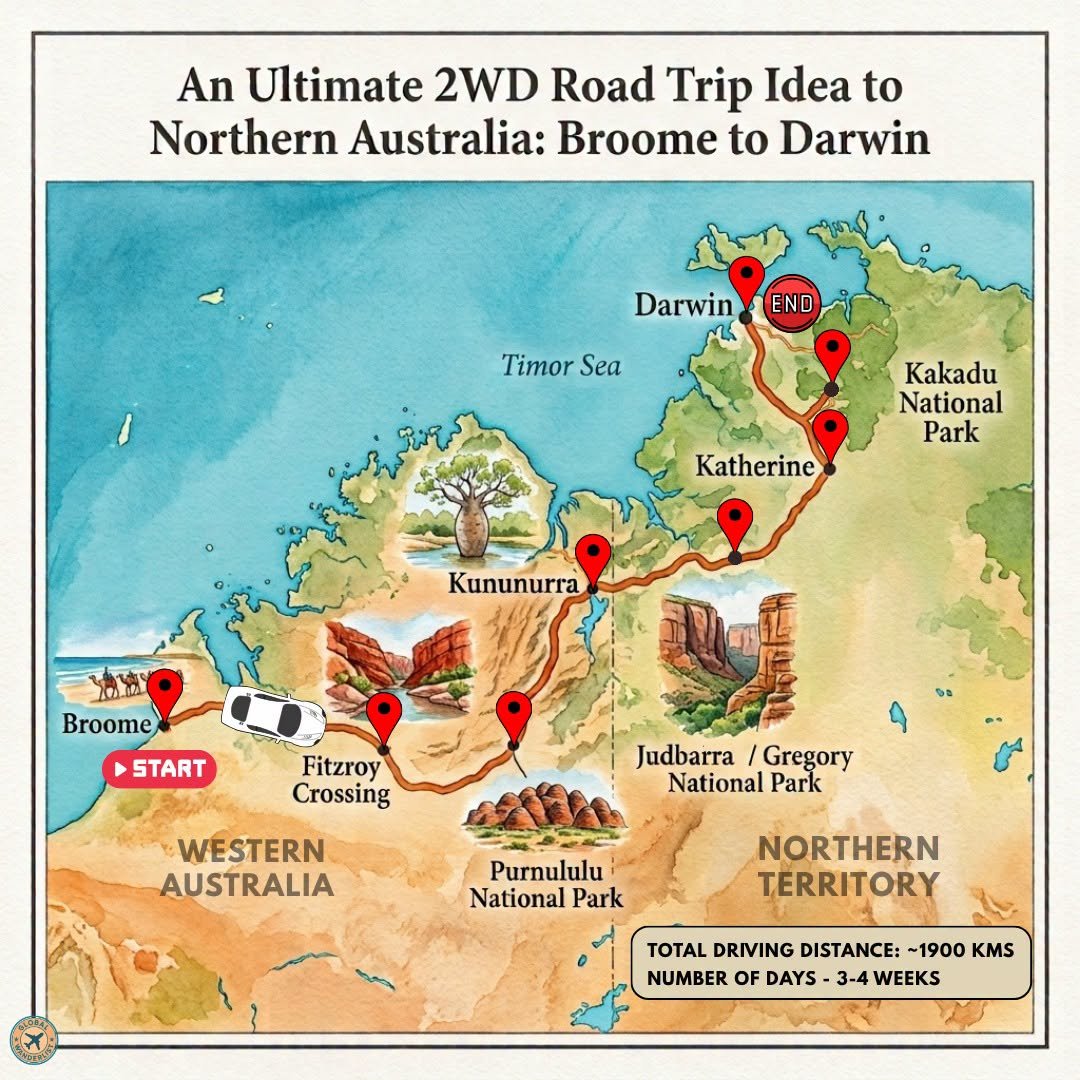
Few drives in Australia feel as vast and untouched as the Broome to Darwin route. This 1,900 kilometer journey crosses the Kimberley region and into the Top End, linking red gorges, cattle stations, and tropical wetlands. Most travelers spend three to four weeks completing it, since the sights along the way reward slow, unhurried exploration.
This route is well suited to a standard 2WD vehicle if you stick to the main highway. Some side trips, like the Bungle Bungles access road, need a high-clearance 4WD. Below is a full breakdown of the journey, along with where to eat and what to see at every major stop.
Route Overview
| Stop | Distance from Previous Stop | Best For |
| Broome (Start) | – | Beaches, pearling history, sunsets |
| Fitzroy Crossing | 260 km | Geikie Gorge, river cruises |
| Purnululu National Park | 250 km | The Bungle Bungle Range |
| Kununurra | 110 km | Lake Argyle, boab trees |
| Judbarra/Gregory National Park | 200 km | Sandstone escarpments, hiking |
| Katherine | 300 km | Nitmiluk Gorge, hot springs |
| Kakadu National Park | 260 km | Rock art, wetlands, wildlife |
| Darwin (End) | 250 km | Harbourfront dining, markets |
Total driving distance runs close to 1,900 kilometers. Spread across three to four weeks, this gives plenty of time for gorge walks, river cruises, and detours off the main highway.
Broome
Broome sits on Roebuck Bay, where turquoise water meets red pindan cliffs. The town built its early economy on pearling, and Chinatown still reflects that multicultural history. Cable Beach draws most visitors, especially for its camel rides at sunset.
Where to Eat in Broome
- Matso’s Broome Brewery remains the town’s most iconic dining spot. Its mango beer and slow-cooked lamb ribs are a local rite of passage, best enjoyed in the heritage beer garden.
- Papá Fuego at The Continental Hotel serves Latin-inspired share plates and flame-grilled meats. It brings a lively, colorful energy that suits a first night in Broome.
What to See in Broome
- Watch the sunset camel ride procession along Cable Beach. It is one of the most photographed scenes in Western Australia.
- Explore Chinatown’s pearling history at the Broome Historical Museum. Old pearling luggers and diving suits tell the story of the town’s origins.
- Visit Gantheaume Point at low tide to see dinosaur footprints exposed in the rock. Time your visit carefully, since the tracks only appear during very low tides.
Also read: Albany to Broome Road Trip Idea
Fitzroy Crossing
Fitzroy Crossing sits beside the Fitzroy River, one of the Kimberley’s major waterways. The town serves as the gateway to Geikie Gorge, where limestone walls rise from the riverbanks. It also marks a practical fuel and supply stop before the long stretch toward the Bungle Bungles.
Where to Eat in Fitzroy Crossing
- The Crossing Inn is the area’s classic outback pub, serving hearty counter meals and cold drinks after a day of driving. It has operated for decades as the social hub of town.
- Fitzroy River Lodge’s restaurant offers a more relaxed sit-down option, with views over the river and a menu built around simple, satisfying dishes.
What to See in Fitzroy Crossing
- Take a boat cruise through Geikie Gorge National Park. Freshwater crocodiles and fruit bats are common sights along the limestone walls.
- Visit Danggu Geikie Gorge at sunrise for the softest light on the ancient reef formations. The gorge was once part of a 350-million-year-old barrier reef.
- Stop by Mimbi Caves on a guided tour with local Traditional Owners. The caves hold significant rock art and geological formations.
Purnululu National Park
Purnululu protects the Bungle Bungle Range, a series of orange and black striped sandstone domes. The park only opened to tourists in the 1980s, despite the formations being millions of years old. Reaching it requires a rough, high-clearance access road, so plan fuel and water carefully.
Where to Eat Near Purnululu
- Bungle Bungle Wilderness Lodge offers meals for guests staying within the park. Its remote setting means options are limited, so book ahead if you plan to eat here.
- Most visitors pack supplies from Kununurra or Halls Creek before entering the park. There are no towns inside Purnululu itself, so self-sufficiency is essential.
What to See in Purnululu National Park
- Walk into Cathedral Gorge, a massive natural amphitheater carved into the domes. The acoustics and scale make it one of the Kimberley’s most memorable stops.
- Take a scenic flight over the Bungle Bungle Range. Aerial views reveal the full scale of the striped dome formations that ground level cannot capture.
- Explore Piccaninny Creek on a longer day walk. It winds between towering rock walls and offers a quieter alternative to the busier gorge trails.
Kununurra
Kununurra sits near the Western Australia and Northern Territory border, built around irrigation from the Ord River scheme. Lake Argyle, one of Australia’s largest man-made reservoirs, sits just south of town. Boab trees dot the surrounding landscape, giving the area a distinctive character.
Where to Eat in Kununurra
- The PumpHouse restaurant overlooks the Ord River and is popular for sunset dinners and cocktails. Its relaxed setting makes it a favorite after a day of exploring.
- Hoochery Distillery combines rum tastings with a casual bistro menu. It is a uniquely Kununurra experience, given the distillery’s use of local sugar cane.
What to See in Kununurra
- Cruise or kayak Lake Argyle, taking in views of the surrounding ranges. The lake holds roughly twenty times the volume of Sydney Harbour.
- Visit Mirima National Park, often called the mini Bungle Bungles. Its compact size makes it an easy walk right on the edge of town.
- Watch the sunset from Kelly’s Knob Lookout. The view stretches across the Kununurra irrigation area and surrounding hills.
Judbarra/Gregory National Park
Judbarra, also known as Gregory National Park, spans a rugged stretch of sandstone escarpments and river valleys. It is one of the Northern Territory’s largest parks and remains relatively undeveloped for tourism. Hiking trails here range from short lookouts to multi-day treks.
Where to Eat Near Judbarra
- Victoria River Roadhouse serves as the main stop for fuel, snacks, and simple meals along this stretch. It sits right on the highway and is a reliable rest point.
- Timber Creek, a small town within the park boundaries, has a hotel bistro offering basic pub meals. Bookings are not usually necessary given its low visitor numbers.
What to See in Judbarra/Gregory National Park
- Hike to Escarpment Walk near Timber Creek for sweeping views over the Victoria River. The lookout captures the layered sandstone cliffs well.
- Drive the Bullita Homestead loop to see remnants of an old cattle station. Interpretive signs explain the area’s pastoral history.
- Spot wildlife along the Victoria River, including freshwater crocodiles and a wide range of birdlife.
Katherine
Katherine sits on the Katherine River, roughly three hours south of Darwin. Nitmiluk National Park, home to Katherine Gorge, is the region’s main drawcard. The town also serves as a key supply stop for travelers heading in either direction along the Stuart Highway.
Where to Eat in Katherine
- Kumbidgee Restaurant sits beside a lily-covered dam just outside town. Its barramundi and buffalo steak dishes have built a strong local reputation for quality.
- Savannah Bar & Restaurant at Knotts Crossing Resort is considered one of Katherine’s finest dining rooms. Its menu highlights regional produce in a relaxed resort setting.
What to See in Katherine
- Cruise or kayak through Nitmiluk Gorge, formed by thirteen sandstone chasms. Sunset cruises are especially popular for the changing light on the cliff faces.
- Soak in Katherine Hot Springs, a series of naturally warm thermal pools along the river. It makes a relaxing stop after a day of gorge walks.
- Visit the Katherine Outback Experience for a look at stock horse and outback culture. Shows combine horsemanship with storytelling about the region’s cattle stations.
Kakadu National Park
Kakadu is Australia’s largest national park and a UNESCO World Heritage site. It protects vast wetlands, sandstone escarpments, and some of the world’s oldest known rock art. Jabiru serves as the park’s main town and central base for exploring.
Where to Eat in Kakadu
- Cooinda Lodge’s restaurant serves meals overlooking the Yellow Water wetlands. It is a popular stop before or after the famous Yellow Water cruise.
- Mercure Kakadu Crocodile Hotel in Jabiru offers a casual dining room shaped, fittingly, like a crocodile from above. It serves as a reliable option within the park township.
What to See in Kakadu National Park
- Take a Yellow Water Billabong cruise at sunrise or sunset. Crocodiles, jabirus, and thousands of waterbirds gather along the water’s edge.
- Visit Ubirr for ancient Aboriginal rock art and panoramic views over the Nadab floodplain. The site holds some of the longest continuously practiced rock art traditions on Earth.
- Explore Nourlangie Rock, another major rock art site with galleries depicting ancestral stories. Short walking trails loop through the surrounding sandstone.
Darwin
Darwin marks the end of this route, a tropical capital rebuilt after Cyclone Tracy in 1974. Its harborfront dining scene has grown into one of the most underrated in the country. Markets, museums, and waterfront parks round out a relaxed final stop.
Where to Eat in Darwin
- The Salted Egg is known for its dry laksa and Humpty Doo barramundi, served in a waterside setting built for long lunches. It captures Darwin’s Southeast Asian-influenced food culture well.
- Laneway Cafe consistently ranks among Darwin’s best coffee spots. It makes an easy, relaxed choice for breakfast before exploring the city.
What to See in Darwin
- Wander the Darwin Waterfront Precinct, with its wave pool, boardwalks, and harbor views. Evening light here is particularly striking.
- Visit the Museum and Art Gallery of the Northern Territory to learn about Cyclone Tracy and regional Aboriginal art. The cyclone gallery is a sobering, well-presented exhibit.
- Catch the Mindil Beach Sunset Market on Thursday or Sunday evenings during the dry season. Food stalls, live music, and beach sunsets make it a signature Darwin experience.
Also read: Adelaide to Darwin Road Trip Idea
Final Thoughts
The Broome to Darwin route trades coastal highways for gorges, wetlands, and some of Australia’s oldest landscapes. Every stop along the way offers something distinct, from pearling history to ancient rock art. Plan for the dry season, pack extra fuel and water, and give yourself the full three to four weeks to do it justice.