
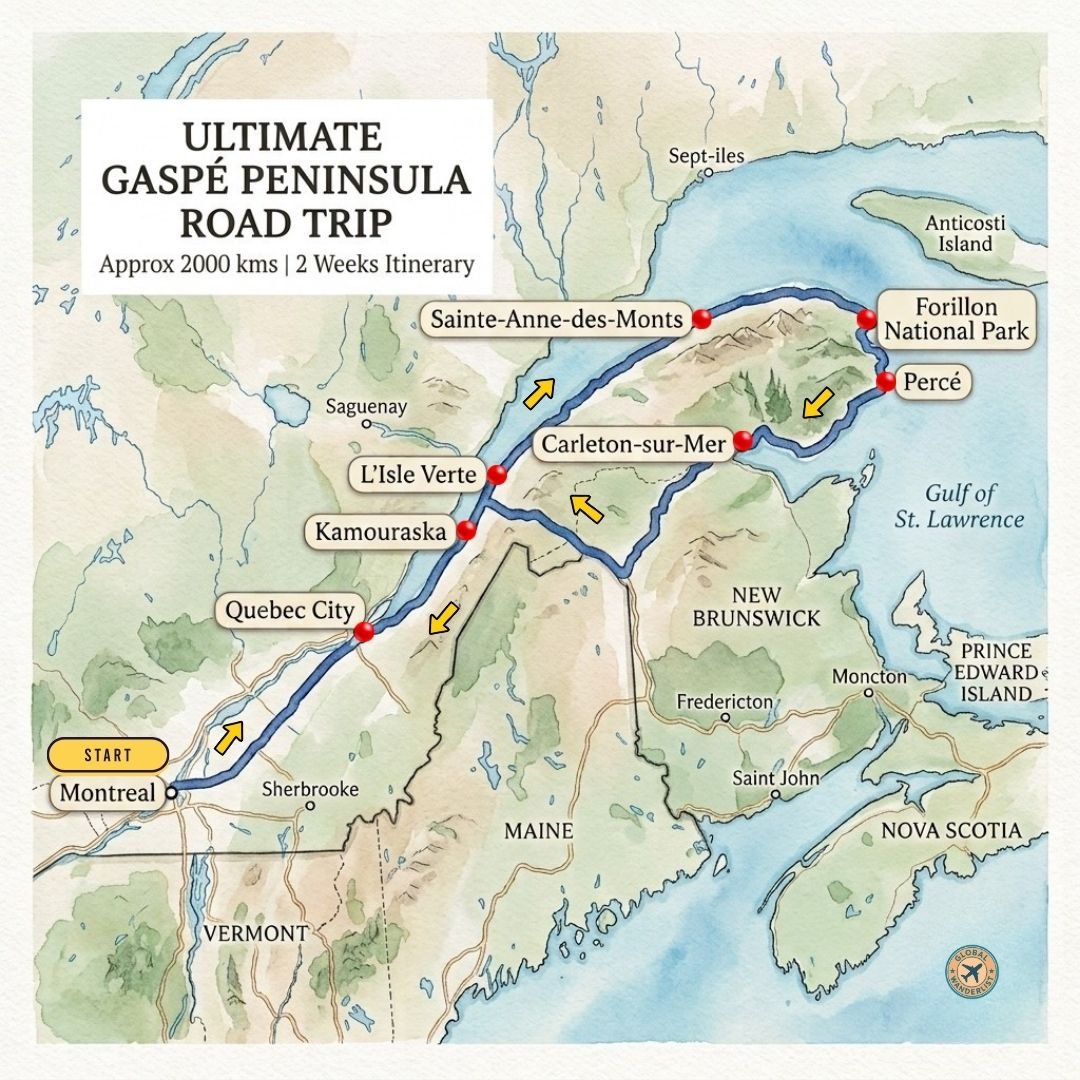
The Gaspé Peninsula road trip is one of the most rewarding drives in eastern Canada, tracing roughly 2,000 kilometers along the St. Lawrence River and the Gulf of St. Lawrence. Starting in Montreal, the route follows the river northeast before curving around the tip of the peninsula and back through the interior. Most travelers set aside two weeks to properly explore the fishing villages, cliffside parks, and seafood along the way.
This drive rewards patience more than speed. Small coastal towns, whale-watching opportunities, and dramatic ocean cliffs appear at nearly every turn once you pass Quebec City. Below is a full breakdown of the route, including where to eat and what to see at each major stop.
Route Overview
| Stop | Distance from Previous Stop | Best For |
|---|---|---|
| Montreal (Start) | – | City sights, departure point |
| Quebec City | 250 km | Old town, fortified walls |
| Kamouraska & L’Isle-Verte | 130 km | River views, small villages |
| Sainte-Anne-des-Monts | 280 km | Gaspésie National Park, wildlife |
| Carleton-sur-Mer | 190 km | Beaches, mountain views |
| Percé | 100 km | Rocher Percé, Bonaventure Island |
| Forillon National Park (End) | 45 km | Coastal cliffs, hiking |
Total driving distance comes to approximately 2,000 kilometers round trip. Spreading this across two weeks allows real time to explore both coastlines of the peninsula rather than just the outbound route.
Montreal
Montreal serves as the natural starting point for this journey, a bilingual city known for its European character and strong food culture. Before departing, it is worth spending a day or two exploring Old Montreal and sampling the city’s famous bagels and smoked meat. The drive northeast toward Quebec City follows the St. Lawrence River for most of the way.
Where to Eat in Montreal
- Schwartz’s Deli remains the city’s most iconic smoked meat institution, having served the same recipe since 1928. Expect a line, but it moves quickly.
- Montreal’s countless bagel shops, particularly in the Mile End neighborhood, are worth sampling before you leave the city behind.
What to See in Montreal
- Walk through Old Montreal’s cobblestone streets, taking in the Notre-Dame Basilica’s striking interior.
- Visit Mount Royal Park for panoramic views over the city skyline and river.
- Explore the Jean-Talon Market for a sense of Quebec’s strong food culture before heading out on the road.
Quebec City
Quebec City is one of the oldest European settlements in North America, and its fortified Old Town remains the only walled city north of Mexico. Cobblestone streets, historic ramparts, and the iconic Château Frontenac give it a distinctly European feel. It makes a natural first overnight stop on the way out of Montreal.
Where to Eat in Quebec City
- Le Clan, helmed by chef Stéphane Modat, earned a Michelin star in 2026 and is considered one of the city’s finest tables. Reservations are essential.
- La Tanière³ offers an ambitious tasting menu built around wild Quebec ingredients, including sturgeon and Kamouraska sea rose, and has held multiple Michelin stars.
What to See in Quebec City
- Walk along the Dufferin Terrace for sweeping views over the St. Lawrence River and the Château Frontenac.
- Explore the Plains of Abraham, site of the pivotal 1759 battle between British and French forces.
- Wander through the narrow streets of Petit Champlain, one of the oldest commercial districts in North America.
Kamouraska and L’Isle-Verte
East of Quebec City, the highway hugs the St. Lawrence River as it widens toward the sea. Kamouraska is known for its distinctive light and has long attracted painters and photographers. L’Isle-Verte, a little further along, offers a quieter, marshier landscape and access to a small nearby island.
Where to Eat in Kamouraska and L’Isle-Verte
- Kamouraska’s small-town bistros focus on local river and coastal ingredients, including the region’s well-known salt marsh lamb.
- L’Isle-Verte’s general stores and casual cafes provide simple, satisfying stops for travelers passing through.
What to See in Kamouraska and L’Isle-Verte
- Watch the sunset over the widening St. Lawrence River, a view that has drawn artists to Kamouraska for generations.
- Visit L’Isle-Verte’s lighthouse and nature reserve, known for its birdlife and salt marsh ecosystem.
- Explore the small art galleries scattered through Kamouraska’s historic village center.
Sainte-Anne-des-Monts
Sainte-Anne-des-Monts marks the gateway to Gaspésie National Park, home to the Chic-Choc Mountains and one of the southernmost caribou herds in North America. The town itself is a practical stop for fuel and supplies before heading into more remote terrain. This stretch marks a clear shift from riverside towns to genuine wilderness.
Where to Eat in Sainte-Anne-des-Monts
- Local seafood restaurants in town make the most of the Gulf of St. Lawrence’s proximity, with fresh cod and shrimp featuring prominently on menus.
- Casual diners and cafes along the main strip offer easy, unpretentious meals before or after a day in the national park.
What to See in Sainte-Anne-des-Monts
- Hike in Gaspésie National Park, home to Mont Jacques-Cartier, one of the highest peaks in southern Quebec.
- Look for woodland caribou on guided hikes, a rare sighting this far south in North America.
- Visit the Exploramer, a marine discovery center focused on the Gulf of St. Lawrence’s ecosystem.
Carleton-sur-Mer
Carleton-sur-Mer sits on the peninsula’s southern coast, known for its beaches and the striking Mont Saint-Joseph rising directly behind town. The Baie des Chaleurs here is notably warmer than much of the surrounding gulf, making it a popular summer stop. Vineyards and orchards dot the surrounding countryside.
Where to Eat in Carleton-sur-Mer
- Waterfront restaurants along the town’s main strip serve fresh local seafood with views over the Baie des Chaleurs.
- Casual cafes near the beach make an easy stop for lunch before continuing along the coastal highway.
What to See in Carleton-sur-Mer
- Take the cable car or hike up Mont Saint-Joseph for panoramic views over the Baie des Chaleurs.
- Relax on the town’s beach, known for its unusually warm water compared to the rest of the Gaspé coast.
- Visit the Carleton-sur-Mer marina for a relaxed evening walk along the waterfront.
Percé
Percé is the visual highlight of the entire peninsula, home to the iconic Rocher Percé, a massive pierced limestone rock formation just offshore. Bonaventure Island, a short boat ride away, hosts one of the largest colonies of northern gannets in the world. The town itself has built its economy almost entirely around this dramatic scenery.
Where to Eat in Percé
- La Maison du Pêcheur is famous for its windowed veranda overlooking Rocher Percé, particularly popular for sunset dinners built around fresh seafood.
- Brise Bise brings a lively bistro atmosphere with seafood risotto and other coastal dishes, known for friendly service and live music.
What to See in Percé
- Take a boat tour around Rocher Percé and out to Bonaventure Island to see the gannet colony up close.
- Walk the boardwalk along Percé’s main beach for the classic view of the pierced rock formation.
- Hike up to the Percé Geopark viewpoint for a wider perspective over the rock, the village, and the gulf beyond.
Forillon National Park
Forillon National Park marks the very tip of the Gaspé Peninsula, where the Appalachian Mountains meet the sea. Dramatic limestone cliffs, sheltered coves, and abundant wildlife make it a fitting finale to the drive. Whales are commonly spotted from several points along the park’s coastline.
Where to Eat Near Forillon National Park
- Magasin Général Forillon offers local products including fresh bakery bread and artisanal goods, a good stop for picnic supplies before hiking.
- Nearby Gaspé town has a range of bistros and seafood spots, including favorites known for their Gaspé-style bouillabaisse.
What to See in Forillon National Park
- Hike Les Graves Trail for a chance to spot seals, whales, and seabirds along the dramatic coastal cliffs.
- Visit Cap-Bon-Ami for one of the park’s most photographed viewpoints over the Gulf of St. Lawrence.
- Explore the park’s historic fishing village exhibits, preserving the area’s maritime heritage.
Also read: Southern Alberta Road Trip Idea
Final Thoughts
The Gaspé Peninsula road trip captures an extraordinary range of Quebec’s landscapes, from the fortified streets of Quebec City to the pierced rock of Percé and the cliffs of Forillon. Every stop along the way adds its own character, built around the rhythm of the sea. Give yourself the full two weeks if possible, and let the smaller villages between the major stops shape the pace of your journey.