
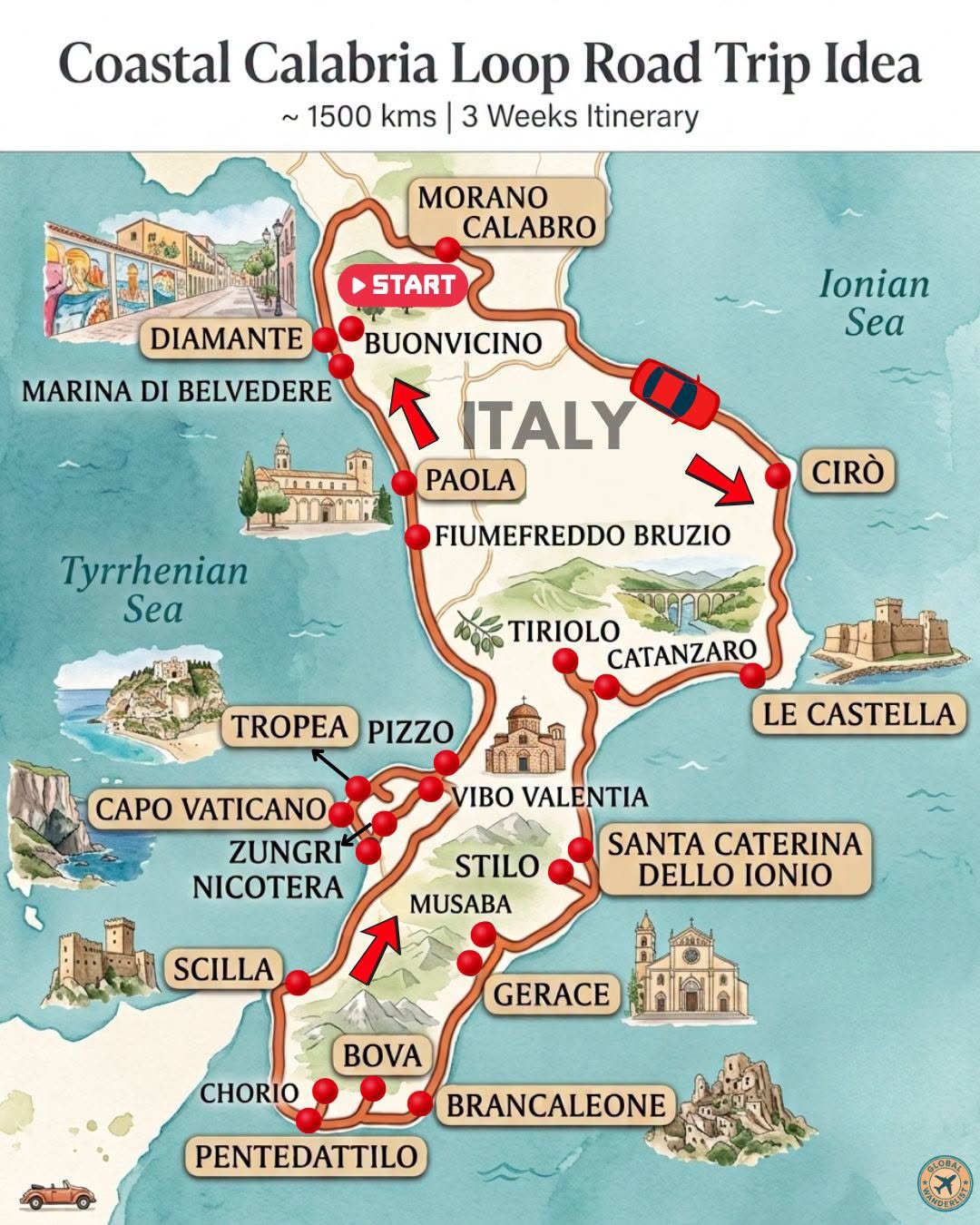
Calabria sits at the very toe of the Italian boot, and it rewards travelers who go slowly. This loop covers roughly 1,500 kilometers. It links two seas, dozens of hilltop villages, and some of the least crowded coastline in Italy.
You will drive along the Tyrrhenian Sea with its orange sunsets and cliffside towns. You will also cross to the Ionian coast, where ancient Greek ruins meet quiet beaches. In between, the route climbs into the Pollino and Aspromonte mountains, past stone villages that feel frozen in time.
This trip suits travelers who love slow food, real history, and landscapes that have not been polished for mass tourism. It works well for couples, photographers, and anyone chasing authentic Italy rather than the well-worn Amalfi crowds. Expect narrow roads, incredible seafood, and warm hospitality at every stop.
Give yourself three weeks if possible. Two weeks works if you skip a few inland detours. Either way, rent a small car. Many town centers have tight, winding streets built centuries before automobiles existed.
Trip Overview
| Stop | Distance from Previous Stop | Driving Time | Main Highlights | Recommended Stay |
|---|---|---|---|---|
| Buonvicino | Start | – | Hilltop views, historic core | 1 night |
| Morano Calabro | 45 km | 50 min | Medieval hill village, Pollino views | 1 night |
| Diamante | 40 km | 45 min | Street murals, chili culture, beaches | 1-2 nights |
| Marina di Belvedere | 10 km | 15 min | Long sandy beach, relaxed promenade | Half day |
| Paola | 20 km | 25 min | Sanctuary of San Francesco, old town | Half day |
| Fiumefreddo Bruzio | 10 km | 15 min | Clifftop medieval village | Half day |
| Cirò | 130 km | 1 hr 45 min | Wine country, coastal views | 1 night |
| Catanzaro | 75 km | 1 hr | City views, Bridge of the Morandi | Half day |
| Tiriolo | 15 km | 20 min | Panoramic ridge village, textiles | Half day |
| Le Castella | 60 km | 1 hr | Aragonese castle on the sea | Half day |
| Santa Caterina dello Ionio | 70 km | 1 hr 10 min | Quiet Ionian beaches | Half day |
| Stilo | 20 km | 25 min | Byzantine Cattolica church | Half day |
| Gerace | 55 km | 1 hr | Cathedral, stone streets, views | 1 night |
| Brancaleone | 45 km | 50 min | Ionian beaches, citrus groves | Half day |
| Pentedattilo | 25 km | 35 min | Ghost village on volcanic rock | Half day |
| Chorio | 10 km | 15 min | Aspromonte foothill hamlet | Half day |
| Bova | 15 km | 25 min | Greek-Calabrian culture, stone lanes | Half day |
| Scilla | 45 km | 1 hr | Chianalea fishing quarter, castle | 1-2 nights |
| Musaba | 20 km | 30 min | Open-air sculpture park | Half day |
| Nicotera | 55 km | 1 hr | Beach town, historic center | Half day |
| Zungri | 20 km | 30 min | Rock-cut cave dwellings | Half day |
| Capo Vaticano | 15 km | 20 min | Dramatic cliffs, best beaches | Half day |
| Tropea | 10 km | 15 min | Clifftop pearl of the Tyrrhenian | 2 nights |
| Pizzo | 15 km | 20 min | Tartufo gelato, Murat’s castle | 1 night |
| Vibo Valentia | 10 km | 15 min | Archaeology museum, castle | Half day |
Buonvicino
Buonvicino is where this loop begins, a small hill town overlooking the Tyrrhenian Sea. Its stone streets climb steeply from terraced olive groves toward a quiet historic core. Few tourists stop here, which makes it a peaceful and authentic starting point.
Where to Eat in Buonvicino
- Trattoria del Borgo – Calabrian home cooking – $$
- Bar Centrale – Coffee, pastries, and light snacks – $
- Locanda San Nicola – Regional cuisine with local wine pairings – $$
What to See in Buonvicino
- The old town’s narrow alleys reveal stone archways and centuries-old doorways worth a slow walk.
- Panoramic viewpoints near the top of town look straight out over the coastline toward the sea.
- The parish church holds modest but interesting religious artwork from the region’s Baroque period.
- Surrounding olive terraces make for an easy morning walk before you get back on the road.
Morano Calabro
Morano Calabro rises in tight concentric circles up a steep hillside, crowned by a ruined Norman castle. It sits at the edge of Pollino National Park, Italy’s largest protected wilderness. The town is often ranked among Italy’s most beautiful villages, and the climb to the top rewards you with sweeping mountain views.
Where to Eat in Morano Calabro
- Ristorante Rocca del Drago – Traditional Calabrian mountain cuisine – $$
- La Locanda del Parco – Regional dishes with Pollino ingredients – $$
- Antica Dispensa – Cured meats, cheeses, and pasta – $$
What to See in Morano Calabro
- The Norman castle ruins sit at the summit and offer the best panoramic view in town.
- Collegiata di Maria Santissima Maddalena houses notable religious art inside its Baroque interior.
- Wandering the spiral of stepped lanes feels like walking through a living medieval postcard.
- Pollino National Park borders the town, offering hiking trails through beech and pine forests.
- Local shops sell Pollino wild strawberries and mountain cheeses worth tasting before you leave.
Diamante
Diamante built its reputation on two things: chili peppers and street art. More than 200 murals cover its historic center, painted by artists from around the world. The town also sits on the Riviera dei Cedri, a stretch of coast famous for citron and swimming beaches.
Where to Eat in Diamante
- Ristorante Il Gabbiano – Fresh seafood and Calabrian pasta – $$
- La Locanda di Zio Rocco – Rustic trattoria known for spicy peperoncino dishes – $
- Trattoria Il Vicoletto – Local seafood in the historic center – $$
What to See in Diamante
- The murals scattered through the old town turn every alley into an open-air gallery.
- Spiaggia Grande offers soft sand and calm water for an easy afternoon swim.
- The Peperoncino Museum explains the region’s obsession with chili in playful detail.
- Boat trips to the nearby Isola di Cirella pair snorkeling with views of a ruined village.
- Sunset from the seafront promenade is one of the best photo opportunities on this stretch of coast.
Marina di Belvedere
Marina di Belvedere sits just south of Diamante, known for one of the longest sandy beaches on this coast. The pace here is relaxed, with beach clubs, gentle waves, and far fewer crowds than nearby resort towns. It makes a good spot to slow down for an afternoon swim.
Where to Eat in Marina di Belvedere
- Sabbia d’Oro – Beachfront dining with sea views – $$
- Ristorante La Tonnara – Seafood specialties near the harbor – $$
- Chalet del Mare – Casual lunch and grilled fish – $
What to See in Marina di Belvedere
- The long sandy beach is ideal for families and anyone wanting calmer water than the rockier coves nearby.
- The clifftop old town of Belvedere Marittimo sits just above, with a Norman-Swabian castle worth the short detour.
- Evening walks along the promenade catch the sun setting behind the sea.
- Local beach clubs rent umbrellas and loungers by the day if you want to linger longer.
Paola
Paola is best known as the birthplace of Saint Francis of Paola, whose sanctuary draws pilgrims from across southern Italy. The town itself has a compact historic center with steep stairways and a lively main street. It works well as a cultural stop between beach towns.
Where to Eat in Paola
- Ristorante La Play – Seafood and regional dishes near the shore – $$
- Antica Trattoria del Vecchio Convento – Traditional Calabrian menu – $$
- Caffè Centrale – Espresso and pastries in the main piazza – $
What to See in Paola
- The Sanctuary of San Francesco di Paola is Calabria’s most important pilgrimage site, with frescoed cloisters and a peaceful courtyard.
- The historic center’s stepped streets are worth wandering for their old stone facades.
- The seafront promenade gives easy access to a pebble beach for a quick swim.
- The town’s Friday market is a good spot to pick up local produce and cheese.
Fiumefreddo Bruzio
Fiumefreddo Bruzio perches on a rocky spur above the Tyrrhenian, one of the smallest and most photogenic villages on this coast. Its name means cold river, referring to a nearby spring. The village has been restored carefully, with boutique guesthouses tucked into old stone buildings.
Where to Eat in Fiumefreddo Bruzio
- Villa Grimaldi Ristorante – Refined Calabrian cuisine with sea views – $$$
- Osteria del Borgo – Simple, local dishes in a historic setting – $$
- Bar Panoramico – Coffee and light bites with a view – $
What to See in Fiumefreddo Bruzio
- The village belvedere offers one of the finest sunset views on the entire Tyrrhenian coast.
- Palazzo Cavalcanti and other restored buildings show off the town’s careful preservation.
- Narrow stone lanes wind past artisan shops selling ceramics and textiles.
- The short drive down to the coastal road passes citrus groves worth a photo stop.
Cirò
Cirò is Calabria’s wine capital, famous for the robust red Cirò DOC made from Gaglioppo grapes. The town sits inland from a stretch of Ionian coast known for quiet beaches and archaeological sites. Wine tasting here feels unpretentious and genuinely local.
Where to Eat in Cirò
- Ristorante Cariddi – Regional cuisine paired with local Cirò wine – $$
- Enoteca Librandi – Wine bar with light plates and tastings – $$
- Trattoria del Contadino – Farm-to-table Calabrian dishes – $
What to See in Cirò
- Local wineries welcome visitors for tastings of Cirò Rosso, one of Italy’s oldest documented wines.
- The medieval castle ruins above town offer sweeping views over vineyards to the sea.
- Cirò Marina’s beaches make a good stop for an afternoon swim after wine tasting.
- The ancient Greek site of Krimisa nearby hints at the region’s classical past.
Catanzaro
Catanzaro is Calabria’s regional capital, built across three hills between the Tyrrhenian and Ionian seas. The city mixes modern infrastructure, including the striking Bisantis Bridge, with a historic core full of churches and museums. It makes a practical stop for a city break mid-route.
Where to Eat in Catanzaro
- Ristorante Abbruzzino – Modern Calabrian fine dining – $$$
- Locanda in Piazza San Rocco – Traditional regional cooking – $$
- Trattoria Pantagruel – Hearty local dishes in a casual setting – $$
What to See in Catanzaro
- The Bisantis Bridge is one of the tallest single-span bridges in Europe and worth photographing from below.
- MARCA, the regional art museum, houses contemporary and modern Calabrian artists.
- The historic center’s Villa Trieste park offers shaded walks and skyline views.
- Catanzaro Lido gives quick access to the sea if you need a break from sightseeing.
Tiriolo
Tiriolo sits on a narrow ridge with views stretching to both the Tyrrhenian and Ionian seas on a clear day. The village is known for handwoven textiles, a tradition still practiced by local artisans. It is a quick but rewarding detour from Catanzaro.
Where to Eat in Tiriolo
- Ristorante Due Mari – Regional dishes with panoramic terrace – $$
- Trattoria della Nonna – Home-style Calabrian cooking – $
- Bar Belvedere – Coffee and snacks with a view – $
What to See in Tiriolo
- The ridge-top viewpoint is one of the few places in Italy where both seas are visible at once.
- Local weaving workshops still produce traditional Calabrian textiles by hand.
- The archaeological museum displays finds from the ancient Tabula Tiriolensis inscription.
- Quiet streets make for an easy, uncrowded stroll before continuing the route.
Le Castella
Le Castella takes its name from the Aragonese castle standing on a small rocky islet, connected to shore by a narrow spit of sand. It is one of the most photographed spots in Calabria, especially at sunset. The surrounding Capo Rizzuto marine reserve protects some of the clearest water on the Ionian coast.
Where to Eat in Le Castella
- Ristorante Annibale – Fresh seafood with castle views – $$
- Trattoria Il Corsaro – Local fish dishes near the harbor – $$
- Bar del Porto – Casual snacks and drinks by the marina – $
What to See in Le Castella
- The Aragonese Castle is the star attraction, especially photogenic in late afternoon light.
- The surrounding marine protected area offers excellent snorkeling in clear water.
- The small beach beside the castle is a great spot for a swim with a historic backdrop.
- Boat tours from the harbor explore nearby coves along the Capo Rizzuto coastline.
Santa Caterina dello Ionio
Santa Caterina dello Ionio combines a quiet hilltop old town with a separate beach area below. The Ionian coast here feels far less developed than the Tyrrhenian side, with long stretches of open sand. It suits travelers looking for an unhurried beach stop.
Where to Eat in Santa Caterina dello Ionio
- Ristorante Riviera – Seafood and grilled fish by the beach – $$
- Trattoria Il Gabbiano dello Ionio – Local Calabrian dishes – $
- Chalet Blu – Casual lunch spot on the sand – $
What to See in Santa Caterina dello Ionio
- The upper old town offers quiet streets and a peaceful break from the coastal heat.
- The beach below stretches for a good distance, with far fewer crowds than the western coast.
- Sunrise here is particularly striking, since the Ionian side faces east.
- Nearby nature trails lead into the hills for those wanting a short hike.
Stilo
Stilo sits at the base of Monte Consolino, home to the Cattolica, one of Italy’s finest surviving Byzantine churches. The small brick structure with its five domes dates back roughly a thousand years. The town around it retains a strong Byzantine and Norman character.
Where to Eat in Stilo
- Ristorante San Giorgio – Traditional Calabrian cuisine – $$
- Trattoria della Cattolica – Local dishes near the historic church – $
- Bar Centrale Stilo – Coffee and light bites – $
What to See in Stilo
- The Cattolica di Stilo is a rare and remarkably intact example of Byzantine architecture in Italy.
- The climb up Monte Consolino rewards hikers with valley views and ruined castle remnants.
- The old town’s stone lanes preserve a distinctly Byzantine layout worth exploring on foot.
- The Museo Diocesano displays religious artifacts tied to the region’s Greek-Byzantine heritage.
Gerace
Gerace is one of Calabria’s most impressive hill towns, built on a rocky spur with sweeping views to the Ionian Sea. Its cathedral is the largest in Calabria, built using columns salvaged from ancient Greek temples. The entire town feels remarkably well preserved.
Where to Eat in Gerace
- A Squella – Traditional Calabrian trattoria – $$
- Ristorante La Casa Nel Borgo – Regional dishes in a historic setting – $$
- Osteria del Duomo – Local specialties near the cathedral – $
What to See in Gerace
- The Cathedral of Gerace is Calabria’s largest church, with a crypt supported by ancient columns.
- The Norman castle ruins at the town’s edge give panoramic views over the surrounding valley.
- Cobblestone streets wind past dozens of small churches packed into a compact old town.
- Local ceramics workshops sell handmade pottery in traditional Calabrian patterns.
Brancaleone
Brancaleone sits on the Ionian coast near the southern tip of Calabria, known for its citrus groves and long sandy beaches. The area has a wilder, less touristy feel than the towns further north. It makes a good stop before heading into the Aspromonte foothills.
Where to Eat in Brancaleone
- Ristorante Costa Jonica – Fresh seafood with sea views – $$
- Trattoria da Peppe – Local Calabrian home cooking – $
- Bar Marina – Casual snacks near the beach – $
What to See in Brancaleone
- The long sandy beaches here are quieter than most on the Tyrrhenian side of the loop.
- Bergamot groves nearby explain the region’s link to the famous citrus used in Earl Grey tea.
- The old town of Brancaleone Superiore, largely abandoned after a landslide, makes an interesting short detour.
- Coastal viewpoints offer clear sightlines toward Sicily on a clear day.
Pentedattilo
Pentedattilo is a striking ghost village built into a rock formation shaped like a five-fingered hand. Most residents left after earthquakes in the 18th and 20th centuries, leaving crumbling stone houses clinging to the cliff. Artists have since moved in, giving the village a slow revival.
Where to Eat in Pentedattilo
- Osteria Il Borgo – Simple Calabrian dishes in a historic setting – $$
- Bar Pentedattilo – Coffee and light snacks – $
- Trattoria delle Cinque Dita – Local specialties near the village entrance – $$
What to See in Pentedattilo
- The rock formation itself is the main attraction, especially striking at sunset when the stone glows orange.
- Wandering the abandoned stone houses gives a haunting sense of the village’s history.
- Small art studios and craft shops have opened inside restored buildings.
- The nearby church ruins add to the atmospheric, half-abandoned feel of the site.
Chorio
Chorio is a small hamlet in the Aspromonte foothills, a quiet stop between the coast and the mountains. It has little in the way of major attractions, but its calm streets and rural setting offer a break from busier towns. Expect a slower pace and genuine local life here.
Where to Eat in Chorio
- Trattoria del Borgo Chorio – Home-style mountain cooking – $
- Bar Aspromonte – Coffee and simple snacks – $
- Agriturismo Le Terre – Farm-to-table regional dishes – $$
What to See in Chorio
- The surrounding hills offer easy walking routes through olive and chestnut groves.
- The village’s modest church anchors a quiet main square worth a short stop.
- Local farms sell homemade cheese and cured meats directly to visitors.
- The drive in and out passes scenic overlooks toward the Ionian coast below.
Bova
Bova is the cultural heart of Calabria’s Greek-speaking minority, where the ancient Griko dialect is still spoken by a few elderly residents. Stone houses climb a steep hill topped by castle ruins. The town has been recognized as one of Italy’s most beautiful villages.
Where to Eat in Bova
- Ristorante Kalos – Traditional dishes with Greek-Calabrian influence – $$
- Trattoria del Castello – Local mountain cuisine – $
- Bar Centrale Bova – Coffee and pastries in the main square – $
What to See in Bova
- The Norman castle ruins at the summit provide sweeping views over the Aspromonte and coastline below.
- The Casa del Parco museum explains the Griko language and Greek-Calabrian heritage in detail.
- Steep stone streets lined with old houses make for a rewarding, if strenuous, walk.
- The cathedral and several small churches reflect centuries of layered religious history.
Scilla
Scilla is one of Calabria’s most beautiful coastal towns, named after the mythical sea monster from Homer’s Odyssey. The Chianalea fishing quarter has houses built directly into the water, with narrow lanes and boats moored at doorsteps. A Norman-era castle crowns the promontory above.
Where to Eat in Scilla
- Trattoria u Bais – Long-running seafood restaurant in Chianalea – $$
- Bleu de Toi – Waterfront dining known for swordfish and tuna – $$
- Glauco Ristorante – Fresh seafood with views over the strait – $$$
What to See in Scilla
- Chianalea, the fishing district, is often called the Venice of the South for its waterfront houses.
- Castello Ruffo sits above town with sweeping views across the Strait of Messina to Sicily.
- Marina Grande beach is a good spot to swim before continuing along the coast.
- Sunset over the strait, with Sicily silhouetted in the distance, is a must-see moment here.
Musaba
Musaba, short for Museo Santa Barbara, is an unusual open-air sculpture park built around a former Basilian monastery. Contemporary art installations sit scattered across gardens and ruins. It is an unexpected cultural stop tucked into the hills near the coast.
Where to Eat near Musaba
- Agriturismo San Rocco – Farm-based Calabrian cooking – $$
- Trattoria della Collina – Local dishes near the museum grounds – $
- Bar Musaba – Coffee and light refreshments – $
What to See in Musaba
- The sculpture park mixes contemporary art with the ruins of a medieval monastery.
- The site’s chapel houses striking modern artwork inside a centuries-old structure.
- Garden pathways wind past installations that change with the seasons.
- The surrounding countryside offers quiet views over the Aspromonte foothills.
Nicotera
Nicotera sits where the Costa degli Dei begins, with a historic hilltop center overlooking a long beach below. The town has Norman and Angevin roots, visible in its old fortress and layered streets. It offers a quieter alternative to the busier resort towns further along the coast.
Where to Eat in Nicotera
- Ristorante Il Vecchio Ulivo – Regional Calabrian cuisine – $$
- Trattoria Marina – Fresh seafood near the beach – $$
- Bar del Corso – Coffee and pastries in the old town – $
What to See in Nicotera
- The historic center’s steep lanes lead up to fortress ruins with coastal views.
- Nicotera Marina’s beach is wide and sandy, ideal for an afternoon swim.
- The Diocesan Museum holds religious art tied to the town’s long ecclesiastical history.
- Local markets sell ‘nduja and other Calabrian specialties worth tasting.
Zungri
Zungri is known for its Grotte, a complex of cave dwellings carved into soft rock by medieval communities. The site gives a rare, tangible sense of how people lived here centuries ago. The village itself is small, with a quiet, rural character.
Where to Eat in Zungri
- Trattoria delle Grotte – Local Calabrian dishes near the cave site – $
- Bar Panorama Zungri – Coffee and snacks with a view – $
- Agriturismo Il Casale – Farm-to-table regional meals – $$
What to See in Zungri
- The rock-cut cave dwellings are the main draw, giving insight into medieval troglodyte life.
- Walking paths around the site pass through olive groves with valley views.
- The village center offers a quiet, unhurried break from the busier coastal towns nearby.
- Local farms sell olive oil and produce grown in the surrounding hills.
Capo Vaticano
Capo Vaticano is widely considered one of the most beautiful stretches of coastline in Italy. Dramatic granite cliffs drop into turquoise water, with hidden coves reachable by short trails. It rivals more famous Italian coastlines without the same level of crowding.
Where to Eat in Capo Vaticano
- Ristorante Baia del Capo – Seafood with panoramic sea views – $$$
- Trattoria Grotticelle – Casual dining near the beach – $$
- Bar Faro Capo Vaticano – Snacks and drinks near the lighthouse – $
What to See in Capo Vaticano
- The lighthouse viewpoint offers one of the best panoramas on the entire Calabrian coast.
- Grotticelle Beach is regularly ranked among Italy’s most beautiful, with pale sand and clear water.
- Short cliffside trails connect several coves worth exploring on foot.
- Sunset here rivals anywhere on the Amalfi Coast, with far fewer people watching it.
Tropea
Tropea is the undisputed star of Calabria’s coastline, a clifftop town overlooking dramatic beaches and the Aeolian Islands in the distance. The Santa Maria dell’Isola church sits on a rock connected to the mainland, one of the most photographed sights in southern Italy. The historic center is packed with shops, restaurants, and viewpoints.
Where to Eat in Tropea
- Osteria del Pescatore – Seafood specialties including swordfish – $$
- Al Pinturicchio – Romantic old-town cellar restaurant – $$
- Pimm’s – Clifftop dining with sea views – $$$
- Genus Loci – Modern Calabrian cuisine on a scenic terrace – $$$
What to See in Tropea
- Santa Maria dell’Isola, perched on its rock above the beach, is the town’s defining image.
- The clifftop promenade offers some of the best sunset views in Calabria.
- The historic center’s lanes are packed with shops selling the town’s famous red onions and local products.
- Tropea’s main beach, right below the old town, is one of the most photogenic in Italy.
- Boat trips from the harbor explore nearby coves and connect toward the Aeolian Islands.
Pizzo
Pizzo is famous across Italy for one thing above all: tartufo, the chocolate-hazelnut gelato dessert invented here. The town’s Castello Murat, where Napoleon’s brother-in-law was executed, adds a dramatic historical footnote. Pizzo’s clifftop piazza is one of the most charming settings in the region.
Where to Eat in Pizzo
- Bar Dante – Historic gelateria famous for the original tartufo – $
- Gelateria Ercole – Another beloved spot for tartufo and gelato – $
- La Tavernetta da Michele – Traditional Calabrian dishes including ‘nduja – $$
- Il Casolare – Local cheeses and cured meats for breakfast or lunch – $
What to See in Pizzo
- Piazza della Repubblica is the heart of town, ringed by cafés serving the original tartufo recipe.
- Castello Murat tells the dramatic story of Joachim Murat’s execution in 1815.
- Chiesetta di Piedigrotta, a small rock-carved church by the sea, holds unusual sculpted interiors.
- The clifftop views over the Gulf of Saint Euphemia are especially striking near sunset.
- Marina di Pizzo beach offers an easy swim spot just below the historic center.
Vibo Valentia
Vibo Valentia closes out this loop, a city layered with Greek, Norman, and Angevin history. Its archaeological museum houses finds from the ancient Greek colony of Hipponion. The historic center and castle make a satisfying final stop before returning north.
Where to Eat in Vibo Valentia
- Ristorante Approdo – Seafood and regional Calabrian cuisine – $$
- Trattoria Il Ritrovo – Traditional local dishes – $$
- Caffè del Corso – Coffee and pastries in the historic center – $
What to See in Vibo Valentia
- The Museo Archeologico Statale displays artifacts from the ancient Greek city of Hipponion.
- Castello Normanno-Svevo offers views over the town and surrounding hills.
- The historic center’s Corso Umberto is ideal for an evening stroll before dinner.
- Nearby Vibo Marina gives quick access to the coast if you want one last swim.
Final Thoughts
This Calabria loop rewards patience. Roads twist through mountains and cling to cliffs, so plan extra time between stops. Fill up on fuel before entering rural stretches, since stations thin out in the Aspromonte and Pollino areas.
Visit in late spring or early autumn for the best mix of warm weather and thinner crowds. Summer brings heat and busy beaches, especially around Tropea and Capo Vaticano.
Pack comfortable shoes for the hill towns and a good camera for the coastline. Few road trips in Italy offer this much variety in such a compact loop. Calabria still feels like a discovery, and that is exactly the point.