
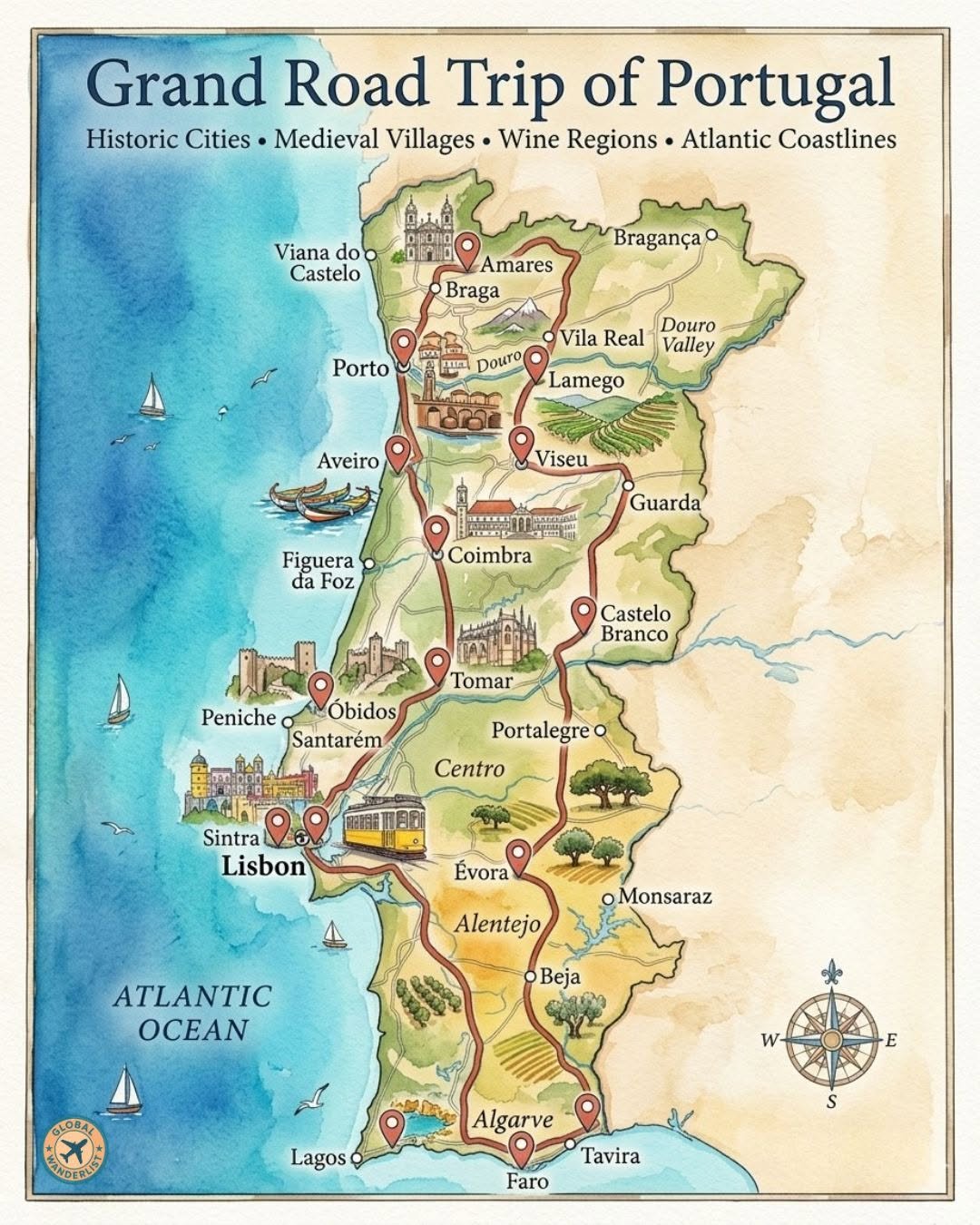
Portugal rewards road trippers with an unusual mix of scenery packed into a single loop. Medieval castles, terraced wine valleys, and fishing villages all sit within a few hours of each other. Few countries in Europe let you trade cathedral spires for vineyard views so quickly.
This route suits travelers who want a complete picture of the country rather than a single region. History lovers can trace centuries of Roman, Moorish, and Templar heritage across a dozen stops. Wine enthusiasts get a proper introduction to the Douro Valley, while beach lovers close out the trip along the Algarve coast.
Plan for at least two to three weeks to cover this loop without rushing. A reliable rental car matters more here than in most European countries, since several stops sit well outside major train lines. Below is a full breakdown of every destination, in driving order, along with practical tips for the road ahead.
Road Trip Overview
| Stop | Distance from Previous Stop | Driving Time | Main Highlights | Recommended Stay Duration |
|---|---|---|---|---|
| Lisbon | Start | – | Historic trams, hilltop viewpoints | 2-3 nights |
| Sintra | 30 km | 40 min | Fairy-tale palaces, forested hills | 1-2 nights |
| Obidos | 75 km | 1 hr | Medieval walled village | 1 night |
| Tomar | 65 km | 1 hr | Templar castle, historic convent | 1 night |
| Coimbra | 75 km | 1 hr 10 min | Historic university, old town | 1-2 nights |
| Aveiro | 60 km | 1 hr | Canals, colorful boats | 1 night |
| Porto | 75 km | 1 hr | Port wine cellars, riverside architecture | 2 nights |
| Braga | 55 km | 1 hr | Baroque churches, religious heritage | 1 night |
| Douro Valley (Lamego) | 100 km | 1 hr 30 min | Terraced vineyards, wine tasting | 1-2 nights |
| Viseu | 40 km | 45 min | Historic center, cathedral | 1 night |
| Castelo Branco | 130 km | 1 hr 45 min | Regional gastronomy, gardens | 1 night |
| Evora | 200 km | 2 hr 30 min | Roman temple, walled old town | 1-2 nights |
| Lagos | 240 km | 2 hr 30 min | Sea caves, golden beaches | 1-2 nights |
| Faro | 90 km | 1 hr | Old town, Ria Formosa lagoon | 1 night |
| Tavira | 30 km | 30 min | Riverside charm, Moorish history | 1 night |
Lisbon
Lisbon opens this loop as Portugal’s capital, spread across seven hills above the Tagus River. Historic trams still climb narrow streets in neighborhoods like Alfama, which survived the devastating 1755 earthquake. Two to three days here allow time for major landmarks and a few quieter corners.
Where to Eat in Lisbon
- Cervejaria Ramiro – Seafood – $$$
- L’Antica Pizzeria da Michele – Neapolitan pizza – $
- Taberna da Rua das Flores – Portuguese petiscos – $$
- Time Out Market Lisboa – Food hall, multiple cuisines – $$
What to See in Lisbon
- Belem Tower and Jeronimos Monastery showcase striking Manueline architecture from the Age of Discoveries.
- Alfama’s maze of narrow streets preserves the city’s oldest and most atmospheric neighborhood.
- Sao Jorge Castle crowns the city with commanding views over the historic center and river.
- Tram 28 winds through several historic districts, best ridden early to avoid crowds.
- Praca do Comercio opens dramatically onto the riverfront, framed by grand arcaded buildings.
Sintra
Sintra sits a short drive from Lisbon, its misty hills scattered with colorful, fairy-tale palaces. Portuguese royalty built increasingly elaborate estates here, earning the town UNESCO World Heritage status. Arrive early, since crowds build quickly at the main sites.
Where to Eat in Sintra
- Tascantiga – Portuguese petiscos – $$
- Incomum by Luis Santos – Modern Portuguese – $$$
- Piriquita – Historic pastry shop – $
What to See in Sintra
- Pena Palace stuns with its bold, multicolored facade and eclectic architectural styles.
- Quinta da Regaleira features underground tunnels and a symbolic spiral Initiation Well.
- Moorish Castle offers dramatic ramparts with views stretching toward the Atlantic.
- Sintra National Palace anchors the town center with its two enormous conical chimneys.
Obidos
Obidos preserves one of Portugal’s best-kept medieval walled villages, its whitewashed houses draped in bougainvillea. Once a wedding gift from Portuguese kings to their queens, the town carries a romantic history. Its compact size makes it easy to explore fully in a few hours.
Where to Eat in Obidos
- Petrarum Domus – Traditional Portuguese – $$
- Alcaide – Regional cuisine – $$$
- 1900 – O Amor Aos Livros – Cafe inside a former hotel – $
What to See in Obidos
- Walking the town walls offers panoramic views over whitewashed houses and countryside.
- Obidos Castle, now a hotel, anchors the highest point of the village.
- Try ginjinha, a cherry liqueur served in a small chocolate cup, sold throughout town.
- Rua Direita, the main street, is lined with shops selling local ceramics and crafts.
Tomar
Tomar holds one of Portugal’s most significant historical sites in the Convent of Christ, a former Knights Templar stronghold. Centuries of architectural layers stack together, from Romanesque origins to elaborate Manueline additions. The Nabao River adds a peaceful backdrop to the old town streets.
Where to Eat in Tomar
- Bela Vista – Traditional Portuguese – $$
- Casa das Ratas – Regional dishes in a former winery – $$
- Chico Elias – Rustic Portuguese, reservations essential – $$
What to See in Tomar
- The Convent of Christ showcases centuries of architecture, including the famous Manueline window.
- The Templar Castle grounds offer quiet gardens and defensive walls to explore.
- The old Jewish quarter preserves a small synagogue, now a museum.
- Mouchao Park, on a river island, provides a peaceful riverside walk.
Coimbra
Coimbra built its reputation around one of the oldest universities in the world, founded in 1290. Steep, narrow streets cascade toward the Mondego River below the hilltop campus. As a former capital of Portugal, the city carries deep cultural and academic significance.
Where to Eat in Coimbra
- Rio Mondego II – Portuguese and Brazilian cuisine – $$$$
- Zé Manel dos Ossos – Traditional Portuguese, cash only – $
- Fangas Mercearia Bar – Modern Portuguese small plates – $$
What to See in Coimbra
- The University of Coimbra’s Joanina Library dazzles with gilded woodwork and old manuscripts.
- Se Velha, the old cathedral, shows fortress-like Romanesque architecture from the 12th century.
- The Mondego riverside offers a pleasant walk with views back toward the university.
- Santa Cruz Monastery holds the tombs of Portugal’s first kings.
Aveiro
Aveiro earns its nickname as the Venice of Portugal thanks to a network of canals through its center. Colorful moliceiro boats, once used to harvest seaweed, now ferry visitors along the water. Art nouveau buildings line the canals, adding an unexpected architectural layer.
Where to Eat in Aveiro
- Restaurante 3800 – International and Portuguese – $$$
- Salpoente – Regional seafood in a converted salt warehouse – $$$
- O Bairro – Casual Portuguese petiscos – $$
What to See in Aveiro
- A ride on a traditional moliceiro boat offers a relaxed way to see the canals.
- The Art Nouveau Museum highlights the city’s distinctive early 20th-century style.
- Costa Nova’s striped houses, a short drive away, make for a photogenic detour.
- Aveiro’s salt pans offer a quiet walk over centuries-old harvesting grounds.
Porto
Porto anchors northern Portugal with a dramatic riverside setting shaped by the port wine trade. Colorful buildings stack up steep hills above the Douro River, connected by the iconic Dom Luis I Bridge. Two nights allow time for both the riverfront and a proper cellar tour.
Where to Eat in Porto
- Cantinho do Avillez – Modern Portuguese – $$$
- Taberna Santo Antonio – Traditional Portuguese – $$
- Café Santiago – Famous for francesinha – $
What to See in Porto
- Ribeira, the riverside district, offers colorful facades and lively restaurants.
- Dom Luis I Bridge’s upper deck delivers sweeping views over the river.
- Livraria Lello, one of the world’s most photographed bookstores, features an ornate staircase.
- Port wine cellars across the river offer tastings explaining centuries of tradition.
Braga
Braga holds the title of Portugal’s religious capital, shaped by centuries of ecclesiastical influence. Its baroque churches and pilgrimage sites draw visitors seeking history and architecture together. A large student population keeps the city feeling lively despite its age.
Where to Eat in Braga
- Cozinha da Se – Traditional Portuguese – $$
- Anjo Verde – Vegetarian Portuguese – $
- Retro AV Bistro – Modern Portuguese small plates – $$
What to See in Braga
- Bom Jesus do Monte features a dramatic zigzagging staircase to a hilltop sanctuary.
- Braga Cathedral blends Romanesque, Gothic, and Baroque architectural layers.
- The historic center’s pedestrian streets are lined with cafes for people-watching.
- Arco da Porta Nova marks the charming entrance to Braga’s old town.
Douro Valley (Lamego)
The Douro Valley stretches inland, covered in terraced vineyards that climb steeply above the river. Lamego sits at the heart of this wine country, an old town where Portugal’s first courts once convened. Basing yourself here opens up quinta visits and dramatic valley viewpoints.
Where to Eat in Douro Valley
- Restaurante Vindouro – Regional Douro cuisine – $$$
- Restaurante Quinta da Pacheca – Wine estate dining – $$$
- Rabelo – Regional fusion cuisine, Pinhao – $$$
What to See in Douro Valley
- River cruises reveal terraced vineyards from a scenic vantage point unavailable by road.
- Quinta visits allow tastings of port and table wines directly where the grapes grow.
- Lamego’s Sanctuary of Nossa Senhora dos Remedios features a monumental Baroque staircase.
- The chapel of Sao Pedro de Balsemao, just outside town, showcases rare pre-Romanesque architecture.
Viseu
Viseu offers a compact, well-preserved historic center in the heart of Portugal’s interior wine country. Its cathedral and surrounding plazas reflect centuries of quiet regional importance. The city makes an easy, relaxed stop between the Douro Valley and points south.
Where to Eat in Viseu
- O Cortico – Traditional Portuguese – $$
- Muralha da Se – Regional cuisine near the cathedral – $$
- Pastelaria Nova Aliança – Historic cafe and pastry shop – $
What to See in Viseu
- Viseu Cathedral combines Gothic and Manueline elements around a striking cloister.
- The historic center’s granite streets hold small museums and quiet plazas.
- Cava de Viseu, the underground wine cellars, offer sparkling wine tastings.
- Parque Aquilino Ribeiro provides a shaded, relaxed stop for a walk.
Castelo Branco
Castelo Branco represents Portugal’s lesser-visited interior, known for rich regional gastronomy and rolling countryside. The city center holds gardens and a historic bishop’s palace worth a stop. It works well as a bridge between the Douro region and the Alentejo.
Where to Eat in Castelo Branco
- Retiro do Cacador – Game and regional meat dishes – $
- Cozinha do Castelo – Regional and international cuisine – $$
- Cabra Preta – Traditional Portuguese – $$
What to See in Castelo Branco
- Jardim do Paco Episcopal features manicured gardens with granite statues and fountains.
- The Cargaleiro Museum showcases modern ceramic and tile art from a celebrated Portuguese artist.
- The historic center’s quiet streets reflect the region’s understated architectural character.
- Regional shops sell Beira Baixa cheeses and olive oils worth tasting before you leave.
Evora
Evora preserves one of the best-maintained Roman heritage sites in Portugal, anchored by a striking ancient temple. Encircled by medieval walls, the compact old town feels frozen in time. Its position in the Alentejo also makes it a gateway to Portugal’s wine country.
Where to Eat in Evora
- Botequim da Mouraria – Traditional Alentejo cuisine – $$
- Dom Joaquim – Regional Portuguese – $$
- Tasquinha do Oliveira – Small, family-run Alentejo spot – $$
What to See in Evora
- The Roman Temple of Evora stands as one of Portugal’s most significant ancient monuments.
- The Chapel of Bones offers an unforgettable interior lined with human skulls and bones.
- Evora Cathedral’s rooftop terrace provides sweeping views over the old town.
- Nearby wineries offer tastings of rich, full-bodied Alentejo wines.
Lagos
Lagos combines a rich maritime history with dramatic coastal scenery along the western Algarve. The town played a role in Portugal’s Age of Discoveries, launching several early exploration voyages. Striking sea caves and cliffs draw boat tours throughout the day.
Where to Eat in Lagos
- A Forja – Traditional Portuguese seafood – $$
- No Patio – Portuguese fine dining – $$$
- Adega da Marina – Casual grilled fish and meats – $$
What to See in Lagos
- Ponta da Piedade’s golden cliffs and sea caves rank among Portugal’s most photographed coastal formations.
- The historic town walls and Governor’s Castle reflect the city’s Age of Discoveries importance.
- Praia Dona Ana offers a small, cove-like beach framed by dramatic rock formations.
- Boat tours from the marina explore hidden grottoes, often spotting dolphins.
Faro
Faro serves as the Algarve’s main gateway, home to the region’s international airport. Its walled old town offers a quieter alternative to busier resort towns nearby. The Ria Formosa lagoon system adds a completely different kind of coastal scenery.
Where to Eat in Faro
- Faz Gostos – Modern Portuguese – $$$
- Tertulia Algarvia – Traditional Algarve cuisine – $$
- Vila Adentro – Regional Portuguese near the old town – $$
What to See in Faro
- The Old Town, enclosed by medieval walls, offers a peaceful contrast to busier coastal resorts.
- Faro Cathedral’s bell tower provides panoramic views over the rooftops and lagoon.
- The Ria Formosa Natural Park protects wetlands home to flamingos and migratory birds.
- Boat tours through the lagoon reveal secluded barrier island beaches.
Tavira
Tavira closes out this road trip, a graceful river town where Moorish walls overlook cobbled streets and quiet plazas. Sitting between the Gilao River and the protected Ria Formosa wetlands, it feels calmer than much of the Algarve. Its restaurant scene has grown increasingly sophisticated in recent years.
Where to Eat in Tavira
- A Ver Tavira – Michelin-recognized modern Portuguese – $$$$
- Restaurante Migu’s – Traditional Portuguese – $$
- Restaurante O Castelo – Portuguese and Brazilian fusion – $$$
What to See in Tavira
- The Moorish castle ruins offer quiet gardens and views over the town’s rooftops.
- Seven arched bridges cross the Gilao River, linking both sides of the historic center.
- Ilha de Tavira, reachable by ferry, offers a long, uncrowded barrier island beach.
- The town’s 37 churches reflect centuries of layered religious and architectural history.
Final Thoughts
This grand loop captures Portugal’s full range, from hilltop castles to riverside wine country and golden southern coastline. Pace yourself with overnight stays rather than rushing between stops, since several of the best moments come from lingering. Book accommodations early during summer months, especially in Sintra and the Algarve.
Watch for narrow, winding roads in the Douro Valley and interior regions, where GPS signal can be unreliable. Pack layers, since temperatures shift noticeably between the coast and inland Portugal. Follow this route at a relaxed pace, and you will come away with a genuinely complete picture of what the country has to offer.