
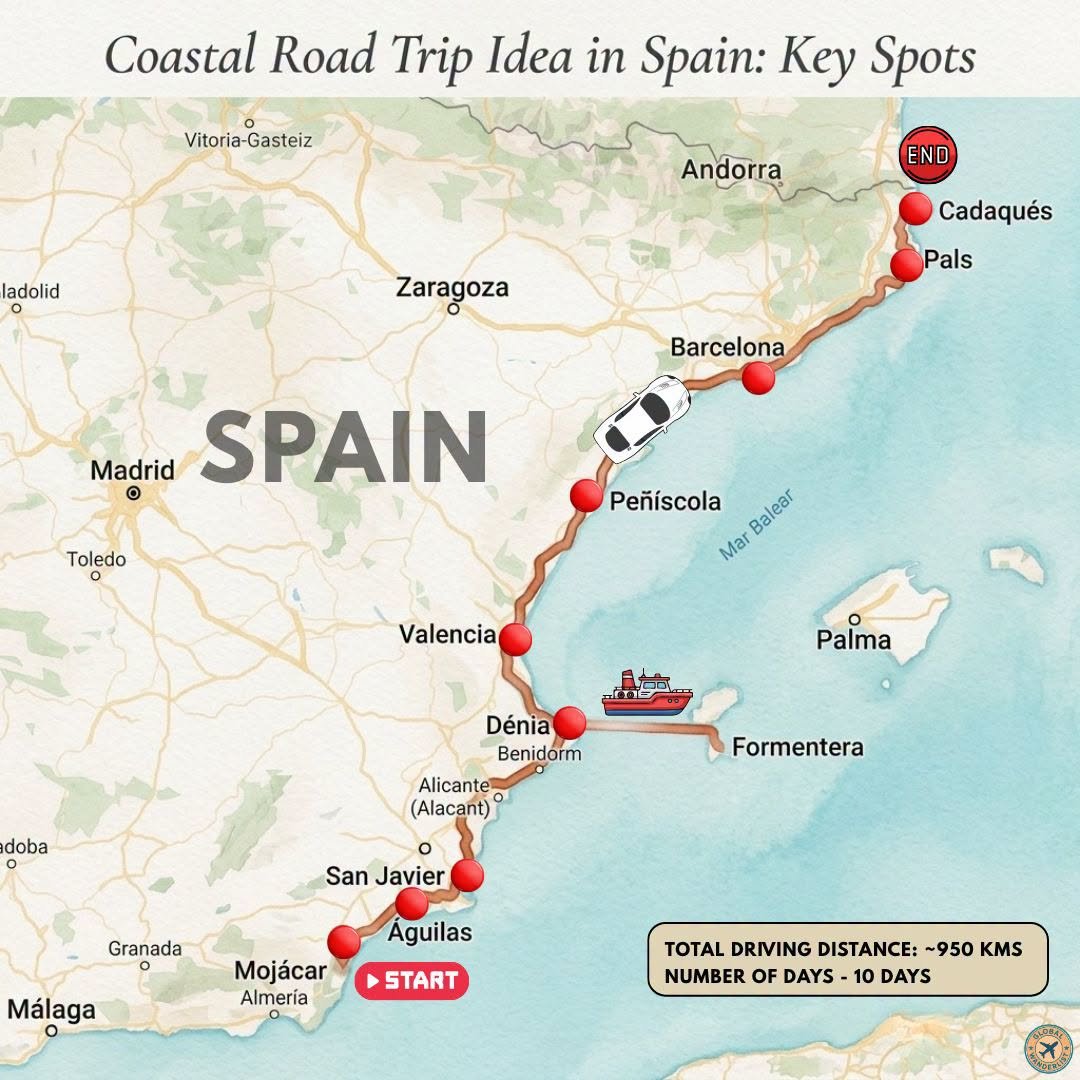
Spain’s eastern coastline offers one of Europe’s best road trips. You start in the sun-baked, dramatic landscapes of Almeria and finish among the whitewashed cliffs of the Costa Brava. Along the way, the scenery shifts from desert cliffs to citrus groves to pine-covered coves.
This route suits travelers who want variety over speed. You will pass fishing villages, Roman ruins, medieval castles, and one of Europe’s most celebrated food cities. Drivers who enjoy stopping often, eating well, and building in beach time will get the most from this itinerary.
Covering roughly 950 kilometers over ten days, the pace stays relaxed. Most days involve a short drive followed by hours of exploring. Rental cars are easy to find at Almeria or Murcia airports, and Spain’s coastal highways stay in excellent condition throughout.
Quick Reference Table
| Stop | Distance from Previous Stop | Driving Time | Main Highlights | Recommended Stay Duration |
|---|---|---|---|---|
| Mojácar | Starting point | N/A | Whitewashed hilltop village, desert coastline | 1-2 nights |
| Águilas | 45 km | 40 minutes | Castle ruins, quiet coves | 1 night |
| San Javier | 90 km | 1 hour | Mar Menor lagoon, seafood rice dishes | 1 night |
| Dénia | 150 km | 1.5 hours | Castle, Michelin dining, ferry port | 1-2 nights |
| Valencia | 95 km | 1 hour | City of Arts and Sciences, paella origins | 2 nights |
| Peñíscola | 140 km | 1.5 hours | Walled old town, castle on the sea | 1 night |
| Barcelona | 200 km | 2 hours | Gaudí architecture, Gothic Quarter | 2 nights |
| Pals | 130 km | 1.5 hours | Medieval stone village, Costa Brava beaches | 1 night |
| Cadaqués | 45 km | 45 minutes | Dalí’s former home, whitewashed harbor town | 1-2 nights |
Actual driving times vary with summer traffic, especially near Barcelona and Valencia. Add extra time in July and August.
Mojácar
Mojácar rises from a hillside above Spain’s driest coastline, its whitewashed buildings stacked like sugar cubes against the desert. The village kept much of its Moorish character even after Christian forces retook the region in the 15th century. That layout, with narrow winding lanes built for shade rather than cars, still defines the old town today.
Below the hilltop pueblo, Mojácar Playa stretches along miles of coastline with a completely different, modern character. The contrast between old village and beach resort gives visitors two distinct experiences within a five-minute drive of each other. This makes a strong starting point for a road trip, since it eases you into Spain’s blend of history and coastline.
Where to Eat in Mojácar
- BaRpublica ($$) serves modern Spanish tapas with a lively atmosphere in the heart of the old village.
- Neptuno Mojácar ($$$) offers seafood with terrace seating and sea views, popular for a relaxed dinner.
- El Antler ($$$) brings a creative, international menu with attentive service in a stylish setting.
- La Cabana ($$$) is known locally for steak, drawing repeat visitors during their stay in the area.
What to See in Mojácar
- Mojácar Pueblo rewards slow wandering, with flower-draped balconies and sudden ocean views around nearly every corner.
- Mirador del Castillo offers one of the best panoramic viewpoints over the village and the Mediterranean below.
- Playa de las Ventanicas provides a clean, family-friendly beach with calm water close to the town center.
- Iglesia de Santa María is a fortified church built in the 16th century, reflecting the region’s history of coastal defense.
- Parque Comarcal gives a shaded, quiet green space, a welcome break from the area’s intense midday sun.
- Cuevas de Los Yesos, a set of natural gypsum caves nearby, appeals to travelers interested in the region’s unusual geology.
Águilas
Águilas sits on a rugged stretch of Murcia’s coastline, its harbor watched over by a 16th-century castle. The town grew historically around fishing and later around iron ore shipping, giving its old center a working-class charm rather than a resort feel. That history left behind a genuine local atmosphere still visible in its markets and bars.
Beyond the town center, Águilas is known for a string of quiet coves along the Cuatro Calas stretch of coastline. These beaches see far fewer visitors than those farther north, making Águilas a good stop for travelers who want a slower pace after Mojácar.
Where to Eat in Águilas
- Bar Restaurante Ginés ($$) serves Mediterranean dishes made with fresh local ingredients and a strong wine selection.
- Restaurante El Faro ($$) sits near the port, known for tapas, cod dishes, and generous daily menus.
- El Refugio de Juanfran ($$$) offers refined cooking at a reasonable price, a favorite for a special dinner.
- Bocaditos y Tapas ($) is a casual, lively spot for cheap tapas and cold beer in the town center.
What to See in Águilas
- Castillo de San Juan de las Águilas overlooks the harbor, offering sweeping coastal views from its restored ramparts.
- Cuatro Calas is a series of small, secluded coves ideal for swimming away from crowds.
- Isla del Fraile sits just offshore, reachable by a short swim or kayak, with clear water for snorkeling.
- Paseo Marítimo runs along the waterfront, a pleasant stretch for an evening walk before dinner.
- Torre de Cope is a historic watchtower a short drive south, built to guard against pirate raids centuries ago.
- Plaza de España anchors the town center, framed by period buildings and casual outdoor cafes.
San Javier
San Javier sits on the shore of the Mar Menor, Europe’s largest saltwater lagoon. This shallow, warm body of water separates from the Mediterranean Sea by a narrow sandbar called La Manga. That geography makes San Javier a favorite for calm-water sports and family-friendly beaches.
The town also has a naval aviation history, home to Spain’s Air Force flight academy. Its promenade along the lagoon has grown into a relaxed dining strip, where families enjoy seafood rice dishes while watching the sunset over the water.
Where to Eat in San Javier
- Los Calderos de Julia ($$) sits directly on the Mar Menor promenade, known for paella and lagoon views.
- Restaurante El Pez Rojo ($$$) has served traditional seafood rice since the 1990s, with a loyal local following.
- Restaurante Carmen Playa ($$) offers a terrace setting with fresh Mar Menor fish and shellfish.
- Kinita Restaurant ($$) focuses on Mediterranean cuisine with an emphasis on local seasonal products.
What to See in San Javier
- Mar Menor promenade gives easy access to calm, warm water, ideal for swimming or paddle sports.
- Santiago de la Ribera neighborhood offers a lively beachfront with cafes and a long sandy stretch.
- La Manga strip separates the lagoon from the open sea, worth a scenic drive along its narrow length.
- Museo Aeronáutico covers the region’s aviation history, tied to the nearby air base.
- Parroquia de San Francisco Javier anchors the town’s historic core with Baroque architecture.
- Los Alcázares boardwalk, a short drive away, offers another pleasant lagoon-side walk with dining options.
Dénia
Dénia has become one of Spain’s most respected food destinations, anchored by its UNESCO Creative City of Gastronomy title. A hilltop castle overlooks the harbor, tracing the town’s Moorish and Christian history back over a thousand years. Ferries to Ibiza and Mallorca depart from Dénia’s port, making it a practical stop if you want a Balearic detour.
Local waters produce the prized gamba roja, a deep red prawn considered among the best in Spain. Restaurants throughout town build entire menus around it, alongside traditional rice dishes like arròs a banda.
Where to Eat in Dénia
- Quique Dacosta ($$$$) holds three Michelin stars, offering an inventive tasting menu built around local ingredients.
- Casa Federico ($$) has served traditional rice dishes and grilled fish since 1980 at fair prices.
- Restaurante Fernando ($$) is a beachfront family restaurant known for paella marinera since 1974.
- Tasca Eulalia ($$) specializes in traditional rice and fresh seafood in a cozy tavern setting.
What to See in Dénia
- Dénia Castle rises above the town, combining Moorish walls with later Christian-era fortifications and harbor views.
- Les Rotes coastline offers a scenic walking path along rocky coves, popular for swimming and snorkeling.
- Dénia fish market gives visitors a look at the daily catch that supplies the town’s celebrated restaurants.
- Montgó Natural Park rises just behind the town, with hiking trails leading to sweeping coastal views.
- Old Town streets wind through the historic quarter, filled with tapas bars and small local shops.
- Dénia port connects the town to the Balearic Islands, worth a stroll even if you are not catching a ferry.
Valencia
Valencia balances centuries of history with some of Spain’s boldest modern architecture. The city claims the invention of paella, a dish that originated in the nearby rice fields of L’Albufera. That culinary identity runs deep, with locals treating an authentic paella lunch as a weekend ritual rather than a tourist activity.
The city transformed its old riverbed into a long public park after redirecting the Turia River following a major 1957 flood. That green corridor now links neighborhoods and leads toward the futuristic City of Arts and Sciences, giving Valencia one of Spain’s most walkable city centers.
Where to Eat in Valencia
- Casa Carmela ($$) is a long-standing beachfront favorite for authentic paella cooked over an open flame.
- La Riua ($$) serves classic rice dishes in the old town, popular enough to warrant a reservation.
- Canyar Restaurante ($$$) draws praise for creative seafood and grilled octopus in a polished setting.
- Arroceria Maribel ($$), located near L’Albufera, holds a Michelin Bib Gourmand for its traditional rice dishes.
What to See in Valencia
- City of Arts and Sciences brings striking modern architecture by Santiago Calatrava, including an opera house and oceanarium.
- Valencia Cathedral blends Gothic and Baroque styles, with a bell tower offering panoramic city views.
- Turia Gardens stretch across the old riverbed, ideal for walking, cycling, or simply relaxing in green space.
- Mercado Central fills an Art Nouveau building with fresh produce and seafood, a great stop for lunch supplies.
- L’Albufera Natural Park protects the wetlands where paella originated, with boat tours across the lagoon at sunset.
- Malvarrosa Beach gives the city a proper stretch of Mediterranean sand within a short tram ride of downtown.
Peñíscola
Peñíscola sits on a rocky peninsula jutting into the Mediterranean, its old town wrapped almost entirely by 16th-century walls. A castle built by the Knights Templar crowns the highest point, later serving as the residence of the schismatic Pope Benedict XIII. That dramatic setting has made Peñíscola a filming location for television and film productions over the years.
Narrow whitewashed streets climb toward the castle, lined with small shops and restaurants. The town’s beaches stretch on either side of the peninsula, giving visitors easy access to both the old quarter and the sand.
Where to Eat in Peñíscola
- Restaurant Casa Jaume ($$) is known for seafood paella, mussels, and langoustine in a relaxed old-town setting.
- El Peñón ($$) offers traditional Mediterranean dishes with a terrace and friendly, attentive service.
- La Pulpería ($$) specializes in octopus and seafood stews, a local favorite worth arriving early for.
- Restaurante Vista al Mar ($$$) delivers panoramic castle and sea views alongside well-prepared rice dishes.
What to See in Peñíscola
- Castillo de Peñíscola dominates the skyline, with rooftop terraces offering sweeping views over the town and sea.
- Old town walls encircle the historic quarter, best explored on foot along the narrow stone lanes.
- Playa Norte stretches along the northern side of the peninsula, popular for swimming and sunset walks.
- Ermita de la Virgen de la Ermitana sits on a bluff south of town, a peaceful spot with coastal views.
- Bufador de Peñíscola is a small blowhole in the rocks where waves crash upward dramatically during rough seas.
- Paseo Marítimo connects the old town to the newer beach area, ideal for an evening stroll.
Barcelona
Barcelona needs little introduction as one of Europe’s most visited cities. Antoni Gaudí’s organic, mosaic-covered buildings define its skyline, while the Gothic Quarter preserves narrow medieval streets built over Roman foundations. Catalonia’s distinct language and culture give the city an identity separate from the rest of Spain.
For a road trip built around coastal scenery, Barcelona also offers a practical break. It is a good place to return a rental car for a day or two, explore on foot or by metro, and then pick up a car again before continuing north toward the Costa Brava.
Where to Eat in Barcelona
- Casa Carmela-style paella spots aside, try Can Culleretes ($$) for classic Catalan cooking in one of the city’s oldest restaurants.
- Cervecería Catalana ($$) is a favorite tapas bar known for consistently fresh, well-executed small plates.
- Bar del Pla ($$) near the cathedral offers creative tapas in a relaxed, informal setting.
- Quimet & Quimet ($$) is a standing-room tapas bar famous for its montaditos and extensive wine list.
What to See in Barcelona
- Sagrada Familia is Gaudí’s unfinished basilica, now the tallest church in the world after reaching full height in 2026.
- Park Guell offers mosaic-covered terraces and sweeping views over the city toward the sea.
- Gothic Quarter preserves medieval streets built over the original Roman settlement of Barcino.
- Casa Batllo showcases Gaudí’s flowing, skeletal facade on the grand Passeig de Gràcia boulevard.
- Barceloneta Beach gives the city a proper seaside neighborhood, ideal for an evening walk before dinner.
- La Boqueria Market has supplied fresh produce and seafood near La Rambla since the 13th century.
Pals
Pals is a fortified medieval village set slightly inland from the Costa Brava’s beaches. Stone houses, arched passageways, and a watchtower survive largely intact from the town’s founding around the 10th century. Restoration efforts through the 20th century preserved its Gothic character, and Pals now ranks among Spain’s most picturesque historic villages.
Surrounding the village, wide plains of rice paddies stretch toward the coast, an unusual sight this far north in Catalonia. Local restaurants build their menus around this Pals rice, paired with the seafood pulled from nearby Costa Brava waters.
Where to Eat in Pals
- Es Portal ($$$) draws praise for refined Catalan cooking in an elegant countryside setting.
- Restaurant El Pedró ($$) serves classic local rice and seafood in a charming old-town building.
- Sol Blanc ($$$) occupies a restored farmhouse surrounded by rice fields, known for hearty Catalan plates.
- Pahissa del Mas ($$$$) holds a Michelin star and offers a tasting menu inside a 14th-century farmhouse.
What to See in Pals
- Torre de les Hores is the village’s medieval watchtower, visible from a distance across the surrounding plains.
- Old town streets wind through Gothic stone architecture, largely restored to its medieval appearance.
- Platja de Pals offers a wide, quiet stretch of sand a short drive from the historic village center.
- Rice paddies surrounding Pals create a striking green landscape, especially scenic in early autumn.
- Mirador de Pals provides panoramic views stretching from the village toward the Mediterranean coastline.
- Church of Sant Pere anchors the village center with Romanesque architectural details dating back centuries.
Cadaqués
Cadaqués closes out this route as one of Spain’s most picturesque coastal towns. Whitewashed houses cluster around a rocky bay, connected by narrow cobblestone lanes that climb away from the water. The town’s isolation, reachable only by a winding mountain road, kept large-scale development away and preserved its authentic character.
Salvador Dalí lived much of his life just outside Cadaqués in nearby Portlligat, and the surrounding landscape clearly shaped his surrealist imagination. Rocky coves, dramatic light, and twisted olive trees still give the area a slightly otherworldly feel that draws artists and photographers today.
Where to Eat in Cadaqués
- Compartir ($$$) offers Mediterranean small plates meant for sharing in a relaxed, contemporary setting.
- Es Baluard ($$$) serves excellent seafood with views over the bay and fishing boats below.
- Casa Anita ($$) is a local institution since 1960, known for wine and traditional seafood tapas.
- Restaurant La Sirena ($$) is a family-run spot near the church, praised for paella and fresh fish.
What to See in Cadaqués
- Casa Museu Salvador Dalí in nearby Portlligat preserves the artist’s former home, filled with his personal touches.
- Cap de Creus Natural Park offers dramatic rock formations and coastal hiking trails just outside town.
- Old town streets climb steeply from the harbor, lined with white-washed houses and small galleries.
- Església de Santa Maria overlooks the bay from its hilltop position, a landmark visible from nearly anywhere in town.
- Platja Es Poal provides a small, calm beach right in the heart of the harbor area.
- Passeig del Mar runs along the waterfront, perfect for watching the sunset with the fishing boats.
Planning Your Drive
Fuel up before leaving larger towns, since some stretches along this route pass through quieter rural areas with fewer stations. Parking gets tight in old town centers like Peñíscola, Pals, and Cadaqués, so look for a paid lot outside the historic core rather than searching for street parking.
Summer brings the heaviest traffic, especially approaching Barcelona and Valencia on weekends. Consider driving early in the morning or in the evening to avoid the worst congestion and to catch better light for photography along the coast.
Spring and early fall offer the most comfortable driving conditions, with mild temperatures and thinner crowds at major stops. Whichever season you choose, this coastal route delivers a genuine cross-section of Spain, from desert cliffs to Michelin dining to medieval stone villages. Pack light, plan flexible days, and let the coastline set the pace.