
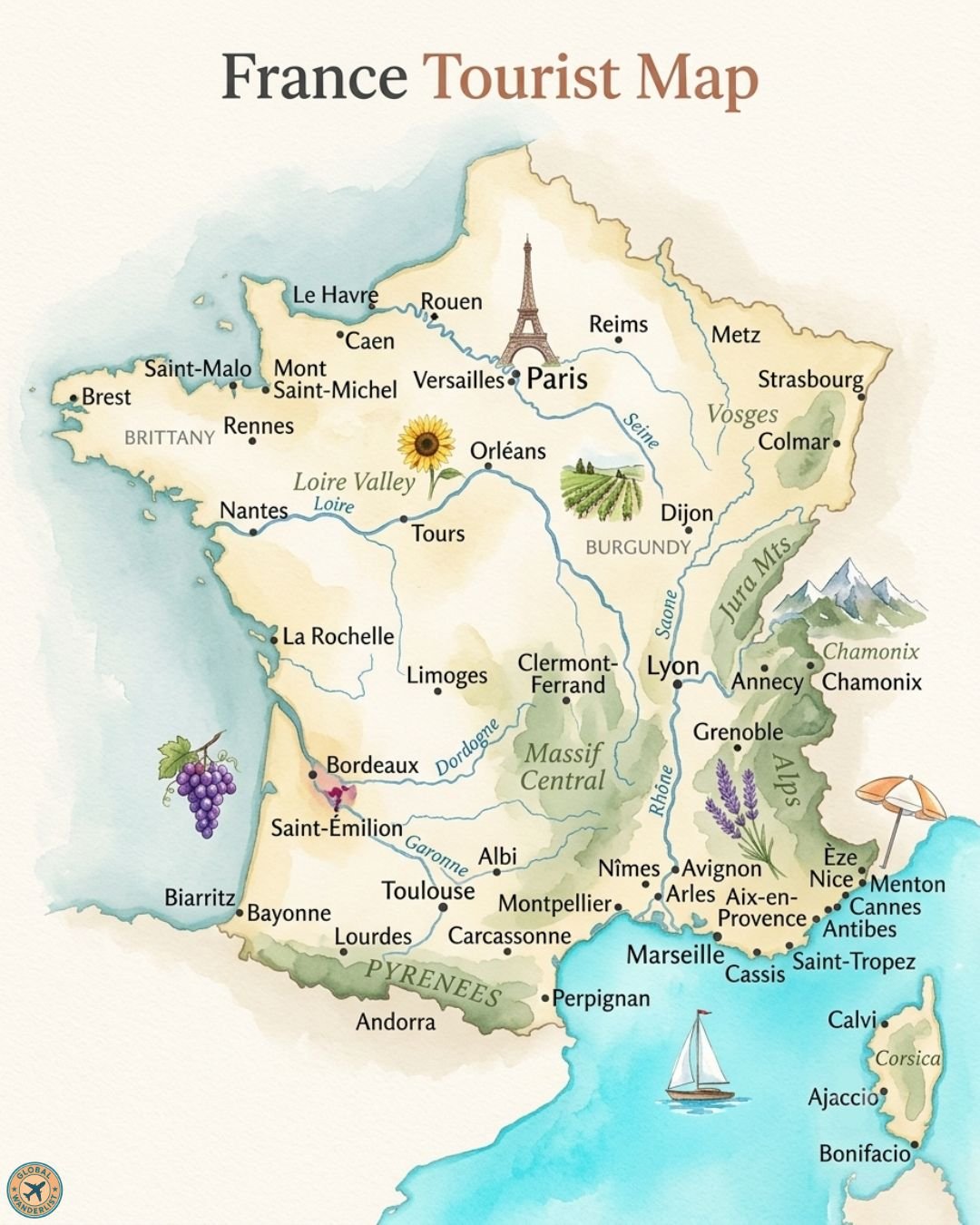
France offers more variety per square mile than almost any country on earth. Snow capped Alps, sun soaked Mediterranean coastline, medieval fortress towns, and world class wine regions all sit within a single, well connected country. Few destinations let you move from Gothic cathedrals to lavender fields to alpine peaks in the span of a single trip.
This guide breaks down France’s major regions and cities, from the boulevards of Paris to the beaches of Corsica. Use it to plan a route that matches your interests, whether that means wine tasting, mountain hiking, or simply soaking up centuries of European history.
| Place | Category | Best Known For | Recommended Visit Duration |
|---|---|---|---|
| Paris and Versailles | Capital region | Landmarks, museums, royal palaces | 4-6 days |
| Normandy and Mont Saint-Michel | Coastal region | D-Day history, tidal island abbey | 3-4 days |
| Brittany | Coastal region | Rugged coastline, walled cities | 3-4 days |
| Loire Valley | River valley | Renaissance châteaux, vineyards | 2-3 days |
| Bordeaux and Wine Country | Wine region | World class wine, elegant architecture | 2-3 days |
| Basque Coast | Coastal region | Surf culture, Basque cuisine | 2-3 days |
| Toulouse and the Pyrenees | Mountain region | Pink brick city, pilgrimage sites | 3-4 days |
| Provence | Countryside region | Lavender fields, Roman ruins | 3-4 days |
| French Riviera | Coastal region | Glamorous beach towns, art history | 4-5 days |
| French Alps | Mountain region | Skiing, alpine lakes | 3-5 days |
| Lyon and Burgundy | Culinary region | Gastronomy, wine, historic architecture | 2-3 days |
| Champagne and Alsace | Northeastern region | Champagne houses, storybook villages | 2-3 days |
| Corsica | Mediterranean island | Beaches, mountains, French-Italian culture | 4-6 days |
Paris and Versailles: The Heart of France
Paris anchors any French itinerary with centuries of art, architecture, and culinary tradition. The city’s layout, organized into 20 spiraling arrondissements, makes it remarkably walkable for a capital of its size. Just outside the city, Versailles offers a dramatic contrast with its opulent former royal palace and manicured gardens.
What to See in Paris and Versailles
- The Eiffel Tower remains France’s most recognizable landmark, best photographed at sunset or with evening lights. Climbing to the top rewards visitors with sweeping views over the entire city.
- The Louvre houses one of the largest and most significant art collections in the world. Focusing on just a few wings makes a visit far more manageable than trying to see everything.
- Notre-Dame Cathedral continues its careful restoration following the 2019 fire, with the interior reopened to visitors in December 2024. Its Gothic architecture remains a defining symbol of the city.
- Montmartre offers a village like escape atop a hill, crowned by the white domes of Sacré-Cœur. Its winding streets once housed artists like Picasso and Renoir.
- The Palace of Versailles showcases the extravagance of the French monarchy through its Hall of Mirrors and sprawling formal gardens. Allow a full day to properly explore both the palace and grounds.
- The Seine River offers a scenic way to see the city from the water, with dinner cruises and daytime boat tours both popular options.
Normandy and Mont Saint-Michel: History and Dramatic Coastline
Normandy stretches along France’s northern coast, carrying deep historical weight from World War II alongside charming medieval towns. Rouen, Caen, and Le Havre each played significant roles in the region’s layered history, from Joan of Arc’s trial to the D-Day landings. Mont Saint-Michel, a tidal island abbey, sits at the region’s dramatic edge.
What to See in Normandy and Mont Saint-Michel
- Mont Saint-Michel rises from tidal flats as one of France’s most photographed landmarks. Checking tide schedules before visiting helps you plan around the causeway’s flooding patterns.
- Rouen’s medieval old town features half timbered buildings and a stunning Gothic cathedral once painted repeatedly by Monet. The city also marks the site of Joan of Arc’s execution.
- The D-Day beaches near Caen, including Omaha and Utah Beach, offer somber, moving memorials to Allied forces. Several museums throughout the region provide detailed historical context.
- Le Havre’s port city center, rebuilt after wartime destruction, holds UNESCO World Heritage status for its modernist architecture. It offers a striking contrast to Normandy’s older towns.
- Caen’s medieval castle, built by William the Conqueror, still anchors the city center today. Its ramparts offer good views over the surrounding rooftops.
Brittany: Rugged Coastline and Celtic Heritage
Brittany occupies France’s northwestern peninsula, known for its dramatic coastline and distinct Celtic cultural identity. Saint-Malo, Rennes, and Brest each offer a different angle on the region, from walled fortress cities to maritime history. The area’s rugged beauty and cooler climate set it apart from France’s more famous Mediterranean coast.
What to See in Brittany
- Saint-Malo’s walled old town sits dramatically along the coast, rebuilt after heavy damage in World War II. Walking the ramparts offers sweeping ocean views in every direction.
- Rennes combines a well preserved medieval center with a lively university town atmosphere. Its half timbered buildings and public squares make for pleasant wandering.
- Brest’s naval history runs deep, reflected in its maritime museums and dramatic harbor setting. The city was largely rebuilt after wartime destruction, giving it a more modern architectural feel than much of Brittany.
- The Breton coastline offers dramatic cliffs, hidden coves, and small fishing villages worth exploring by car. Renting a vehicle makes it easier to reach the region’s quieter corners.
- Local crêperies throughout the region serve traditional buckwheat galettes, a Breton specialty worth seeking out. Pairing them with local cider is the traditional way to enjoy the meal.
The Loire Valley: Renaissance Châteaux and Vineyards
The Loire Valley stretches along central France’s longest river, famous for its Renaissance era châteaux and rolling vineyards. Nantes, Tours, and Orléans anchor the region’s major cities, each offering easy access to the valley’s most celebrated castles. This area earned UNESCO World Heritage status for its exceptional cultural landscape.
What to See in the Loire Valley
- Tours serves as a convenient base for exploring the valley’s most famous châteaux, including Chenonceau and Chambord. Its compact old town also holds its own charm, worth a half day of exploration.
- Nantes blends historic architecture with a creative, modern edge, reflected in art installations throughout the city. The Machines de l’Île, featuring a giant mechanical elephant, has become a signature attraction.
- Orléans holds deep significance in Joan of Arc’s story, since she famously liberated the city from siege in 1429. Its cathedral and riverside old town reflect centuries of history.
- Vineyard tours throughout the region introduce visitors to Loire Valley wines, particularly crisp whites like Sancerre and Vouvray. Many estates offer tastings paired with views of the surrounding countryside.
- Cycling along the Loire à Vélo route lets travelers explore the valley at a relaxed pace. Well marked paths connect many of the region’s top châteaux and villages.
Bordeaux and Wine Country: Elegance and World Class Wine
Bordeaux anchors southwestern France’s most celebrated wine region, combining elegant 18th century architecture with world renowned vineyards. The nearby village of Saint-Émilion adds a smaller scale, equally storied wine destination just a short drive away. Together, this region draws wine lovers from around the globe.
What to See in Bordeaux and Wine Country
- Bordeaux’s Place de la Bourse reflects the city’s grand 18th century architecture, especially striking when mirrored in the adjacent water feature. It ranks among the most photographed spots in the city.
- The Cité du Vin museum offers an immersive introduction to wine culture and history from around the world. Its distinctive, swirling architecture stands out along the riverfront.
- Saint-Émilion’s medieval village sits atop a hillside surrounded by vineyards, holding UNESCO World Heritage status. Its underground monolithic church is one of the largest of its kind in Europe.
- Vineyard tours throughout the Bordeaux region introduce visitors to some of the world’s most prestigious wine estates. Many chateaux require advance booking for tastings and tours.
- Bordeaux’s pedestrian friendly city center makes it easy to explore on foot, with a mix of historic streets and modern tram lines connecting major sights.
Basque Coast: Surf Culture and Bold Flavors
The Basque Coast stretches along France’s southwestern edge near the Spanish border, centered around Biarritz and Bayonne. This region carries a distinct cultural identity, blending French and Basque traditions in its language, food, and architecture. Reliable Atlantic surf breaks have made it one of Europe’s most established surf destinations.
What to See in Basque Coast
- Biarritz built its reputation as a glamorous beach resort in the 19th century, and its elegant villas still reflect that history today. Its beaches remain some of the best in France for both surfing and sunbathing.
- Bayonne’s old town features colorful half timbered buildings along the river, along with a strong culinary tradition centered on chocolate and cured ham. The city’s covered market offers a great introduction to regional specialties.
- Surf schools throughout Biarritz cater to all experience levels, with reliable swells drawing surfers from across Europe. Mornings typically offer the calmest conditions for beginners.
- Basque cuisine distinguishes itself with bold flavors like piment d’Espelette, a regional chili pepper used throughout local dishes. Pintxos bars offer a fun, casual way to sample multiple specialties in one sitting.
- The coastal path connecting Biarritz and Bayonne offers scenic walking and cycling routes. It provides a good overview of the region’s varied coastal scenery.
Toulouse and the Pyrenees: Pink Brick Cities and Mountain Pilgrimage
Toulouse, known as the Pink City for its distinctive brick architecture, anchors southwestern France near the Pyrenees mountains. Nearby Carcassonne and Lourdes each draw visitors for very different reasons, from medieval fortress walls to religious pilgrimage. The Pyrenees themselves form a dramatic natural border with Spain and the tiny principality of Andorra.
What to See in Toulouse and the Pyrenees
- Toulouse’s Basilica of Saint-Sernin ranks among the largest surviving Romanesque churches in Europe. Its pink brick construction gives the entire city a distinctive, warm glow at sunset.
- Carcassonne’s fortified medieval city features double ramparts and towering turrets, among the best preserved fortress cities in Europe. Walking its cobblestone streets feels like stepping into the Middle Ages.
- Lourdes draws millions of religious pilgrims each year to its famous shrine and grotto. Even non-religious visitors often find the scale and devotion of the site notable.
- The Pyrenees mountains offer extensive hiking trails and dramatic scenery along the Spanish border. Andorra, tucked into the mountains, makes for an interesting day trip with duty free shopping.
- Toulouse’s aerospace industry has made it a hub for aviation history, reflected in its Aeroscopia museum. It offers an interesting contrast to the region’s medieval landmarks.
Provence: Lavender Fields and Roman Legacy
Provence stretches across southeastern France, famous for its lavender fields, Roman ruins, and sun drenched countryside. Avignon, Arles, Nîmes, and Aix-en-Provence each carry distinct historical layers, from papal history to ancient Roman infrastructure. This region has long inspired artists, including Van Gogh and Cézanne.
What to See in Provence
- Avignon’s Palais des Papes reflects the city’s history as the seat of the papacy during the 14th century. Its massive Gothic architecture remains one of the largest medieval palaces in Europe.
- Arles preserves an exceptionally well kept Roman amphitheater, still used for events today. The town also inspired numerous paintings by Van Gogh during his time living there.
- Nîmes holds some of the best preserved Roman architecture outside Italy, including its own amphitheater and the nearby Pont du Gard aqueduct. Both sites offer a detailed look at Roman engineering.
- Aix-en-Provence charms visitors with its tree lined boulevards and elegant fountains. The city’s connection to painter Paul Cézanne draws art lovers to his former studio.
- Lavender fields throughout Provence bloom in vivid purple from late June through early August, particularly around the Luberon region. Timing a visit around this window adds striking color to any countryside drive.
French Riviera: Glamour Along the Mediterranean
The French Riviera stretches along the Mediterranean coast from Marseille to the Italian border, encompassing some of the world’s most glamorous beach towns. Nice, Cannes, Saint-Tropez, and Antibes each carry their own reputation, from film festivals to artist colonies. The hilltop village of Èze and the border town of Menton add further variety to this stretch of coastline.
What to See in French Riviera
- Nice’s Promenade des Anglais stretches along the waterfront, lined with palm trees and grand belle époque architecture. The city’s old town adds a livelier, more local contrast to the polished seafront.
- Cannes hosts its famous film festival each May, though its beaches and boutiques draw visitors year round. La Croisette remains the city’s iconic waterfront promenade.
- Saint-Tropez built its reputation as a glamorous hideaway for artists and celebrities alike. Its small harbor and boutique lined streets retain genuine charm beyond the yacht culture.
- Marseille, France’s oldest and second largest city, offers a grittier, more authentic port city experience. Its Old Port and nearby Calanques National Park reward visitors willing to venture beyond the polished resort towns.
- Èze perches dramatically on a clifftop above the Mediterranean, with a medieval village core and botanical garden offering sweeping coastal views. It makes an easy half day trip from Nice.
- Antibes and nearby Cassis both offer quieter alternatives to the busier resort towns, with excellent art museums and scenic harbor walks respectively.
French Alps: Skiing and Alpine Scenery
The French Alps rise dramatically in the country’s southeast, centered around Chamonix, Annecy, and Grenoble. This region draws visitors year round, with skiing in winter and hiking in summer both major attractions. Mont Blanc, Western Europe’s highest peak, towers over the entire area.
What to See in French Alps
- Chamonix sits at the base of Mont Blanc and serves as one of the world’s premier mountaineering and skiing destinations. Cable cars carry visitors up for dramatic views without requiring technical climbing experience.
- Annecy’s old town winds along canals often compared to Venice, backed by a stunning alpine lake. Its clear turquoise water ranks among the cleanest of any lake in Europe.
- Grenoble combines a lively university city atmosphere with easy access to surrounding mountain ranges. A cable car ride up to the Bastille fortress offers sweeping views over the city.
- Lake Annecy offers swimming, kayaking, and cycling paths along its shoreline during warmer months. It provides a relaxed contrast to the region’s more demanding mountain activities.
- Hiking trails throughout the French Alps range from gentle valley walks to serious multi-day routes. Summer offers the most reliable conditions for exploring higher elevation trails.
Lyon and Burgundy: France’s Culinary Heartland
Lyon anchors central eastern France as one of the country’s most celebrated food cities, sitting at the edge of the Burgundy wine region. Dijon serves as Burgundy’s cultural capital, known for its mustard and medieval architecture. Together, this region represents one of France’s richest culinary and cultural landscapes.
What to See in Lyon and Burgundy
- Lyon’s old town, Vieux Lyon, features Renaissance architecture and hidden passageways called traboules. Exploring these narrow interconnected corridors reveals a distinctly different side of the city.
- The city’s bouchons, traditional Lyonnais restaurants, serve hearty regional specialties in cozy, informal settings. Trying a bouchon meal is considered essential for understanding Lyon’s culinary reputation.
- Dijon’s historic center features colorful glazed tile roofs and a well preserved medieval core. The city’s mustard heritage remains deeply tied to its culinary identity today.
- Burgundy’s vineyards produce some of the world’s most celebrated wines, particularly Pinot Noir and Chardonnay. Wine tours throughout the region range from casual tastings to in depth estate visits.
- Beaune, a smaller Burgundy town near Dijon, houses the historic Hôtel-Dieu with its distinctive patterned roof. It offers an easy day trip focused on wine and architecture.
Champagne and Alsace: Sparkling Wine and Storybook Villages
Reims and Metz anchor France’s Champagne region, home to the sparkling wine that shares its name. Further east, Strasbourg and Colmar showcase Alsace’s distinctive blend of French and German influence. This northeastern corner of France offers a different architectural and culinary character from the rest of the country.
What to See in Champagne and Alsace
- Reims Cathedral served as the traditional coronation site for French kings for centuries. Its Gothic architecture ranks among the finest examples in the country.
- Champagne house tours throughout the Reims area introduce visitors to the traditional production methods behind the region’s famous sparkling wine. Many tours include cellar visits and tastings.
- Strasbourg’s old town, Petite France, features canals and half timbered houses reflecting its Franco-German heritage. The city’s Gothic cathedral remains one of the tallest churches built during the medieval period.
- Colmar charms visitors with its fairytale architecture and canal lined streets, often considered one of France’s most picturesque towns. Its Christmas markets are especially popular during the winter season.
- Metz blends French and German architectural influences, reflected in its striking cathedral and modern Centre Pompidou-Metz museum. It offers a quieter alternative to the busier Alsace towns.
Corsica: A Mediterranean Island Apart
Corsica sits in the Mediterranean Sea, combining French administration with a distinct island culture shaped by centuries of Italian influence. Calvi, Ajaccio, and Bonifacio each showcase different sides of the island, from dramatic clifftop fortresses to sandy beaches. Napoleon’s birthplace and the island’s rugged mountain interior add further depth to a Corsica visit.
What to See in Corsica
- Ajaccio, Corsica’s capital, holds deep connections to Napoleon Bonaparte, who was born in the city. His childhood home is now a museum open to visitors.
- Bonifacio’s dramatic clifftop old town perches above the sea, with limestone cliffs plunging directly into turquoise water below. Boat tours around the cliffs offer some of the island’s best photo opportunities.
- Calvi combines a historic citadel with excellent beaches, making it a popular base for both history and relaxation. Its marina adds a lively atmosphere in the evenings.
- Corsica’s mountainous interior offers serious hiking opportunities, including the demanding GR20 trail considered one of Europe’s toughest long distance routes. Shorter day hikes are available for less experienced hikers.
- The island’s beaches rank among the clearest and most scenic in the Mediterranean, particularly around the southern coast near Bonifacio. Renting a car makes it easier to reach the more secluded coves.
Final Thoughts on Exploring France
France rewards travelers who venture beyond its most famous landmarks. Ancient Roman ruins, alpine peaks, and storybook wine villages all sit within reach of a well connected rail network. Few countries offer this much regional diversity within a single, manageable trip.
Whether you come for the châteaux of the Loire Valley, the beaches of the French Riviera, or the mountain trails of Corsica, France leaves a lasting impression at every turn. Take the time to explore its smaller towns and regional specialties, and you will find a country far richer than its postcard images suggest.